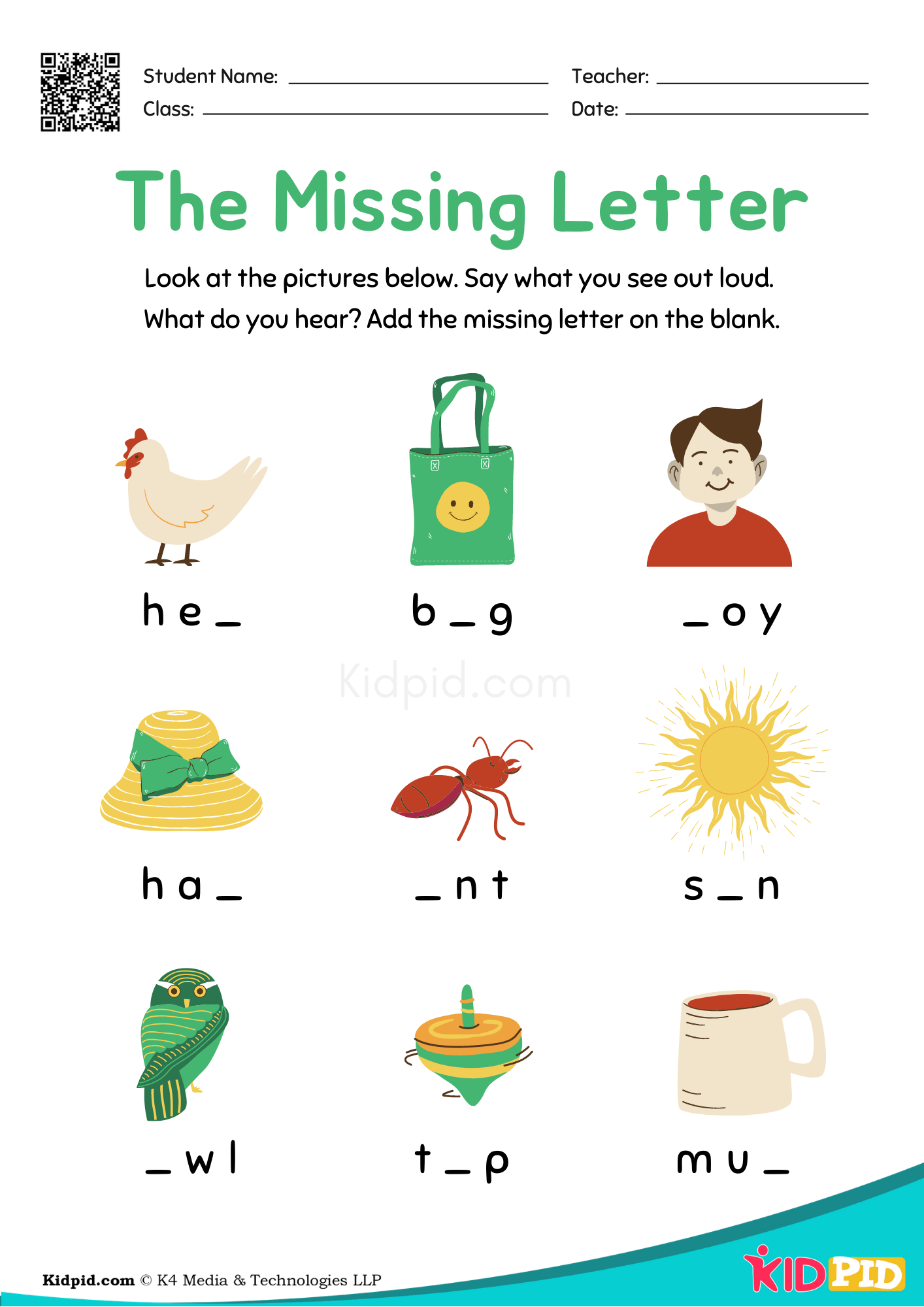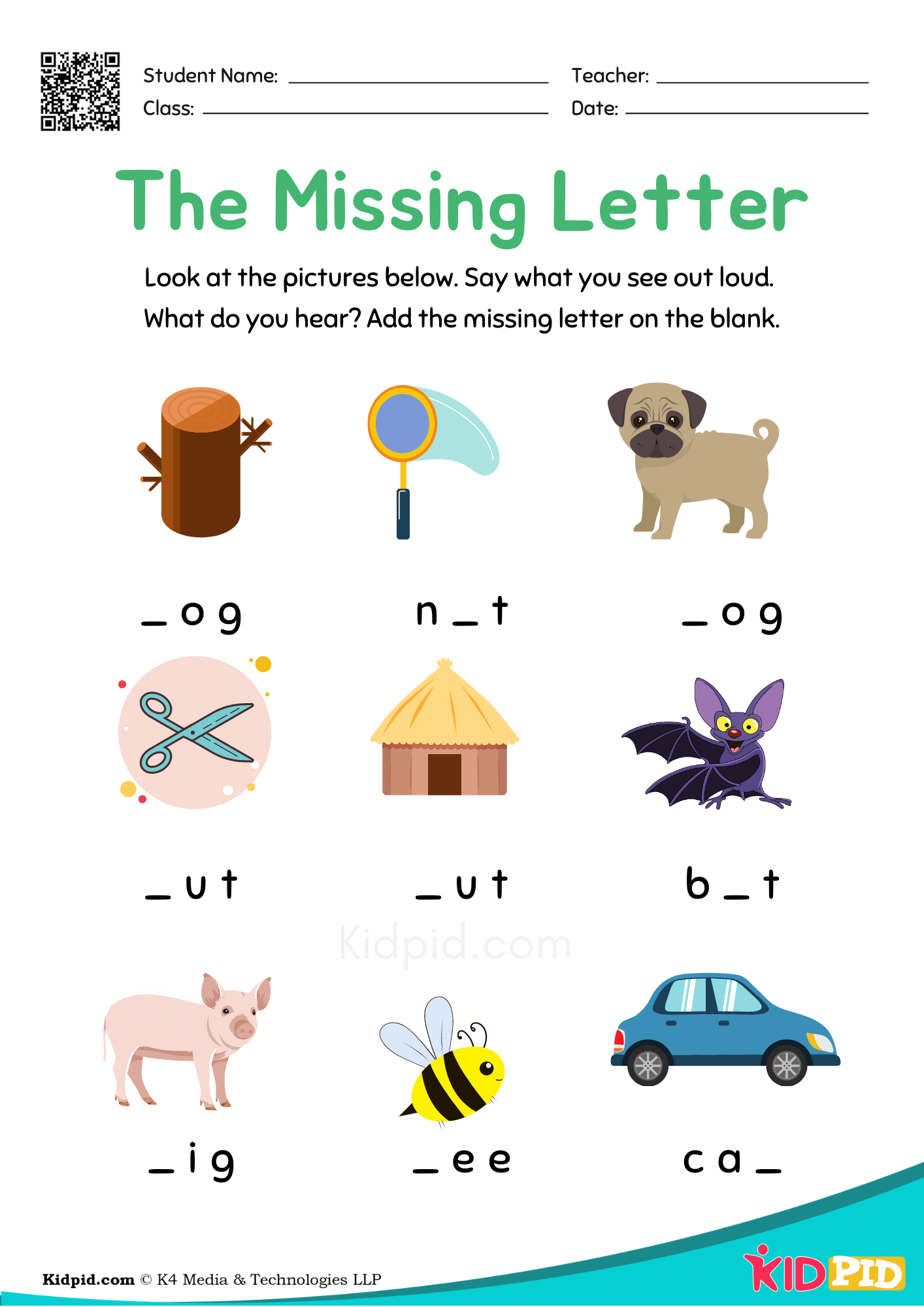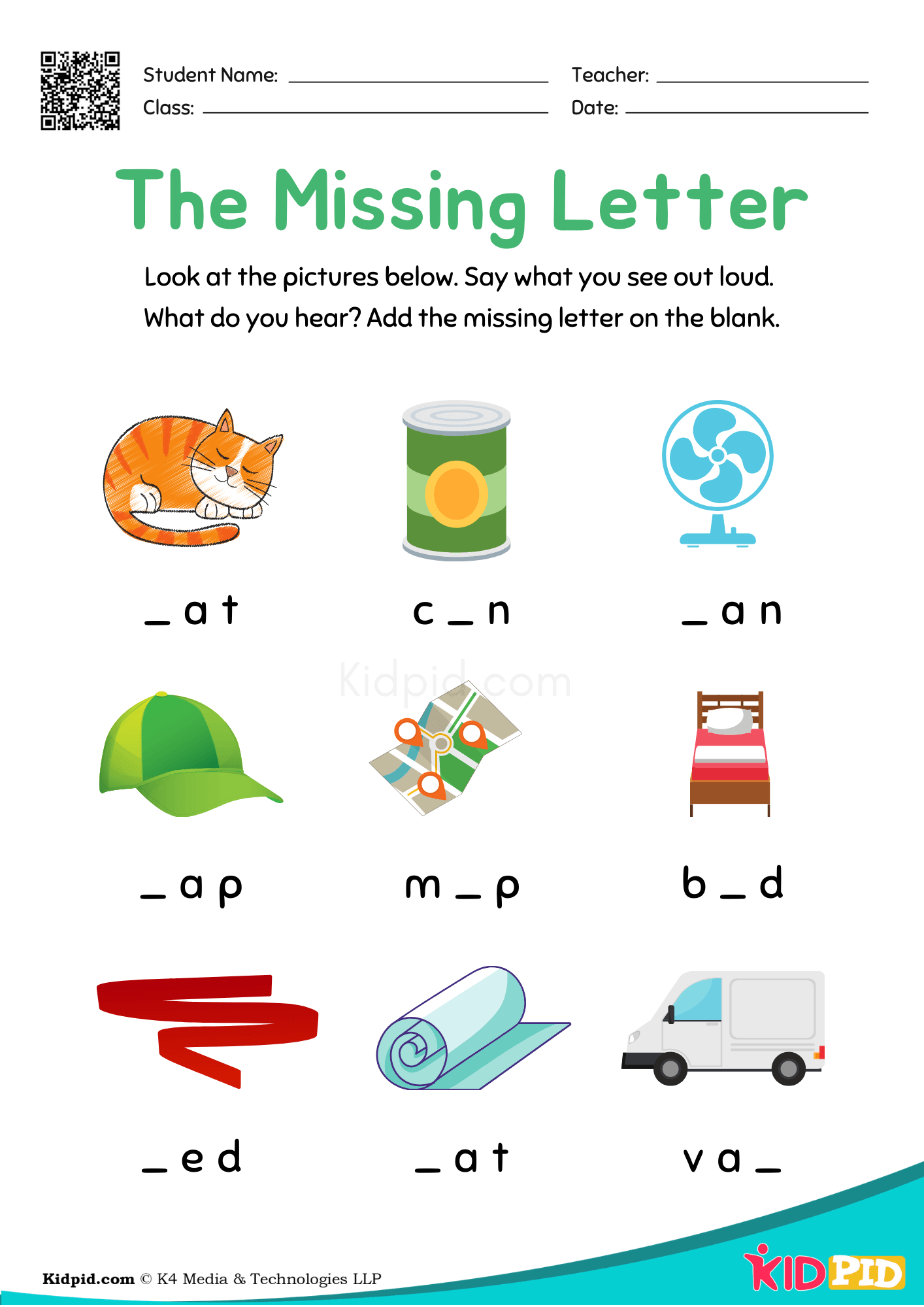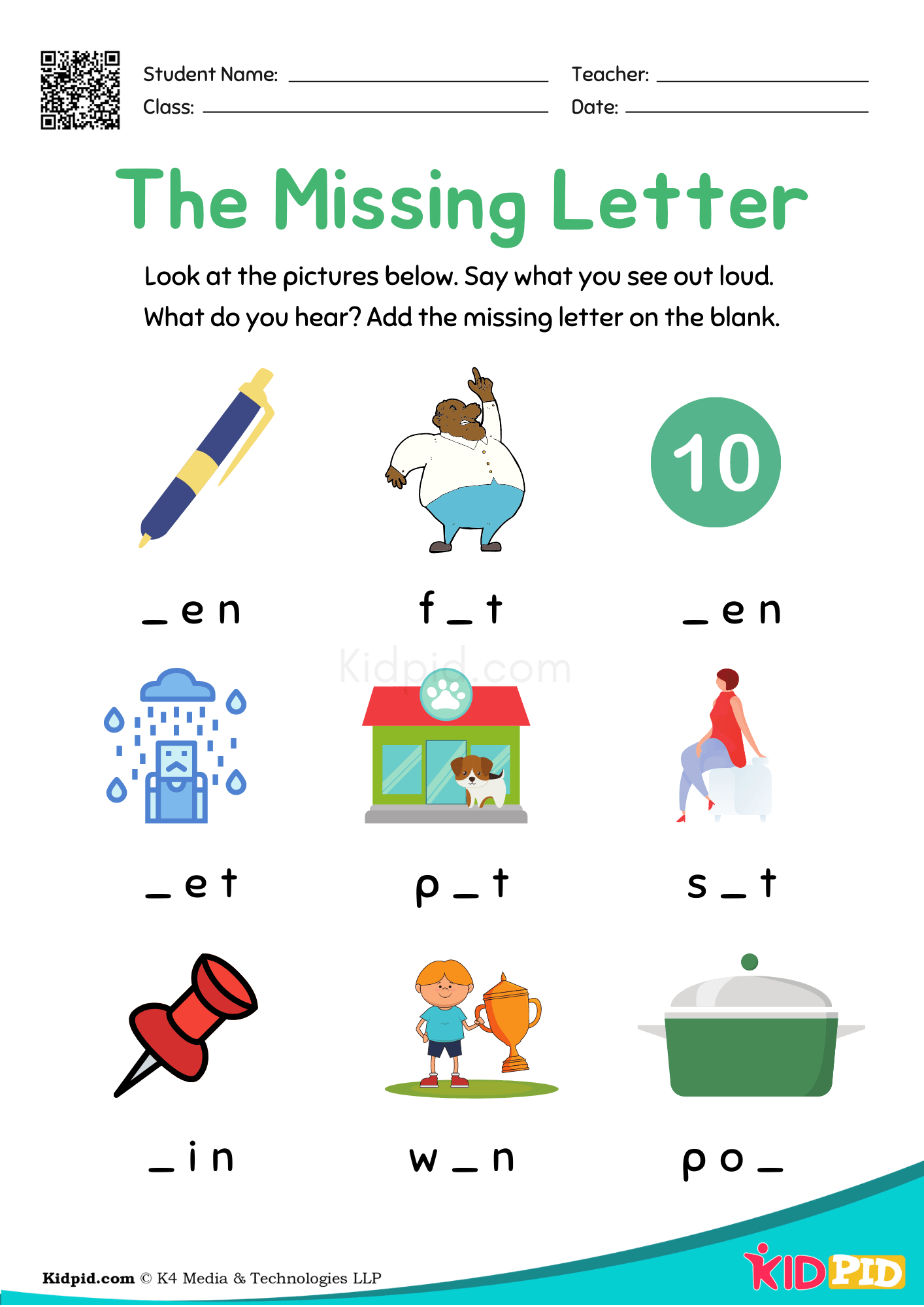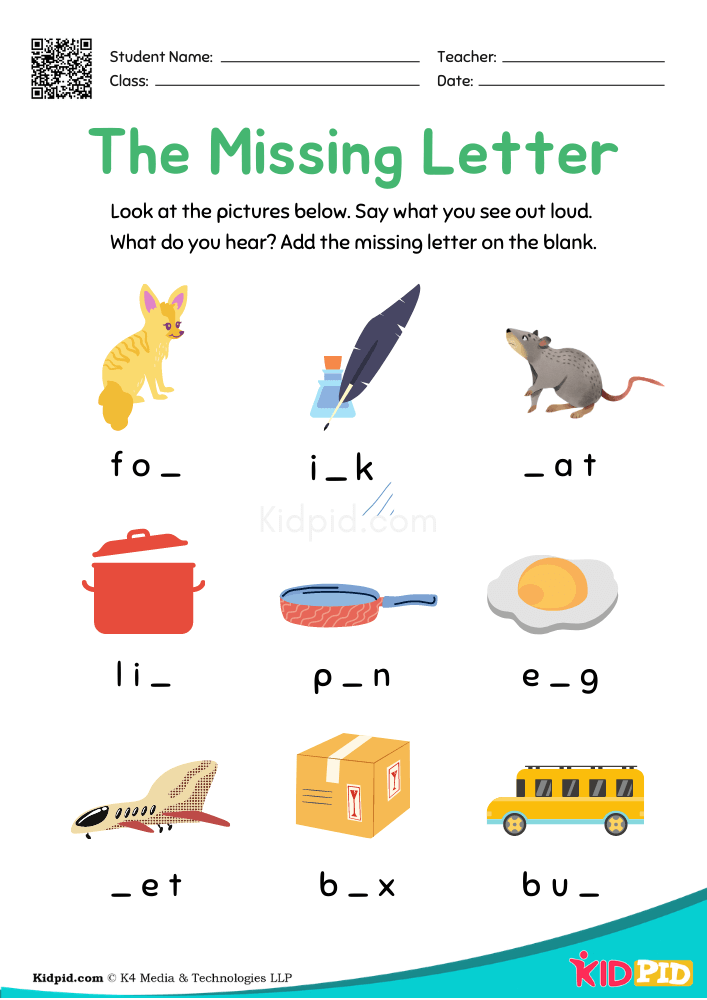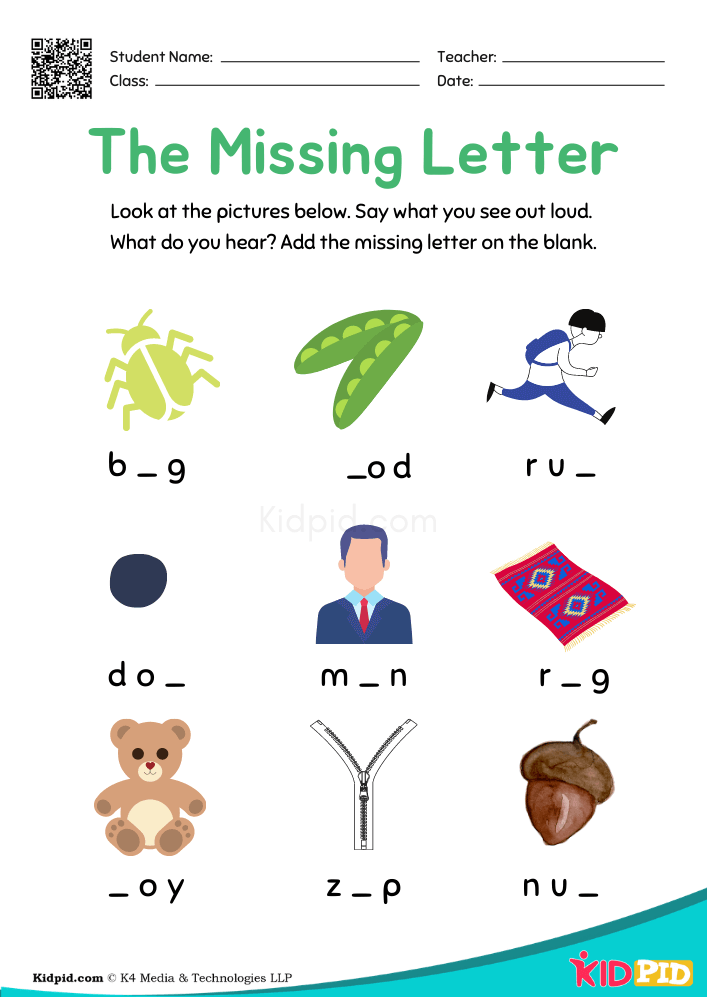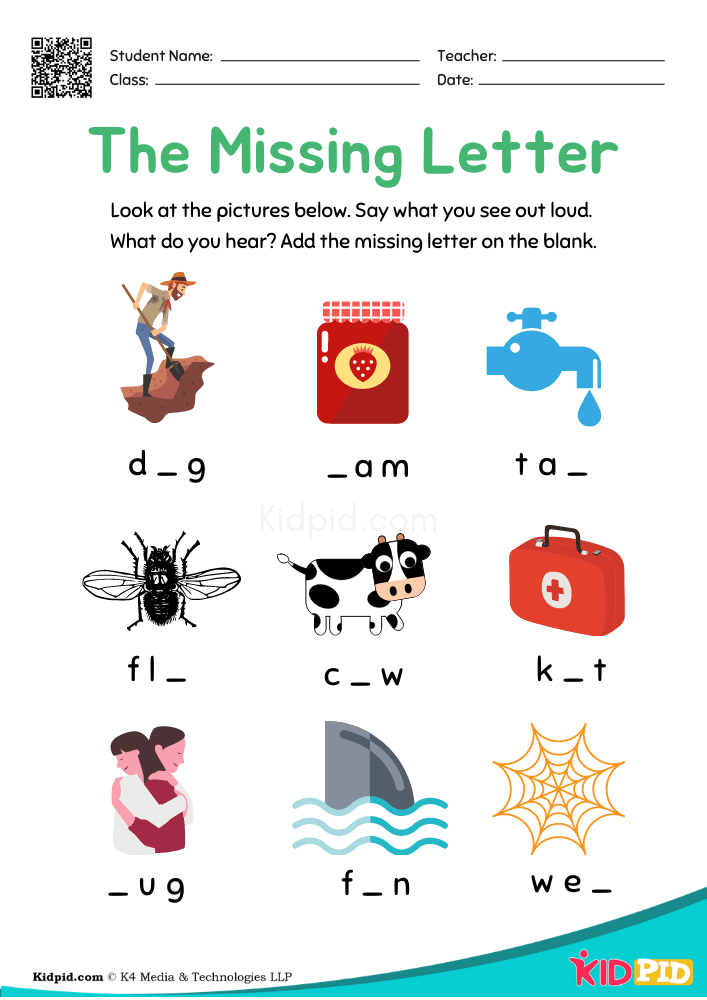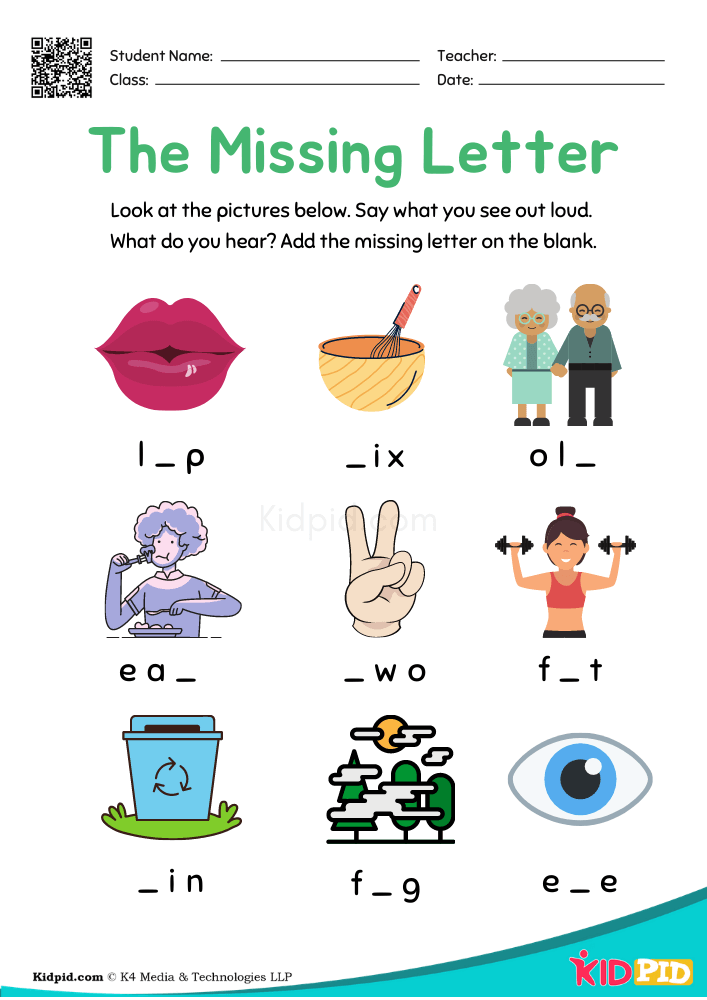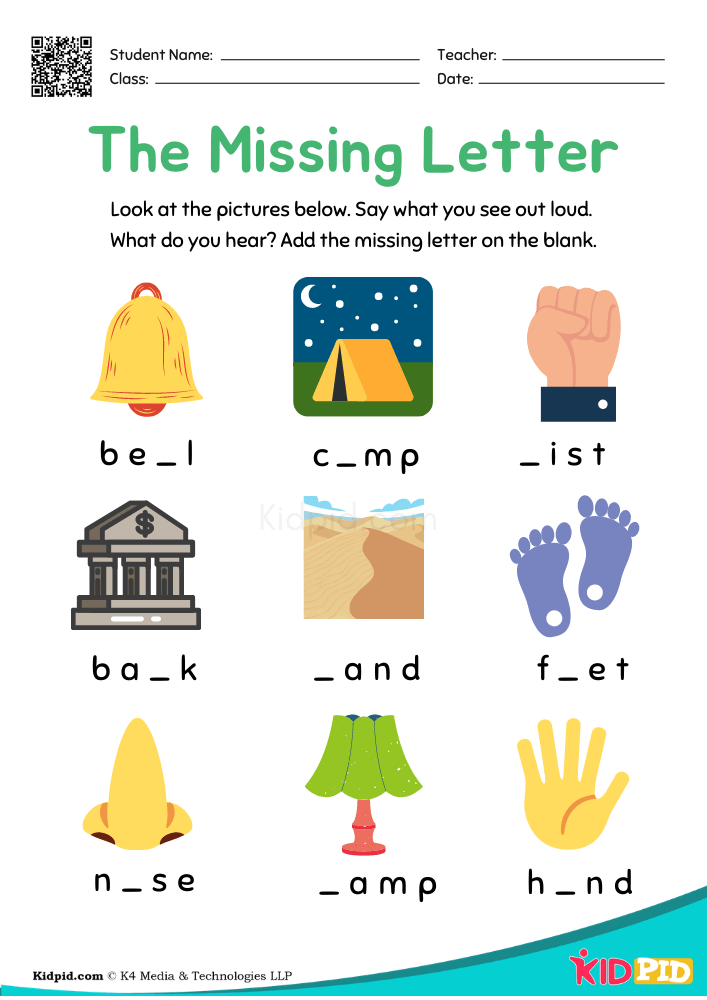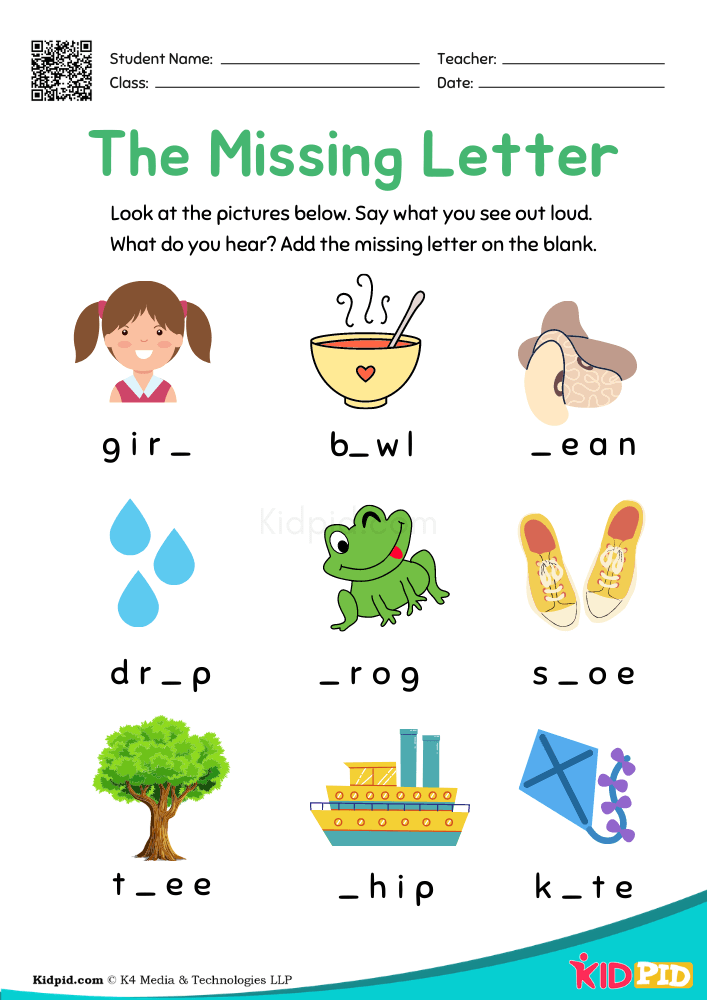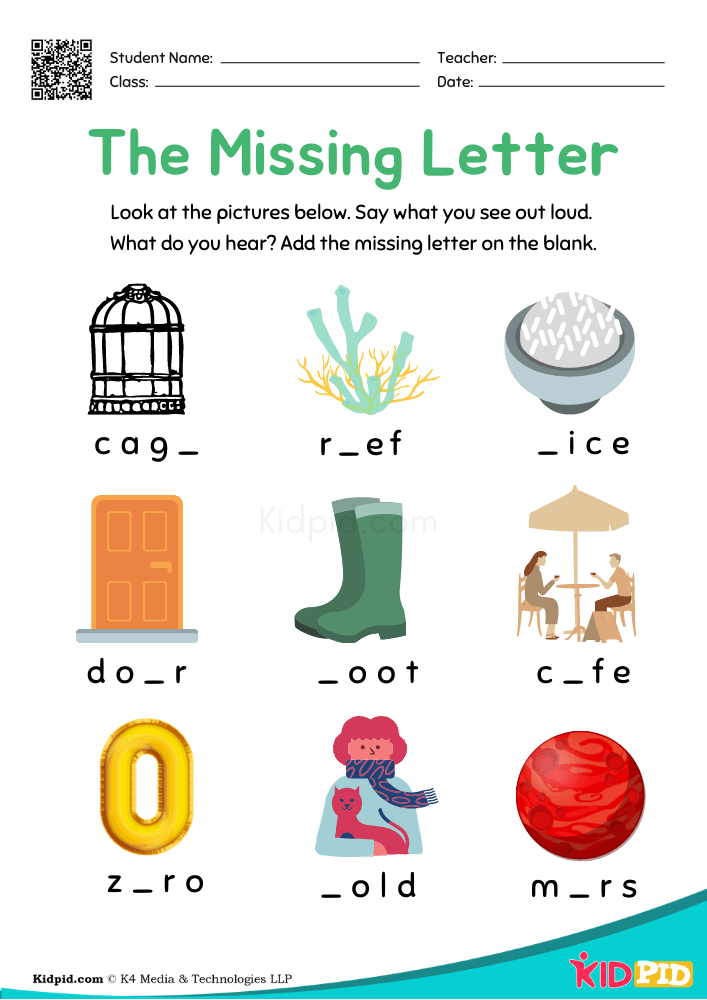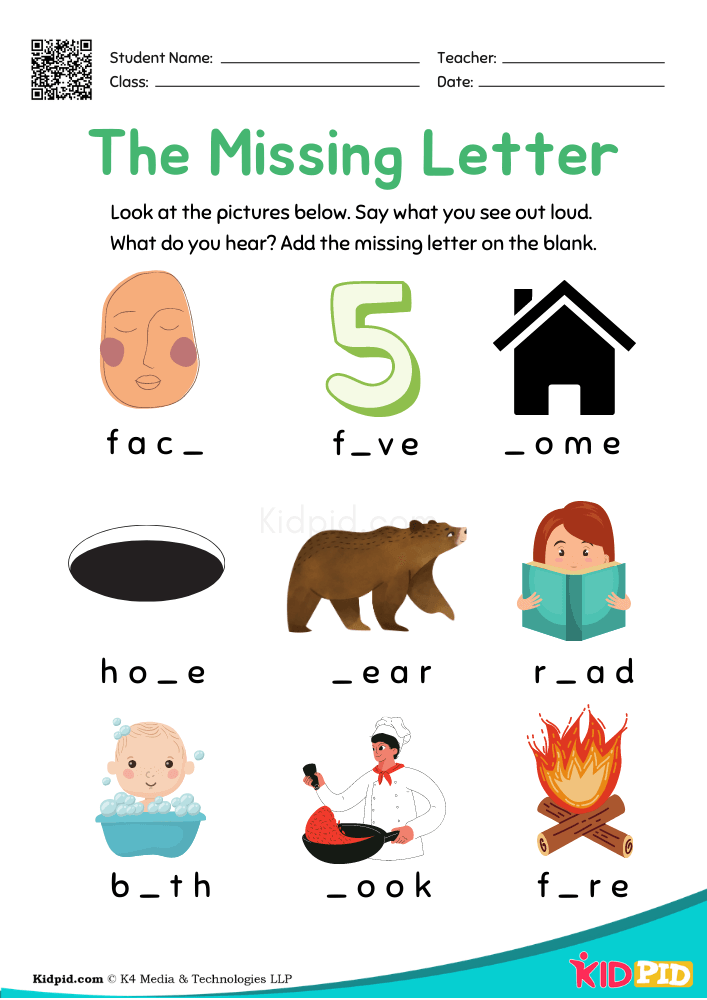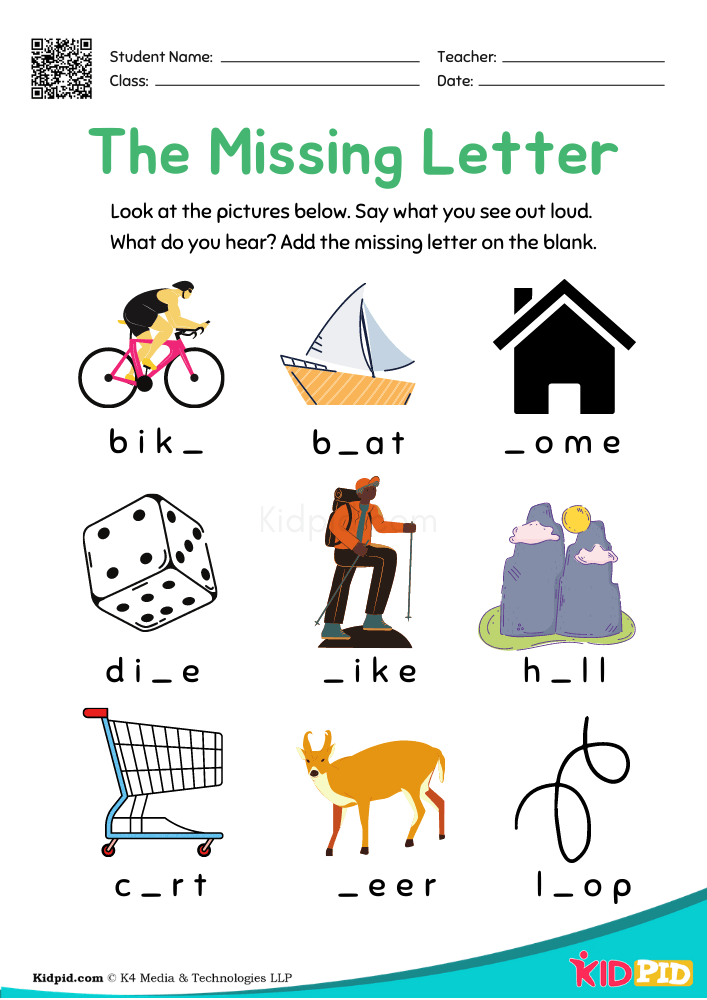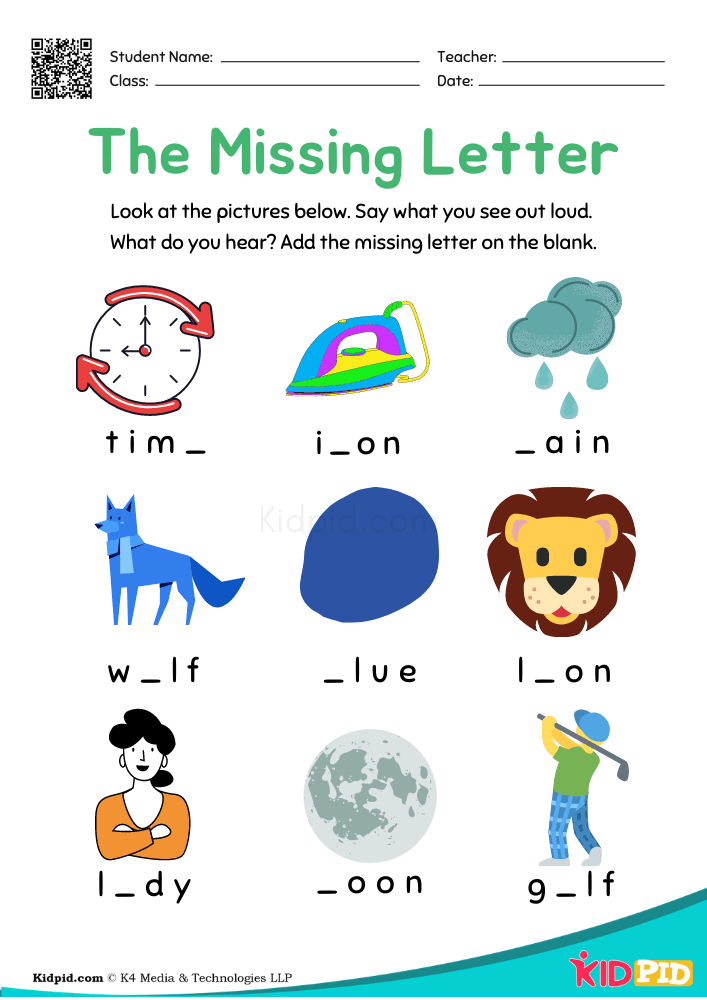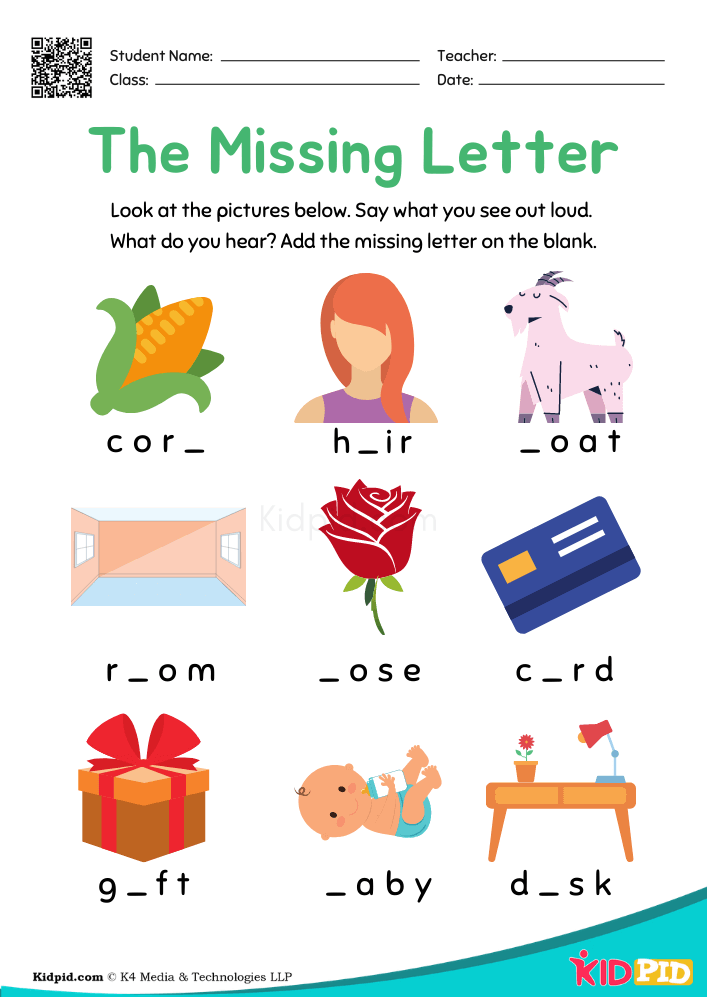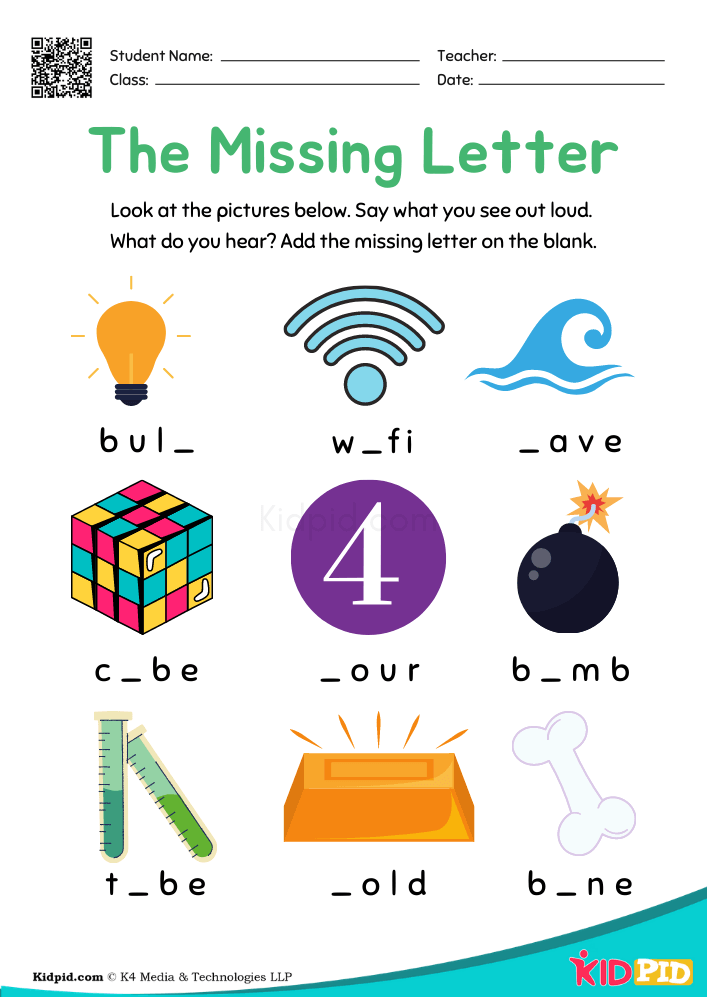
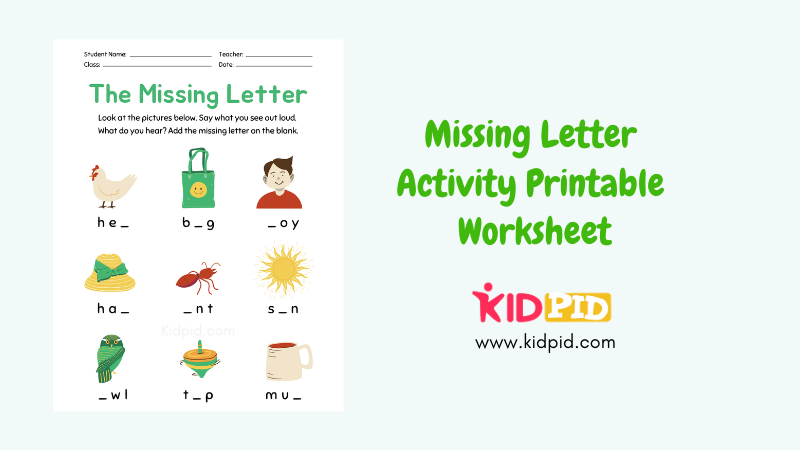
Boost your child’s spelling and vocabulary skills with this Colorful English Spelling Missing Letter Activity Printable Worksheet. Kids complete missing letters in fun words while improving letter recognition, reading confidence, concentration, and early language development through engaging practice.

The Missing Letter

Look at the pictures below. Say what you see out loud.

What do you hear? Add the missing letter to the blank.

 

Click here for more printable worksheets.

Key Facts About Spelling Missing Letter Activity Printable Worksheet

Early childhood literacy relies heavily on sensory association and pattern recognition. This free printable worksheet is a targeted tool designed to transition young learners from basic letter identification to phonetic spelling.

  • Target Audience: Ideal for toddlers, preschoolers, kindergarteners, and early Grade 1 students (Ages 3 to 6).
  • Core Focus: Phonemic awareness, letter sequencing, and spelling foundations.
  • Design Layout: Clean, engaging, and colorful visual cues combined with clear blank lines for handwriting practice.
  • Accessibility: Available as a free downloadable and printable PDF resource for parents, homeschoolers, and classroom teachers.

Parts, Types, and Examples of Missing Letter Worksheets

Missing letter worksheets are versatile tools that scale in difficulty as a child’s vocabulary grows. To build a robust literacy curriculum, educators typically categorize these activities into specific types:

  • Beginning Sound Identification (Consonants): The worksheet provides a picture and the ending of a word, requiring the child to supply the starting sound.
    • Example: A picture of a pig with the text ___ ig.
  • CVC Word Medial Vowels: Focused on short vowel sounds (a, e, i, o, u) situated in Consonant-Vowel-Consonant words.
    • Example: A picture of a cat with the text c ___ t.
  • Ending Sound Isolation: Encourages children to listen to the final tail sound of a spoken word.
    • Example: A picture of a sun with the text su ___.
  • Alphabetical Letter Sequencing: Instead of tracking images, children fill in the blanks of a standard sequence to practice alphabetical order.
    • Example: A, B, ___, D, E.

How Does a Missing Letter Spelling Activity Work?

This activity works by triggering orthographic mapping—the mental process readers use to turn unfamiliar written words into instantly recognizable sight words. The visual and auditory loop operates in three sequential steps:

  1. Visual Stimulus (The Picture): The child identifies a familiar object (like a fan, a bed, or a mop), which retrieves the conceptual word from their memory.
  2. Auditory Isolation (The Sound): By saying the word aloud, the child breaks the word down into its individual sounds—a process called segmenting.
  3. Graphophonemic Translation (The Writing): The child connects the missing sound to its corresponding written letter shape (grapheme) and physically writes it on the worksheet blank space.

Benefits of Learning with Missing Letter Worksheets

  • Accelerates Phonics Mastery: National reading standards show that children who practice isolating sounds learn to read up to 40% faster than those practicing memorization alone.
  • Refines Fine Motor Skills: Handwriting letters inside defined structural lines trains early pencil grip and spatial awareness.
  • Boosts Self-Correction Skills: Because the worksheet provides part of the word, children receive immediate feedback if their chosen letter doesn’t naturally fit the structural context of the word.
  • Reduces Cognitive Load: Writing a whole word can overwhelm a preschooler. Missing letter formats break spelling into micro-tasks, keeping learning low-stress and highly rewarding.

Learning Objectives

By completing these foundational literacy worksheets, students will achieve the following developmental milestones:

  • Phonological Awareness: Demonstrate the ability to isolate and pronounce the initial, medial, and final sounds in three-letter words.
  • Grapheme-Phoneme Correspondence: Accurately map spoken letter sounds to their correct written symbol.
  • Alphabet Knowledge: Recognize both uppercase and lowercase letter formations in printed sequences.
  • Handwriting Dexterity: Control a pencil to print legible letters within standard primary lines.

Worksheet Instructions

To ensure a smooth learning session, share these clear, step-by-step instructions with your young learners:

  1. Look and Identify: Point to the colorful picture in the row and say the name of the object out loud.
  2. Listen Closely: Repeat the word slowly. Focus specifically on the missing sound (such as the first sound you make with your mouth).
  3. Trace or Write: Use your pencil to write the missing letter clearly on the blank line to complete the word.
  4. Read it Back: Point under each letter from left to right and blend them to read your completed word!

Interesting Facts About Language & Spelling Development

  • Vowels Are the Hardest: For young brains, mapping short vowel sounds (like the difference between the “e” sound in bed and the “i” sound in bid) is the hardest part of early spelling development.
  • The “Picture” Advantage: Human brains process visual images 60,000 times faster than written text. Coupling a picture with a spelling blank bridges the abstract gap of language processing.
  • Kinesthetic Memory: The physical act of writing down a missing letter creates a stronger cognitive pathway in a child’s brain than typing or pointing to a screen.

Real-Life Applications

Spelling worksheets don’t just live on paper—they teach skills that apply directly to a child’s daily environments:

  • Navigating the Real World: Recognizing words on grocery store items, cereal boxes, and street signs relies on the exact same pattern-completion skills practiced on missing letter sheets.
  • Interactive Storytime: Parents can mimic this worksheet strategy during bedtime reading by pausing at simple words and asking the child, “What letter sound do you think starts that next word?”
  • Labeling Belongings: Once children master missing letters, they gain the confidence to spell out labels for their toy bins, drawings, and school cubbies.

FAQs

Q1. At what age are missing letter worksheets best suited?

Answer: These activities are perfect for children aged 3 to 6 years old (Preschool, Kindergarten, and early 1st Grade). If a child knows their basic alphabet sounds, they are ready to try these worksheets.

Q2. How can I assist a child who keeps getting the letters wrong?

Answer: Avoid telling them the answer. Instead, exaggerate the missing sound using phonics. For example, if the word is mop, say: “Mmm-mmm-op. Do you hear the Mmm sound? What letter makes the Mmm sound?”

Q3. Should my child practice with uppercase or lowercase letters?

Answer: Early literacy experts recommend practicing with lowercase letters first. Over 90% of all printed text in books is lowercase, making it the most practical script for reading readiness.

Q4. Can these printables be reused for classroom settings?

Answer: Yes! To make worksheets reusable, slip the printed page into a plastic dry-erase sleeve. Children can fill in the missing letters using a dry-erase marker, wipe it clean, and hand it to the next student.

Strengthen spelling skills with this Colorful English Spelling Missing Letter Activity printable worksheet. Children complete missing letters, expand vocabulary, improve phonics, and build word recognition. Fun practice enhances confidence while supporting early reading, spelling, and language development. Explore fun worksheets, essays, paragraphs, flashcards, quizzes, and interactive resources on our website. Follow us on YouTube & Facebook.

The Content Team prepared this worksheet to strengthen educational outcomes.

Reviewed By Sandra K Udayan

More Printables

About the Author

Content Team

Kidpid Content Team is a team of experienced educators, curriculum researchers, and child-focused content creators specializing in early childhood and primary education. The team develops high-quality, research-based worksheets, learning activities, and educational articles aligned with age-appropriate learning standards. Every resource is carefully reviewed to ensure accuracy, clarity, and educational value, making Kidpid a trusted platform for parents, teachers, and schools worldwide.

View All Articles