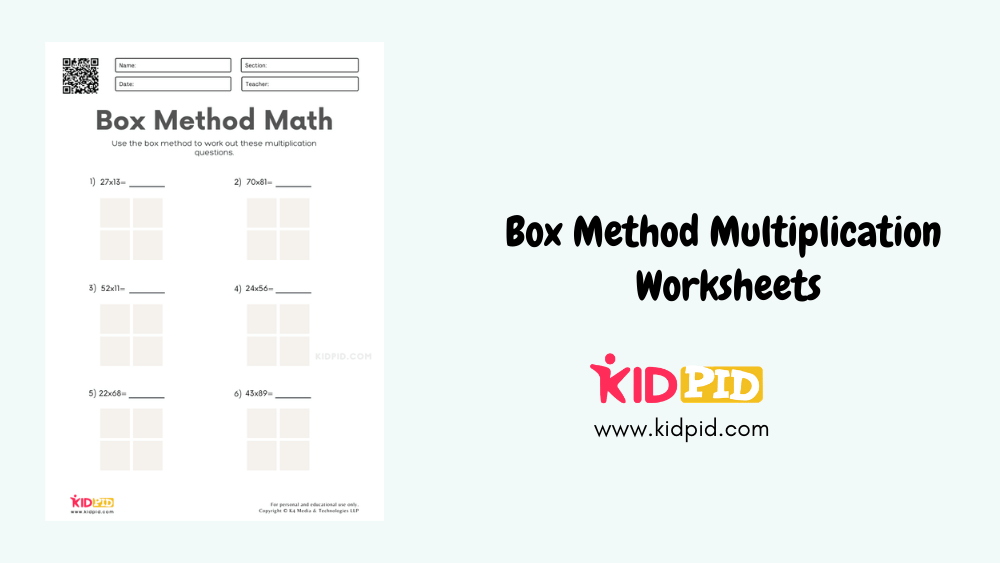
We are here with a box method multiplication worksheet to download and print to start a sweet mathematical journey!
Your kid has learnt one-digit and two-digit multiplication. Now, it’s time to learn multi-digit multiplication. Your child may find it a bit difficult at first. We are here to help your child with the easiest thing possible to help him learn and understand it in a better way.
Your child needs to upgrade his multiplication skills from one-digit to multi-digit multiplication because he has to apply this in real-life chores, and he should learn and be prepared for his future problems.
The easiest and most convenient method of performing multi-digit multiplication is with the help of the box method.
Contents
- What is Box Method Multiplication?
- 2-Digit Box Method Multiplication Worksheets
- 2-Digit Box Method Multiplication Worksheet: 1
- 2-Digit Box Method Multiplication Worksheet: 2
- 2-Digit Box Method Multiplication Worksheet: 3
- 2-Digit Box Method Multiplication Worksheet: 4
- 2-Digit Box Method Multiplication Worksheet: 5
- 2-Digit Box Method Multiplication Worksheet: 6
- 2-Digit Box Method Multiplication Worksheet: 7
- 2-Digit Box Method Multiplication Worksheet: 8
- 2-Digit Box Method Multiplication Worksheet: 9
- Key Facts About Box Method Multiplication Worksheets
- Parts/Types/Examples of Box Method Multiplication Worksheets
- How Does Box Method Multiplication Work?
- Benefits of Learning About Box Method Multiplication Worksheets
- Learning Objectives
- Worksheet Instructions
- Interesting Facts About Box Method Multiplication
- Vocabulary Words
- Real-Life Applications
- FAQs
- Q1. What is the box method in multiplication?
- Q2. Who should use box method multiplication worksheets?
- Q3. Why is the box method important?
- Q4. Is the box method easier than traditional multiplication?
- Q5. Can the box method be used for large numbers?
- Q6. How often should children practice these worksheets?
- Q7. Does the box method help with future math learning?
- Q8. Are these worksheets suitable for homeschooling?
What is Box Method Multiplication?
Also known as the Grid method, multiplication is an initial approach to solving multi-digit multiplication for numbers more than 10. This method is often introduced to children during their elementary years. Hence, also known as the Grammar School method.
So, let’s get started.
To teach your kid the Box method, you have to follow the following steps:
STEP 1: Draw a two-by-two grid as shown in the above worksheet. Draw two lines vertically and two horizontally.
STEP 2: Now, you need to expand the given numbers and write the numbers vertically and horizontally outside the boxes. For example, let me show you by solving the first problem of worksheet 2.
So, the number 33 will be 30+3, and 68 will be 60+8. You have to write 30 and 3 vertically and 60 and 8 horizontally outside the grids. You can also change the position of the numbers, but in the same pattern.
STEP 3: For the third step, you have to perform the basic step, and that is multiplication. Teach your kid to ignore zeros for a while, just multiply 3×6 rather than 30×60. This will be a lot easier procedure for them.
So, now they have to just add the zeros behind the numbers. Here, we ignored two zeros, so we will add two zeros after 3×6=12. By adding zero, it will be 1200.
STEP 4: For the next step, you have to multiply the same term, i.e., 30, by another number besides 60, i.e., 8, and the answer will be 8×6=48, and by adding a zero that we ignored earlier, it will be 480.
Repeat step 4 for the following number in a vertical grid that is 3. Multiply it by 60 to get the answer, which is 3×6=12, and adding the zero, the answer will be 120.
Again, multiply 3 by 8 and the answer will be 3×8=24.
STEP 5: For the last and final step, you simply add all the numbers inside the boxes that you get after multiplication.
Like for our problem 1200+240+120+24= 1584
And, koala! This is your answer.
2-Digit Box Method Multiplication Worksheets

Use the box method to work out these multiplication questions.
2-Digit Box Method Multiplication Worksheet: 1
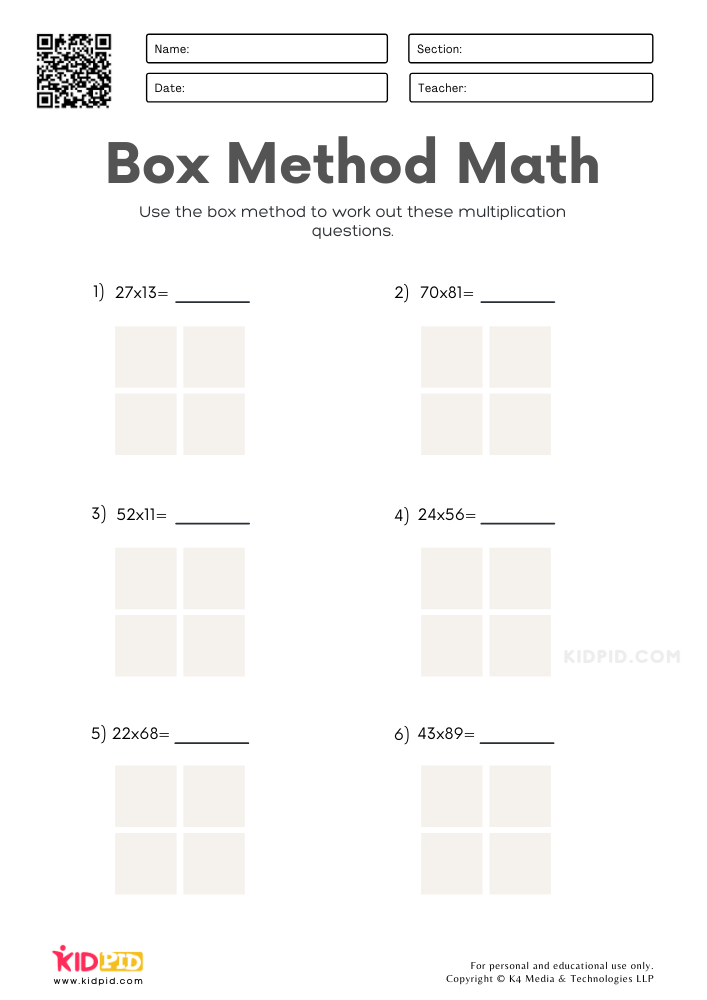
2-Digit Box Method Multiplication Worksheet: 2
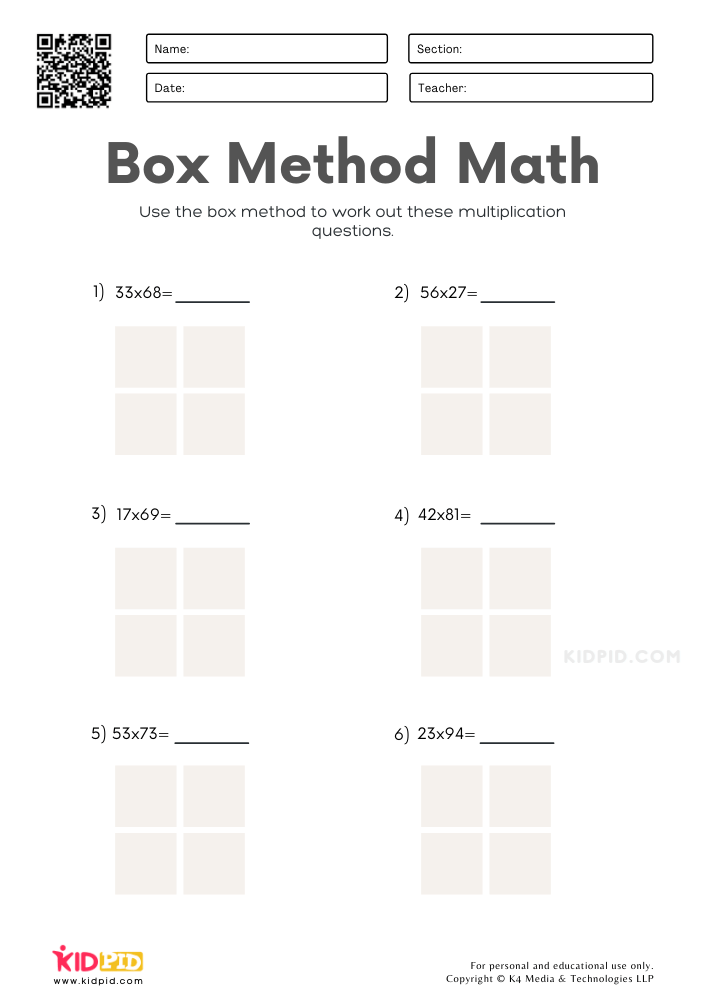
2-Digit Box Method Multiplication Worksheet: 3
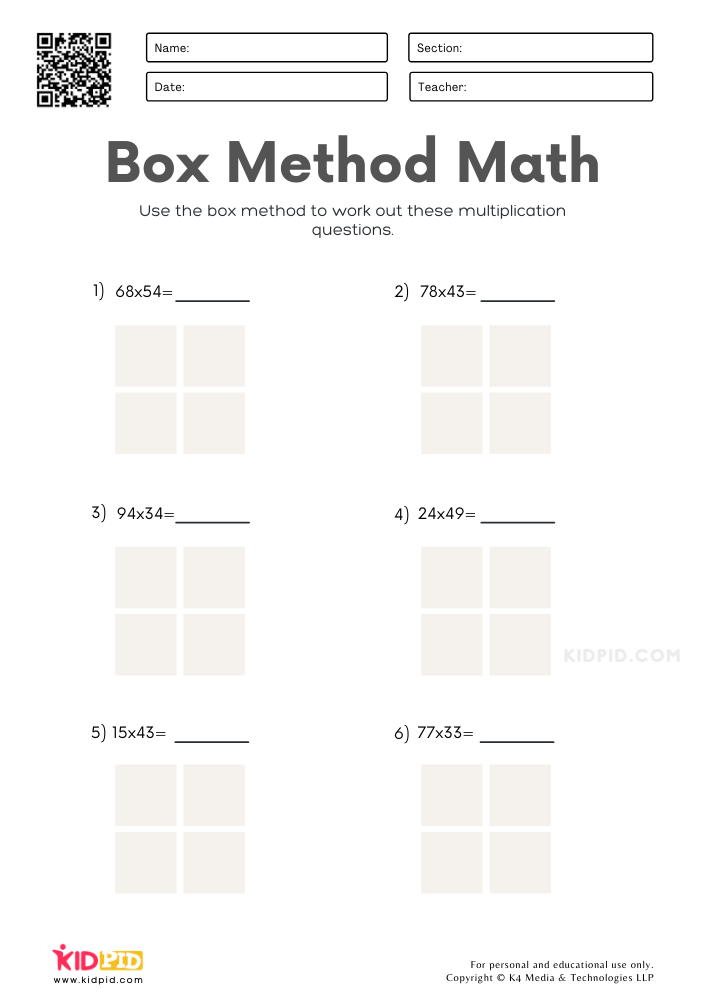
2-Digit Box Method Multiplication Worksheet: 4
2-Digit Box Method Multiplication Worksheet: 5
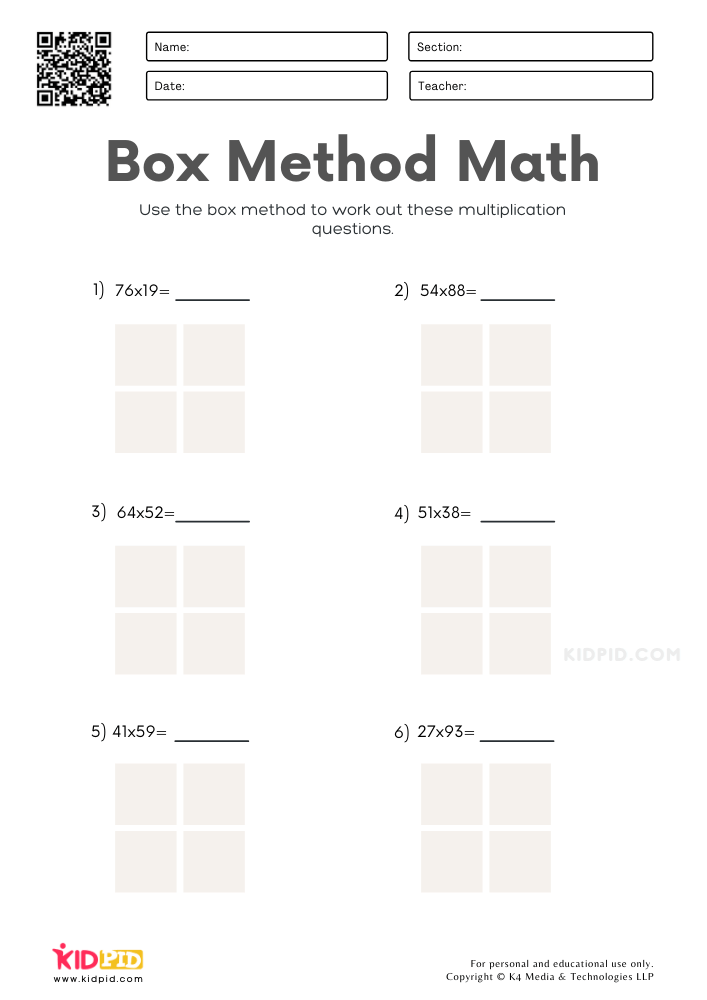
2-Digit Box Method Multiplication Worksheet: 6
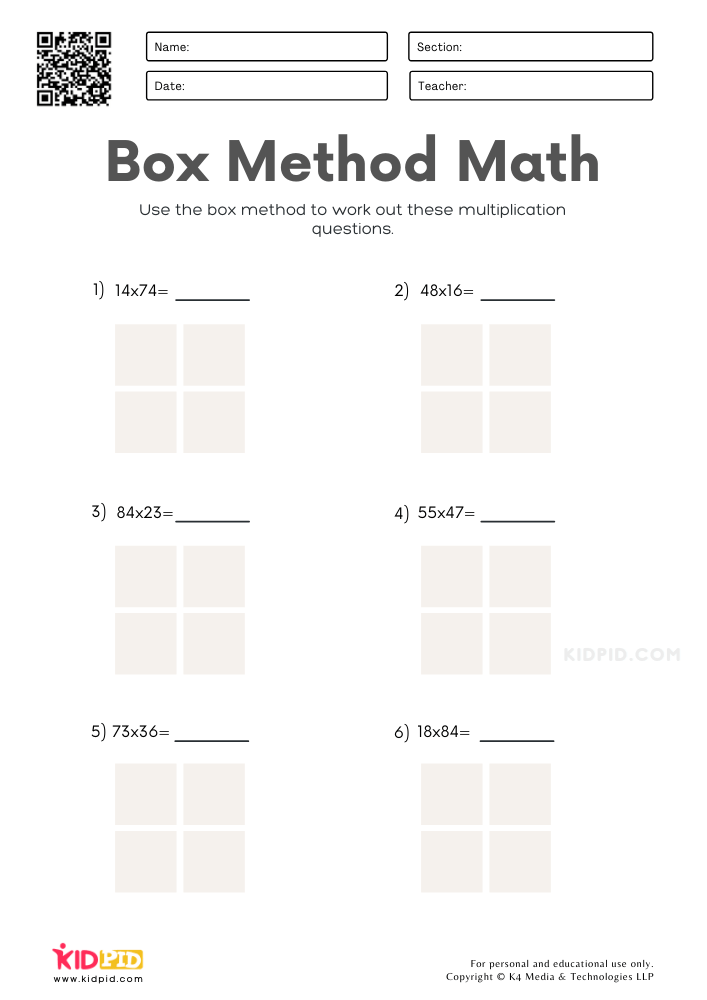
2-Digit Box Method Multiplication Worksheet: 7
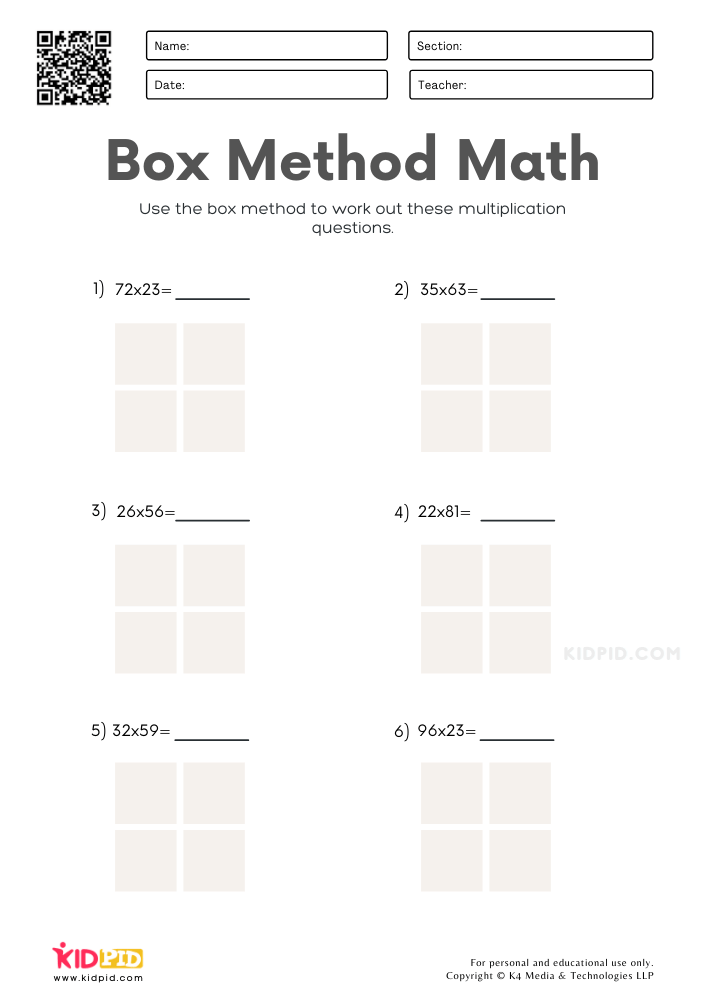
2-Digit Box Method Multiplication Worksheet: 8
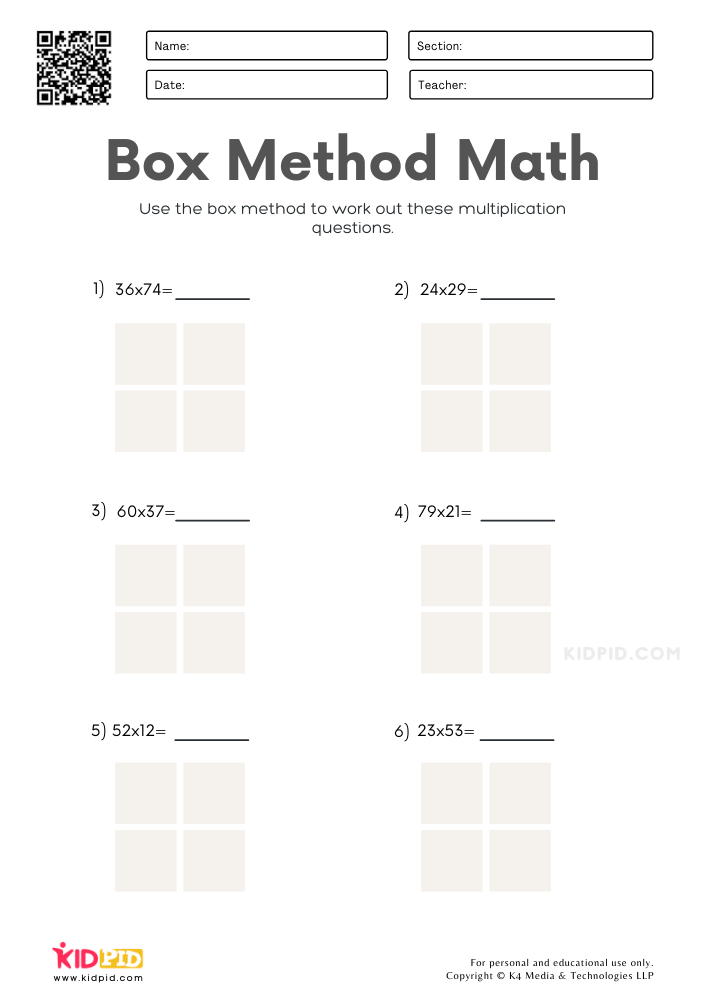
2-Digit Box Method Multiplication Worksheet: 9
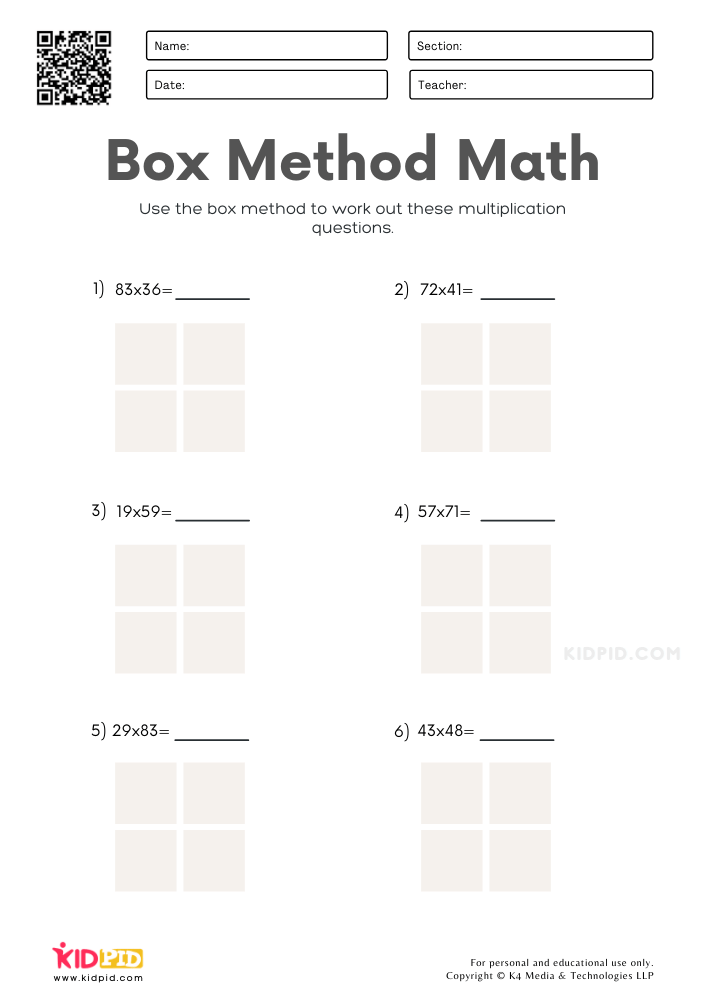
This simple and easy method will make your kid understand every concept of multi-digit multiplication. This will not only boost his confidence when he can perform and apply this method in actual life, but will also help him to stay ahead in his academics.
Remember to make your kid focus properly while solving these problems. To do this, you can offer them sweets as they complete their problems. One sweet for each problem.
These box method multiplication worksheets will make the activity more fun, and he will always love to study and learn new things. Our printables will help your kid to solve them and learn this method. You can download these worksheets very conveniently. We will keep working to prepare more exciting and fun worksheets for your kids.
Key Facts About Box Method Multiplication Worksheets
- Box Method Multiplication Worksheets help children solve multiplication problems by breaking numbers into smaller place-value parts.
- The box method is also known as the area model method and is commonly taught in elementary math.
- These worksheets improve understanding of place value, multiplication concepts, and number relationships.
- Students multiply each section of the box separately and then add the partial products together.
- The worksheets are suitable for 3rd, 4th, and 5th-grade learners.
- They support visual learning and help children organize complex multiplication problems.
- Box method worksheets can be used for one-digit, two-digit, and multi-digit multiplication practice.
- Regular practice strengthens mental math, accuracy, and problem-solving skills.
Parts/Types/Examples of Box Method Multiplication Worksheets
Parts of a Box Method Worksheet
- Multiplication problem
- Place-value boxes or grid
- Partial product spaces
- Final answer section
- Practice and review questions
Types of Box Method Multiplication Worksheets
- One-digit by two-digit multiplication
- Two-digit by two-digit multiplication
- Three-digit by two-digit multiplication
- Advanced multi-digit multiplication
- Word problem multiplication worksheets
- Color-by-answer box multiplication activities
Examples
- 23 × 14
- 45 × 12
- 126 × 23
- 308 × 15
- 234 × 46
How Does Box Method Multiplication Work?
The box method separates numbers according to place value before multiplying. Students draw a grid and split each number into tens, hundreds, and ones. Each section is multiplied individually to find partial products. After completing all boxes, students add the partial products to get the final answer.
For example, when solving 23 × 14:
- Split 23 into 20 and 3.
- Split 14 into 10 and 4.
- Multiply: 20×10, 20×4, 3×10, and 3×4.
- Add all partial products to find the final answer.
This structured process helps students understand multiplication more deeply and reduces calculation errors.
Benefits of Learning About Box Method Multiplication Worksheets
- Builds a strong foundation in multiplication concepts.
- Reinforces place-value understanding.
- Improves accuracy when solving large multiplication problems.
- Encourages logical and organized problem-solving.
- Supports visual and hands-on learners.
- Develops confidence in multi-digit multiplication.
- Prepares students for advanced math topics.
- Reduces anxiety associated with traditional long multiplication methods.
- Enhances critical thinking and reasoning skills.
Learning Objectives
By completing these worksheets, students will:
- Understand how place value affects multiplication.
- Use the box method to solve multiplication problems accurately.
- Calculate and combine partial products correctly.
- Develop fluency with multi-digit multiplication.
- Strengthen mathematical reasoning and problem-solving skills.
- Apply multiplication strategies to real-world situations.
- Increase confidence in independent math practice.
- Improve computational accuracy and speed.
Worksheet Instructions
- Read the multiplication problem carefully.
- Divide each number into its place-value components.
- Write the values along the top and side of the box grid.
- Multiply the numbers in each box.
- Record all partial products neatly.
- Add the partial products together.
- Write the final answer in the space provided.
- Check your work for accuracy before moving to the next problem.
Interesting Facts About Box Method Multiplication
- The box method visually represents the distributive property of multiplication.
- It helps students understand why multiplication works instead of simply memorizing steps.
- Many modern math curricula use the box method before teaching traditional algorithms.
- The strategy can be extended to algebra and polynomial multiplication.
- Visual multiplication models improve comprehension for many young learners.
- The method is commonly used in classrooms worldwide to support conceptual math learning.
- It can simplify large multiplication problems into manageable steps.
Vocabulary Words
- Multiplication – Repeated addition of equal groups.
- Factor – A number being multiplied.
- Product – The answer to a multiplication problem.
- Place Value – The value of a digit based on its position.
- Partial Product – The result of multiplying part of a number.
- Area Model – A visual representation of multiplication using boxes.
- Grid – The boxes used to organize multiplication steps.
- Distributive Property – A math rule used to break apart multiplication problems.
- Equation – A mathematical statement showing equality.
- Strategy – A method used to solve a problem.
Real-Life Applications
- Calculating the total cost of multiple items while shopping.
- Determining the number of seats in rows and columns.
- Finding the area of rectangular spaces.
- Planning classroom supplies for students.
- Estimating materials needed for construction projects.
- Organizing inventory in stores and warehouses.
- Calculating event seating arrangements.
- Solving everyday budgeting and financial calculations.
FAQs
Q1. What is the box method in multiplication?
Answer: The box method is a visual multiplication strategy that breaks numbers into place-value parts and multiplies them separately before combining the results.
Q2. Who should use box method multiplication worksheets?
Answer: These worksheets are ideal for elementary students learning multi-digit multiplication and place-value concepts.
Q3. Why is the box method important?
Answer: It helps students understand the multiplication conceptually and improves accuracy with larger numbers.
Q4. Is the box method easier than traditional multiplication?
Answer: Many students find it easier because it organizes the multiplication process into smaller, manageable steps.
Q5. Can the box method be used for large numbers?
Answer: Yes. The method works for two-digit, three-digit, and even larger multiplication problems.
Q6. How often should children practice these worksheets?
Answer: Regular practice, even 10–15 minutes a few times per week, can significantly improve multiplication skills.
Q7. Does the box method help with future math learning?
Answer: Yes. It builds foundational skills that support algebra, geometry, and higher-level mathematics.
Q8. Are these worksheets suitable for homeschooling?
Answer: Absolutely. They provide structured, independent practice that works well in both classrooms and home learning environments.
Breaking multiplication into smaller steps makes complex calculations easier to understand. These box method worksheets improve accuracy, reinforce multiplication strategies, and help learners solve two-digit problems with confidence. Unlock more learning opportunities with our collection of worksheets, essays, flashcards, paragraphs, quizzes, and interactive resources. Follow us on YouTube & Facebook for fresh content daily.
The Content Team designed this worksheet to promote learning success.
Reviewed By Minakshi
You’ll Also Like