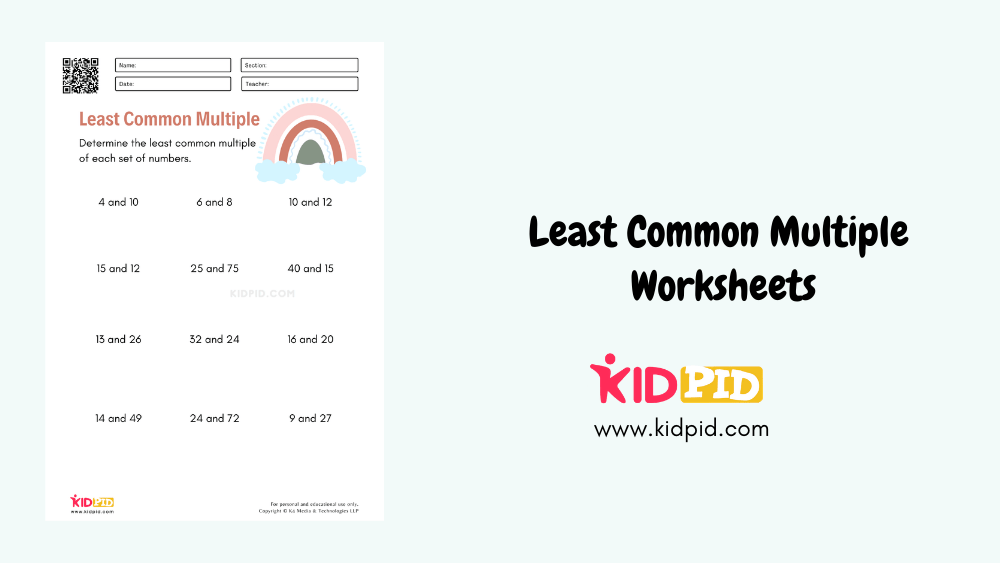
A mathematical operation that has vast applications in problem-solving is the L.C.M., or Least Common Multiple. What is the L.C.M.? Well, first, let’s understand what a multiple is. A multiple of a number is a number that can be divided by the given number without leaving any remainder. Confused?
Let’s take an example. 20 is a multiple of 5, which basically means that 20 can be divided by 5 completely, providing a remainder of zero, or basically no remainder. When we talk about the least common multiple or L.C.M., we associate it with a given set of numbers. So, the L.C.M. of a given set of numbers is nothing but the smallest possible number that is completely divisible by all the numbers in the set given to us.
Let’s try to find the L.C.M. of 2 and 5.
Now, 2 has the following multiples:
2*1 = 1
2*2 = 4
2*3 = 6
2*4 = 8
2*5 = 10
Now, the multiples of 5:
5*1 = 5
5*2 = 10
5*3 = 15
5*4 = 20
5*5 = 25
On comparing the multiples of the two numbers, we can see that 10 is a common multiple for 2 and 5, and it is also the smallest multiple that is common to both numbers. Therefore, the L.C.M. of 2 and 5 is 10.
The method we used in this example to determine the L.C.M. is known as the multiple method.
Finding the L.C.M. of a given set of numbers has several applications, most importantly in calculations involving fractions. So, let’s get started with our worksheets!
Now, the most basic operation is to determine the L.C.M. of two given numbers, and it is important to start with two numbers to learn the correct steps. Quick recall of the multiplication table is necessary while solving these problems, so don’t be disheartened if you make a few mistakes in the beginning.
Contents
- Least Common Multiple Worksheets
- Key Facts About Least Common Multiple Worksheets
- Parts/Types/Examples of Least Common Multiple Worksheets
- How Does Least Common Multiple Worksheets Work?
- Benefits of Learning About Least Common Multiple Worksheets
- Learning Objectives
- Worksheet Instructions
- Interesting Facts About Least Common Multiple Worksheets
- Vocabulary Words
- Real-Life Applications
- FAQs
- Q1. What is the Least Common Multiple (LCM)?
- Q2. Why is learning LCM important?
- Q3. What methods can be used to find the LCM?
- Q4. At what grade level are LCM worksheets appropriate?
- Q5. How do LCM worksheets improve math skills?
- Q6. Can LCM be used in real life?
- Q7. What is the difference between LCM and GCF?
- Read More:
Least Common Multiple Worksheets

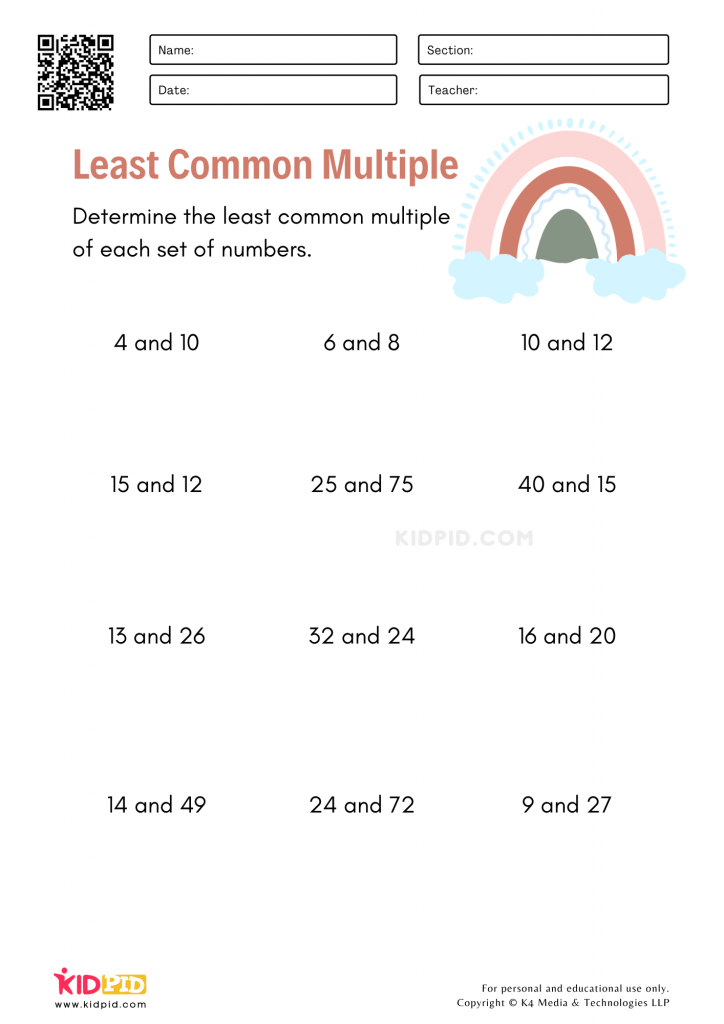
A great way to get into the habit of mentally determining the multiples is to first practice writing them down. This helps students calculate faster, and with time, they will be able to calculate it in their head, without having to work it out on paper.
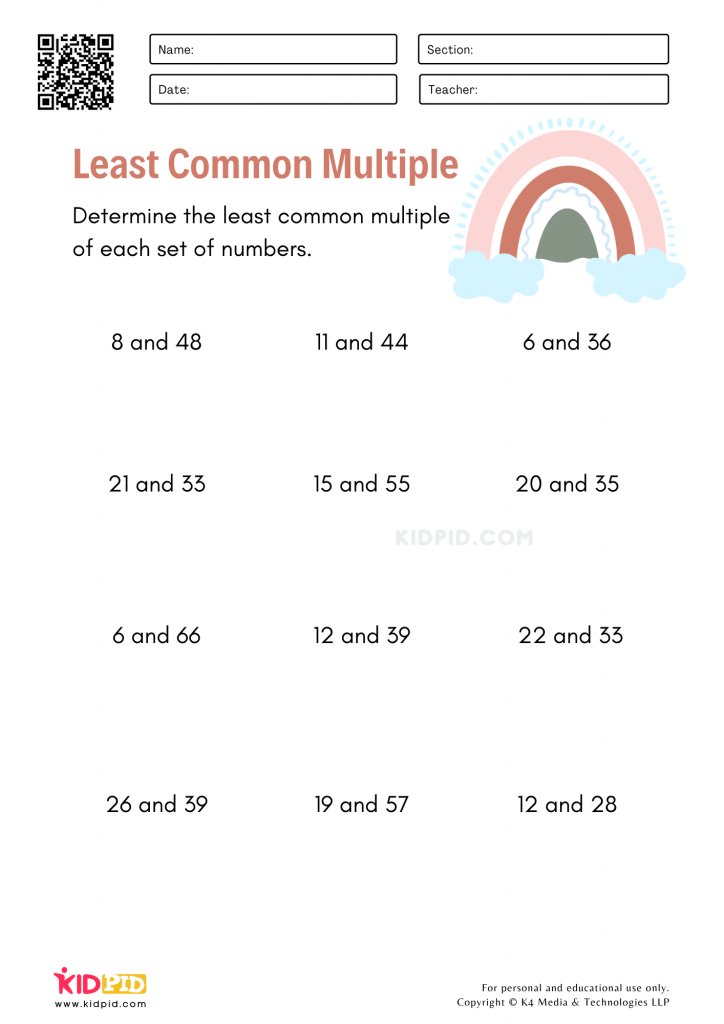
Now, although we have highlighted the multiple methods here, there are two more methods for determining the L.C.M. of a given set of numbers. These are 1. the prime factorization method, 2. the common division method.
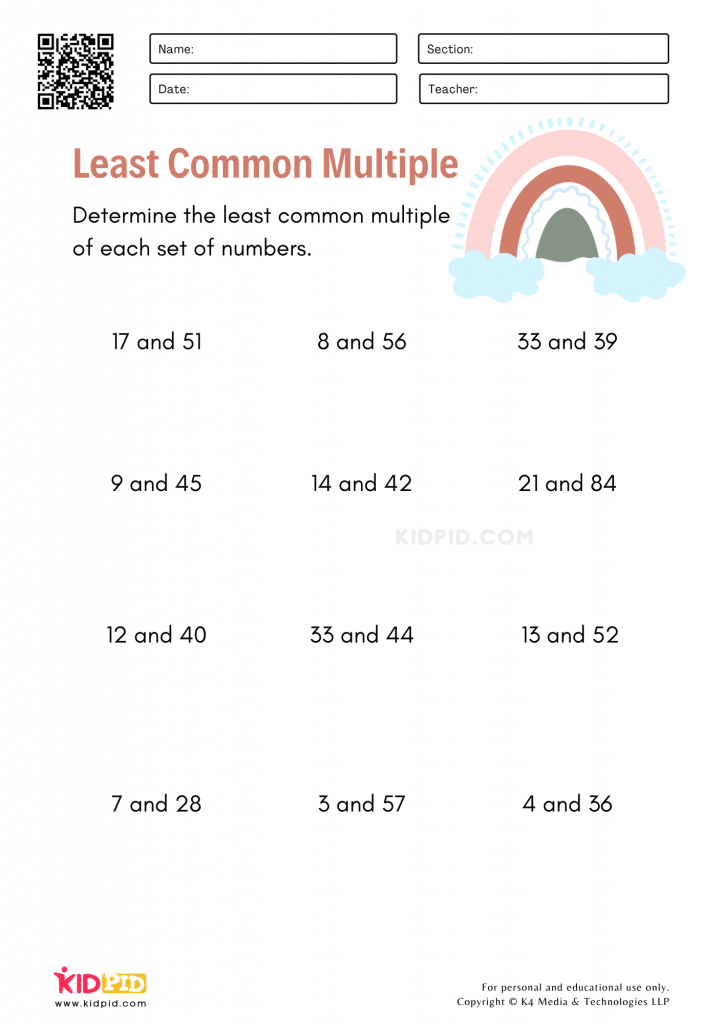
In the prime factorization method, the prime factors for each of the numbers are determined separately. Then, the common multiples of both numbers are taken and multiplied to obtain the L.C.M.
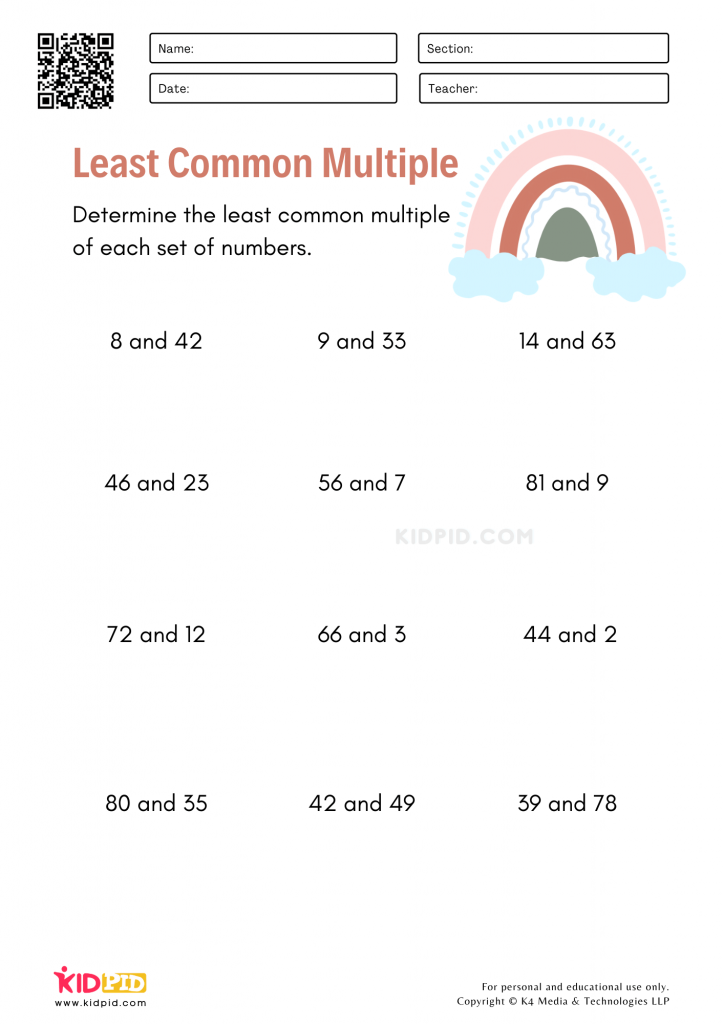
In the case of the common division method, the two given numbers are taken as the common dividend and divided by suitable numbers or divisors until they are no longer divisible. Then the quotients and the divisors are multiplied to obtain the L.C.M. of the given numbers.
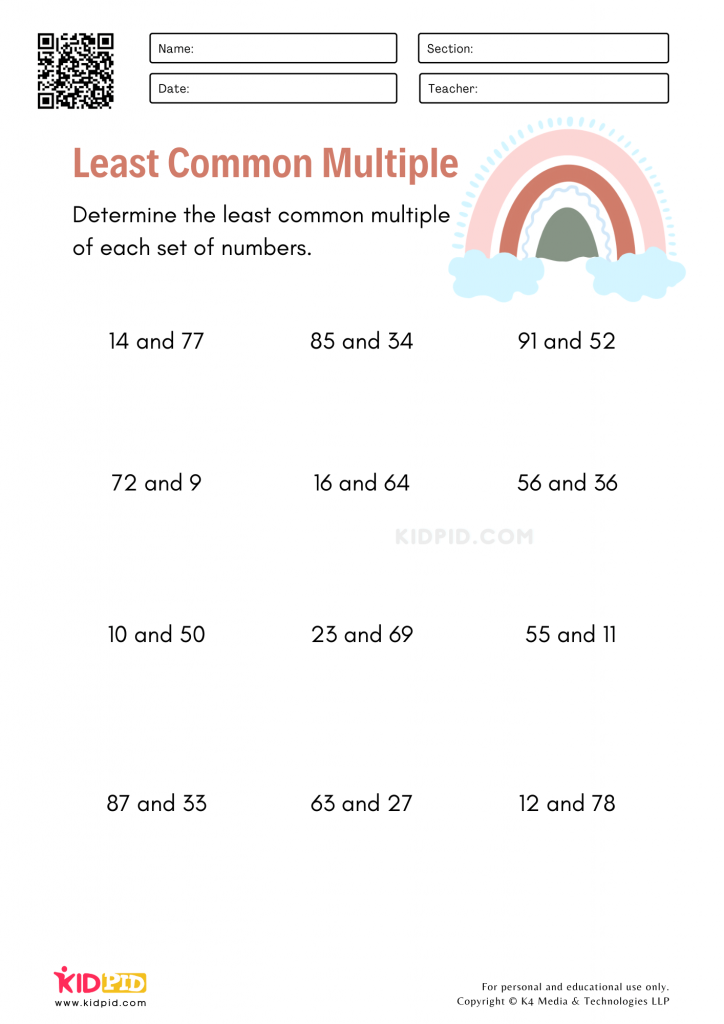
Practice makes perfect, and that phrase is most applicable in mathematics. Errors and mistakes are part of learning, and it is important for children not to give up and keep going. Once they get the hang of solving the L.C.M.s of two numbers, they will get better at it and eventually be able to calculate it mentally, which will ultimately help them become more efficient at solving problems. Worksheets are a great way for children to approach a new topic in a step-by-step manner without feeling intimidated by hefty books and never-ending exercises. This helps them learn and understand concepts in a positive way, which ultimately helps them learn better.
Key Facts About Least Common Multiple Worksheets
Least Common Multiple (LCM) worksheets help children learn how to find the smallest common multiple shared by two or more numbers. These worksheets introduce important number concepts through engaging exercises, making mathematics easier to understand and apply. Students practice identifying multiples, comparing number patterns, and solving real-world problems involving common multiples. LCM worksheets are suitable for elementary and middle school learners and support the development of strong arithmetic and problem-solving skills.
Parts/Types/Examples of Least Common Multiple Worksheets
Parts of LCM Worksheets
- Number pairs or groups for finding the LCM
- Multiple listing exercises
- Prime factorization activities
- Word problems involving LCM
- Multiple-choice and fill-in-the-blank questions
- Challenge problems for advanced learners
Types of LCM Worksheets
- Basic LCM finding worksheets
- Listing multiple worksheets
- Prime factorization LCM worksheets
- LCM word problem worksheets
- Mixed review worksheets
- Puzzle and game-based LCM activities
Examples
- Find the LCM of 4 and 6.
- List the first five multiples of 8.
- Use prime factorization to find the LCM of 12 and 18.
- Solve a word problem involving repeating events.
How Does Least Common Multiple Worksheets Work?
LCM worksheets guide students through various methods of finding the least common multiple. Learners may begin by listing multiples of numbers and identifying the smallest common value. As skills improve, they can use prime factorization or division methods for larger numbers. The worksheets gradually increase in difficulty, allowing students to build confidence while strengthening their understanding of number relationships and mathematical reasoning.
Benefits of Learning About Least Common Multiple Worksheets
- Improves number sense and arithmetic skills
- Strengthens multiplication knowledge
- Develops logical thinking and problem-solving abilities
- Prepares students for fractions and algebra concepts
- Encourages independent learning and practice
- Builds confidence in handling mathematical challenges
- Supports classroom learning and homework activities
Learning Objectives
By completing these worksheets, students will:
- Understand the concept of least common multiples
- Identify multiples of different numbers accurately
- Find the LCM using various methods
- Apply LCM concepts to real-life situations
- Improve mathematical reasoning and critical thinking
- Develop fluency with multiplication facts
- Enhance problem-solving skills
Worksheet Instructions
- Read each question carefully.
- List the multiples of the given numbers when required.
- Find the smallest multiple common to all numbers.
- Use prime factorization if instructed.
- Show your work for complete understanding.
- Check your answers before moving to the next question.
- Complete all word problems using the appropriate method.
Interesting Facts About Least Common Multiple Worksheets
- The LCM helps solve many everyday scheduling problems.
- LCM is closely related to the Greatest Common Factor (GCF).
- Ancient mathematicians used common multiples in calculations.
- LCM plays an important role in working with fractions.
- Engineers and computer programmers use LCM concepts in practical applications.
- Understanding LCM helps students transition smoothly into advanced mathematics.
Vocabulary Words
- Least Common Multiple (LCM)
- Multiple
- Factor
- Prime Number
- Prime Factorization
- Common Multiple
- Division Method
- Number Pattern
- Arithmetic
- Problem Solving
- Mathematical Reasoning
- Multiplication
Real-Life Applications
Least common multiples are used in many real-world situations, including:
- Scheduling buses, trains, or recurring events
- Coordinating sports practice schedules
- Synchronizing machine operations
- Planning classroom activities
- Music, rhythm, and beat patterns
- Computer programming and algorithm design
- Managing production cycles in manufacturing
FAQs
Q1. What is the Least Common Multiple (LCM)?
Answer: The Least Common Multiple is the smallest positive number that is a multiple of two or more given numbers.
Q2. Why is learning LCM important?
Answer: LCM helps students solve fraction problems, schedule tasks, and understand many advanced math concepts.
Q3. What methods can be used to find the LCM?
Answer: Students can use listing multiples, prime factorization, or the division method.
Q4. At what grade level are LCM worksheets appropriate?
Answer: LCM worksheets are commonly used for students in grades 4 through 8, depending on the difficulty level.
Q5. How do LCM worksheets improve math skills?
Answer: They strengthen multiplication knowledge, number sense, logical thinking, and problem-solving abilities.
Q6. Can LCM be used in real life?
Answer: Yes. LCM is useful for scheduling events, coordinating cycles, and solving practical timing problems.
Q7. What is the difference between LCM and GCF?
Answer: LCM is the smallest common multiple of numbers, while GCF is the largest factor shared by the numbers.
Finding the least common multiple becomes easier with consistent, step-by-step practice. These worksheets strengthen multiplication concepts, improve problem-solving abilities, and build confidence in tackling more advanced math challenges. Find new ways to learn with worksheets, paragraphs, quizzes, flashcards, essays, and exciting educational activities on our website. Stay inspired on YouTube & Facebook.
The Content Team designed this worksheet to support learning success.
Reviewed By Sheereen
Read More: