

The Punctuation Practice Worksheet is an engaging resource designed to help kindergarten students develop a strong foundation in using punctuation correctly. Through interactive exercises focused on identifying and applying essential punctuation marks, such as periods, question marks, and exclamation points, children will enhance their written communication skills and build confidence in expressing themselves.
[Scroll Down for Download Link]
Contents
- Write The Correct Punctuation Practice Worksheet
- Key Facts About the Punctuation Practice Worksheet
- Parts, Types, and Examples of Punctuation
- How Does This Punctuation Practice Worksheet Work?
- Benefits of Learning About Punctuation
- Learning Objectives
- Worksheet Instructions for Teachers and Parents
- Interesting Facts About Punctuation
- Vocabulary Words
- Real-Life Applications
- FAQs
- Read More:
Write The Correct Punctuation Practice Worksheet
Read More: VCOP – Punctuation Wall Display Reference

- Did you eat lunch?
- She wants a cookie.
- Where is Mom?
- What a cute puppy!

- Why are you so mad?
- She moved the chair.
- Did you get to school on time?
- I am so mad!

- What a happy ending!
- How are you?
- I like to read.
- The sun is shining.

- Will you be home soon?
- He wears a hat.
- Are your shoes on?
- How well do you listen?

- He is such a kind person.
- I swim in the pool.
- Mrs Black is a great teacher.
- Who is playing soccer?

- How much is the candy?
- The door is closed.
- My cat is lazy.
- That cake was so good.

- Meera and I are good friends.
- Is that a cup or a mug?
- Alas! The king is no more.
- How could it be today?

- My favorite subject is Hindi.
- Is Maya at home?
- What a tasty dish it is!
- Charlie is playing cricket.
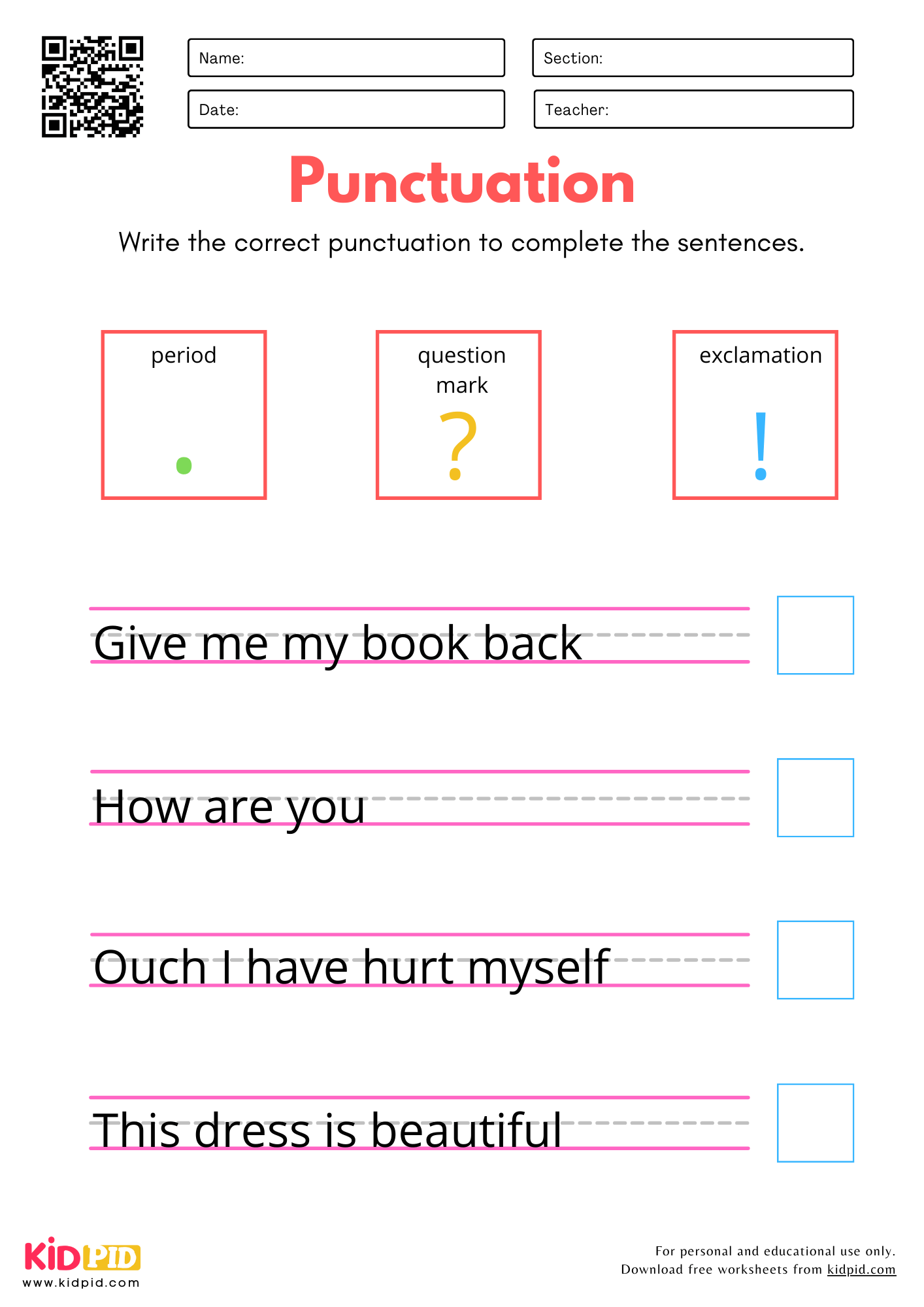
- Give me my book back!
- How are you?
- Ouch, I have hurt myself!
- The dress is beautiful.

- The ball is near the bat.
- Hurrah! We won the match.
- Put the toys in the basket.
- Do you like dolls?
Key Facts About the Punctuation Practice Worksheet
- Target Audience: Kindergarteners (ages 5 to 6) and early primary school learners.
- Core Skills Taught: Identification and manual placement of terminal punctuation marks.
- Punctuation Focus: Period / Full Stop (.), Question Mark (?), and Exclamation Point (!).
- Format: Free, downloadable, and printable high-quality PDF worksheets.
- Educational Alignment: Aligned with foundational early literacy, phonics, and introductory English grammar standards.
Parts, Types, and Examples of Punctuation
This interactive worksheet guides young learners through the three most fundamental end-of-sentence markers. Children learn to recognize sentence context to apply the correct “stop sign”:
- The Period / Full Stop (.): Used for telling sentences or statements.
- Worksheet Example: “I like to read.” or “The sun is shining.”
- The Question Mark (?): Used for asking sentences or inquiries.
- Worksheet Example: “Where is Mom?” or “Is Maya at home?”
- The Exclamation Point (!): Used for shouting sentences or expressing strong feelings like excitement, fear, or joy.
- Worksheet Example: “What a cute puppy!” or “Hurrah! We won the match.”
How Does This Punctuation Practice Worksheet Work?
The worksheet leverages visual tracking and contextual clues to transition children from simple reading to active mechanics.
- Read Aloud: A parent or teacher reads the unpunctuated sentence aloud, mimicking the natural vocal inflection (raising pitch for a question, showing excitement for an exclamation).
- Context Clue Analysis: The child identifies the intent of the sentence. Is it telling, asking, or shouting?
- The Pencil Drop: Using the empty box or space at the end of each line, the child physically writes the correct punctuation mark, bridging the gap between auditory language and written rules.
Benefits of Learning About Punctuation
Introducing punctuation in kindergarten offers massive cognitive advantages for early literacy development:
- Improves Reading Fluency: Understanding punctuation helps children know when to pause, breathe, and alter their expression, preventing monotone reading.
- Prevents Mixed Meanings: Early writers learn that “We are eating, Grandpa!” is very different from “We are eating Grandpa!” Punctuation creates safety and clarity in text.
- Builds Writing Confidence: When children master the “stop signs” of sentences, their writing structure moves from chaotic strings of words into neat, logical thoughts.
Learning Objectives
By completing these interactive practice sets, students will achieve the following milestones:
- Identify and visually distinguish between a period, a question mark, and an exclamation point.
- Differentiate between a statement, an interrogative sentence, and an exclamatory phrase based on text context.
- Demonstrate proper pencil control by drawing small, accurate punctuation symbols in designated zones.
- Apply foundational grammar rules to independent writing activities moving forward.
Worksheet Instructions for Teachers and Parents
To maximize the educational value of this printable pack, follow these simple delivery steps:
- Print in Clear Quality: Download the PDF file directly from Kidpid and print it out. A clean, physical page is highly recommended over a digital screen to practice fine motor pencil grips.
- Review the Signs: Before starting, draw a large
.,?, and!on a separate sheet. Have the child mimic the emotion or voice of each sign. - One Line at a Time: Guide the child through each sentence. Let them try to read simple sight words like “Mom”, “cat”, or “good” independently.
- Praise the Effort: Check their written symbols. If they struggle to draw a straight line or dot, model it gently next to the box.
Interesting Facts About Punctuation
Keep your young learner engaged with these fun, trivia-style breakdowns while taking breaks between exercises:
- The Invisible Space: Long ago, ancient Greeks didn’t use spaces OR punctuation marks. ALL THE WORDS WERE RUN TOGETHER LIKE THIS. It made reading incredibly slow!
- A Question of Latin: The question mark (?) originally came from the Latin word Quaestio (meaning inquiry). Scholars used to write “Qo” at the end of a sentence, which eventually morphed into the curly
?symbol we use today. - The Loudest Mark: The exclamation point used to be called the “note of admiration” and was used sparingly to show intense wonder.
Vocabulary Words
While practicing mechanics, your child will also expand their structural sight vocabulary. Key words explicitly highlighted or reinforced in this activity set include:
- Statement: A sentence that gives a fact or tells us something.
- Question: A sentence that asks for information and needs an answer.
- Exclamation: A sentence spoken with powerful emotion or high volume.
- Punctuation: The special marks we put into pieces of writing to make our meaning clear.
Real-Life Applications
Grammar rules aren’t just for school worksheets—they are used everywhere in a child’s day-to-day life:
- Storytime Trackers: When reading bedtime stories, point out when a character is shouting (
!) or asking a question (?), asking the child to mimic the character’s voice. - Street Signs and Ads: Look at billboards or store signs while driving. Spotting a big exclamation point on a “SALE!” banner shows real-world application.
- Writing Cards: When writing a simple birthday card to a friend or a thank-you note to a grandparent, encourage the child to add their own period or exclamation mark at the end of their name.
FAQs
Q1. At what age should a child start learning about punctuation symbols?
Answer: Introduction typically starts around ages 5 to 6 in Kindergarten. Children should ideally have basic letter-sound recognition and understand that sentences are read from left to right before diving deep into end marks.
Q2. My kindergarten child keeps drawing exclamation points backward or making the dot too large. Is this normal?
Answer: Absolutely. At the kindergarten level, spatial awareness and fine motor control are still developing. Reversals and oversized dots are incredibly common. Focus on the conceptual understanding first, and the physical writing precision will catch up naturally.
Q3. Should I teach commas and quotation marks to a kindergartener?
Answer: It is best to avoid overloading them early on. Master the “Big Three” first: the period, question mark, and exclamation point. Advanced tools like commas, apostrophes, and quotation marks are best saved for later first-grade and second-grade curricula once sentence boundaries are secure.

Build strong grammar foundations with this Punctuation Practice Worksheet for Kindergarten. Engaging exercises help children use basic punctuation correctly, improve sentence structure, enhance reading comprehension, and develop clear, confident writing skills. Explore fun educational content with worksheets, essays, paragraphs, flashcards, quizzes, and interactive resources for kids. Stay connected on YouTube & Facebook
The Content Team created this worksheet to promote academic learning.
Reviewed By Nausheen Fatima
Read More:



