Welcome to your Three-Letter Blends Worksheet! In this activity, you’ll practice tracing, writing, and spelling words with three-letter blends. Blends are groups of letters that come together to make a special sound. For example, “spl” in “splat” or “str” in “street.” Follow the instructions to trace each word, write it on your own, and spell it out loud. Have fun learning and improving your spelling skills!

[Scroll Down for Download Link]

Trace, Write, and Spell Three-Letter Blend Word Worksheets For Grade 3

Read More: Word Blends Printable Worksheets for Kids

‘air’ – Three Letter Blend Words
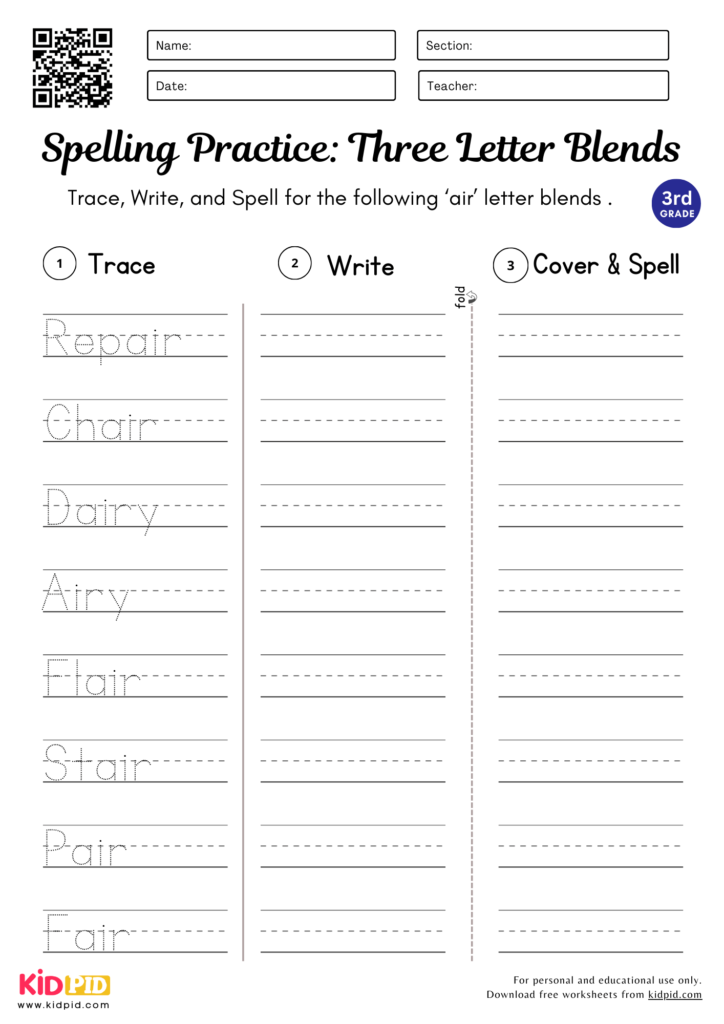
Three Letter Blends Worksheet for Grade 3

‘ear’ – Three Letter Blend Words

Three Letter Blends Worksheet for Grade 3

‘eer’ – Three Letter Blend Words

Three Letter Blends Worksheet for Grade 3

‘igh’ – Three Letter Blend Words

Three Letter Blends Worksheet for Grade 3

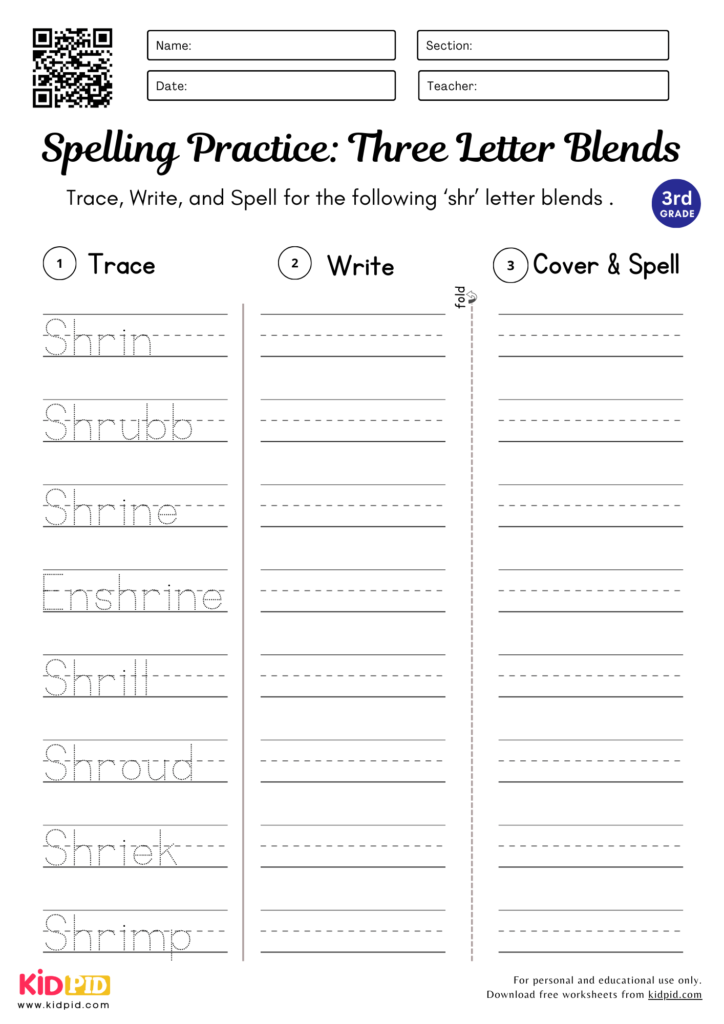
‘shr’ – Three Letter Blend Words

Three Letter Blends Worksheet for Grade 3

‘squ’ – Three Letter Blend Words

Three Letter Blends Worksheet for Grade 3

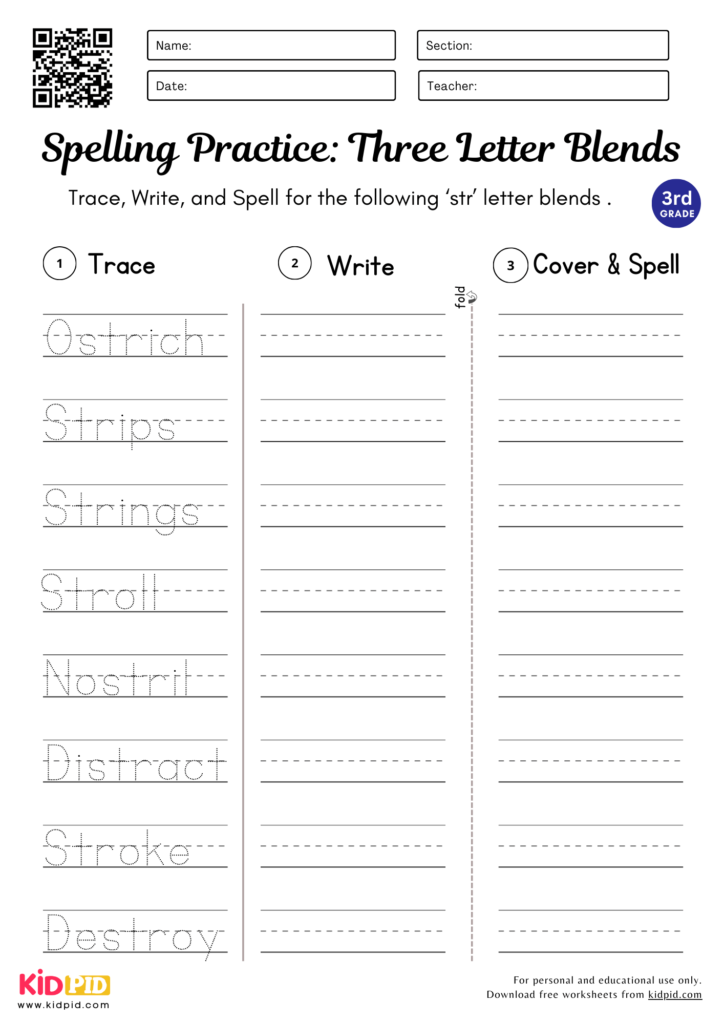
‘str’ – Three Letter Blend Words

Three Letter Blends Worksheet for Grade 3

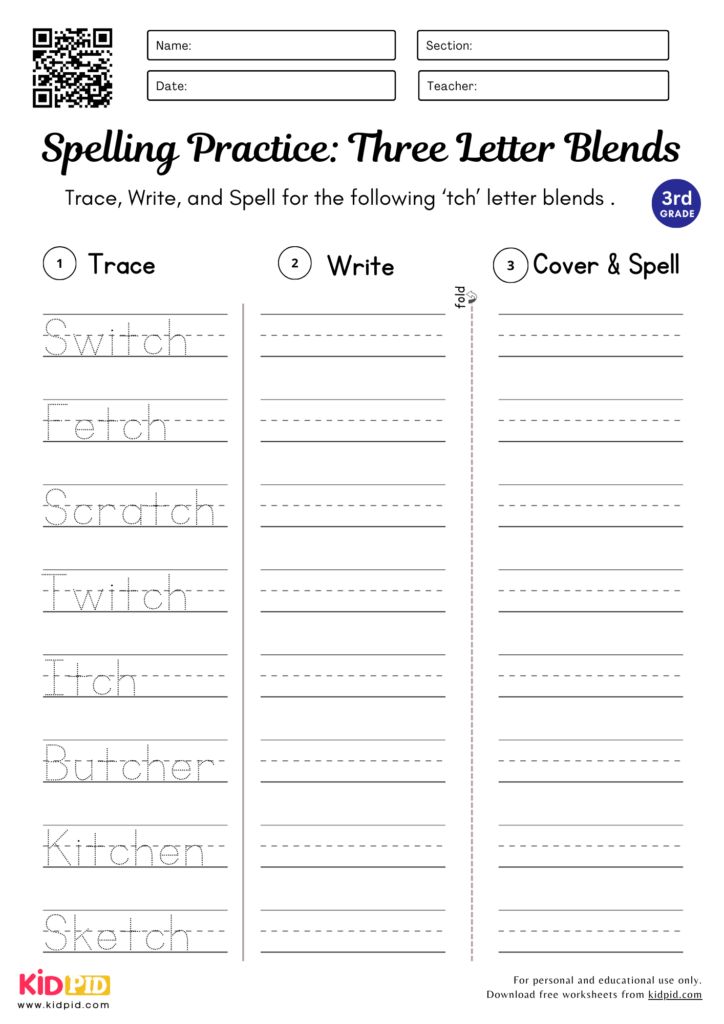
‘tch’ – Three Letter Blend Words

Three Letter Blends Worksheet for Grade 3

‘thr’ – Three Letter Blend Words

Three Letter Blends Worksheet for Grade 3

Key Facts About Three-Letter Blends Worksheets

  • Target Audience: Designed for Grade 3 students to bridge the gap between basic phonics and advanced literacy.
  • Skill Focus: Targets mastery of consonant clusters and trigraphs (three-letter combinations that create a single or blended sound).
  • Format: Employs a multisensory approach, incorporating tracing, writing, and oral spelling to reinforce muscle memory and auditory processing.
  • Curriculum Aligned: Developed by educators to align with standard English Language Arts (ELA) expectations for spelling and word recognition.

Parts, Types, and Examples of Three-Letter Blends

Three-letter blends are categorized by their sound patterns:

  • Initial Consonant Blends (Trigraphs): Appear at the beginning of words.
    • Examples: Str (street, strong), Shr (shrimp, shrug), Thr (three, throat), Squ (square, squash).
  • Ending/Vowel-Consonant Combinations: Unique letter groupings that create specific sounds within or at the end of words.
    • Examples: -air (chair, stair), -ear (bear, pear), -eer (cheer, deer), -igh (high, night), -tch (watch, patch).

How Does This Worksheet Work?

The “Trace, Write, and Spell” methodology improves literacy through four stages:

  1. Visual Recognition: Seeing the blend in the context of a word.
  2. Motor Engagement: Tracing letters to internalize physical formation.
  3. Active Production: Writing the word independently to test retention.
  4. Auditory Reinforcement: Spelling aloud to connect the phoneme (sound) to the grapheme (symbol).

Benefits of Learning Three-Letter Blends

  • Decoding Mastery: Break down multi-syllabic words quickly instead of sounding them out letter-by-letter.
  • Fluency: Reduces cognitive load, leading to smoother and faster reading.
  • Spelling Accuracy: Mastering patterns like ‘tch’ or ‘igh’ reduces common phonetic errors in writing.

Learning Objectives

  • Identify and isolate three-letter consonant blends in various positions.
  • Improve handwriting and fine motor control.
  • Demonstrate correct spelling of target trigraphs.
  • Apply phonetic knowledge to improve reading comprehension.

Worksheet Instructions

  1. Print: Download the PDF from the Kidpid platform.
  2. Trace: Follow stroke order when tracing the target blend.
  3. Write: Write the word independently in the blank space.
  4. Say: Spell the word aloud to reinforce the sound-letter connection.
  5. Review: Use sheets as a reference or for daily practice.

Interesting Facts

  • The Power of ‘Tch’: A rule used to protect the short vowel sound; it almost always follows a single vowel (e.g., watch, patch, catch).
  • The ‘Squ’ Anomaly: The ‘u’ acts as a semi-vowel, creating a distinct “skw” sound unique in English.

Real-Life Applications

  • Reading Fluency: Navigate literature and real-world text with confidence.
  • Enhanced Writing: Express ideas clearly by spelling complex words.
  • Confidence Building: Removes the “fear” of long, unfamiliar words.

FAQs

Q1. Are these suitable for struggling readers?

Answer: Yes. Breaking words into manageable parts helps build essential phonemic awareness.

Q2. How often should my child practice?

Answer: Consistency is key. One or two worksheets per week is usually sufficient.

Q3. Who created these materials?

Answer: They were developed by the Kidpid Content Team, consisting of experienced educators and curriculum researchers.

Three-letter blend activities help Grade 3 students recognize advanced sound patterns in words. These engaging worksheets improve decoding, spelling accuracy, reading fluency, vocabulary growth, and overall literacy skills with consistent practice. Discover interactive resources featuring essays, paragraphs, flashcards, quizzes, worksheets,  and interactive resources on our website. Stay connected on YouTube & Facebook.

This worksheet was developed by the Content Team to support lesson-based learning.

Reviewed By Madhulika

Read More:

About the Author

Content Team

Kidpid Content Team is a team of experienced educators, curriculum researchers, and child-focused content creators specializing in early childhood and primary education. The team develops high-quality, research-based worksheets, learning activities, and educational articles aligned with age-appropriate learning standards. Every resource is carefully reviewed to ensure accuracy, clarity, and educational value, making Kidpid a trusted platform for parents, teachers, and schools worldwide.

View All Articles