Welcome to our Four-Letter Blends Worksheet for Grade 3! This engaging worksheet is designed to help you trace, write, and spell four-letter blends. By practicing these blends, you’ll improve your reading and writing skills while having fun. Each section will guide you through tracing the blends, writing them out, and using them in words. It’s a great way to build your phonics skills and boost your confidence. Enjoy learning!

[Scroll Down for Download Link]

Trace, Write, and Spell Letter Blend Word Worksheets For Grade 3

Read More: Letter Hunt Worksheet Printables for Preschool

‘augh’ – Four Letter Blend Words
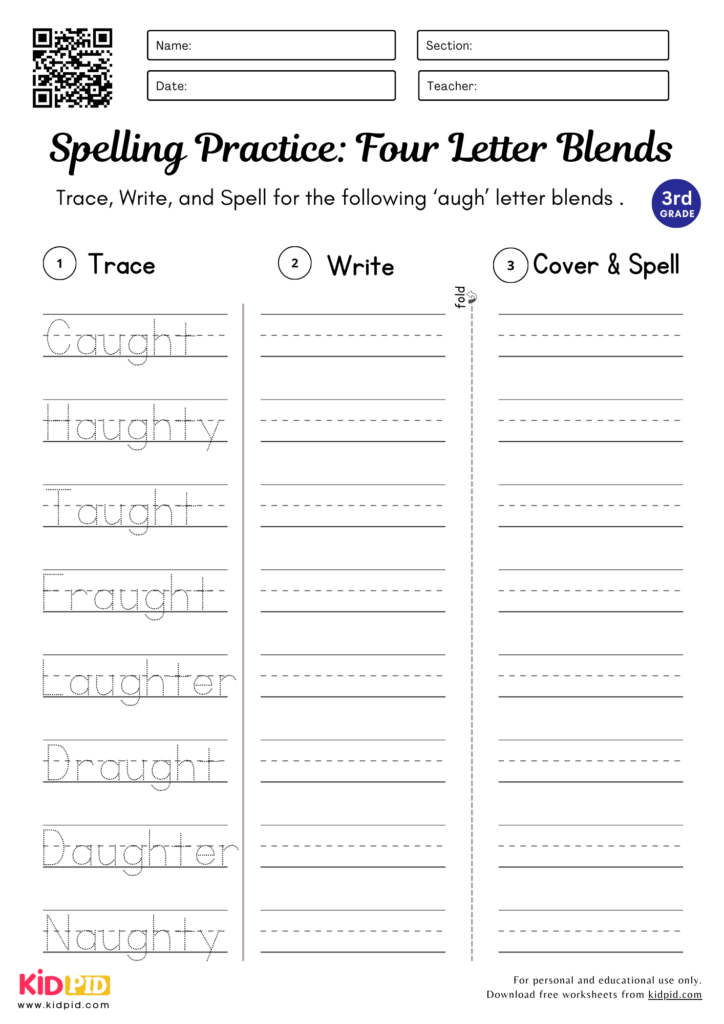
Four Letter Blends Worksheet for Grade 3

‘eigh’ – Four Letter Blend Words

Four Letter Blends Worksheet for Grade 3

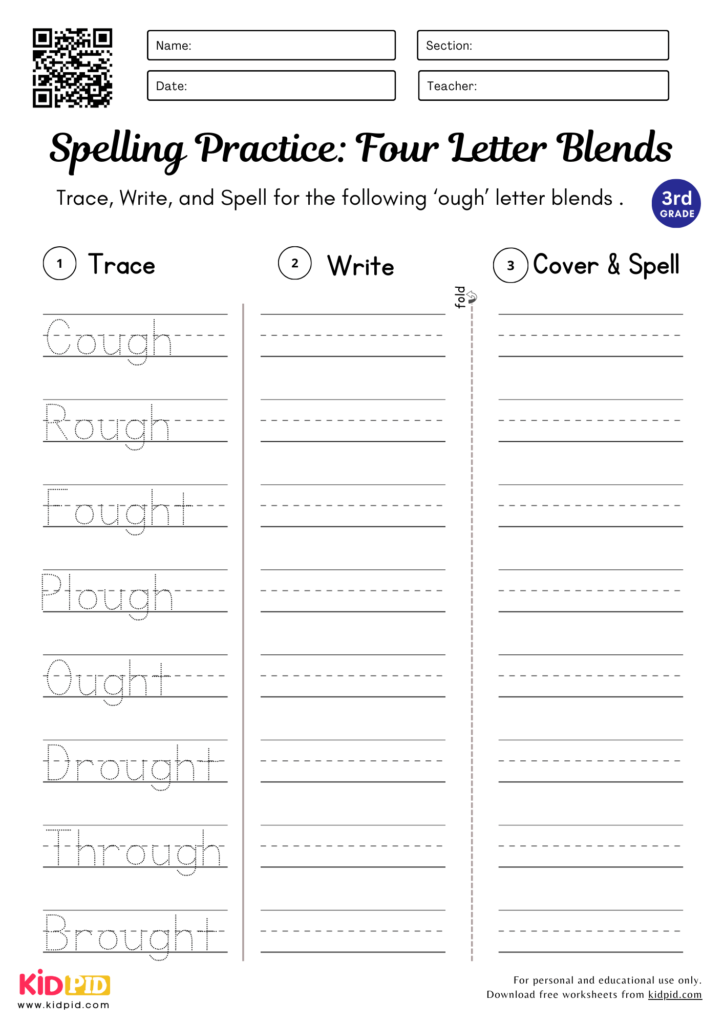
‘ough’ – Four Letter Blend Words

Four Letter Blends Worksheet for Grade 3

Key Facts About Four-Letter Blends Worksheets

  • Target Audience: Specifically designed for 3rd-grade students transitioning from basic phonics to more complex English spelling patterns.
  • Focus Areas: Targets tricky English digraphs and trigraphs, specifically focusing on “augh,” “eigh,” and “ough.”
  • Skill Development: Combines tactile learning (tracing) with cognitive reinforcement (writing and spelling).
  • Educational Goal: To bridge the gap between recognizing phonemes and applying them to complex vocabulary.

Parts/Types/Examples of Four-Letter Blends

These worksheets focus on complex clusters that often confuse learners due to their silent letters or inconsistent pronunciation.

  • ‘augh’ Blends: Found in words like caught, taught, daughter.
  • ‘eigh’ Blends: Found in words like eight, weight, neighbor.
  • ‘ough’ Blends: Highly versatile, found in words with varying sounds like though, through, thought, rough.

How Does This Worksheet Work?

The worksheet utilizes a multi-sensory approach:

  1. Visual Recognition: Students observe the specific four-letter blend pattern.
  2. Motor Skills (Tracing): Students trace the letters, which helps with muscle memory and handwriting consistency.
  3. Active Recall (Writing): Students independently write out the blends to solidify the spelling pattern.
  4. Application: The worksheet encourages using these blends within words, contextualizing the abstract sounds into recognized vocabulary.

Benefits of Learning About Four-Letter Blends

  • Improved Reading Fluency: By mastering these common, complex patterns, students spend less time “sounding out” words and more time reading with flow.
  • Enhanced Spelling Accuracy: Reduces common errors made when students try to spell complex sounds phonetically rather than by convention.
  • Confidence Building: Tackling these “harder” blends prepares students for the higher-level literacy demands of upper elementary school.

Learning Objectives

  • Objective 1: Students will identify and correctly spell words containing “augh,” “eigh,” and “ough” clusters.
  • Objective 2: Students will demonstrate improved fine motor control through handwriting exercises.
  • Objective 3: Students will apply phonics rules to enhance their reading vocabulary.

Worksheet Instructions

  1. Warm-up: Read the target blend aloud to the student, highlighting the specific sound it makes.
  2. Trace: Instruct the child to carefully trace the letters, paying attention to the stroke order.
  3. Write: Have the child copy the provided words into the designated spaces.
  4. Review: Once completed, ask the child to read the list of words back to you to check for correct pronunciation.

Interesting Facts About Four-Letter Blend Vocabulary Words

  • Inconsistent Sounds: The “ough” cluster is famous in English for having up to seven different pronunciations (e.g., rough /f/, though /oʊ/, through /uː/). Learning these in a structured worksheet helps demystify these irregularities.
  • Historical Origins: Many of these four-letter blends are vestiges of Old English spelling, which explains why the letters do not always sound like their individual parts.

Real-Life Applications

  • Daily Reading: Identifying these blends helps students recognize sight words in storybooks and textbooks faster.
  • Written Communication: Accurate usage of these blends is essential for creative writing assignments and spelling assessments in 3rd grade and beyond.
  • Decoding Unfamiliar Words: When students encounter new, long words, recognizing these common clusters allows them to break the word into manageable “chunks.”

FAQs

Q1. At what age or grade level is this worksheet most effective?

Answer: While designed for 3rd graders, it is excellent for any student (remedial or ESL) who needs extra practice with complex phonetic clusters.

Q2. Can I use this for homeschool?

Answer: Absolutely. These worksheets are designed for both classroom and home use, allowing parents to reinforce curriculum standards easily.

Q3. Why are these blends considered “four-letter” if they sometimes make one sound?

Answer: In linguistics, these are often considered digraphs or trigraphs (two or three letters making one sound), but since they occupy four letter-spaces in a word, they are categorized here as four-letter patterns to help students visualize spelling chunks.
Four-letter blend practice helps Grade 3 students decode complex words with greater confidence and accuracy. These engaging worksheets strengthen phonics, spelling, reading fluency, vocabulary development, and essential language skills through practice. Explore educational worksheets, essays, paragraphs, flashcards, quizzes, and interactive resource content on our website. Follow us on YouTube & Facebook.

The Content Team prepared this worksheet to promote academic engagement.

Reviewed By Mahak Agarwal

Read More:

About the Author

Content Team

Kidpid Content Team is a team of experienced educators, curriculum researchers, and child-focused content creators specializing in early childhood and primary education. The team develops high-quality, research-based worksheets, learning activities, and educational articles aligned with age-appropriate learning standards. Every resource is carefully reviewed to ensure accuracy, clarity, and educational value, making Kidpid a trusted platform for parents, teachers, and schools worldwide.

View All Articles