
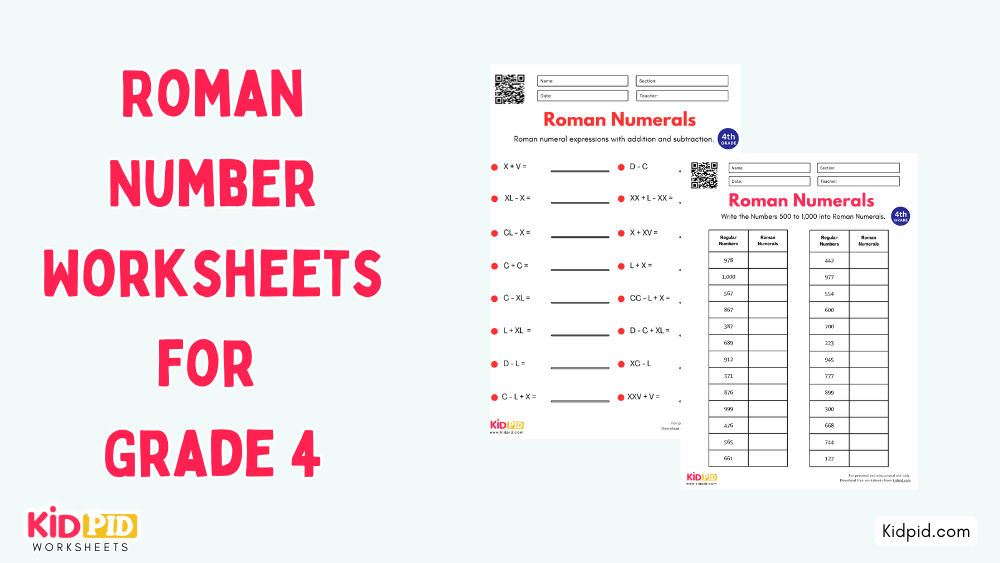
Roman numerals are ancient numbers that were used to represent numbers by ancient Rome. The main aim of this worksheet is to introduce the concept of Roman numerals, which will help kids to learn how numbers are represented differently, and this worksheet will also help them with their school projects and homework. Below, we have a different Roman numerical exercise which is especially designed for 4th-grade kids. So, kids, be ready to learn our new concept. We hope this will encourage your math skills.
Contents
- Learn Roman Number Worksheets For Grade 4
- Roman Numbers From 1 to 500 Into Regular Number Worksheets For Grade 4
- Roman Numbers From 500 to 1,000 Into Regular Number Worksheets For Grade 4
- Numbers From 1 to 500 Into Roman Numerals Worksheets For Grade 4
- Numbers 500 to 1,000 into Roman Numerals Worksheets For Grade 4
- Roman Numerals by Addition And Subtraction Worksheets For Grade 4
- Key Facts About Roman Number Worksheets for Grade 4
- Parts, Types, and Examples of Roman Number Worksheets
- How Do These Worksheets Work?
- Benefits of Learning About Roman Number Worksheets
- Learning Objectives
- Worksheet Instructions
- Interesting Facts About Roman Numerals
- Vocabulary Words
- Real-Life Applications
- FAQs
Learn Roman Number Worksheets For Grade 4
Read More: Comparing Numbers up to 1 Million Worksheet For Grade 4
Roman Numbers From 1 to 500 Into Regular Number Worksheets For Grade 4

- LIII = 53
- CIV = 104
- CXLVII = 147
- CCXXIII = 223
- CCCLXXXV = 385
- CDXLV = 445
- D = 500
- XL = 40
- V = 5
- LXVII = 67
- CXXXII = 132
- CLXV = 165
- CLXXXVI = 186
- CCLXXIX = 279
- CCCXXXIV = 334
- CCCLIV = 354
- CDXCI = 491
- LXV = 65
- LXXXI = 81
- XCIV = 94
- CXXXVI = 136
- CCCLXXXIV = 384
- CDXI = 411
- CDXXXVII = 437
- CDXLVII = 447
- CCCXXVII = 327
In this exercise, we have to write Roman numerical numbers in regular form. Above, we have a total of twenty-seven exercises, and for each, we have to identify Roman numbers and then write them into regular form. Some basic Roman numerals help you to solve this exercise: L = 50, C = 100, D = 500, M = 1000. If you want more details, we have a Roam numerical worksheet for grades 4th to 6th, so you can check our website. Let’s solve an example: LIII. As we see, L stands for 50 and III for 3, so the final regular number will be 53.
Roman Numbers From 500 to 1,000 Into Regular Number Worksheets For Grade 4

- D = 500
- DVI = 506
- DLX = 560
- DCC = 700
- DCCCXII = 812
- DCCCXXXII = 832
- DCCCXLVII = 847
- DCCCXLIX = 849
- DCCCXLVI = 846
- CM = 900
- CMI = 901
- CMX = 910
- CMXX = 920
- DCCCXLVIII = 848
- DCCCXLV = 845
- DCCCXLII = 842
- DCCCXL = 840
- DCCCXXXV = 835
- CMXVIII = 918
- CMXVII = 917
- CMXVI = 916
- CMXCV = 995
- CMXCIV = 994
- CMXLVII = 947
- CMXL = 940
- CMXXXV = 935
👉 Download free Ordinal number worksheets
Now the numbers are a little bit higher, but we believe that if we know the process, we can solve any range of numbers. Above, there are a total of twenty-six exercise that needs to be performed. This worksheet introduces a new and fresh concept that was used in our ancient times, so it will help them to understand our history and culture. We want kids to perform this exercise without any help. To solve this, kids need to follow the same instructions given above. If kids face any problem, they can see the solved example.
Numbers From 1 to 500 Into Roman Numerals Worksheets For Grade 4

- 450 = CDL
- 256 = CCLVI
- 453 = CDLIII
- 123 = CXXIII
- 223 = CCXXIII
- 500 = D
- 232 = CCXXXII
- 333 = CCCXXXIII
- 477 = CDLXXVII
- 124 = CXXIV
- 398 = CCCXCVIII
- 487 = CDLXXXVII
- 121 = CXXI
- 60 = LX
- 198 = CXCVIII
- 444 = CDXLIV
- 100 = C
- 99 = XCIX
- 49 = XLIX
- 78 = LXXVIII
- 90 = XC
- 298 = CCXCVIII
- 376 = CCCLXXVI
- 478 = CDLXXVIII
- 456 = CDLVI
- 231 = CCXXXI
In this exercise, we have to do the opposite of what we have done so far. We have to write numbers from one to five hundred in Roman form. Above in the table, we have a total of twenty-six exercises, and for each, we need to write down their Roman numbers. It will help kids to improve their number sense and improve their math skills. Clocks, books (chapters or volumes), and certain architecture all use Roman numbers. Kids who learn them are better able to read and recognize these numbers in everyday situations.
Numbers 500 to 1,000 into Roman Numerals Worksheets For Grade 4

- 978 = CMLXXVIII
- 1,000 = M
- 567 = DLXVII
- 867 = DCCCLXVII
- 387 = CCCLXXXVII
- 689 = DCLXXXIX
- 912 = CMXII
- 371 = CCCLXXI
- 876 = DCCCLXXVI
- 999 = CMXCIX
- 476 = CDLXXVI
- 565 = DLXV
- 661 = DCLXI
- 442 = CDXLII
- 977 = CMLXXVII
- 554 = DLIV
- 600 = DC
- 700 = DCC
- 223 = CCXXIII
- 945 = CMXLV
- 777 = DCCLXXVII
- 899 = DCCCXCIX
- 300 = CCC
- 668 = DCLXVIII
- 744 = DCCXLIV
- 122 = CXXII
Kids can learn quicker if Roman numerals are mixed with enjoyable activities like puzzle solving or reading clock faces! In this exercise, we write the numbers from 500 to 1000 in Roman numeral form. At this stage, we believe kids have understood our concept, and they can handle this exercise. We want kids to perform this without any help. It will build their confidence in solving math.
Roman Numerals by Addition And Subtraction Worksheets For Grade 4

- X + V = 15
- XL – X = 30
- CL – X = 140
- C + C = 200
- C – XL = 60
- L + XL = 90
- D – L = 450
- C – L + X = 60
- D – C = 400
- XX + L – XX = 50
- X + XV = 25
- L + X = 60
- CC – L + X = 160
- D – C + XL = 440
- XC – L = 40
- XXV + V = 30
By solving this exercise, kids will improve their problem-solving skills, and their arithmetic and problem-solving abilities will be improved as they convert between Roman numerals and current numbers using basic mathematical operations like addition and subtraction. In this exercise, kids need to perform basic addition and subtraction. They need to write down the resulting number in a regular form. So we hope kids will perform this quickly.
Key Facts About Roman Number Worksheets for Grade 4
- Historical Foundation: These worksheets bridge the gap between modern arithmetic and the ancient numeral system used by the Roman Empire.
- Skill Alignment: Specifically curated for Grade 4 curriculum standards, focusing on numbers ranging from 1 to 1,000.
- Dual-Directional Learning: Exercises cover both converting Roman numerals to Hindu-Arabic (regular) numbers and vice versa.
- Operational Proficiency: Includes advanced practice in solving arithmetic equations (addition and subtraction) using Roman numeral notation.
Parts, Types, and Examples of Roman Number Worksheets
These worksheets are categorized by the specific mathematical challenge they address:- Conversion (1–500): Focuses on foundational symbols (I, V, X, L, C). Example: Converting CXLVII to 147.
- Advanced Conversion (500–1,000): Introduces larger symbols (D, M) and more complex string patterns. Example: Converting CMXVIII to 918.
- Arithmetic Operations: Challenges students to perform addition and subtraction directly within the Roman system. Example: XC – L = 40.
How Do These Worksheets Work?
The worksheets utilize a structured, scaffolding approach. Students begin by identifying the value of individual symbols (e.g., L=50, C=100) and then learn the additive and subtractive rules required to form larger numbers. Each exercise is designed to be self-guided, encouraging students to reference a key or provided examples to solve problems independently, which fosters self-reliance and cognitive retention.Benefits of Learning About Roman Number Worksheets
- Cognitive Flexibility: Learning a secondary numeral system forces the brain to think outside the standard base-10 structure, enhancing mental flexibility.
- Historical Literacy: Provides cultural context on how history and architecture (such as clock faces, dates on monuments, and book chapters) are documented.
- Arithmetic Strengthening: By performing basic math with different symbols, students gain a deeper, conceptual understanding of addition and subtraction rather than relying solely on rote memorization.
Learning Objectives
By completing these worksheets, students will:- Master the recognition and writing of Roman numerals up to 1,000.
- Understand the subtractive rule (e.g., why IV represents 4).
- Develop the ability to translate between Roman and Hindu-Arabic numeral systems accurately.
- Apply Roman numerals to solve simple algebraic addition and subtraction problems.
Worksheet Instructions
- Review the Key: Familiarize yourself with the basic values: I=1, V=5, X=10, L=50, C=100, D=500, M=1000.
- Analyze Patterns: If a smaller value precedes a larger one, subtract it; if it follows, add it.
- Step-by-Step Execution: For each exercise, break the number down into its parts before combining them.
- Self-Check: Review your answers against the provided examples to identify potential errors in rule application.
Interesting Facts About Roman Numerals
- Zero Absence: The Roman system did not originally have a symbol for zero, which makes it distinct from our modern decimal system.
- Architectural Legacy: Roman numerals were the standard for European record-keeping for over a thousand years, which is why we still see them on old buildings and historical manuscripts.
- The “4” Rule: While we usually write 4 as “IV,” ancient stone carvers sometimes used “IIII” to avoid confusion with “VI.”
Vocabulary Words
- Numeral: A symbol or figure used to represent a number.
- Hindu-Arabic System: The base-10 number system used universally today (0, 1, 2, 3…).
- Additive Principle: Adding values together to reach a total (e.g., VI = 5+1).
- Subtractive Principle: Placing a smaller value before a larger one to decrease it (e.g., IV = 5-1).
Real-Life Applications
- Timekeeping: Reading traditional analog clock faces.
- Literary/Formal Documentation: Understanding chapter numbering in books, Super Bowl editions, or historical event dates.
- Architecture: Identifying dates inscribed on historic buildings, cornerstones, and statues.
FAQs
Q1. At what age should kids start learning Roman numerals?
Answer: Typically, students are introduced to Roman numerals in Grade 4, as they have developed the arithmetic foundation required to understand the system’s rules.
Q2. Are these worksheets aligned with Common Core standards?
Answer: Yes, they are designed to support primary curriculum requirements regarding number sense and historical math concepts.
Q3. Can these worksheets be used for classroom group work?
Answer: Absolutely. They serve as excellent material for individual homework, group practice, or as a supplement for students requiring advanced challenges in number theory.
Build confidence with Roman numerals using Roman Number Worksheets for Grade 4. These engaging activities improve numeral recognition, conversion skills, number understanding, and mathematical accuracy while making learning enjoyable and effective. Find printable classroom resources that encourage creativity and learning, including paragraphs, quizzes, worksheets, essays, flashcards, and interactive resources. Follow us on Telegram, YouTube, & Facebook.
This educational worksheet is produced by our Content Team for learning support.
Reviewed By Sushmita
Read More: