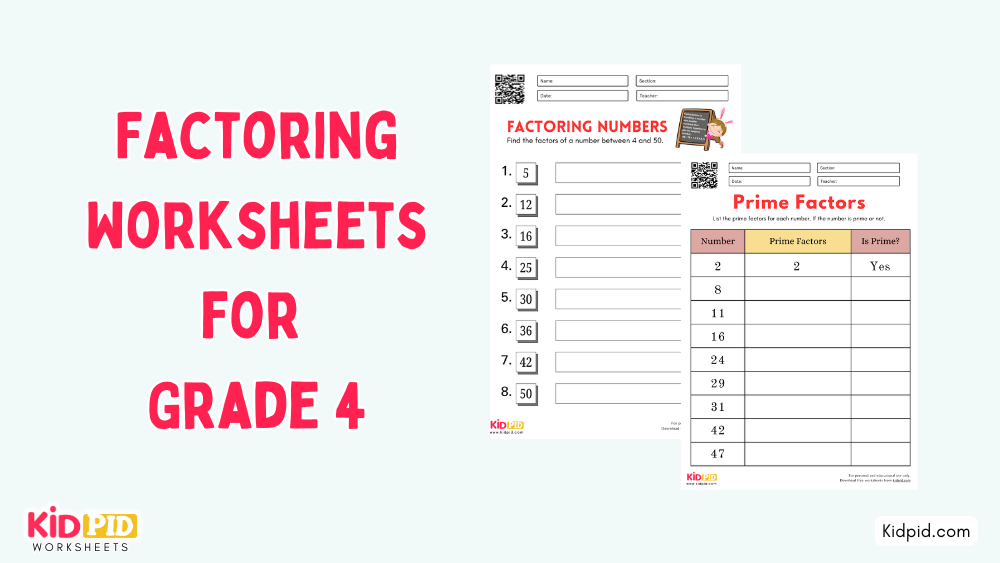
This factoring worksheet is designed for fourth-grade students. The purpose of this worksheet is to introduce the concept of factors, which will help kids expand their knowledge in mathematics. So, kids, let’s understand factors. Factoring is a type of process where we break down numbers into smaller parts, and the parts should give the same number when we multiply all of them together. We hope this worksheet will grab kids’ attention and increase their interest in solving math.
Contents
- Factoring Number Worksheets For Grade 4
- Factoring Numbers Between 4 and 50 Worksheet For Grade 4
- Factoring Numbers Between 50 to 100 Worksheet For Grade 4
- Prime Factor Tree Worksheets For Grade 4
- Prime Numbers 2 to 50 Worksheets For Grade 4
- Prime Numbers 50 to 100 Worksheets For Grade 4
- Divisibility Rules Math Worksheet For Grade 4
- Multiples Of Whole Numbers (2 – 20) Worksheets For Grade 4
- Key Facts About Factoring Worksheets for Grade 4
- Parts, Types, and Examples
- How Does Factoring Work?
- Benefits of Learning About Factoring
- Learning Objectives
- Worksheet Instructions
- Vocabulary Words
- Real-Life Applications
- FAQs
Factoring Number Worksheets For Grade 4
Read More: Math Expanded Form Worksheets for Grade 4
Factoring Numbers Between 4 and 50 Worksheet For Grade 4
 1. 5 ->1,5 2. 12 ->1, 2, 3, 4, 6, 12 3 . 16 -> 1, 2, 4, 8, 16 4. 25 ->1, 5, 25 5. 30 ->1, 2, 3, 5, 6, 10, 15, 30 6 . 36-> 1, 2, 3, 4, 6, 9, 12, 18, 36 7 . 42->1, 2, 3, 6, 7, 14, 21, 42 8. 50-> 1, 2, 5, 10, 25, 50 In this exercise, we have to find factors of a number between four to fifty. Above, there are a total of eight queries, and for each, we need to follow a basic rule. First, we have to break a number into smaller parts and remember that when we are calculating all parts, we should get the same number. Like 5 -> 1,5. When we calculate both (1×5), we get the same number. Let’s take an example: 12 – As per the rule, the factors will be 1, 2, 3, 4, 6, 12. You can check if the factor is correct or not by multiplying all the parts: 1 x 12 = 12, 2 x 6 = 12, 3 x 4 = 12, 4 x 3 = 12, 6 x 2 = 12, 12 x 1 = 12.
Factoring Numbers Between 50 to 100 Worksheet For Grade 4
 1. 52 -> 1, 2, 4, 13, 26, 52 2. 58 ->1, 2, 29, 58 3. 64 -> 1, 2, 4, 8, 16, 32, 64 4. 69 -> 1, 3, 23, 69 5. 74 -> 1, 2, 37, 74 6. 80 -> 1, 2, 4, 5, 8, 10, 16, 20, 40, 80 7. 95 -> 1, 5, 19, 95 8. 100 -> 1, 2, 4, 5, 10, 20, 25, 50, 100 In this exercise the numbers are higher, we have to find out the factors of a number between fifty to hundred. Children don’t have to worry about it; we have done the above exercise, and this exercise will also be performed in the same manner. We believe that the kids have solved all the above queries, and now they are ready to handle this exercise. If kids solve this exercise, it means that they have understood the first step of our factoring worksheet.
Prime Factor Tree Worksheets For Grade 4
 In this exercise, kids will learn how factorial numbers are represented by a graph. A prime factor tree is a simple graph that is used to represent the factorial of a number. Above, we have a total of six queries, and in each, we have two empty circles, and we need to fill the circles by breaking the number into smaller parts. Remember that the parts should be equal when we are multiplying. For example: 14. We can divide 14 into two smaller parts, which are 2 and 7. When we calculate 7×2 = 14, we get the same number, which means we have got the correct smaller part. We would be very happy if kids performed this exercise on their own. It is a simple exercise, and it helps them to understand the pictorial representation of a number.
Prime Numbers 2 to 50 Worksheets For Grade 4
 1. 2
1. 2
-
- prime factor:- 2
- is prime? – Yes
2. 8
-
- prime factor:- 2 x 2 x 2
- is prime? – No
3. 11
-
- prime factors: 11
- is prime? – Yes
4. 16
-
- prime factor:-2 x 2 x 2 x 2
- is prime? – No
5. 24
-
- prime factor:- 2 x 2 x 2 x 3
- is prime? – No
6. 29
-
- prime factor:-29
- is prime? – Yes
7. 31
-
- prime factors: 31
- is prime? – Yes
8. 42
-
- prime factor:- 2 x 3 x 7
- is prime? – No
9. 47
-
- prime factors: 47
- is prime? – Yes
This exercise introduces a new concept where kids will learn about prime numbers. A prime number is nothing but a number bigger than one, and they don’t have any divisors except one or itself. Above, we have a total of nine queries, and for each, we need to identify whether the number is prime or not. To solve this, we only have to check whether the number is divisible by two or not; if yes, then the number is not prime; if no, then the number is prime. It is a simple exercise, and we hope kids will solve this without any help.
Prime Numbers 50 to 100 Worksheets For Grade 4
 1. 53
1. 53
-
- Prime factor: 53
- is prime? – Yes
2. 58
-
- prime factor:- 2 x 29
- is prime? – No
3. 65
-
- prime factor:- 5 x 13
- is prime? – No
4. 67
-
- prime factor:-67
- is prime? – Yes
5. 74
-
- prime factor:- 2 x 37
- is prime? – No
6. 76
-
- prime factor:–2 x 2 x 19
- is prime? – No
7. 83
-
- prime factors 83
- is prime? – Yes
8. 90
-
- prime factor:- 2 x 3 x 3 x 5
- is prime? – No
9. 97
-
- prime factors 97
- is prime? – Yes
Now the numbers are higher than the previous ones, but we believe nothing is impossible if we decide to do something. Above, we have a higher number range starting from fifty to a hundred. This exercise should be performed quickly; the process will be the same. We only have to check whether the number is divisible by two or not. If the number is divisible, that means the number is not a prime, and if not, that means the number is prime.
Divisibility Rules Math Worksheet For Grade 4

- 2 -> A number is divisible by 2 if the last digit is 0, 2, 4, 6, or 8. Example: 248 is divisible by 2 because the last digit is 8.
- 3 ->A number is divisible by 3 if the sum of its digits is divisible by 3. Example: 381 is divisible by 3 because 3+8+1=12, and 12 is divisible by 3.
- 5 ->A number is divisible by 5 if the last digit is 0 or 5. Example: 35 is divisible by 5 because the last digit is 5.
- 9 ->A number is divisible by 9 if the sum of its digits is divisible by 9. Example: 378 is divisible by 9 because 3+7+8=18, and 18 is divisible by 9.
- 10 ->A number is divisible by 10 if the last digit is 0. Example: e.g. 60, 110, 850
 In this exercise, kids need to check whether the number is divisible or not. If yes, then make a correct sign; if no, then mark the wrong sign. To solve this exercise, we need to follow the above rules. First, you have to write down the rules in the above empty box, and as per the rules, we have to solve this exercise. It is a simple exercise that helps kids improve their number sense. We will be happy to know if the kids solve this without any help.
Multiples Of Whole Numbers (2 – 20) Worksheets For Grade 4

- 2-> 4, 6, 8, 10, 12
- 6-> 12, 18, 24, 30, 36
- 8->16, 24, 32, 40, 48
- 12-> 24, 36, 48, 60, 72
- 15-> 30, 45, 60, 75, 90
- 17->34, 51, 68, 85, 102
- 20-> 40, 60, 80, 100, 120
In this exercise, we have to write down the first five multiples for each number. It is a simple exercise that improves kids’ mathematical skills and encourages their confidence to handle more complex problems. Above, we have a total of seven exercises, and for each, we have five empty boxes that need to be filled. We hope that at this stage, kids have understood our concept and can handle this exercise.
Key Facts About Factoring Worksheets for Grade 4
- Target Level: Specifically designed for 4th-grade curriculum standards, focusing on foundational number sense.
- Conceptual Focus: Transitions students from basic multiplication to understanding the relationship between numbers and their divisors.
- Skill Progression: The worksheets build linearly, starting from basic factors of small numbers (4–50) and advancing to complex prime factorization.
- Tooling: Includes visual aids like Prime Factor Trees to support varied learning styles.
- Aligned Standards: Integrates divisibility rules and multiple identification, which are critical precursors to fraction work and algebraic thinking.
Parts, Types, and Examples
Factoring worksheets utilize several distinct types of exercises to ensure comprehensive understanding:- Standard Factoring: Breaking down integers into all possible divisors (e.g., for 12, identifying 1, 2, 3, 4, 6, 12).
- Prime Factorization: Determining the prime numbers that multiply together to reach a target number (e.g., 14 = 2 x 7).
- Prime Factor Trees: A visual, branching graph method used to map out the prime factors of a composite number.
- Divisibility Rule Exercises: Targeted drills that teach shortcuts for identifying factors (e.g., knowing a number is divisible by 5 if it ends in 0 or 5).
- Multiples Tables: Practice in identifying the first five multiples of numbers 2–20 to solidify the “reverse” concept of factoring.
How Does Factoring Work?
Factoring is the mathematical process of decomposing a composite number into its parts. When you multiply these parts together, you return to the original number. For 4th graders, this process serves as a “reverse multiplication” exercise. By using these worksheets, students verify their work through the identity: Factor A × Factor B = Original Product. This process demystifies numbers, helping students see them not just as static values, but as products of smaller building blocks.Benefits of Learning About Factoring
- Enhanced Number Sense: Students gain a deeper intuition regarding how numbers interact and combine.
- Preparation for Advanced Math: Mastery of factors is essential for later work in simplifying fractions, finding common denominators, and performing algebraic division.
- Improved Calculation Speed: Familiarity with divisibility rules significantly reduces the time spent on mental math.
- Problem-Solving Confidence: Breaking large, intimidating numbers into smaller, manageable parts boosts a student’s confidence when approaching complex math word problems.
Learning Objectives
By completing these worksheets, students will:- Define and distinguish between prime and composite numbers.
- List all factor pairs for integers between 4 and 100.
- Construct Prime Factor Trees to visualize the components of numbers.
- Apply divisibility rules (for 2, 3, 5, 9, and 10) to identify factors quickly.
- Generate a list of multiples for numbers 2 through 20.
Worksheet Instructions
For optimal learning, follow this sequential approach:- Review the Rules: Always begin by refreshing knowledge of divisibility rules provided in the worksheet header.
- Start with Smaller Numbers: Complete the 4–50 range first to build procedural memory.
- Use Visuals: When working on Prime Factor Trees, draw your branches clearly to ensure no factors are missed.
- Verification: Always multiply your found factors back together to ensure they equal the original number. If they don’t, re-check your divisors.
Vocabulary Words
- Factor: A number that divides another number exactly, leaving no remainder.
- Prime Number: A whole number greater than 1 whose only factors are 1 and itself.
- Composite Number: A positive integer greater than 1 that has more than two factors.
- Divisibility: The ability of a number to be divided by another without leaving a remainder.
- Multiple: The product of a given number and any other whole number.
Real-Life Applications
- Time Management: Understanding factors helps in dividing time into smaller, equal blocks for schedules or tasks.
- Financial Literacy: Recognizing factors is useful when grouping money or calculating discounts/splits.
- Measurement & Cooking: Dividing ingredients or measuring supplies often requires identifying factors to adjust recipes for different serving sizes.
- Design & Organization: Factors are used to arrange objects in equal rows and columns (e.g., how to arrange 24 chairs in a room).
FAQs
Q1. Why is factoring important in 4th grade?
Answer: It lays the foundation for understanding fractions and is necessary for simplifying math expressions in later grades.
Q2. How can I tell if a number is prime?
Answer: A prime number cannot be divided evenly by any number other than 1 and itself. Use the divisibility rules provided in our worksheet to check for small divisors first.
Q3. Are these worksheets suitable for daily practice?
Answer: Yes, daily practice with factoring improves mental math speed and strengthens number recognition.
Q4. How do Prime Factor Trees help?
Answer: They provide a visual way to “break” a number down into its simplest prime components, making abstract math concepts concrete and easier to track.
Strengthen mathematical foundations with Factoring Worksheets for Grade 4. Students practice finding factors, improve number sense, enhance logical thinking, and develop essential problem-solving skills through engaging and effective exercises. Explore educational printables for every subject with quizzes, worksheets, essays, flashcards, paragraphs, and interactive resources and classroom activities. Connect with us on Facebook, YouTube, Pinterest& Telegram.
Created by our Content Team, this worksheet aids student education.
Reviewed By Swati
Read More: