


Understanding fractions, decimals, and percentages is essential for mastering math concepts. This worksheet will help you practice arranging these numbers in ascending order, improving your skills in comparing and ordering different forms of numerical representation. By completing these exercises, you’ll build a strong foundation for tackling more advanced math problems. Let’s get started!
[Scroll Down for Download Link]
Contents
- Arrange Fractions, Decimals, and Percentages In Ascending Order
- Key Facts About Arranging Fractions, Decimals Worksheet
- Parts/Types/Examples of Arranging Fractions, Decimals
- How Does the Arrange Fractions, Decimals Worksheet Work?
- Benefits of Learning About Arranging Fractions and Decimals
- Learning Objectives
- Worksheet Instructions
- Interesting Facts About Fractions, Decimals, and Percentages
- Vocabulary Words
- Real-Life Applications
- FAQs
- Q1. What is the purpose of this worksheet?
- Q2. Why should students learn equivalent forms of numbers?
- Q3. What is the easiest way to compare fractions, decimals, and percentages?
- Q4. At what grade level is this worksheet appropriate?
- Q5. How do these skills help in real life?
- Q6. Can this worksheet improve problem-solving skills?
- Q7. How often should students practice these concepts?
Arrange Fractions, Decimals, and Percentages In Ascending Order
Read More: Apostrophes Printable Worksheets for Grade 2
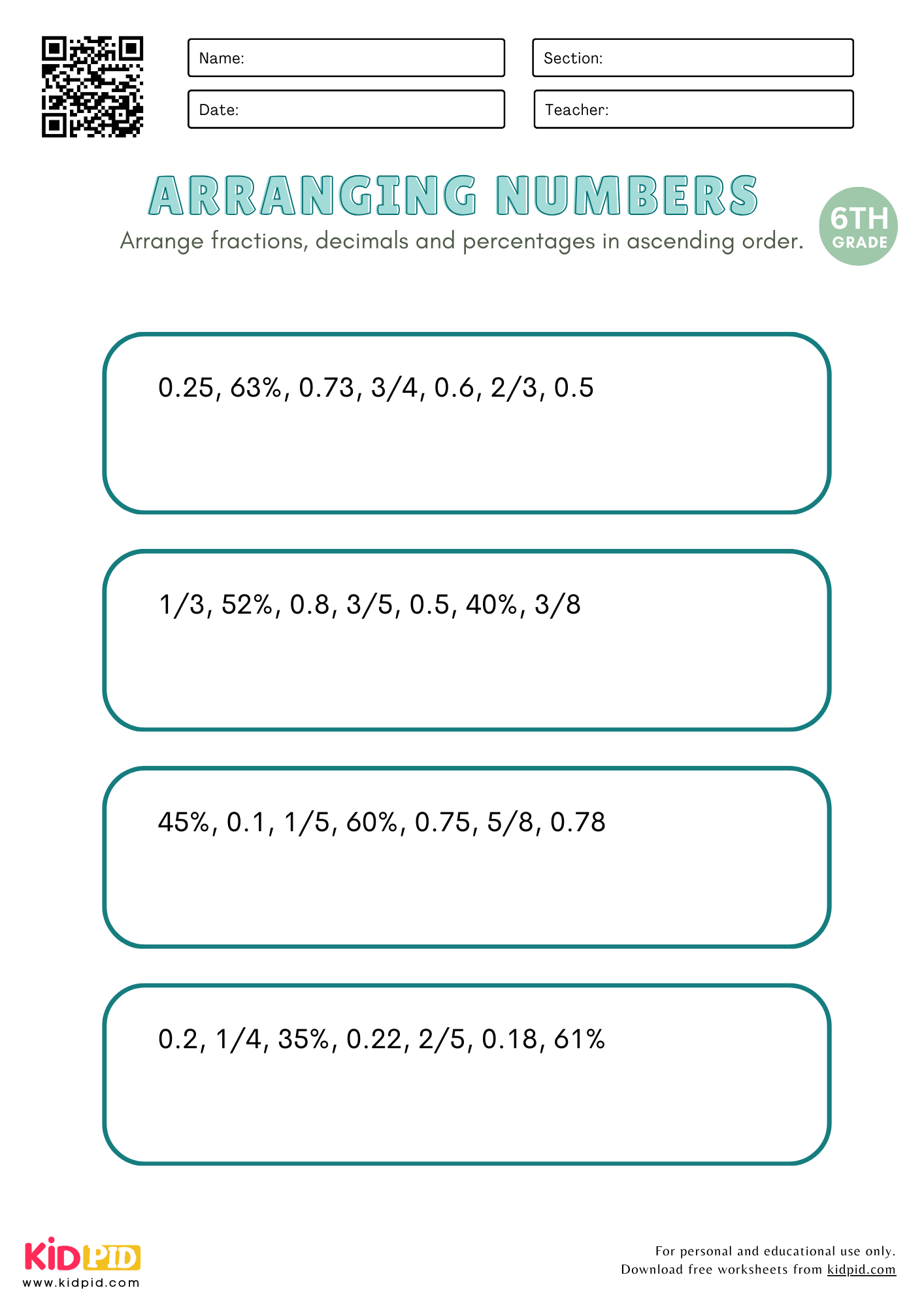
- 0.25, 63%, 0.73, 3/4, 0.6, 2/3, 0.5
= 0.25, 0.5, 0.6, 63%, 2/3, 0.73, 3/4 - 1/3, 52%, 0.8, 3/5, 0.5, 40%, 3/8
= 1/3, 3/8, 40%, 52%, 3/5, 0.8 - 45%, 0.1, 1/5, 60%, 0.75, 5/8, 0.78
= 0.1, 1/5, 45%, 60%, 5/8, 0.75, 0.78 - 0.2, 1/4, 35%, 0.22, 2/5, 0.18, 61%
= 0.18, 0.2, 0.22, 1/4, 35%, 2/5, 61%
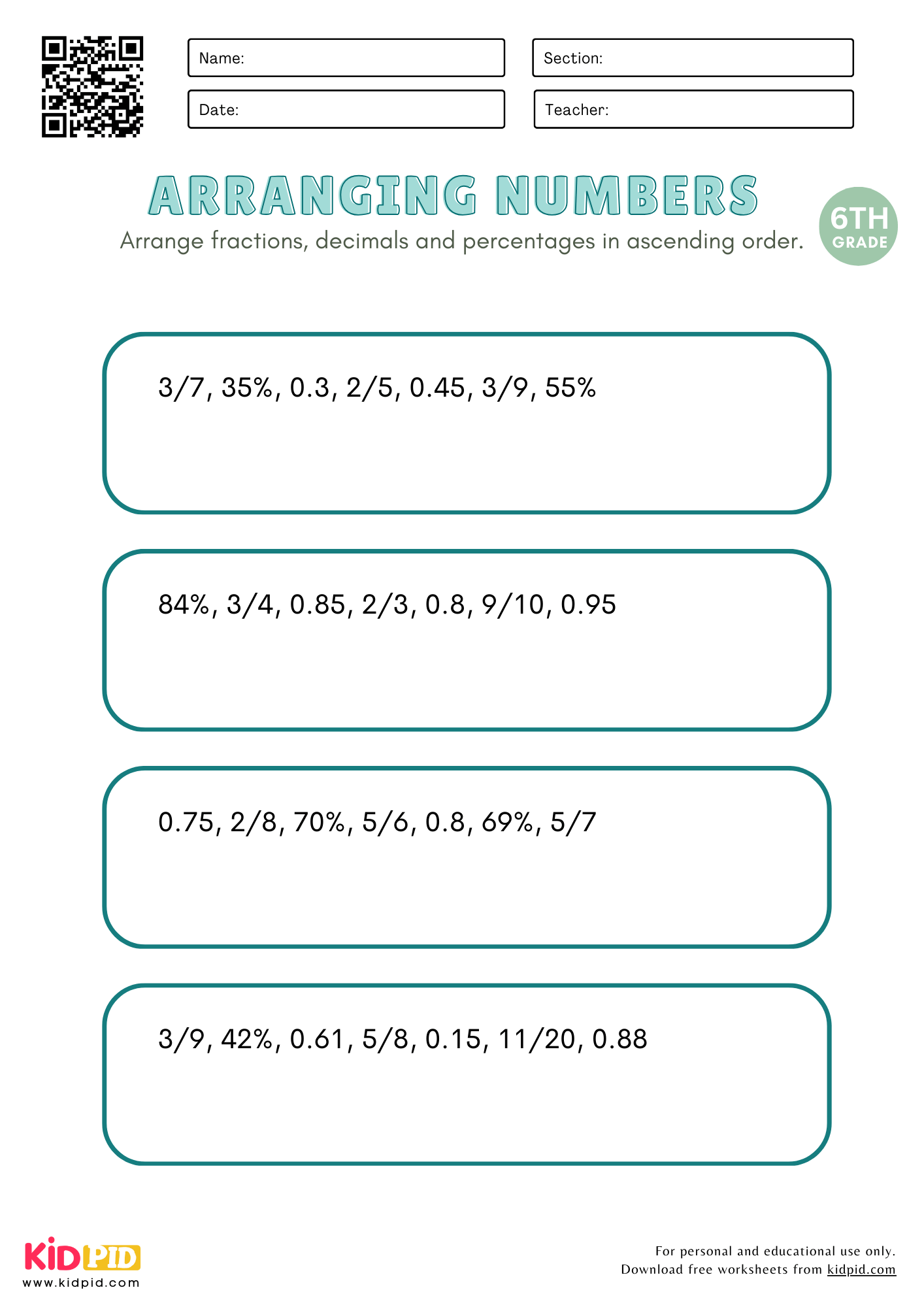
- 3/7, 35%, 0.3, 2/5, 0.45, 3/9, 55%
= 0.3, 3/9, 35%, 2/5, 3/7, 0.45, 55% - 84%, 3/4, 0.85, 2/3, 0.8, 9/10, 0.95
= 2/3, 3/4, 0.8, 84%, 0.85, 9/10, 0.95 - 0.75, 2/8, 70%, 5/6, 0.8, 69%, 5/7
= 2/8, 69%, 70%, 5/7, 0.75, 0.8, 5/6 - 3/9, 42%, 0.61, 5/8, 0.15, 11/20, 0.88
= 0.15, 3/9, 42%, 11/20, 0.61, 5/8, 0.88
Key Facts About Arranging Fractions, Decimals Worksheet
The Arrange Fractions, Decimals, and Percentages Worksheet for Grade 6 helps students compare and organize different forms of numbers. Learners practice converting fractions into decimals and percentages, then arrange them in ascending or descending order. This activity strengthens number sense, improves mathematical reasoning, and builds confidence in handling equivalent values. The worksheet aligns with Grade 6 curriculum standards and supports foundational skills needed for algebra, statistics, and real-world calculations.
Parts/Types/Examples of Arranging Fractions, Decimals
Parts of the Worksheet
- Fraction problems
- Decimal comparison exercises
- Percentage conversion questions
- Ordering and ranking activities
- Mixed-number practice sets
Types of Activities
- Arrange from smallest to largest
- Arrange from largest to smallest
- Convert before comparing
- Identify equivalent values
- Mixed representation ordering
Examples
- Arrange: 1/2, 0.75, 25%
- Arrange: 0.6, 3/5, 70%
- Arrange: 80%, 0.8, 4/5
How Does the Arrange Fractions, Decimals Worksheet Work?
Students first convert all values into a common form, usually decimals or percentages. Once converted, they compare the numerical values and arrange them according to the instructions. Through repeated practice, learners recognize equivalent values more quickly and develop stronger comparison skills. The worksheet gradually increases in difficulty, helping students master conversions and ordering techniques step by step.
Benefits of Learning About Arranging Fractions and Decimals
- Improves understanding of equivalent values.
- Strengthens mental math and estimation skills.
- Builds confidence in comparing numbers.
- Enhances problem-solving and logical thinking.
- Supports success in higher-level mathematics.
- Helps students interpret data and percentages accurately.
- Encourages accuracy and attention to detail.
Learning Objectives
By completing this worksheet, students will:
- Understand relationships between fractions, decimals, and percentages.
- Convert numbers between different forms accurately.
- Compare equivalent and non-equivalent values.
- Arrange numbers in ascending and descending order.
- Develop critical thinking and mathematical reasoning.
- Apply mathematical concepts to everyday situations.
Worksheet Instructions
- Read each set of fractions, decimals, and percentages carefully.
- Convert all values into a common form if needed.
- Compare the numerical values.
- Arrange them according to the given direction.
- Double-check your conversions and ordering.
- Complete all questions neatly and accurately.
- Review incorrect answers to improve understanding.
Interesting Facts About Fractions, Decimals, and Percentages
- A percentage is simply a fraction out of 100.
- The decimal 0.5, fraction 1/2, and percentage 50% represent the same value.
- Decimals are commonly used in money calculations.
- Percentages help compare quantities quickly.
- Fractions have been used for thousands of years in trade and measurement.
- Many real-world statistics are expressed as percentages.
Vocabulary Words
- Fraction
- Numerator
- Denominator
- Decimal
- Percentage
- Equivalent
- Conversion
- Ascending Order
- Descending Order
- Compare
- Value
- Representation
- Ratio
- Number Sense
- Mathematical Reasoning
Real-Life Applications
Understanding fractions, decimals, and percentages is useful in many daily situations:
- Calculating discounts during shopping.
- Understanding test scores and grades.
- Measuring ingredients in cooking and baking.
- Managing personal finances and budgets.
- Interpreting sports statistics.
- Analyzing survey and research data.
- Comparing prices and product values.
These skills help students make informed decisions in everyday life.
FAQs
Q1. What is the purpose of this worksheet?
Answer: The worksheet helps students learn how to convert, compare, and arrange fractions, decimals, and percentages accurately.
Q2. Why should students learn equivalent forms of numbers?
Answer: Understanding equivalent forms improves mathematical flexibility and helps students solve problems more efficiently.
Q3. What is the easiest way to compare fractions, decimals, and percentages?
Answer: Convert all values into the same form, such as decimals or percentages, and then compare them.
Q4. At what grade level is this worksheet appropriate?
Answer: This worksheet is designed primarily for Grade 6 students but can also benefit advanced Grade 5 learners and students needing extra practice.
Q5. How do these skills help in real life?
Answer: They are used in shopping, budgeting, data analysis, measurements, financial planning, and interpreting percentages in everyday situations.
Q6. Can this worksheet improve problem-solving skills?
Answer: Yes. It encourages logical thinking, numerical reasoning, and the ability to analyze relationships between different numerical representations.
Q7. How often should students practice these concepts?
Answer: Regular practice through worksheets, games, and real-life examples helps students build mastery and long-term retention.
Ordering fractions, decimals, and percentages helps Grade 6 students compare numerical values with confidence. These worksheets develop critical thinking, number sense, accuracy, and a deeper understanding of equivalent mathematical representations. Help children learn with our collection of worksheets, essays, paragraphs, flashcards, quizzes, and interactive resources, and engaging educational content. Visit our website, YouTube & Facebook. today
The worksheet is created by the Content Team to enhance learning effectiveness.
Reviewed By Minakshi
Read More:



