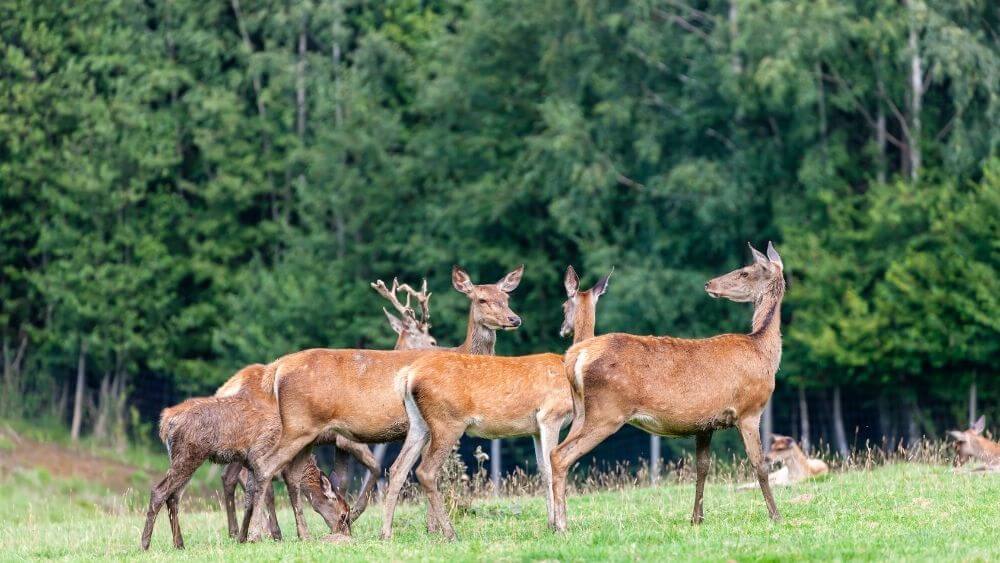
What is the purpose of making National Parks, Wildlife sanctuaries and biosphere reserves?
- The purpose of Making National Parks, Wildlife Sanctuaries and Biosphere Reserves is to take care of the endangered animals and plants.
- They try to provide the animals and plants a natural environment.
Deforestation:
- Cutting down trees and using it for any other purpose is called as deforestation.
- Trees are cut to use it for stationary purposes, in the making of buildings, in the making of furniture, for fuel etc..
- Deforestation also happens due to natural forest fires or in drought condition ( Reduction in rainfall leads to droughts).
- Trees are very important to us as it regulate the earth’s temperature.
- Deforestation increases the temperature and thus results in global warming and it also increases the pollution level as trees helps to clean the air.
- Rainfall and soil fertility reduces due to deforestation.
- Deforested area has a high risk of floods as deforestation decreases the water holding capacity of the soil.
- Fewer trees leads to soil erosion.
- Desertification is the condition when the top layer of the soil gets removed and the fertile land gets converted into desserts.
Conservation of forest and wildlife:
- The surface of the earth occupied by living organisms are termed as biosphere.
- To protect our plants and animals or our flora and fauna protected areas are made.
- These protected areas are known as Wildlife Sanctuaries, Biosphere Reserves and National Parks.
- Areas where animals are protected are known as Wildlife Sanctuaries.
- Black Buck, White eyed buck, rhinoceros etc.. are some animals who are kept in a wild life sanctuary.
- Areas reserved for wildlife where they can use the habitats are known as National Parks.
- Large areas of protected land for conservation of wild life and of tribals living in that area are termed as Biosphere Reserves.
- Biospheres helps to maintain the biodiversity and the culture of that area.
Flora and Fauna:
- The plants found in a particular area are termed as Flora.
- The animals found in a particular area are termed as Fauna.
Endemic Species:
- The species which are found only in a particular area and not in other area are known as Endemic Species.
- Species are a group of population which are capable of interbreeding.
- There are many plants and animals which are found in a particular state or country and not in other states or countries.
- Sal is an example of endemic flora.
- Bison is an example of endemic Fauna.
Endangered Species:
- Animals who are on the verge of extinction are known as Endangered Species.
- Tiger is an example of Endangered Species.
Ecosystem:
- An ecosystem is made up of all living and non-living components.
Red Data Book:
- Red Data Book is the source book which keeps a record of all the endangered species.
Migration:
- The phenomenon of the movement of the species from it’s own natural habitat to some other habitat for a particular time period every year.
Reforestation:
- Planting trees which are cut down is termed as Reforestation.
- Reforestation takes place naturally also if the deforested area remains untouched.
You may like these:
The Journey and Impact of Discarded Plastic

Discarded plastic often ends up in landfills, oceans, or ecosystems, persisting for centuries. It harms wildlife, pollutes water, and breaks into microplastics, posing environmental and health risks globally.
Simple Paragraph on ‘Deforestation’

Deforestation destroys forests, endangering wildlife and contributing to climate change. It disrupts ecosystems, reduces biodiversity, and impacts livelihoods, highlighting the urgent need for conservation and sustainable practices.
Quick Paragraph on ‘Value of Oxygen and Water in Life/Earth’

Oxygen and water are essential for survival, sustaining all living organisms. Oxygen supports respiration, while water nourishes life, regulates climate, and maintains ecological balance on Earth.
A Brief Paragraph on ‘Global Warming’

Global warming causes rising temperatures, melting ice caps, and extreme weather. It disrupts ecosystems, threatens biodiversity, and impacts human lives, urging immediate action to reduce emissions and combat climate change.
Easy Paragraph on ‘Flowers’

Flowers beautify nature with vibrant colors and fragrances, attracting pollinators like bees. They play a vital role in reproduction, support ecosystems, and bring joy and inspiration to human life.