
This activity will help the third-grade students to describe various people with various professions. They will fill in the blanks with accurate words or adjectives provided in the word bank. It will teach them about human beings’ different ages and personalities. So check out these worksheets to improve your English grammar and write the correct adjectives.
[Scroll Down for Download Link]
Contents
- Describing People Adjective Vocabulary Worksheets For Grade 2
- Key Facts About Describing People: Adjectives Worksheet for Grade 2
- Parts/Types/Examples of Adjectives Used
- How Does This Worksheet Work?
- Benefits of Learning About Adjectives
- Learning Objectives
- Worksheet Instructions
- Interesting Facts About Vocabulary Words
- Real-Life Applications
- FAQs
- Q1. Is this worksheet suitable for students outside of Grade 2?
- Q2. Can I use this for homeschooling?
- Q3. Why is there an Answer Key included?
- Q4. How can I help my child if they struggle with these words?
- You may like these:
- Animal Adjective Learning Cards
- Worksheets for Animal Descriptions – Grade 2
- Printable Worksheets: Adjectives vs. Adverbs – Grade 1
- Bird Description Worksheets – Grade 3
Describing People Adjective Vocabulary Worksheets For Grade 2
Read More: Animal Adjectives Flashcards

Ms. Gilmore is pretty.
She is slim and tall.
She has brown hair, a round face, big
eyes, a pointed nose, and red lips.
She has a fair complexion.
Dean is tall and attractive.
He is good-looking.
He has black hair, a round face, blue
eyes, a pointed nose, and a small mouth.
He is young.
Mrs. Hayden is old.
She is fat and short.
She has grey hair, a small face, brown
eyes, a pointed nose, and small lips.
She has a fair complexion.
Travis is short.
He is thin.
He has curly hair, a round face, and brown
eyes and a small nose.
He has a dark complexion.
In this worksheet, students will describe different people of different ages and professions. They have to fill in the blanks with suitable words or adjectives from the word bank. It includes four people and consists of an answer key for the students to correct their mistakes.

Ariana is beautiful.
She is slim and tall.
She has long hair, a round face, big eyes, a pointed nose, and pink lips.
She has a fair complexion.
Mr. Scott is tall.
He is attractive.
He has brown curly hair, a long face, green eyes, small nose.
He is muscular.
Bella is short.
She is thin.
She has black hair, an oval face, brown eyes, small nose.
She has a fair complexion.
Mr. Danes is short.
He is thin.
He has short white hair, a round face, black eyes, and a pointy nose.
He is an old man.
In this worksheet, students will describe the different people by writing the correct adjective in the blank column from the word bank. It includes four people: a girl, a boy, a child, and an old man. Students will describe them, and after that, check the correct answers from the answer key.
Key Facts About Describing People: Adjectives Worksheet for Grade 2
- Target Audience: Designed specifically for 2nd-grade students (approx. 7–8 years old).
- Educational Focus: Builds essential English grammar skills by teaching students how to use descriptive adjectives to characterize individuals.
- Content Structure: Features diverse profiles, including children, adults, and elderly figures, to provide a comprehensive look at human variety.
- Skill Development: Targets vocabulary expansion, sentence structure improvement, and the ability to identify physical traits (hair, eyes, build, complexion).
- Self-Assessment: Includes an answer key, empowering students to practice independently and learn through self-correction.
Parts/Types/Examples of Adjectives Used
The worksheet categorizes descriptors to help children build a systematic vocabulary:
- Physical Appearance: Tall, short, slim, muscular, thin.
- Facial Features: Round, oval, pointed (nose), small, big (eyes).
- Hair Characteristics: Curly, long, short, brown, black, grey.
- General Impressions: Beautiful, attractive, good-looking, young, old.
- Complexion: Fair, dark.
How Does This Worksheet Work?
This worksheet utilizes a “Fill in the Blanks” methodology paired with a curated word bank.
- Reading Comprehension: Students read short, descriptive passages about specific characters (e.g., Ms. Gilmore, Mr. Scott).
- Vocabulary Selection: Students analyze the physical traits presented in the text and select the most appropriate adjective from the provided word bank.
- Contextual Application: By placing the adjective within the sentence, students learn how adjectives function grammatically to modify nouns.
- Verification: Students compare their answers against the provided answer key to gauge their understanding and correct errors immediately.
Benefits of Learning About Adjectives
- Improved Communication: Equips children with the precise language needed to express themselves clearly and fluently.
- Descriptive Writing Skills: Provides the building blocks for creative writing, allowing students to paint “word pictures” in their stories and reports.
- Critical Thinking: Encourages students to observe people closely and select the most accurate adjective rather than just any word.
- Grammar Foundation: Lays the groundwork for more complex sentence structures in later grades.
Learning Objectives
By completing this worksheet, students will be able to:
- Identify the difference between nouns (people) and adjectives (descriptive words).
- Use adjectives appropriately to describe physical traits and age.
- Demonstrate correct grammar usage when linking adjectives to nouns.
- Enhance their ability to read for detail and context.
Worksheet Instructions
- Read the Character Profile: Start by carefully reading the description provided for each person.
- Consult the Word Bank: Look at the list of adjectives provided.
- Select & Fill: Choose the best word that fits the context of the sentence and write it in the blank space.
- Review: Once all blanks are filled, check your answers against the provided Answer Key at the end of the document.
- Practice: Read the completed sentences aloud to see how the adjectives make the descriptions more vivid.
Interesting Facts About Vocabulary Words
- Functional Language: Adjectives are the “paint” of the English language. Without them, we would only know who we are talking about, but not what they look like.
- Evolution of Description: Learning these words is the first step in “Show, Don’t Tell” writing, a core concept in advanced creative writing.
- Cultural Connection: Describing complexions and hair types helps children acknowledge and celebrate human diversity through language.
Real-Life Applications
- Describing Friends and Family: Helping children talk about their loved ones with more detail and affection.
- Storytelling: Enabling kids to create richer, more engaging characters in their own creative writing assignments.
- Building Empathy: By learning to describe others objectively, students develop the habit of observation, which is a precursor to social awareness.
FAQs
Q1. Is this worksheet suitable for students outside of Grade 2?
Answer: Yes! While designed for Grade 2, it is excellent for advanced Grade 1 students or as remedial practice for Grade 3 students who need a refresher on basic descriptive grammar.
Q2. Can I use this for homeschooling?
Answer: Absolutely. These worksheets are crafted by experienced educators specifically to be clear, engaging, and easy to use in both classroom and home settings.
Q3. Why is there an Answer Key included?
Answer: We believe in fostering independent learning. The answer key allows students to take ownership of their learning process by checking their own work, which reinforces the correct usage of vocabulary.
Q4. How can I help my child if they struggle with these words?
Answer: Try practicing by describing people in your house or photos from a family album using the adjectives listed in the worksheet. Real-world application makes abstract grammar concepts stick much faster!
Help children learn descriptive adjectives with this engaging Grade 2 worksheet. Students build vocabulary, improve grammar, and develop sentence-writing skills while confidently describing people using accurate and meaningful words. Discover quality learning materials, including quizzes, worksheets, essays, flashcards, paragraphs, and interactive resource activities for kids. Follow us on YouTube & Facebook.
The Content Team prepared this worksheet to strengthen effective practice.
Reviewed By Drashti
You may like these:
Animal Adjective Learning Cards
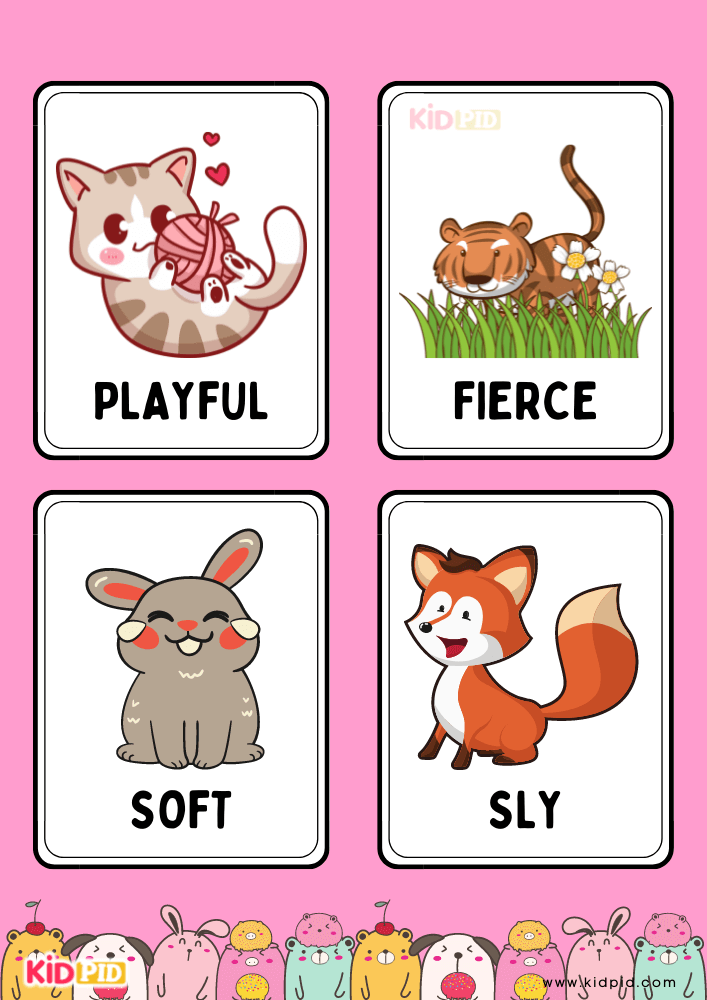
These flashcards help students learn animal-related adjectives. Each card features a different animal, encouraging kids to describe characteristics and enhance their vocabulary through fun interaction and engaging activities.
Worksheets for Animal Descriptions – Grade 2

This worksheet focuses on helping second graders describe animals using adjectives. Students will improve their vocabulary and writing skills by identifying and expressing the unique traits of various animals.
Printable Worksheets: Adjectives vs. Adverbs – Grade 1
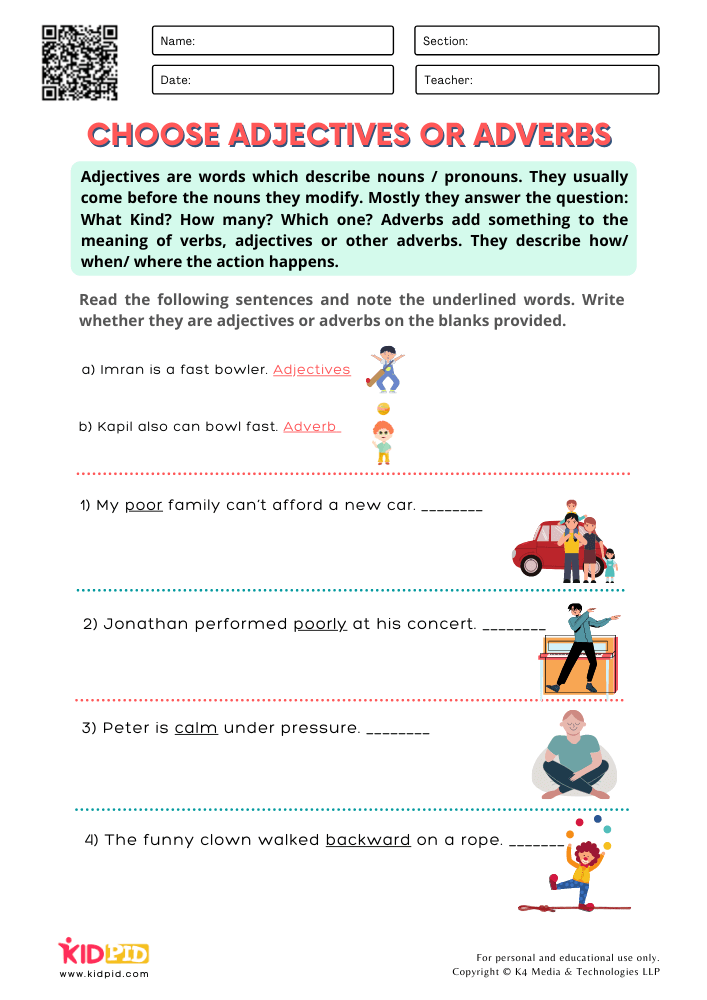
In this printable worksheet, first graders will learn the difference between adjectives and adverbs. Fun exercises will help them practice using both types of words in sentences effectively.
Bird Description Worksheets – Grade 3

This worksheet guides third graders in using adjectives to describe birds. Students will explore vocabulary, practice creative writing, and learn to express distinctive features of different bird species.