


This engaging worksheet is designed to enhance children’s vocabulary, spelling, and cognitive skills by challenging them to unscramble mixed-up letters to form the names of various vegetables. Perfect for first graders, this activity not only supports literacy development but also encourages familiarity with healthy food choices.
[Scroll Down for Download Link]
Contents
- Unscramble The Vegetable Words Worksheets For Grade 1
- Key Facts About the Jumbled Vegetables Words Worksheet
- Parts/Types/Examples of the Worksheet
- How Does This Worksheet Work?
- Benefits of Learning About Vegetables Through Word Games
- Learning Objectives
- Worksheet Instructions
- Interesting Facts About Vegetable Vocabulary
- Real-Life Applications
- FAQs
Unscramble The Vegetable Words Worksheets For Grade 1
Read More: Fruits and Vegetables / FREE Printable Worksheets for Kindergarten
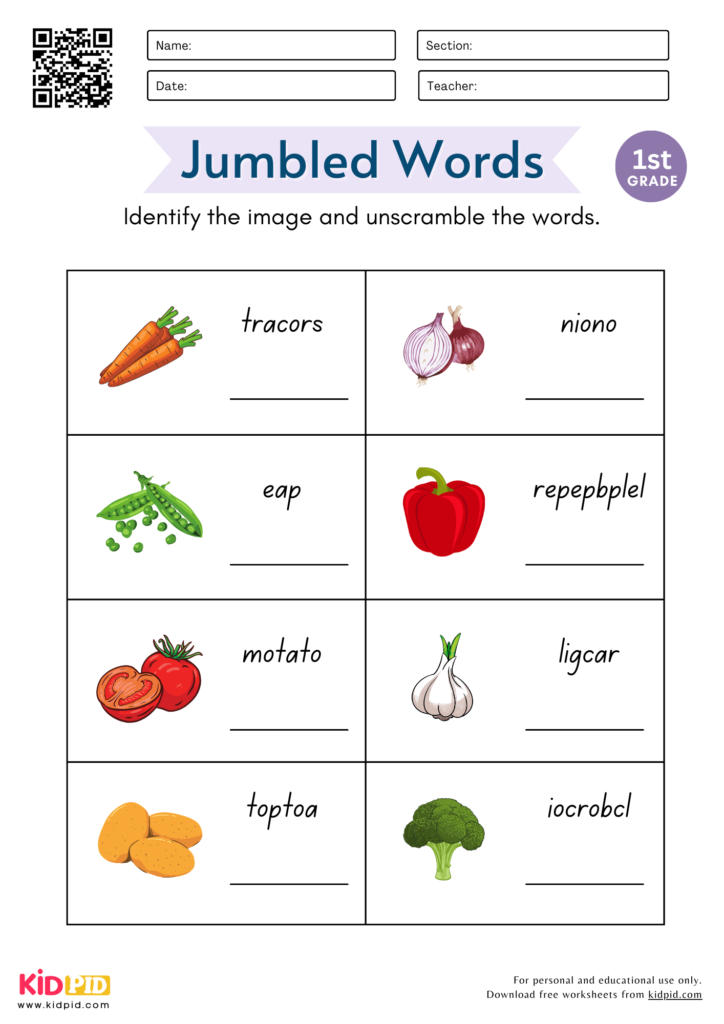
- carrots
- onion
- pea
- bellpepper
- tomato
- garlic
- potato
- broccoli

- radish
- cucumber
- corn
- eggplant
- mushroom
- pumpkin
- turnip
- beans
Key Facts About the Jumbled Vegetables Words Worksheet
- Target Audience: Specifically designed for Grade 1 students (ages 6–7).
- Skill Focus: Enhances orthographic processing, spelling accuracy, and vocabulary expansion.
- Curriculum Alignment: Supports early literacy and healthy living modules common in elementary school curricula.
- Format: Interactive print-based activity where students unscramble letters to identify common vegetable names.
- Cognitive Benefit: Strengthens cognitive flexibility by requiring students to manipulate letter order to recognize patterns.
Parts/Types/Examples of the Worksheet
This worksheet typically breaks down into three core components:
- Visual Cues: Often accompanied by small illustrations of the vegetables to help students bridge the gap between word and object.
- Scrambled Sets: A list of jumbled letter strings (e.g., “R-C-A-O-T-R-S” for “CARROTS”).
- Writing Lines: Blank spaces are provided to encourage proper letter formation and handwriting practice.
- Example Vocabulary Included: Broccoli, Pumpkin, Cucumber, Eggplant, Radish, and Bell Pepper.
How Does This Worksheet Work?
The worksheet functions as a decoding puzzle. Presenting familiar vegetable names in a randomized letter format, it forces the student to move beyond “whole word recognition” and focus on individual letter identification and phonics. Students must analyze the scrambled letters, apply their knowledge of spelling rules, and mentally reorder the letters to form the correct word, reinforcing orthographic memory.
Benefits of Learning About Vegetables Through Word Games
- Dual Learning: Students learn spelling (English language arts) while simultaneously learning about nutrition (science/health).
- Active Recall: Rather than passive reading, students actively work to construct words, which leads to higher retention rates.
- Confidence Building: Completing a puzzle provides an immediate sense of accomplishment, encouraging a positive attitude toward learning and healthy eating.
Learning Objectives
- Literacy: To improve spelling accuracy and recognition of common vocabulary related to food.
- Cognitive: To develop critical thinking skills and the ability to recognize letter patterns.
- Health Literacy: To increase familiarity with a variety of healthy vegetables, potentially encouraging curiosity about nutrition.
Worksheet Instructions
- Analyze: Look at the jumbled letters provided next to each vegetable image.
- Sound It Out: Say the letters aloud to identify the sound patterns.
- Unscramble: Mentally rearrange the letters to form the correct name of the vegetable.
- Write: Carefully write the correct spelling on the provided line, ensuring all letters are formed clearly.
- Review: Once finished, go back and double-check spelling against a word bank or with a parent/teacher.
Interesting Facts About Vegetable Vocabulary
- Botanical Classifications: Some common “vegetables” (like tomatoes, cucumbers, and pumpkins) are botanically classified as fruits because they contain seeds.
- Root vs. Leaf: Learning these words helps children distinguish between different parts of plants (e.g., carrots as roots, lettuce as leaves).
- Multisensory Learning: Connecting the word broccoli to its specific shape and color in the mind creates a “mental map” that makes the vocabulary easier to recall.
Real-Life Applications
- Grocery Shopping: Children can identify vegetables in the grocery store based on the names they have learned to spell.
- Meal Preparation: Engaging with these words can make children more excited to help wash or prepare vegetables for family meals.
- Menu Planning: Understanding the names of vegetables is the first step in being able to read and understand nutritional content.
FAQs
Q1. Is this worksheet suitable for students with learning difficulties?
Answer: Yes, the visual nature of the worksheet helps children who rely on visual cues for learning. However, additional teacher or parent guidance may be helpful for early readers.
Q2. How can I use this to encourage healthy eating?
Answer: Pair the worksheet with a taste test! After your child spells “carrot,” enjoy a raw carrot stick as a snack to connect the spelling task to a real-world experience.
Q3. At what age should a child start doing these worksheets?
Answer: These are specifically curated for Grade 1, but they are also excellent for advanced Kindergarten students or as remedial practice for early Grade 2 students.

Jumbled Vegetable Words Worksheets help Grade 1 students unscramble vegetable names through enjoyable word activities. These worksheets strengthen spelling, vocabulary, reading skills, word recognition, critical thinking, and confidence in language learning. Browse our website for paragraphs, worksheets, essays, flashcards, quizzes, and interactive resources designed for curious learners. Follow us for more amazing ideas on YouTube & Facebook.
The Content Team designed this worksheet to support learning practice.
Reviewed By Sheereen
Read More:



