


This counting backward worksheet is specially designed for grade 1. This worksheet will help kids learn counting in a fun way. Counting backward is a process where kids need to count backward, which will help kids learn to count. Below, we have different counting exercises that kids need to complete. We have used simple charts that grab kids’ attention, and they feel like it is a fun activity, like a puzzle game. So we hope kids will like our worksheet and they will perform our exercises.
Contents
- Number Chart & Counting Backward Worksheet For Grade 1
- Key Facts About Counting Backward Worksheets
- Parts, Types, and Examples
- How Does Counting Backward Work?
- Benefits of Learning About Counting Backward
- Learning Objectives
- Worksheet Instructions
- Interesting Facts About Counting Backward
- Vocabulary Words
- Real-Life Applications
- FAQs
Number Chart & Counting Backward Worksheet For Grade 1
Read More: Tally Marks and Numbers Worksheet For Grade 1
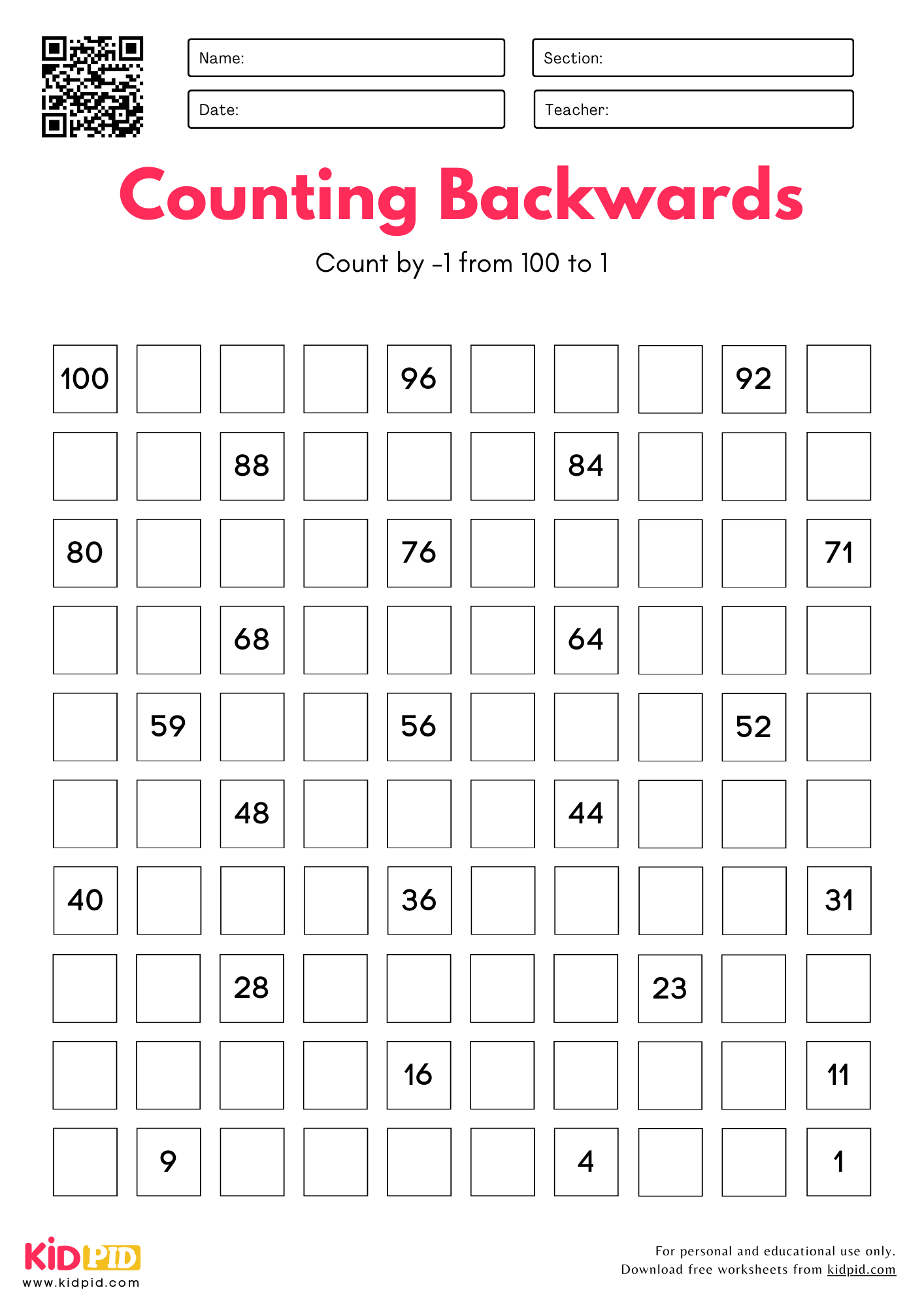
Number Chart: Counting Backwards by 1’s Worksheet For Grade 1
Number Chart: Counting Backwards by 2s Worksheet For Grade 1

Number Chart – Counting Backwards by5ss Worksheet For Grade 1
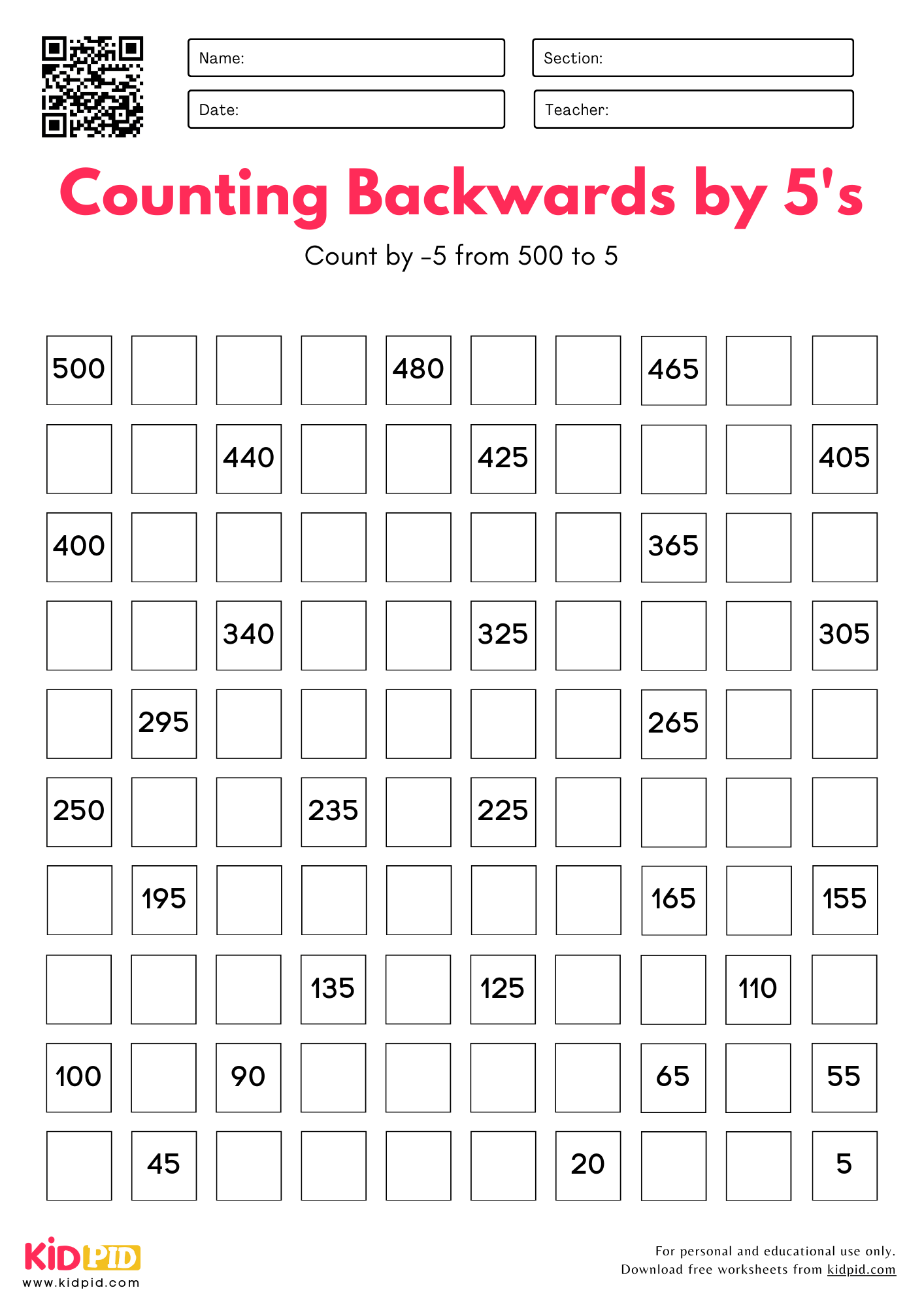 In this chart, the counting starts at 5 and ends with 500. So kids need to start counting from five hundred and fill all the empty boxes. This worksheet will help them to improve their memory and learn counting in a fun way. We want kids to perform this without any help.
Key Facts About Counting Backward Worksheets
- Target Audience: Specifically designed for Grade 1 students (ages 6–7).
- Skill Focus: Strengthens number sense, mental math capabilities, and understanding of numerical sequences.
- Learning Methodology: Uses interactive, “fill-in-the-blank” chart formats that gamify the learning process.
- Progression: Includes scaffolding from simple 1-by-1 counting up to skips of 2s and 5s, supporting tiered learning objectives.
- Educational Foundation: Aligns with core primary mathematics standards for number fluency.
Parts, Types, and Examples
These worksheets are categorized by the level of complexity, allowing students to progress naturally:
- Counting Backwards by 1s (100 to 1): Focuses on basic sequencing and recognizing immediate predecessors.
- Counting Backwards by 2s (200 to 2): Introduces pattern recognition and even/odd number awareness.
- Counting Backwards by 5s (500 to 5): Challenges students to recognize patterns in multiples, reinforcing skip-counting logic.
- Example format: A grid containing specific starting numbers with empty cells requiring the student to deduce the correct descending value.
How Does Counting Backward Work?
Counting backward is the cognitive process of descending through a sequence of numbers ($n, n-1, n-2…$). By using these number charts, students learn to visualize the number line in reverse. Instead of memorizing sequences, they practice identifying the relationship between consecutive numbers, which builds a robust mental framework for future subtraction skills.
Benefits of Learning About Counting Backward
- Improves Mental Math: It lays the groundwork for understanding subtraction as a “taking away” or “moving left” process.
- Develops Number Sense: Helps children understand that numbers are not just labels but have a specific magnitude and order.
- Enhances Memory: Repeatedly filling in charts strengthens recall and concentration.
- Boosts Confidence: Mastering sequences helps children feel more capable when tackling more complex arithmetic later.
Learning Objectives
By the end of these exercises, students will be able to:
- Correctly identify the number that comes immediately before a given number.
- Demonstrate fluency in descending sequences by 1, 2, and 5.
- Fill in missing values in a sequence accurately without teacher assistance.
- Apply number recognition skills to larger ranges (up to 500).
Worksheet Instructions
- Preparation: Print the worksheet and provide a pencil and eraser.
- Observation: Ask the student to look at the chart and identify the starting number.
- Analysis: Determine the skip pattern (by 1, 2, or 5).
- Execution: Fill in the blank boxes with the correct preceding numbers.
- Review: Once finished, have the student read the sequence backward aloud to verify the pattern.
Interesting Facts About Counting Backward
- The Predecessor Concept: In mathematics, the number that comes before is called the predecessor. Learning to count backward is the first step toward understanding this concept.
- Cognitive Agility: Being able to count backward requires more brain power than counting forward because the brain cannot rely on rote memory; it must actively manipulate the sequence.
Vocabulary Words
- Descending: Moving from a higher value to a lower value.
- Sequence: A particular order in which related things follow each other.
- Predecessor: The number that comes immediately before another number.
- Interval: The space between numbers (e.g., in counting by 5s, the interval is 5).
Real-Life Applications
- Timers and Countdowns: Understanding how long until a TV show ends or a timer goes off.
- Daily Tasks: Understanding how many days are left until a birthday or holiday.
- Basic Money Skills: Learning how to calculate change when paying for items.
FAQs
Q1. At what age should kids start counting backward?
Answer: Typically, children begin developing these skills in late Kindergarten or early Grade 1 as they solidify their understanding of forward counting.
Q2. Why is counting backward important for subtraction?
Answer: Subtraction is effectively counting backward. If a student can count backward by 1s, they can easily solve problems like “5 minus 1.”
Q3. How can I help my child if they are struggling?
Answer: Start with smaller ranges (e.g., 10 to 1) and use physical manipulatives like blocks that you remove one by one as they count down.
Designed to support learning, this worksheet was created by our Content Team.
Reviewed By Sheereen
Read More:



