Kids develop the strength to read any word by the primary tone or sound of the word, and then move to learn the sound and articulation of the entire word. They start to realize what different letters can make words sound like. Similarly, they need to work on their numbers and counting skills as well.
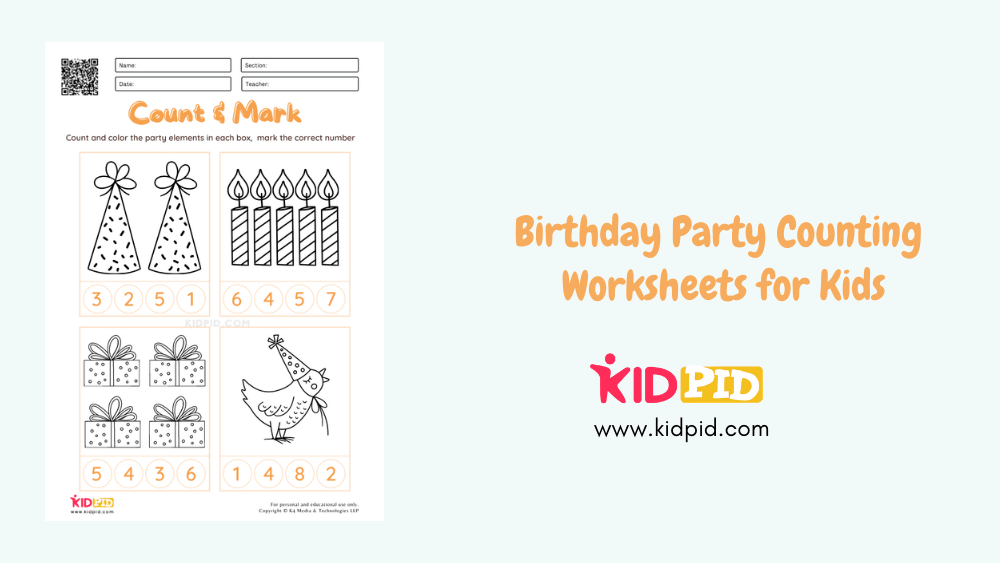
So, in this edition, we have brought some worksheets that are going to ask the child to count and color the party elements in each given box, and also mark the correct number after counting the items.
[Scroll Down for Download Link]
Contents
- Birthday Party Counting Practice Worksheets
- Key Facts About Birthday Party Counting Worksheets
- Parts, Types, and Examples of Birthday Party Counting Elements
- How Do Birthday Party Counting Worksheets Work?
- Learning Objectives
- Worksheet Instructions
- Benefits of Learning About Counting with Birthday Themes
- Vocabulary Words
- Real-Life Applications
- FAQs
Birthday Party Counting Practice Worksheets
The first worksheet works on the basic counting skills of the child, where he’ll count the party elements, and after successfully counting and marking the number, he will get to color it. Kids love art during their early days. This will help them learn new items according to the boxes that make up the word, and thereby help them understand how to color them correctly.
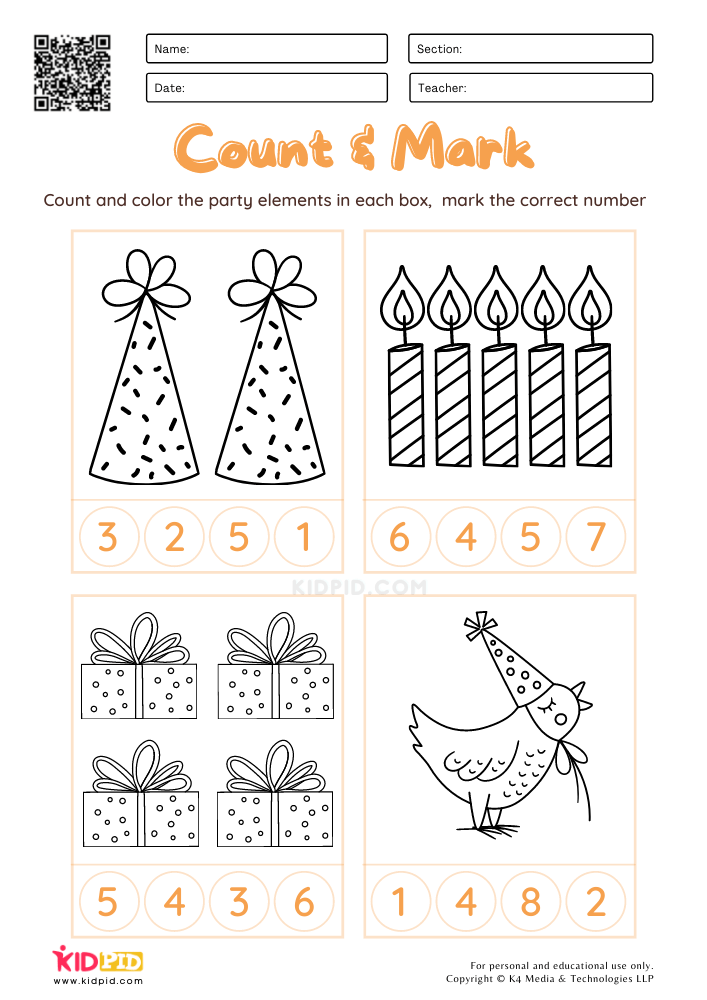
Yet another exercise to engage children and help them learn. Just like the previous worksheet, it’ll help children learn new items and expand their counting skills, and it’ll be more fun. It is important to make sure that children keep themselves engaged in the worksheets and do not lose their attention.
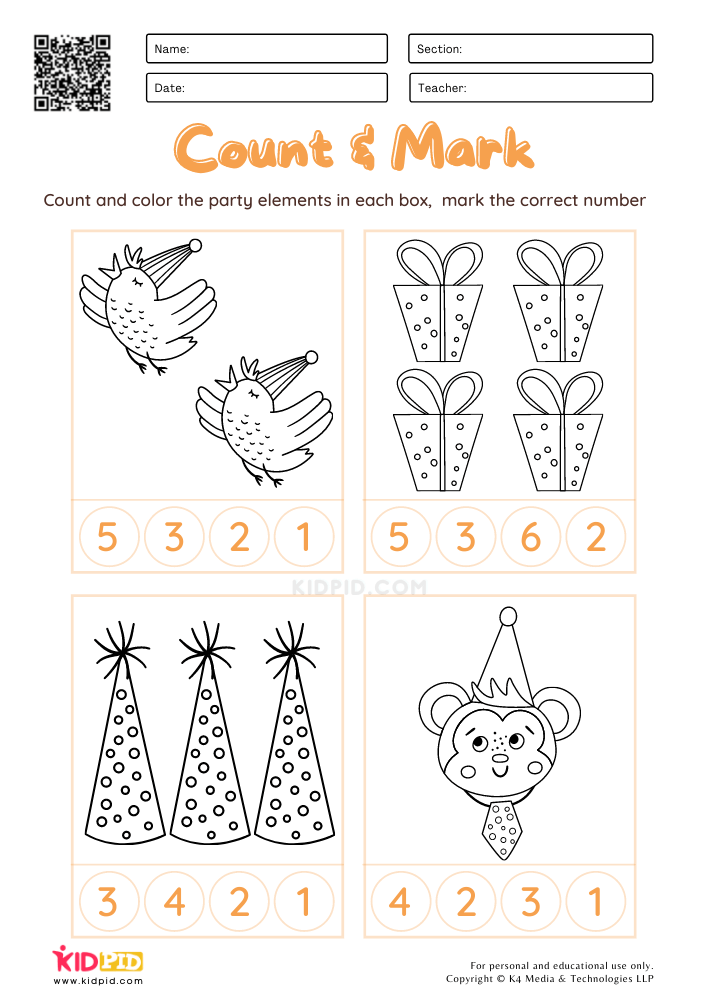
In the third worksheet, there are new party elements, which will enlighten the child’s mind and help him concentrate on his work. There is one certainty: the kid will not get bored in this worksheet. This becomes easy for the kids after finishing the above two worksheets.
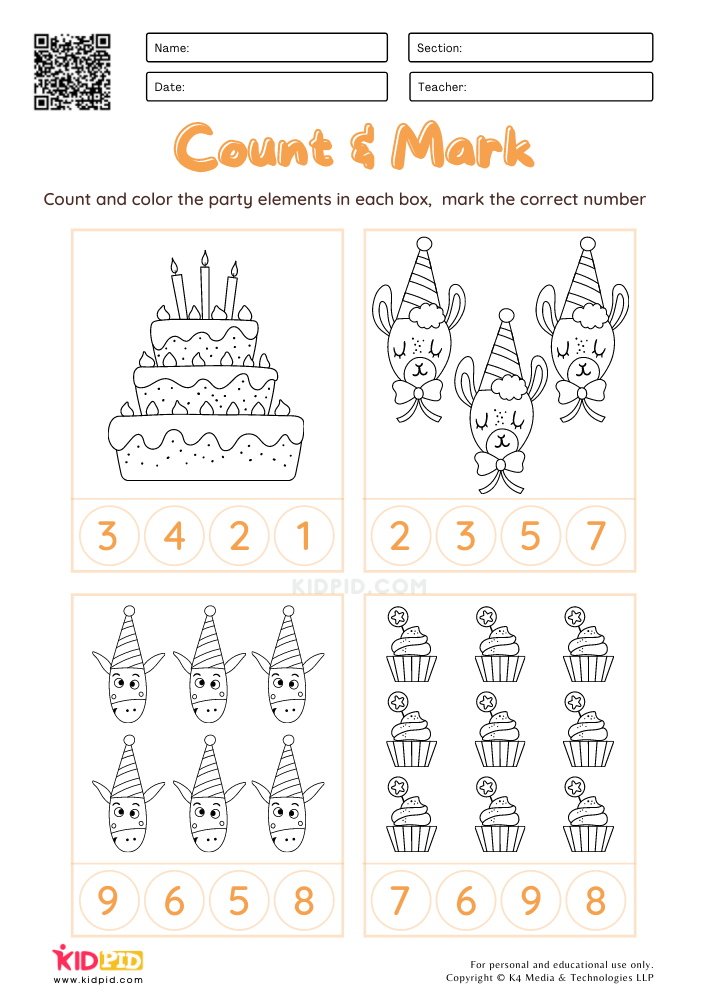
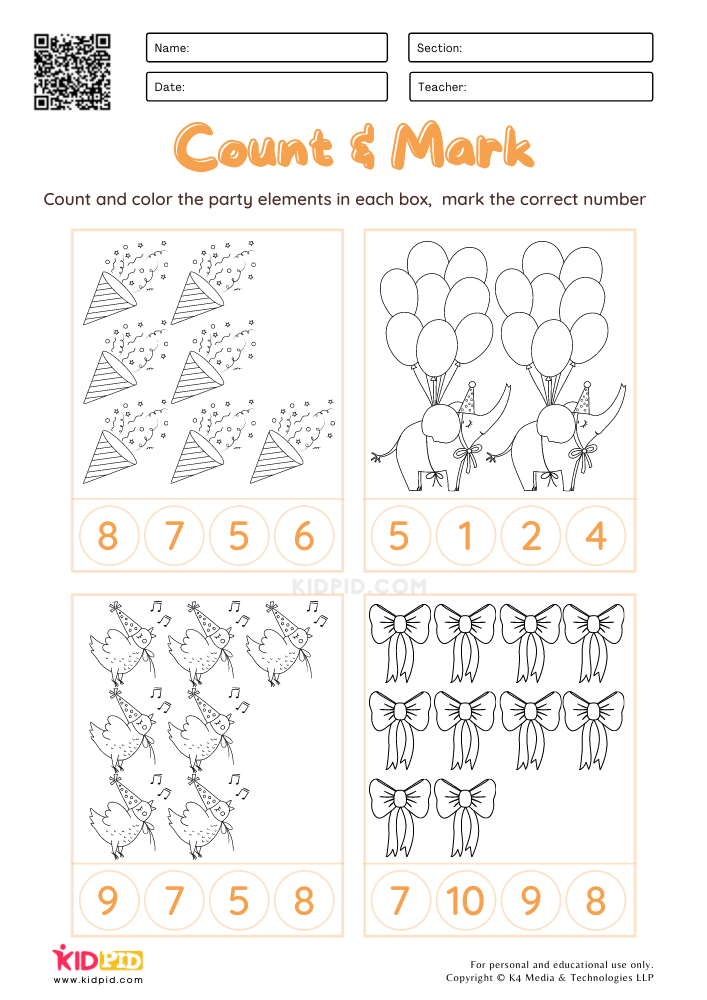
These worksheets will also allow children to understand the difference between the items and how to count the numbers. These are pretty common objects that a kid will understand with ease, and the kids will also become aware of their surroundings with the help of such worksheets.
Key Facts About Birthday Party Counting Worksheets
Early math development relies heavily on visual engagement and relatable themes. These worksheets utilize a celebratory “birthday party” motif to introduce foundational mathematical concepts to young learners.
- Target Age Group: Ideal for toddlers, preschoolers, and kindergarteners (ages 3 to 6).
- Core Math Concept: Focuses on one-to-one correspondence (matching one number name to one physical object) and cardinality (understanding that the last number counted represents the total amount).
- Skill Integration: Combines fine motor skill practice (coloring and pencil grip) with cognitive quantitative analysis.
- Format: Free printable PDF worksheets featuring vibrant, high-contrast illustrations of familiar celebratory objects.
Parts, Types, and Examples of Birthday Party Counting Elements
To prevent cognitive fatigue, the worksheets introduce a variety of distinct visual elements across different pages. This keeps children engaged while teaching them to categorize and count structurally diverse shapes.
- Celebration Treats: Counting sweet items like tiered birthday cakes, frosted cupcakes with sprinkles, and lit birthday candles.
- Party Decor Elements: Identifying and totaling clusters of floating balloons, striped party hats, and hanging pennant banners.
- Gifts and Surprises: Quantifying wrapped gift boxes with bows and festive party noisemakers.
- Structured Layouts: Items are arranged in distinct, boxed grid formats to help children track their counting pathway from left to right, mirroring early reading tracking.
How Do Birthday Party Counting Worksheets Work?
The worksheets follow a simple, pedagogically sound three-step learning loop designed for independent or guided study:
- Identify and Track: The child looks at a specific box and identifies the featured party object. They use their finger to point to each item individually, preventing accidental double-counting.
- Color to Confirm: As the child counts each object, they color it in. This dual-action mechanism acts as a visual marker, helping the child naturally keep track of which items have already been counted.
- Quantify and Record: Once all items in a set are colored, the child determines the final total and circles or writes the corresponding number in the designated space, reinforcing digit recognition.
Learning Objectives
By completing these interactive printables, young learners will achieve the following early childhood education benchmarks:
- Master Counting 1-10: Accurately count sets of physical objects up to ten without skipping numbers.
- Develop Subitizing Skills: Build the ability to instantly recognize small groups of items (like 2 or 3 balloons) without counting them one by one.
- Enhance Fine Motor Control: Refine small muscle movements in the hand through targeted coloring within defined boundaries and circling numbers.
- Strengthen Number-Numeral Association: Successfully connect a spoken quantity to its written numeric symbol.
Worksheet Instructions
Parents and educators can use these straightforward directions to guide kids through the activity:
- Prepare Your Tools: Print out the sheets and grab a set of crayons, colored pencils, or washable markers.
- Point and Count: Pick a box on the sheet. Have your child point to the first item and say “One,” then move to the next item and say “Two,” continuing until every item has been counted.
- Color the Items: Let your child color each party item as they count it to make the learning active and fun.
- Mark the Total: Look at the number options at the bottom or side of the box. Have your child call out the final number they counted and draw a circle around the matching digit.
Benefits of Learning About Counting with Birthday Themes
Using a birthday theme transforms abstract math into a tangible, exciting, real-world concept for kids.
- High Emotional Resonance: Birthdays carry positive emotional weight for young children. Harnessing this excitement increases attention span and reduces math anxiety.
- Contextualized Learning: Kids learn best when concepts apply to their lived experiences. Seeing objects they interact with at real parties makes the math meaningful.
- Improves Spatial Awareness: Figuring out how items are grouped inside the boxes helps kids learn to scan pages systematically, an essential skill for early reading.
Vocabulary Words
Enhance your child’s language development alongside their math skills by practicing these thematic and quantitative words during the lesson:
- Count (Verb): To name numbers to find the total amount of items.
- Quantity (Noun): The total amount or number of something.
- Numeral (Noun): The written symbol that stands for a number (e.g., “4”).
- Emulsion of Colors / Pattern (Noun): The arrangement of alternating colors on party hats or balloons.
- Correspondence (Noun): Matching one object directly to one number count.
Real-Life Applications
Counting on paper is just the starting point. You can easily bridge these worksheet exercises into everyday household scenarios to solidify your child’s math skills:
- Setting the Table: Have your child count out the exact number of plates, napkins, and forks needed for dinner based on the number of family members.
- Toy Cleanup: Turn tidying up into a game by asking them to count out loud as they put away 10 blocks or stuffed animals into a toy box.
- Grocery Shopping: While in the produce aisle, ask your child to help you count and bag exactly five apples or three lemons.
FAQs
Q1. At what age is it best suited for these counting worksheets?
Answer: These worksheets are designed for children aged 3 to 6 years old. They perfectly match the developmental goals of preschool, Pre-K, and kindergarten classrooms.
Q2. How does coloring help my child learn math?
Answer: Coloring serves as a kinetic and visual tracking aid. When a child colors an object, it ensures they don’t count it twice or skip it entirely, which reinforces accurate one-to-one correspondence.
Q3. Can these worksheets be used for children struggling with number recognition?
Answer: Yes. Because the worksheets feature concrete images alongside written numerals, they provide excellent visual scaffolding for children who find abstract numbers difficult to memorize.
Q4. How can I make these printables reusable?
Answer: Slide the printed sheets into plastic dry-erase pockets. Your child can then use dry-erase markers to circle the numbers and cross off items as they count, allowing you to use the pages over and over again.
The most authentic way to learn anything is to focus on the work at hand while enjoying the process, and what better way to do that than with fun worksheets filled with pictures of things that are used at parties. Get these worksheets done for the betterment of your kid. Improve learning skills with our paragraphs, flashcards, essays, quizzes, worksheets, and educational activities for every age. Follow us on YouTube & Facebook.
The Content Team developed this worksheet to support academic improvement.
Reviewed By Mahak Agarwal
Read More: