

“Tsunami” is a crucial topic that students may be asked to write a paragraph about in school exams. Tsunamis are giant ocean waves triggered by earthquakes, volcanic eruptions, or underwater landslides, causing immense destruction. Please check the various versions (in 100 words, 150 words, 200 words, and 300 words) provided below for the paragraph.
Contents
- Paragraph on ‘Tsunami’ in 100 words
- Paragraph on ‘Tsunami’ in 150 words
- Paragraph on ‘Tsunami’ in 200 words
- Paragraph on ‘Tsunami’ in 300 words
- MCQ’s on ‘Tsunami’
- 1. What causes a tsunami?
- 2. How fast can a tsunami travel in deep water?
- 3. What happens when a tsunami reaches the shore?
- 4. What should you do if you feel an earthquake near the ocean?
- 5. Where do tsunamis most often occur?
- 6. Which of the following is a warning sign of a tsunami?
- 7. What can a tsunami do when it hits land?
- 8. What should people do when there is a tsunami warning?
- 9. Which countries are at risk for tsunamis?
- 10. What does a tsunami remind us of?
- You may like these:
Paragraph on ‘Tsunami’ in 100 words


A tsunami is a large ocean wave caused by an underwater earthquake or volcanic eruption. It can travel very fast across the sea. When the wave reaches the shore, it can grow much bigger and cause serious damage. Tsunamis often happen in places near the ocean. They are dangerous because they can flood the land and destroy buildings. People living in areas where tsunamis are common are taught how to stay safe. Moving to higher ground and staying away from the beach is important if you feel an earthquake.
Paragraph on ‘Tsunami’ in 150 words

A tsunami is a giant wave usually caused by an underwater earthquake or volcanic eruption. When the ground shakes under the ocean, it pushes the water up and creates waves. These waves travel very fast, sometimes up to 500 miles per hour. As the waves move closer to land, they grow taller and can become very dangerous. Tsunamis can cause flooding and destroy buildings and homes. They often hit coastal areas, which are close to the ocean. If you feel an earthquake or see the water suddenly pull away from the shore, it’s a warning that a tsunami might happen. People in these areas must move to higher ground to stay safe.
Paragraph on ‘Tsunami’ in 200 words

A tsunami is a huge wave that happens after an earthquake, volcanic eruption, or landslide under the ocean. These waves are different from normal waves because they travel across the ocean very quickly. A tsunami can move as fast as 500 miles per hour in deep water. But when the wave gets close to the shore, it slows down and grows taller. Tsunamis can be very dangerous because they can flood the land, destroy buildings, and wash away anything in their path.
Tsunamis happen most often in areas near the Pacific Ocean, where earthquakes are common. They can also occur after volcanic eruptions or when large parts of land fall into the sea. People living near the coast are taught to recognize signs of a tsunami. If the ground shakes or the water suddenly goes away, it means a tsunami could be coming. People must move to higher ground and stay there until it’s safe. Tsunamis are a reminder of how powerful nature can be, and they show how important it is to be prepared and stay safe during such events.
Paragraph on ‘Tsunami’ in 300 words
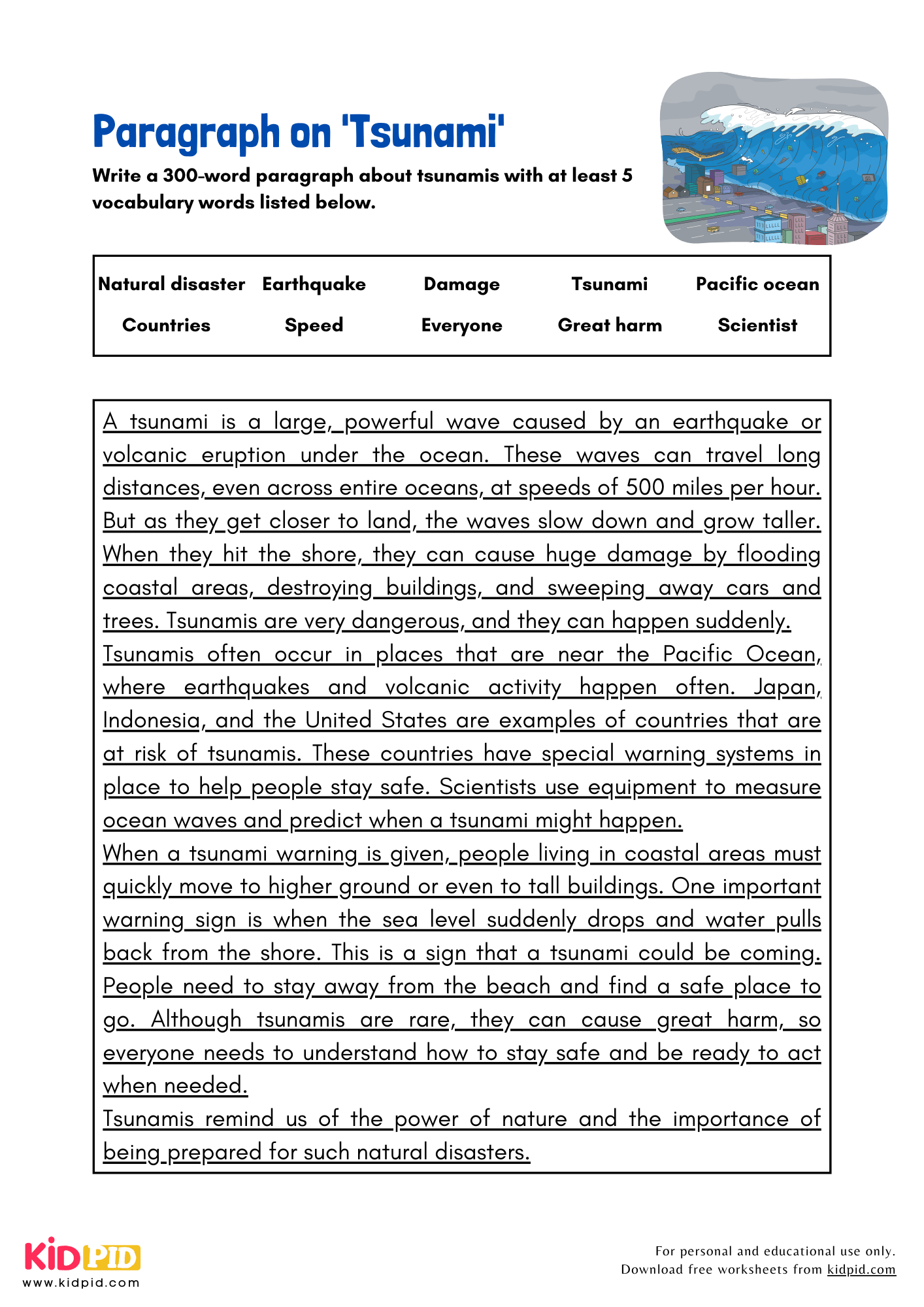
A tsunami is a large, powerful wave caused by an earthquake or volcanic eruption under the ocean. These waves can travel long distances, even across entire oceans, at speeds of 500 miles per hour. But as they get closer to land, the waves slow down and grow taller. When they hit the shore, they can cause huge damage by flooding coastal areas, destroying buildings, and sweeping away cars and trees. Tsunamis are very dangerous, and they can happen suddenly.
Tsunamis often occur in places that are near the Pacific Ocean, where earthquakes and volcanic activity happen often. Japan, Indonesia, and the United States are examples of countries that are at risk of tsunamis. These countries have special warning systems in place to help people stay safe. Scientists use equipment to measure ocean waves and predict when a tsunami might happen.
When a tsunami warning is given, people living in coastal areas must quickly move to higher ground or even to tall buildings. One important warning sign is when the sea level suddenly drops and water pulls back from the shore. This is a sign that a tsunami could be coming. People need to stay away from the beach and find a safe place to go. Although tsunamis are rare, they can cause great harm, so everyone needs to understand how to stay safe and be ready to act when needed.
Tsunamis remind us of the power of nature and the importance of being prepared for such natural disasters.
MCQ’s on ‘Tsunami’
1. What causes a tsunami?
A) High winds
B) Underwater earthquake or volcanic eruption
C) Heavy rain
D) Strong tides
Answer: B) Underwater earthquake or volcanic eruption
Explanation: Tsunamis are usually caused by earthquakes or volcanic eruptions under the ocean.
2. How fast can a tsunami travel in deep water?
A) 100 miles per hour
B) 300 miles per hour
C) 500 miles per hour
D) 1,000 miles per hour
Answer: C) 500 miles per hour
Explanation: Tsunamis can travel at speeds of up to 500 miles per hour in deep water.
3. What happens when a tsunami reaches the shore?
A) It disappears
B) It grows taller
C) It moves faster
D) It becomes smaller
Answer: B) It grows taller
Explanation: As tsunamis get closer to land, they slow down and grow taller, becoming dangerous.
4. What should you do if you feel an earthquake near the ocean?
A) Go to the beach
B) Stay where you are
C) Move to higher ground
D) Run away from the water
Answer: C) Move to higher ground
Explanation: Feeling an earthquake near the ocean means a tsunami might be coming, so moving to higher ground is important.
5. Where do tsunamis most often occur?
A) Near mountain ranges
B) In desert areas
C) In coastal regions near the Pacific Ocean
D) In river valleys
Answer: C) In coastal regions near the Pacific Ocean
Explanation: Tsunamis are most common in regions near the Pacific Ocean due to frequent earthquakes and volcanic activity.
6. Which of the following is a warning sign of a tsunami?
A) The sky turns dark
B) The sea level suddenly drops
C) Birds fly in circles
D) There is no change in the water
Answer: B) The sea level suddenly drops
Explanation: A sudden drop in sea level is a warning that a tsunami might occur.
7. What can a tsunami do when it hits land?
A) It can flood the area
B) It can create a peaceful beach
C) It can make the water rise slightly
D) It can freeze the land
Answer: A) It can flood the area
Explanation: Tsunamis can flood coastal areas and cause major damage to buildings and land.
8. What should people do when there is a tsunami warning?
A) Go to the beach to watch
B) Move to higher ground
C) Stay near the water
D) Wait for the wave to pass
Answer: B) Move to higher ground
Explanation: During a tsunami warning, people should move to higher ground to stay safe.
9. Which countries are at risk for tsunamis?
A) United States, Japan, Indonesia
B) Canada, Russia, Germany
C) Brazil, South Africa, Argentina
D) India, Egypt, Spain
Answer: A) United States, Japan, Indonesia
Explanation: These countries are near the Pacific Ocean, which is prone to tsunamis.
10. What does a tsunami remind us of?
A) The power of the wind
B) The power of nature
C) The importance of fishing
D) The need for warmer weather
Answer: B) The power of nature
Explanation: Tsunamis remind us of the powerful forces of nature and the importance of being prepared.


We hope you found the paragraphs on the topic “Tsunami” insightful, written by our team of experienced teachers. Keep visiting our website and explore more paragraphs, essays, worksheets, flashcards, Quizzes, and many other interactive resources. Don’t forget to follow us on YouTube & Facebook.
You may like these:
What causes a tsunami?
Tsunamis are caused by underwater earthquakes, volcanic eruptions, or landslides, displacing large water masses and creating powerful waves that can devastate coastal areas.
Short Paragraph on ‘Land Pollution’


Land pollution occurs due to waste disposal, deforestation, and industrial activities, contaminating soil, harming ecosystems, and reducing land fertility, affecting both humans and wildlife.
Why do earthquakes happen?
Earthquakes occur when stress along tectonic plate boundaries causes rocks to break, releasing energy in seismic waves, and leading to ground shaking and possible destruction.
Write a Paragraph on ‘What is Sound and How Does It Travel?’

Sound is a vibration that travels in waves through air, water, or solids. It moves by compressing and expanding particles, requiring a medium for transmission.
Write a short Paragraph on ‘The Formation of Mountains’

Mountains form through tectonic movements, volcanic activity, or erosion. Colliding plates push land upward, creating mountain ranges like the Himalayas and the Rockies.


