
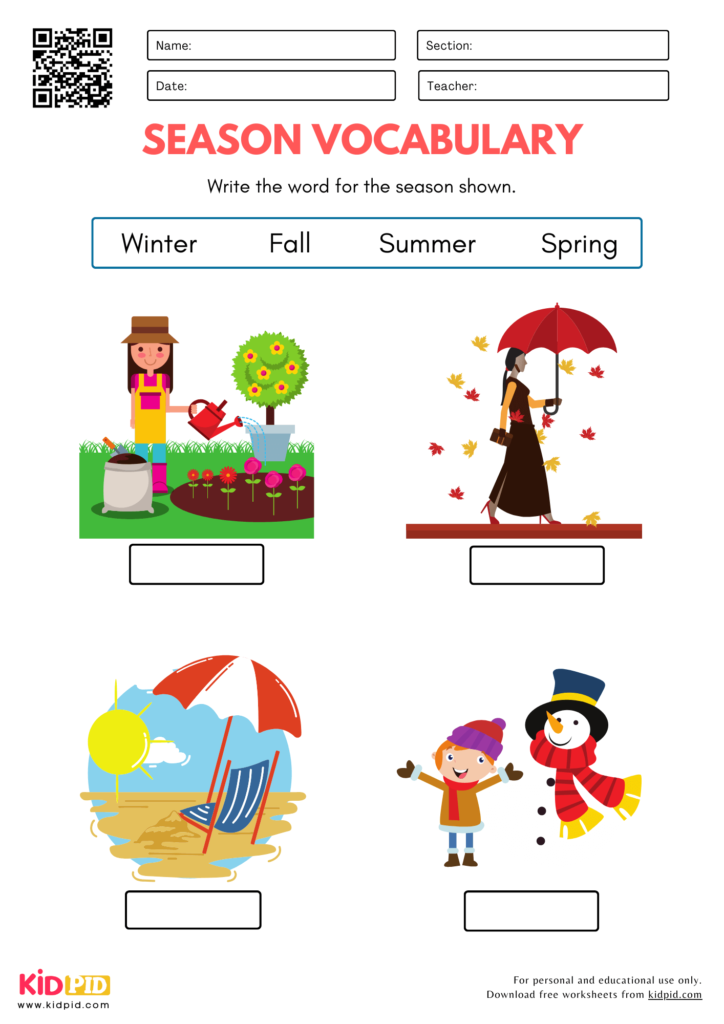
Hello kindergarten kids! We have some amazing worksheets for season name practice. Students will learn the correct spelling of the seasons. They have to write the word for the season shown in the picture and complete the word after the first letter. This will help them to enhance their vocabulary and writing skills for the future. So, practice these amazing worksheets and build your knowledge.
Contents
- Season Vocabulary Worksheet For Kindergarten
- Key Facts About Season Words Practice Worksheet for Kindergarten
- Parts, Types, and Examples of Season Words Practice Worksheet
- How Does the Season Words Practice Worksheet Work?
- Benefits of Learning About Season Words: Practice Worksheet
- Learning Objectives
- Worksheet Instructions
- Interesting Facts About Season Vocabulary Words
- Real-Life Applications
- FAQs
- Q1. What is a Season Words Practice Worksheet for Kindergarten?
- Q2. What age group is this worksheet suitable for?
- Q3. Why is learning season vocabulary important?
- Q4. What skills does this worksheet develop?
- Q5. Can this worksheet be used at home?
- Q6. How often should children practice seasonal vocabulary?
- Q7. Does this worksheet support early science learning?
- Q8. Are visual activities included in the worksheet?
- Read More:
Season Vocabulary Worksheet For Kindergarten
[Scroll Down for Download Link]
Read More: Imagine, Draw, and Write Practice Worksheet for Kindergarten


Key Facts About Season Words Practice Worksheet for Kindergarten
The Season Words Practice Worksheet for Kindergarten is an engaging educational activity designed to help young learners recognize, read, and understand vocabulary associated with the four seasons: spring, summer, autumn (fall), and winter. Through tracing, matching, reading, and writing exercises, children develop early literacy skills while learning about seasonal changes in nature.
Key Facts:
- Introduces season-related vocabulary in a child-friendly format.
- Supports kindergarten language and science learning standards.
- Helps improve word recognition and spelling skills.
- Encourages observation of weather and environmental changes.
- Develops reading comprehension and vocabulary retention.
- Suitable for classroom learning, homeschooling, and independent practice.
Parts, Types, and Examples of Season Words Practice Worksheet
Season vocabulary worksheets can include various activities that make learning enjoyable and interactive.
Parts of the Worksheet
- Vocabulary word list
- Picture-word matching exercises
- Tracing activities
- Fill-in-the-blank sections
- Word identification tasks
- Coloring and labeling activities
Types of Activities
- Matching season words to pictures
- Tracing and writing vocabulary words
- Identifying seasonal objects
- Sorting words by season
- Reading and recognizing seasonal terms
Examples of Season Vocabulary Words
Spring:
- Flowers
- Rain
- Butterfly
- Garden
Summer:
- Beach
- Sun
- Ice Cream
- Swimming
Autumn/Fall:
- Leaves
- Pumpkin
- Harvest
- Acorn
Winter:
- Snow
- Snowman
- Coat
- Mittens
How Does the Season Words Practice Worksheet Work?
The worksheet presents children with season-related words and corresponding images. Students complete activities such as tracing, matching, identifying, and writing vocabulary terms associated with each season.
The learning process typically includes:
- Looking at seasonal pictures.
- Identifying the correct vocabulary word.
- Tracing or writing the word.
- Matching words with images.
- Reinforcing understanding through repetition and visual learning.
This structured approach helps children connect words with real-world seasonal experiences.
Benefits of Learning About Season Words: Practice Worksheet
Learning seasonal vocabulary provides numerous educational advantages for young children.
Language Development
- Expands vocabulary knowledge.
- Improves pronunciation and word recognition.
- Strengthens early reading skills.
Cognitive Growth
- Enhances memory and classification abilities.
- Develops observation and comparison skills.
- Encourages critical thinking about seasonal changes.
Science Awareness
- Introduces basic weather concepts.
- Helps children understand nature’s yearly cycle.
- Builds environmental awareness.
Academic Readiness
- Supports kindergarten literacy goals.
- Strengthens handwriting practice.
- Improves listening and comprehension skills.
Learning Objectives
By completing this worksheet, children will be able to:
- Identify the four seasons.
- Recognize common season-related vocabulary words.
- Match seasonal words with corresponding images.
- Improve handwriting through tracing and writing activities.
- Expand vocabulary and language skills.
- Understand basic seasonal characteristics and weather patterns.
- Develop visual discrimination and observation skills.
Worksheet Instructions
- Carefully observe each picture on the worksheet.
- Read or listen to the season-related vocabulary word.
- Trace the provided word neatly.
- Match the word with the correct seasonal image.
- Write the word independently if required.
- Complete all matching and identification activities.
- Review the vocabulary words after finishing the worksheet.
- Discuss each season and its unique characteristics with a teacher or parent.
Interesting Facts About Season Vocabulary Words
- The Earth’s tilt and orbit around the Sun create the four seasons.
- Different parts of the world experience seasons differently.
- Some regions have only two main seasons: wet and dry.
- Spring is often associated with new plant growth and blooming flowers.
- Summer usually has the longest daylight hours of the year.
- Autumn is known for colorful falling leaves in many regions.
- Winter brings colder temperatures and snow in certain areas.
- Learning seasonal vocabulary helps children better understand weather forecasts and nature.
Real-Life Applications
Season vocabulary is useful in many everyday situations.
Daily Communication
- Talking about weather conditions.
- Describing outdoor activities.
- Discussing seasonal events and holidays.
Academic Learning
- Supports science and geography lessons.
- Helps with reading comprehension activities.
- Builds foundational vocabulary for future studies.
Environmental Awareness
- Understanding seasonal changes in plants and animals.
- Recognizing weather patterns.
- Observing nature throughout the year.
Social Development
- Participating in classroom discussions.
- Sharing seasonal experiences with friends and family.
- Developing confidence in verbal communication.
FAQs
Q1. What is a Season Words Practice Worksheet for Kindergarten?
Answer: It is an educational worksheet that helps children learn vocabulary related to spring, summer, autumn, and winter through interactive activities.
Q2. What age group is this worksheet suitable for?
Answer: The worksheet is primarily designed for kindergarten students, typically ages 4–6 years.
Q3. Why is learning season vocabulary important?
Answer: Season vocabulary improves language development, reading skills, environmental awareness, and understanding of weather-related concepts.
Q4. What skills does this worksheet develop?
Answer: Children improve vocabulary, handwriting, reading readiness, observation skills, and word-picture association abilities.
Q5. Can this worksheet be used at home?
Answer: Yes. Parents can use it for homeschooling, homework practice, or additional learning support.
Q6. How often should children practice seasonal vocabulary?
Answer: Regular practice throughout the year helps children remember vocabulary and connect words to real-world seasonal experiences.
Q7. Does this worksheet support early science learning?
Answer: Yes. It introduces basic concepts about weather, seasonal changes, and environmental observations.
Q8. Are visual activities included in the worksheet?
Answer: Most season vocabulary worksheets include pictures, matching exercises, tracing activities, and word recognition tasks to support visual learning.
This season words practice worksheet helps kindergarten children recognize and spell seasonal vocabulary through enjoyable activities. It strengthens reading, writing, and word recognition skills while making learning about seasons engaging and meaningful. Find creative worksheets, essays, paragraphs, flashcards, quizzes, and interactive resources on our website for a better learning experience. Follow us on YouTube & Facebook.
The Content Team created this worksheet to strengthen practice-based skills.
Reviewed By Gargy
Read More: