
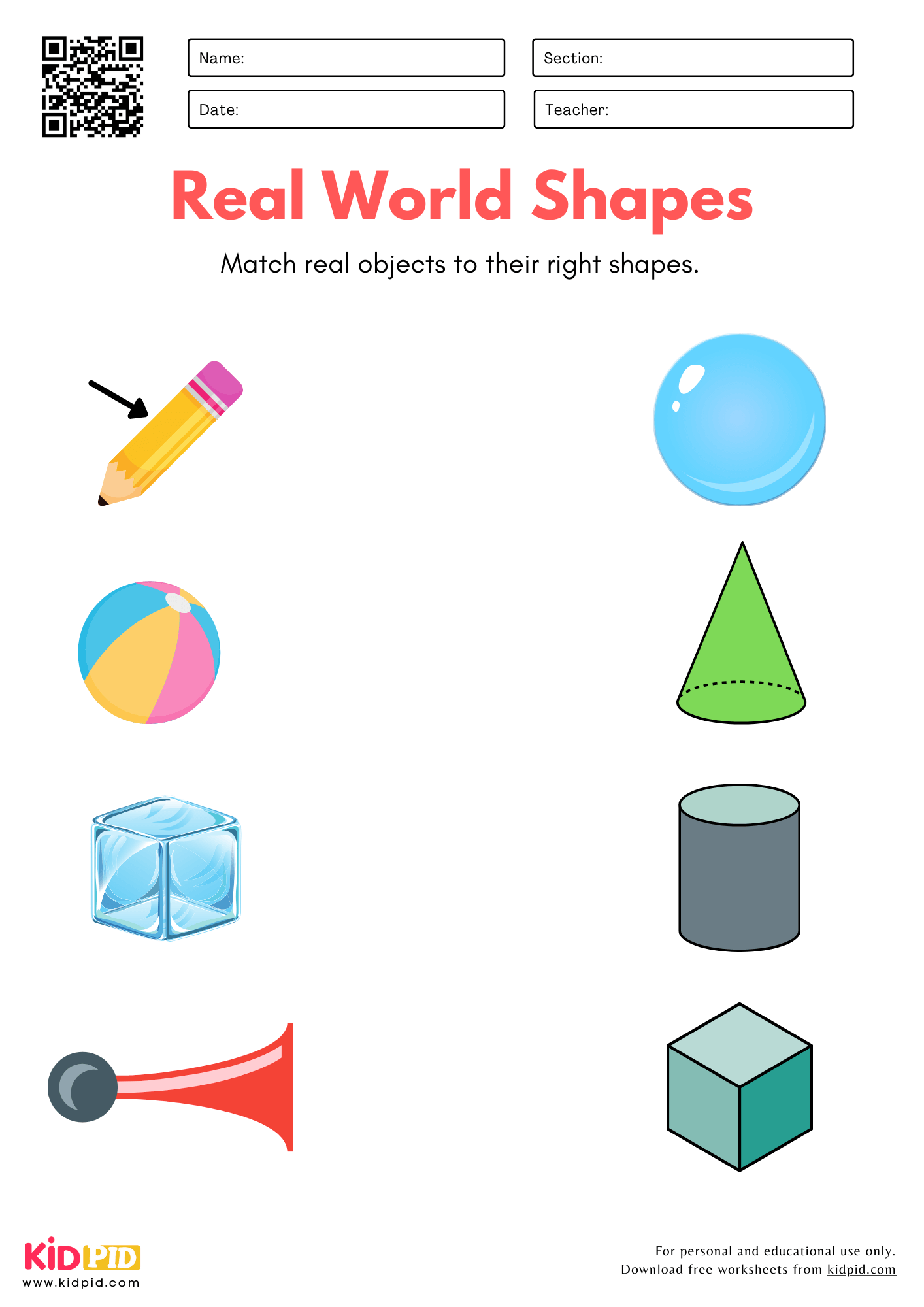
In this fun worksheet, you’ll match real objects to their corresponding shapes. This activity helps you understand how everyday items relate to shapes like circles, squares, and triangles. Grab your pencil and let’s start discovering how shapes are all around us in the real world. It’s a great way to learn while having fun!
[Scroll Down for Download Link]
Contents
- Match Real Objects to Their Right Shapes Worksheet For Kindergarten
- Key Facts About Shape and Real Object Matching Practice Worksheets
- Parts, Types, and Examples of Shape and Real Object Matching Practice Worksheets
- How Does a Shape and Real Object Matching Practice Worksheet Work?
- Benefits of Learning About Shapes and Real Objects
- Learning Objectives
- Worksheet Instructions
- Interesting Facts About Shapes in the Real World
- Vocabulary Words
- Real-Life Applications
- FAQs
- Read More:
Match Real Objects to Their Right Shapes Worksheet For Kindergarten
Read More: Times Tables Multiplication Matching Card Game Flashcards




Early childhood geometry is about much more than just memorizing names; it is the foundation of structural thinking. Here is what makes shape-matching worksheets essential for early learners:
A well-designed geometry worksheet breaks down abstract geometric concepts into relatable, everyday visual puzzles. Effective worksheets typically categorize shapes into clear 2D variations and pair them with distinct physical items.
The process of matching a 2D shape to a 3D real-world item requires a multi-step cognitive loop in a child’s brain:
By utilizing these practice worksheets, young learners will achieve the following educational goals:
To maximize learning and prevent frustration, guide your student through the practice page using these clear, step-by-step instructions.
Keep your student engaged by sharing these fun, real-life shape trivia facts during your lesson:
The learning doesn’t have to stop when the worksheet is put away. You can reinforce these concepts throughout the day:
Answer: Most children can begin recognizing and matching basic geometric shapes around 3 to 4 years old. By age 5 (kindergarten), they should be able to consistently match abstract shapes to complex real-world objects and name them confidently.
Answer: Letter recognition depends entirely on a child’s ability to notice subtle geometric differences. For example, the letters ‘O’ and ‘C’ are built on circular lines, while ‘E’ and ‘L’ use right angles. Mastering shape discrimination ensures they don’t easily confuse similar-looking letters.
Answer: If paper worksheets feel too abstract, switch to hands-on learning. Gather actual items from around the house—like a real round plate, a square coaster, and a triangular block—and have them physically place the items on top of large shapes drawn on pieces of paper. Moving from 3D objects to flat paper builds a stronger conceptual bridge.

Key Facts About Shape and Real Object Matching Practice Worksheets
Parts, Types, and Examples of Shape and Real Object Matching Practice Worksheets
Geometric Shape
Real-World Object Example
Visual Distinguishing Attribute
Circle
Wall clock, coin, bicycle wheel, button
Continuous curved edge, zero corners
Square
Windowpane, chessboard, slice of sandwich bread
Four equal sides, four right angles
Triangle
Slice of pizza, roof of a house, yield sign
Three straight sides, three points/vertices
Rectangle
Classroom door, envelope, smartphone screen
Two long parallel sides, two short parallel sides
Common Worksheet Formats
How Does a Shape and Real Object Matching Practice Worksheet Work?
Benefits of Learning About Shapes and Real Objects
Learning Objectives
Worksheet Instructions
Interesting Facts About Shapes in the Real World
Vocabulary Words
Word
Easy-to-Understand Definition for Young Learners
Geometry
The math playground where we study lines, shapes, sizes, and positions.
2D (Two-Dimensional)
Flat shapes that have height and width but are completely flat, like a drawing on paper.
Attribute
A feature or characteristic that helps describe something, like the color, size, or number of sides on an object.
Vertex (Corner)
The sharp point where two straight lines meet. (Plural: Vertices).
Visual Discrimination
The superpower of using your eyes to see tiny differences and similarities between objects.
Real-Life Applications
FAQs
Q1. At what age should a child start matching shapes to objects?
Q2. How does shape recognition help a child learn how to read?
Q3. What should I do if my child struggles to connect a 3D object to a 2D shape?

Shape and Real Object Matching Practice Worksheets help kindergarten children connect shapes with everyday objects. These engaging activities strengthen shape recognition, observation, vocabulary, and critical thinking while making early learning fun. Explore interactive learning with worksheets, essays, paragraphs, flashcards, quizzes, and interactive resources on our website. Connect with us on YouTube & Facebook.
This worksheet is designed by the Content Team to foster educational learning.
Reviewed By Madhulika
Read More: