


In this worksheet, first graders will match sight words to specific shapes. By writing the words from the provided list into the corresponding boxes, children will enhance their ability to recognize and spell essential sight words. This engaging activity helps improve reading skills by associating words with different shapes, making the learning process both fun and effective for young learners.
[Scroll Down for Download Link]
Contents
- Sight Word Shape Worksheets For Grade 1
- Key Facts About Sight Words By Shape Worksheet for Grade 1
- Parts, Types, and Examples of Shape-Based Sight Words
- How Does a Sight Words By Shape Worksheet Work?
- Benefits of Learning About Sight Words By Shape
- Learning Objectives
- Worksheet Instructions
- Interesting Facts About Sight Words & Vocabulary
- Real-Life Applications
- FAQs
- Read More:
Sight Word Shape Worksheets For Grade 1
Read More: Sight Words Worksheets for Preschoolers


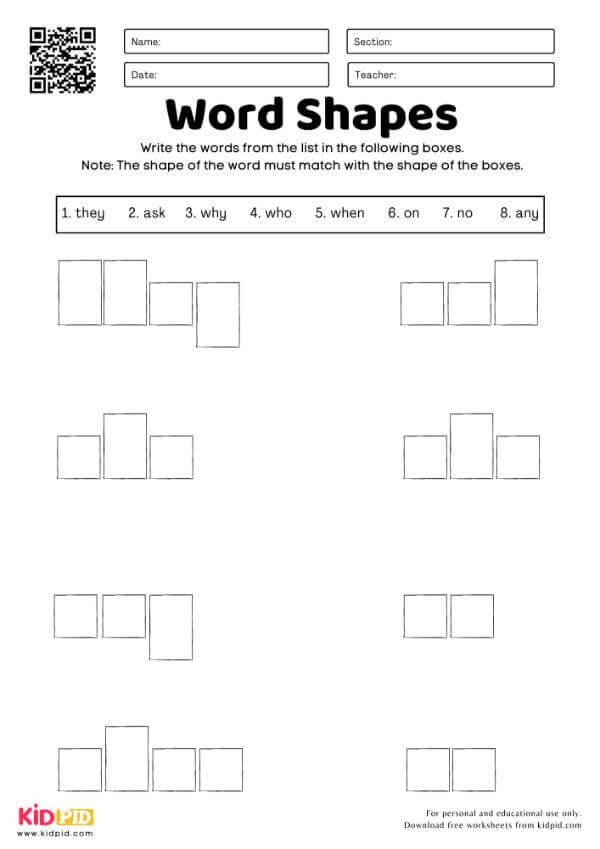
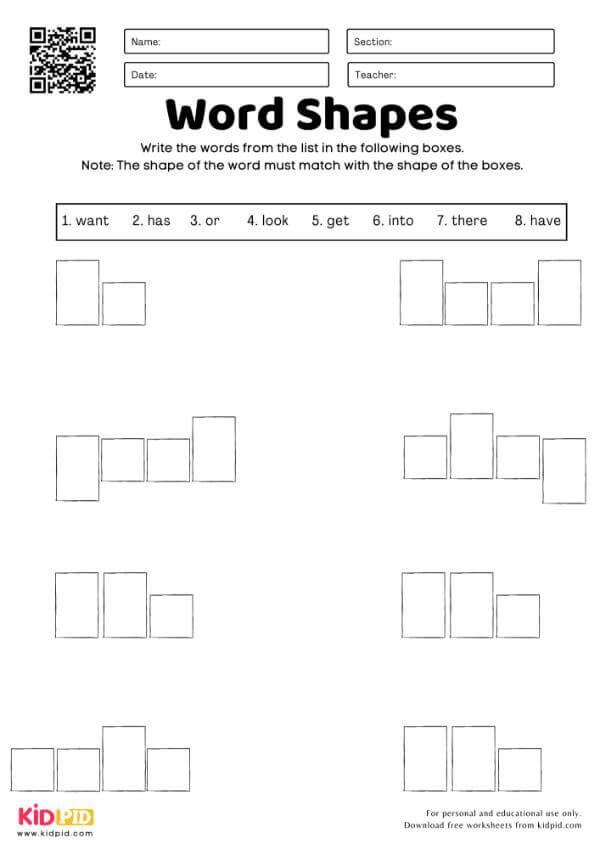
Key Facts About Sight Words By Shape Worksheet for Grade 1
- Target Audience: First-grade students (typically ages 6–7), transitioning kindergarteners, or struggling early readers.
- Core Strategy: Utilizes word configuration boxes (visual boundaries) to teach high-frequency sight words.
- Skill Focus: Structural word recognition, orthographic mapping (connecting sounds to written letters), spelling practice, and reading fluency.
- Pedagogical Alignment: Supports early literacy standards (like Common Core RF.1.3.G) by teaching students to recognize untypical or high-frequency words by sight rather than pure phonics decoding.
Parts, Types, and Examples of Shape-Based Sight Words
When children look at shape worksheets, words are broken down by how their individual letters sit on a baseline. The configuration boxes are divided into three specific physical types of letters:
- Tall Letters (Ascenders): Letters that stretch upward into the top box space. Examples: b, d, f, h, k, l, t.
- Short Letters (Small): Letters that stay entirely within the middle block. Examples: a, c, e, m, n, o, r, s, u, v, w, x, z.
- Tail Letters (Descenders): Letters that drop below the baseline into the bottom box space. Examples: g, j, p, q, y.
Examples of Word Shapes Used in the Worksheet:
- The word “the” Features a tall box (t), a tall box (h), and a short box (e).
- The word “play” Features a short box (p with a tail), a tall box (l), a short box (a), and a tail box (y).
How Does a Sight Words By Shape Worksheet Work?
Young children are highly visual learners who naturally recognize objects by their silhouettes. Shape worksheets leverage this exact instinct. Instead of treating a word as just a flat string of abstract symbols, the worksheet places unique block outlines around each letter.
- A first grader looks at a word list at the top of the page (e.g., and, go, see, look).
- They evaluate the puzzle-like boxes below.
- By matching the physical height and depth of the letters to the physical borders of the boxes, the brain creates a mental “blueprint” of the word. This makes it far easier to retrieve from memory during independent reading sessions.
Benefits of Learning About Sight Words By Shape
- Accelerates Reading Fluency: High-frequency words make up over 50% of all elementary reading material. Mastering them by shape means children don’t get stuck trying to sound out phonetically irregular words like “said” or “was.”
- Prevents Letter Reversals: The physical walls of a shape box make it clear that a
dclimbs high while abclimbs high but on the opposite side, helping children who struggle with spatial awareness. - Builds Pre-Spelling Confidence: Writing words inside structured, self-correcting borders gently forces proper letter sizing and line placement.
Learning Objectives
By completing this worksheet activity, students will be able to:
- Identify and sort Grade 1 sight words based on their visual structure and letter heights.
- Read aloud targeted high-frequency words automatically without relying on slow phonetic decoding.
- Demonstrate correct letter formation by keeping short letters small and properly extending ascenders and descenders.
Worksheet Instructions
Follow these steps to get the most out of this printout:
- Read the Word Bank: Have your child read the list of sight words out loud at the top of the page before picking up a pencil.
- Analyze the Shapes: Pick an empty set of shape boxes. Ask your child: “How many tall boxes do you see? Are there any boxes with tails that hang low?”
- Match and Write: Find the word from the word bank that fits that specific silhouette. Write the letters carefully inside the boundaries using a pencil.
- Cross it Out: Cross out the used word from the top list and move to the next shape puzzle.
Interesting Facts About Sight Words & Vocabulary
- The “Camera” Mindset: Sight words are often called “camera words” because early education experts encourage children to take a mental snapshot of the entire word layout rather than sound it out bit by bit.
- The Dolch & Fry Origins: Most first-grade sight word lists are based on decades-old research by educators Edward William Dolch and Edward Fry, who cataloged the exact words that appear most frequently in children’s literature.
- The “Aha!” Silhouette Effect: Neuroscientists have discovered that skilled adult readers don’t read letter-by-letter; our brains recognize the global shape or silhouette of an entire word instantly! Shape worksheets train young brains to use this exact system early on.
Real-Life Applications
Mastering sight words by shape has immediate benefits outside of the classroom:
- Environmental Literacy: Children will quickly begin pointing out familiar words on cereal boxes, street signs, and grocery storefronts because they recognize the overall shape of the logo text.
- Smoother Storytime: Bedtime reading transitions from a frustrating chore to an enjoyable routine as children start recognizing core text blocks instantly, boosting their overall confidence.
FAQs
Q1. What exactly are sight words?
Answer: Sight words are high-frequency words that children are encouraged to recognize immediately (within a fraction of a second) without needing to decode them phonetically. Many of them do not follow traditional phonics rules (e.g., come, of, the).
Q2. Why do some educators use shape boxes for teaching reading?
Answer: Shape boxes (or configuration boxes) provide a visual scaffold. They break down abstract text into a concrete, spatial puzzle, which naturally matches how a young child’s visual cortex processes symbols and shapes.
Q3. Is learning words by shape a replacement for phonics?
Answer: No, it is a tool meant to work alongside phonics. Phonics is vital for decoding unfamiliar words, while shape recognition is excellent for memorizing common, irregular words that speed up reading flow.
Q4. At what age should a child start using this worksheet?
Answer: This worksheet is ideally designed for first graders (ages 6–7), but it is also highly effective for kindergarteners who are showing advanced interest or second graders who need an extra boost with spelling confidence.

Make Sight words practice more engaging with this Sight Words by Shape Worksheet for Grade 1. Children improve word recognition, reading fluency, vocabulary, and visual discrimination while building confidence through fun shape-based learning activities. Discover worksheets, essays, paragraphs, flashcards, quizzes, and interactive resources on our website to make learning fun and engaging for kids. Follow us on YouTube & Facebook for more educational updates.
The Content Team created this worksheet to advance overall learning success.
Reviewed By Riten
Read More:



