


This Trace Sentence with Pictures Worksheet is an engaging activity designed to help kindergarten students develop their early writing and language skills. By tracing simple sentences paired with corresponding illustrations, children will practice letter formation, build vocabulary, and strengthen their understanding of the connection between words and visual representations. This worksheet is an excellent tool for reinforcing literacy concepts in a fun and interactive way.
[Scroll Down for Download Link]
Contents
- Look At The Picture and Complete The Sentences
- Key Facts About Sentence Tracing Worksheets for Kindergarten
- Parts, Types, and Examples of Picture Tracing Worksheets
- How Do Sentence Tracing Worksheets Work?
- Benefits of Learning with Sentence Tracing Worksheets
- Learning Objectives
- Worksheet Instructions
- Interesting Facts About Early Writing & Literacy
- Vocabulary Words Introduced
- Real-Life Applications
- FAQs
Look At The Picture and Complete The Sentences
Read More: A-Z Letter Focus Worksheets for Preschool

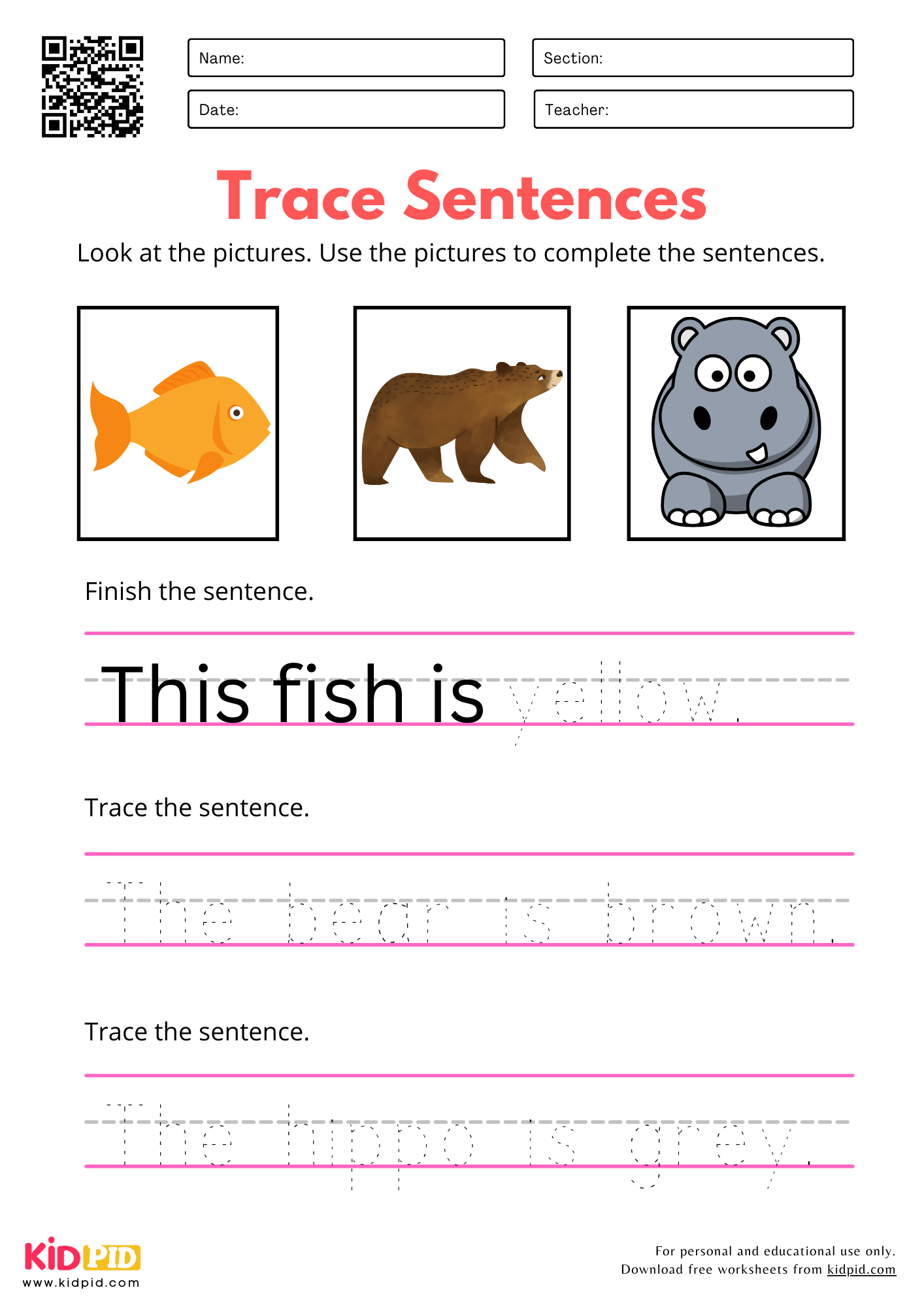
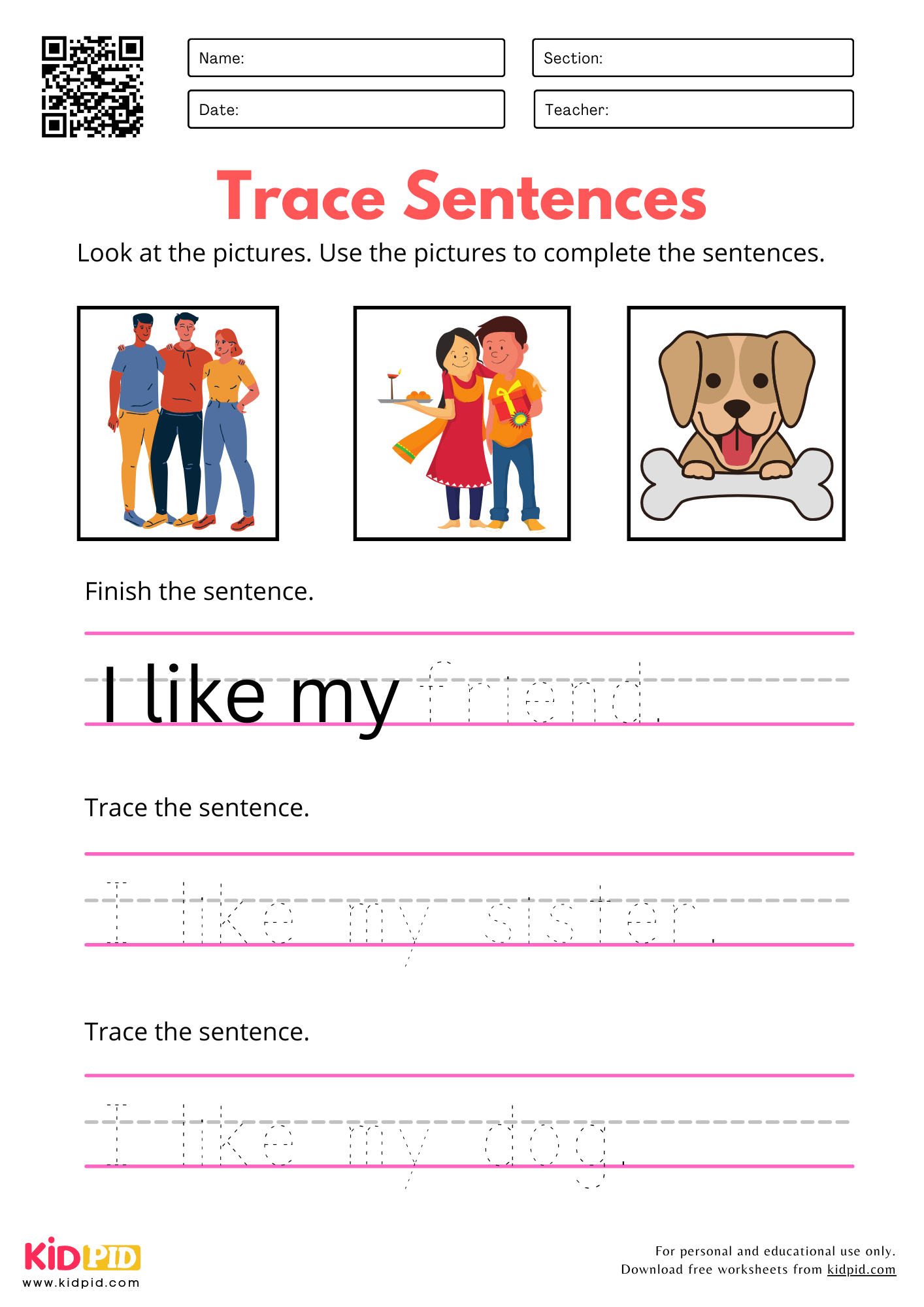

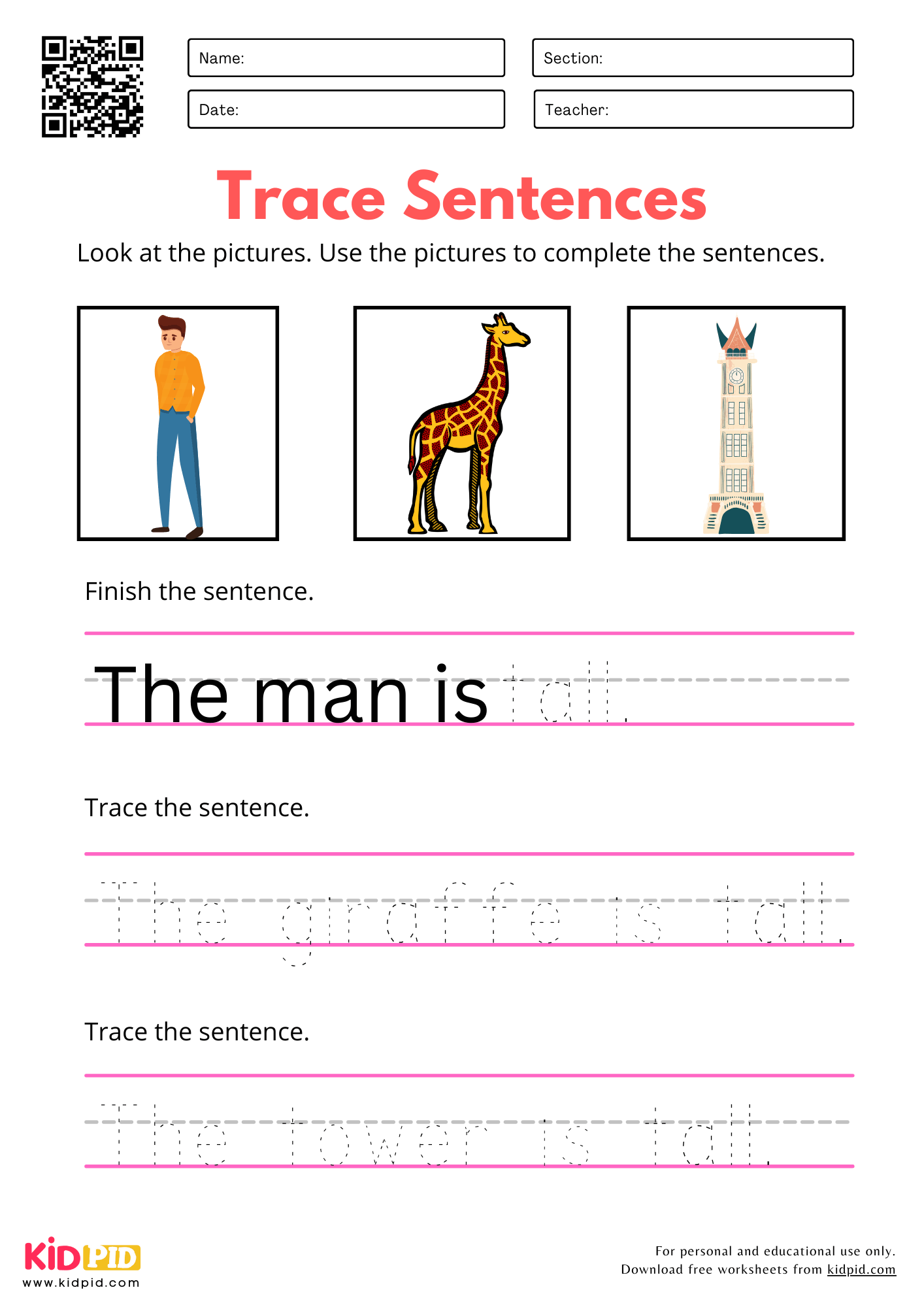

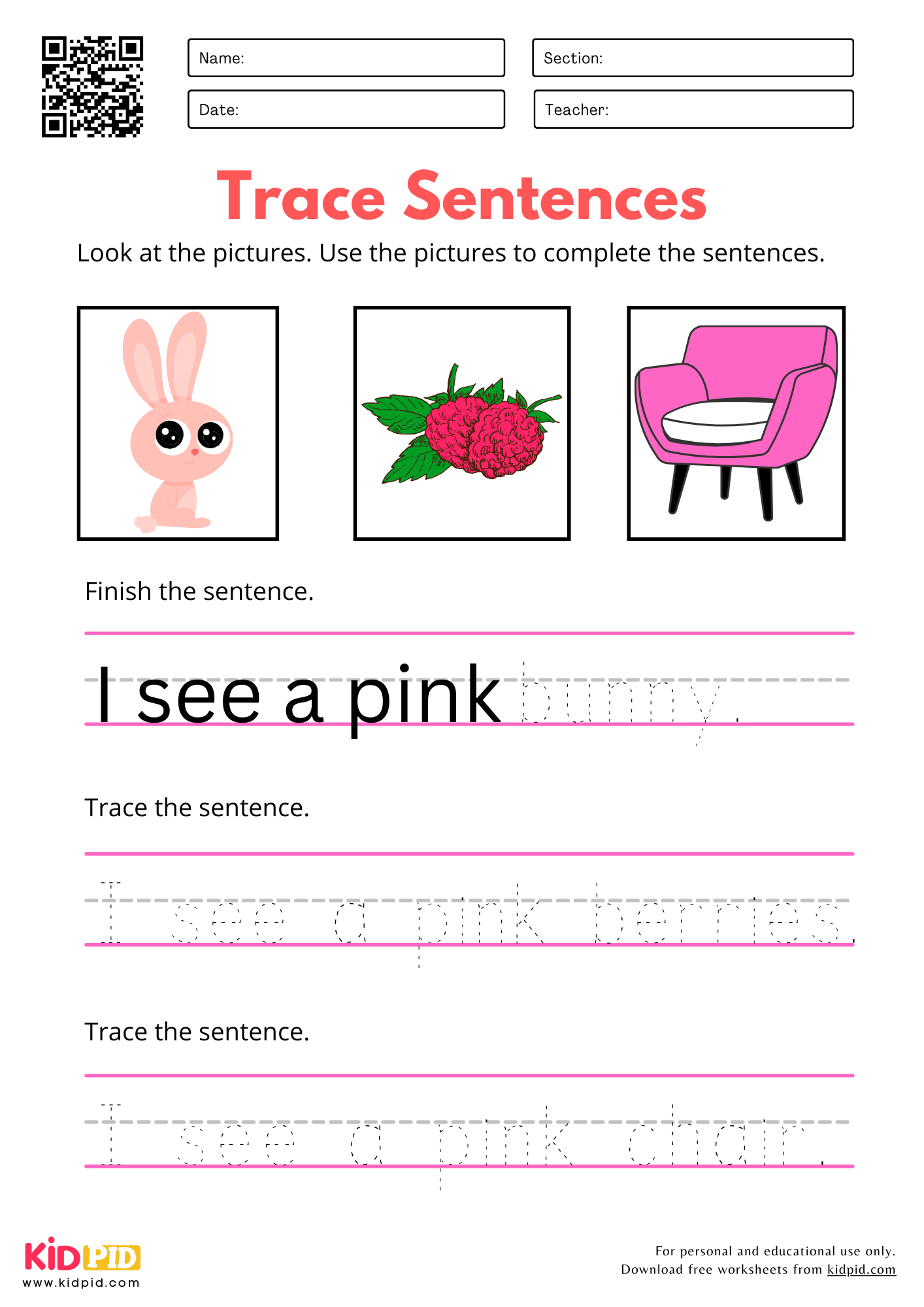
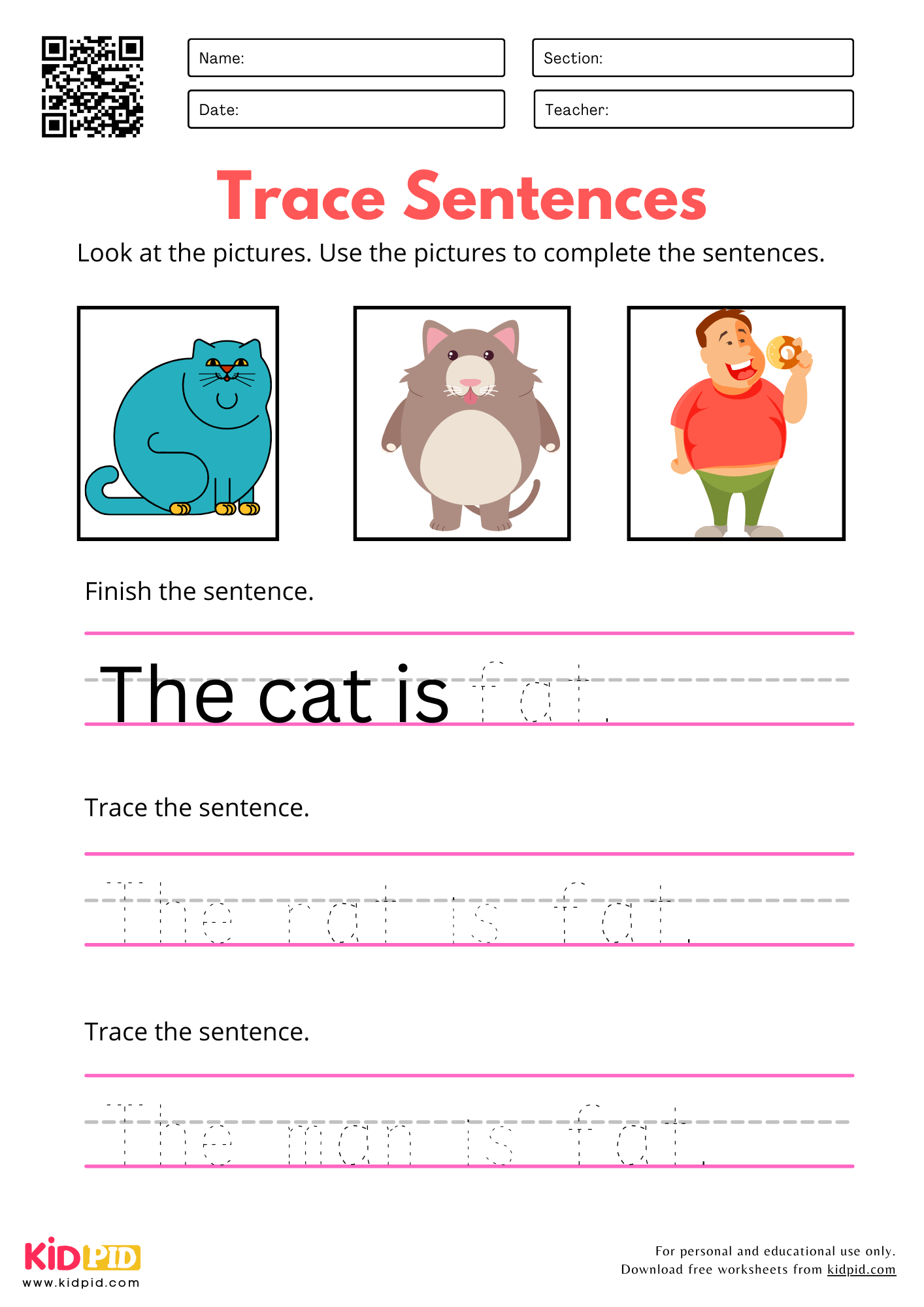
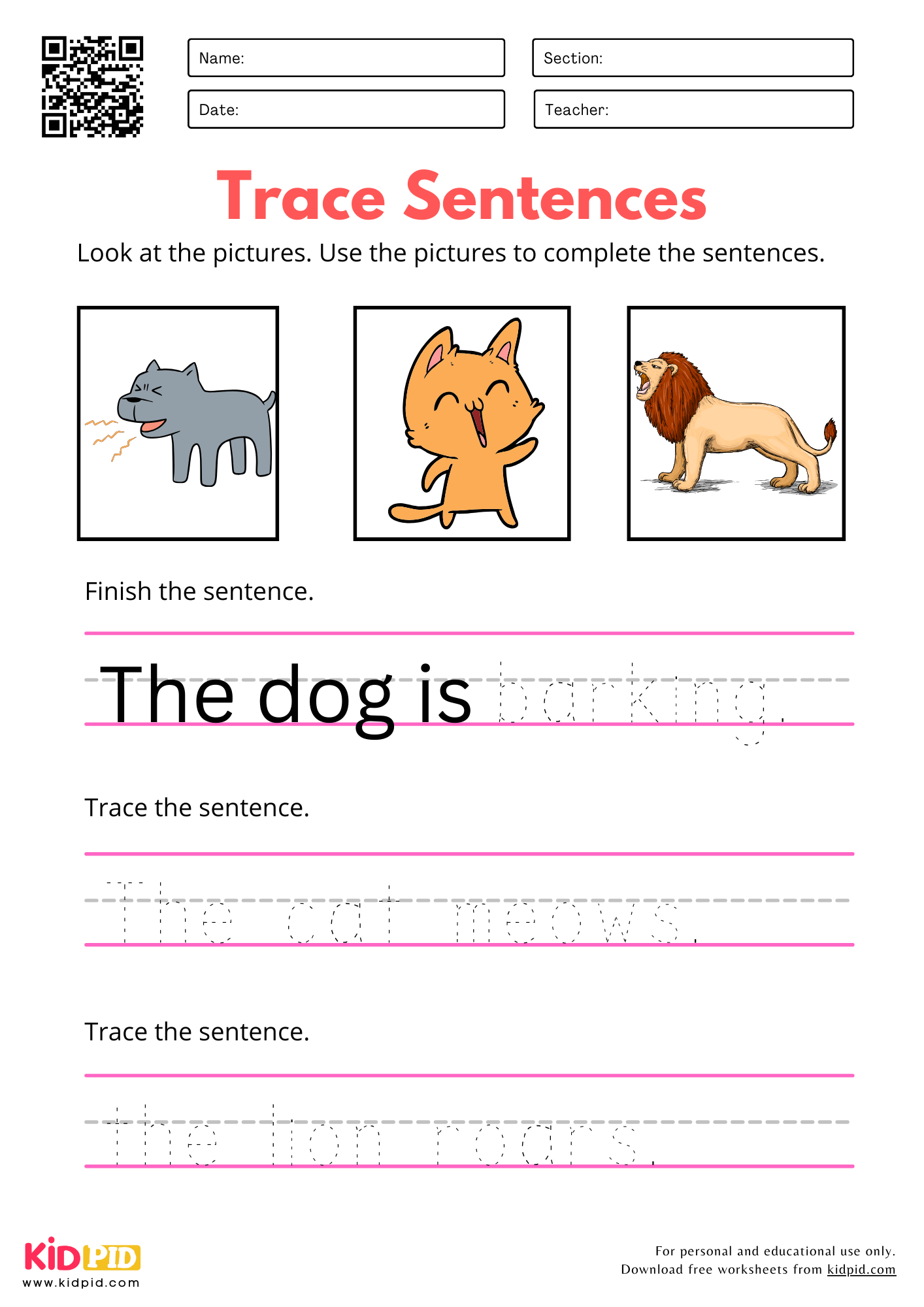

Key Facts About Sentence Tracing Worksheets for Kindergarten
- Developmental Target: Best suited for children ages 4 to 6 who are transitioning from single-letter formation to full-word writing.
- Dual-Sensory Approach: These worksheets combine visual cues (pictures) with physical hand movements (kinesthetic tracking) to build dual-channel memory retrieval.
- Core Literacy Pillars: They simultaneously target three foundational reading skills: concepts of print (tracking left to right), phonological awareness, and orthographic mapping (matching letter shapes to speech sounds).
Parts, Types, and Examples of Picture Tracing Worksheets
Sentence tracing worksheets generally follow a structured progression to prevent cognitive overload in young readers. The primary variants include:
- Sight Word Predictable Sentences: Built around high-frequency words paired with a clear object noun image.
- Example: “I see a [cat image].”
- CVC (Consonant-Vowel-Consonant) Activity Sheets: Focusing on phonetically regular words that children can easily sound out.
- Example: “The [bug image] is on the rug.”
- Action-Based Verb Sentences: Showing characters doing an activity to build vocabulary around action words.
- Example: “The boy can [run image].”
How Do Sentence Tracing Worksheets Work?
These worksheets bridge the gap between abstract letter symbols and meaningful communication through a multi-step cognitive loop:
- Visual Priming: The child looks at the picture to instantly understand the contextual meaning of the sentence before trying to decode the text.
- Left-to-Right Tracking: As they place their pencil at the starting dot of the first word, they practice tracking print across the page.
- Fine Motor Execution: Following the dashed lines strengthens the hand muscle memory needed for proper letter slant, sizing, and spacing.
- Contextual Reinforcement: Reading the sentence back aloud wraps up the exercise, connecting phonetic decoding directly back to the visual image.
Benefits of Learning with Sentence Tracing Worksheets
Using these worksheets consistently offers direct benefits across early childhood development:
- Builds Fine Motor Control: Tracing requires delicate spatial awareness and fine motor precision, directly contributing to pencil grip mastery.
- Boosts Confidence: Traditional open-ended writing can frustrate young learners. Dashed guidelines offer an “academic safety net” that ensures immediate success.
- Improves Word Spacing Conscious Awareness: A common hurdle in kindergarten is writing words jammed together. Tracing visually demonstrates exactly how much space to leave between words.
Learning Objectives
By completing these worksheet activities, students will be able to:
- Form uppercase and lowercase letters with correct stroke order.
- Identify and read basic sight words (e.g., I, see, the, look, a).
- Point to words individually from left to right as they read them aloud.
- Use visual context clues from an illustration to predict and decode unfamiliar words.
Worksheet Instructions
To get the most out of these printables, guide your child through these steps:
- Look and Say: Have the child point to the illustration at the beginning of the row and name what they see.
- Finger Trace: Before picking up a pencil, ask them to trace over the dotted letters using their index finger while reading the sentence.
- Pencil Control: Direct them to pick up their pencil using a proper tripod grip (pinched between thumb and index finger, resting on the middle finger) and slowly trace the dashed lines.
- Coloring Reward: Once the writing is complete, let them color in the picture to reinforce their engagement with the task.
Interesting Facts About Early Writing & Literacy
- The “Write to Read” Connection: Neurological studies show that physically writing letters fires up brain pathways that help children recognize those same letters during reading tasks much faster than typing or viewing them on a screen.
- Hand-Eye Synchronization: Fine motor tracking activities, like keeping a pencil inside a dashed line, stimulate the exact same neural pathways used for visual tracking during reading.
- Semantic Anchor Effects: Children are up to 40% more likely to remember a new sight word if it is paired directly with a matching visual image on the page during their initial exposure.
Vocabulary Words Introduced
- Trace: To follow a line, mark, or path with a pencil or drawing tool.
- Sentence: A complete group of words that tells a whole thought or action.
- Sight Word: A common word that kids learn to recognize instantly by sight without needing to sound it out.
- Tracking: Following words across a page from left to right with your eyes or finger while reading.
Real-Life Applications
The skills practiced on these worksheets show up in everyday childhood activities outside the classroom:
- Reading environmental print: Recognizing signs at the grocery store or park.
- Labeling drawings: Writing a simple caption under an artwork they made at home.
- Functional writing: Writing their name and short messages on a birthday card or gift tag for family members.
FAQs
Q1. What age group is best suited for sentence tracing worksheets?
Answer: These sheets are tailored for children aged 4 to 6 who are in preschool, Pre-K, or kindergarten. They should already have some experience tracing individual letters of the alphabet before moving up to full sentences.
Q2. How many tracing worksheets should a child do per day?
Answer: For kindergarteners, consistency is better than volume. Completing 1 or 2 pages a day is plenty to build strong habits without causing hand fatigue or frustration.
Q3. My child keeps going outside the dotted lines. Is that okay?
Answer: Yes, absolutely! Perfection isn’t the goal. Developing finger strength and spatial awareness takes time. Praise their effort and encourage them to slow down on the next attempt.
Q4. Why are pictures included next to the sentences?
Answer: Pictures act as a helpful context clue. If a child runs into an unfamiliar word, looking at the illustration gives them a hint, which prevents frustration and builds their reading confidence.

Trace Sentence with Pictures Worksheets help kindergarten children practice handwriting, sentence reading, and word recognition while connecting text with images. These engaging activities build confidence, fine motor skills, and early literacy. Discover engaging worksheets, essays, paragraphs, flashcards, quizzes, and interactive resources on our website. Stay connected on YouTube & Facebook.
The Content Team designed this worksheet to advance academic learning.
Reviewed By Manpreet Kaur
Read More:



