Prefixes are the letters placed at the beginning of words to change their meaning. In this worksheet, grade 4 students will practice tracing, writing, and spelling words with common prefixes such as ‘de’, ‘dis’, ‘im’, ‘in’, ‘ir’, and ‘pre’. Understanding prefixes helps students build their vocabulary and read more complex words. So check out these worksheets and recognize the prefix words to enhance your communication skills.
[Scroll Down for Download Link]
Contents
- Trace, Write & Spell Prefix Words Worksheets For Grade 4
- Spelling Practice: With Prefix ‘De’
- Spelling Practice: With Prefix ‘Dis’
- Spelling Practice: With Prefix ‘Im’
- Spelling Practice: With the Prefix ‘In’
- Spelling Practice: With Prefix ‘Ir’
- Spelling Practice: With the Prefix ‘Mis’
- Spelling Practice: With Prefix ‘Pre’
- Spelling Practice: With Prefix ‘Re’
- Spelling Practice: With Prefix ‘Un’
- Key Facts About Words with Prefixes Worksheets for Grade 4
- Parts/Types/Examples of Prefixes
- How Does This Worksheet Work?
- Benefits of Learning About Prefixes
- Learning Objectives
- Worksheet Instructions
- Interesting Facts About Vocabulary Words with Prefixes
- Real-Life Applications
- FAQs
Trace, Write & Spell Prefix Words Worksheets For Grade 4
Read More: Sleuth Spelling Activity Printable Worksheets
Spelling Practice: With Prefix ‘De’

In this worksheet, students will practice the spelling of the prefix words. They have to trace the words, write them, and then cover and spell them accurately for the following words with the prefix ‘de’. It includes words like devote, demand, debates, etc.
Spelling Practice: With Prefix ‘Dis’
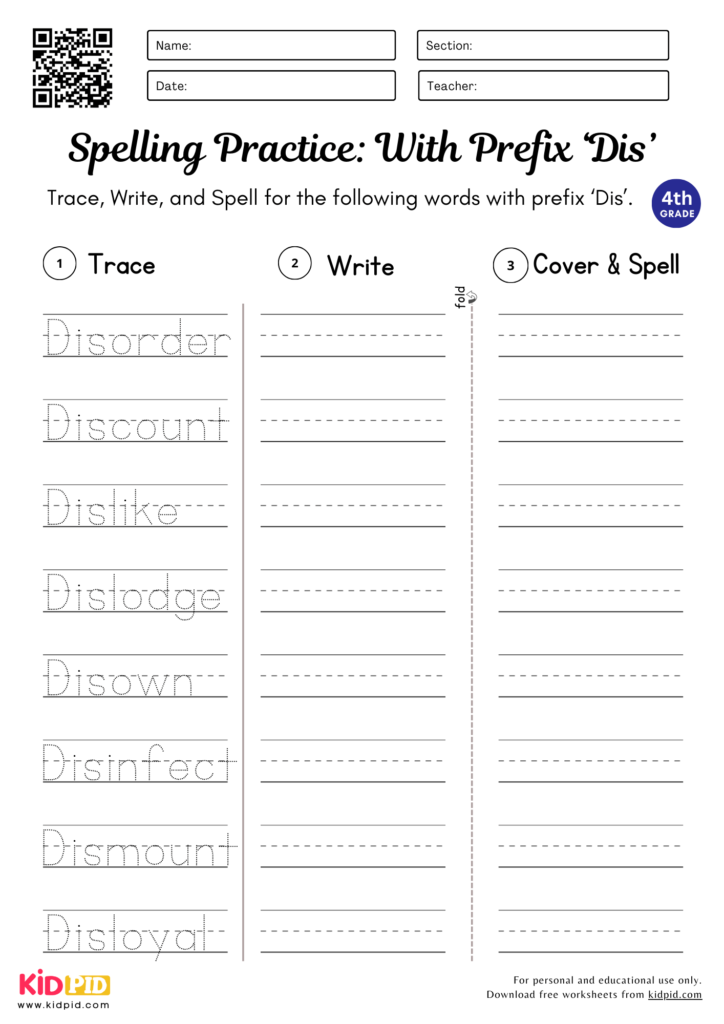
In this worksheet, grade 4 students will learn about the new prefix words and understand them. It includes tracing the words, writing them, and then covering and tracing them accurately for the following words with the prefix ‘dis’.
Spelling Practice: With Prefix ‘Im’
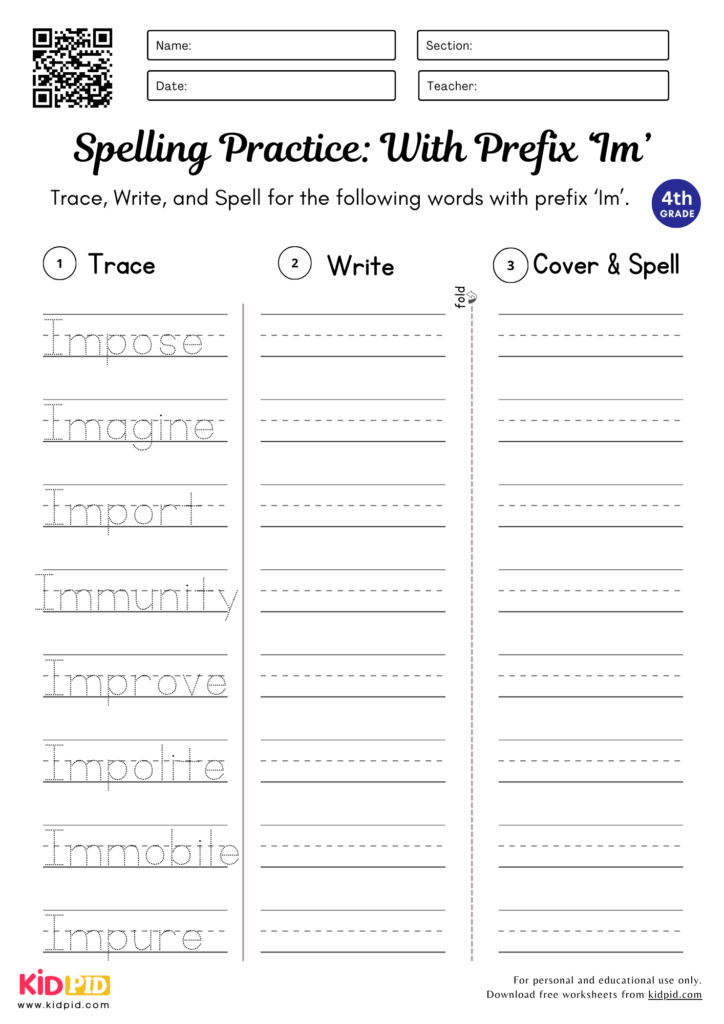
Here are some prefix words that the grade 4 students have to practice. They have to trace the words, write them, and then cover and spell them perfectly to become proficient in these words and understand how to write and spell. It includes words like impure, immobile, etc., as it consists of words with the prefix ‘im’.
Spelling Practice: With the Prefix ‘In’
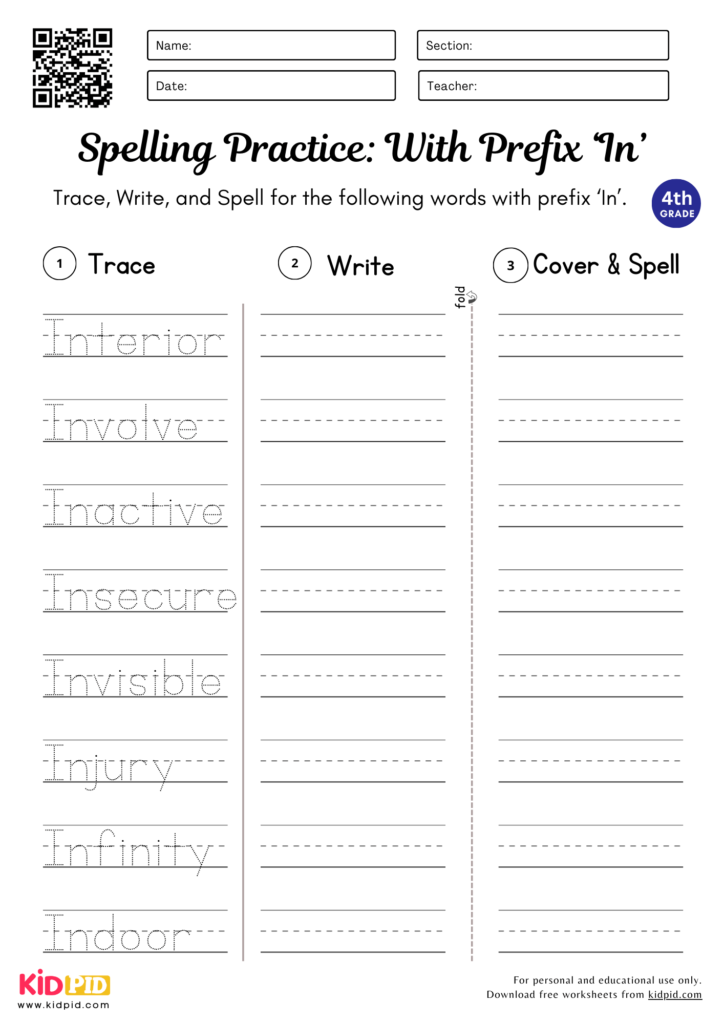
This worksheet is for grade 4 students, in which they have to practice spelling by tracing the words, writing them, and then covering and spelling them accurately for the following words with the prefix ‘in’. Some examples of these words are indoor, infinity, and injury.
Spelling Practice: With Prefix ‘Ir’

In this worksheet, students will practice the spelling of ‘ir’ prefix words. They have to trace the words, write them, and then cover and spell them accurately. It includes some words like irregular, irrelevant, irradiate, etc. So, practice them.
Spelling Practice: With the Prefix ‘Mis’
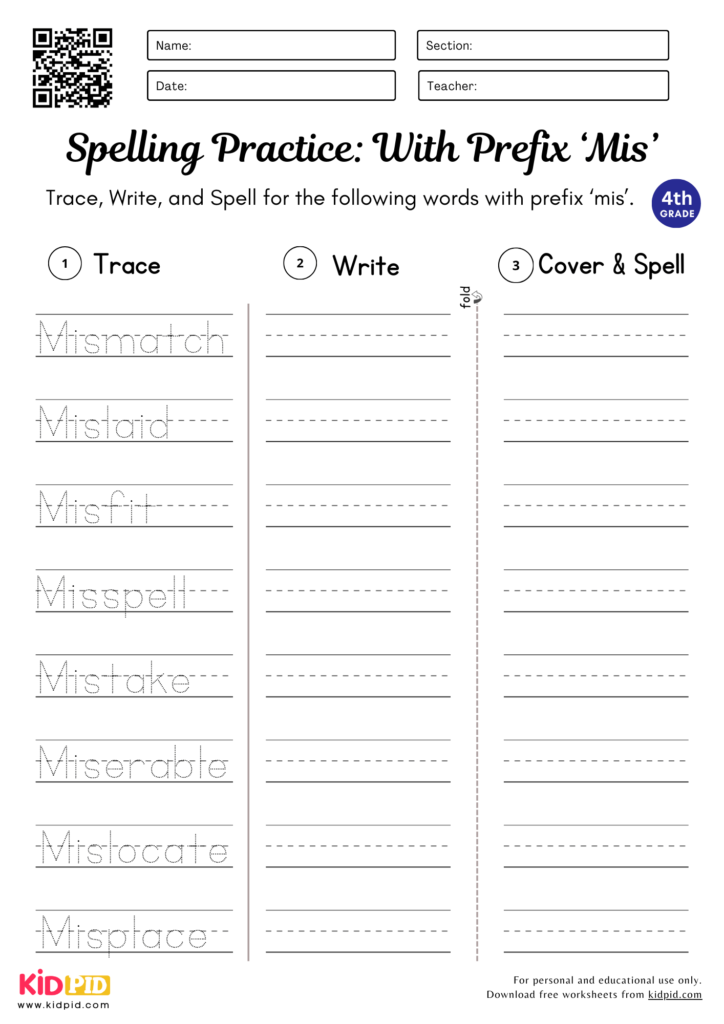
In this worksheet, students have to practice the spelling of the prefix words. They have to trace the words, write them, and then cover and spell them for the following words with the prefix ‘mis’.
Spelling Practice: With Prefix ‘Pre’

Grade 4 students will practice the prefix words and recognize them in this worksheet. It includes activities like tracing the words, writing them, and then covering and spelling them accurately for the following words with the prefix ‘pre’.
Spelling Practice: With Prefix ‘Re’

To practice the spelling of these prefix words, students have to trace the words, write them, and then cover and spell them accurately. It includes some prefix words like redirect, regroup, readjust, etc., as they consist of the suffix ‘re ‘. So,o practice these worksheets and build your knowledge.
Spelling Practice: With Prefix ‘Un’
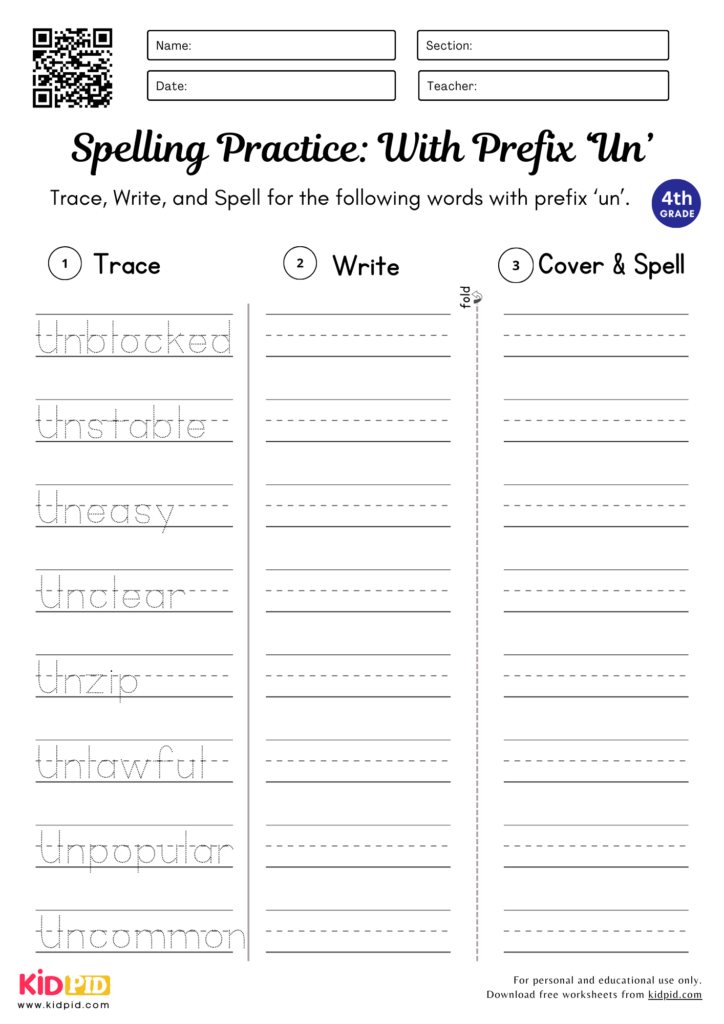
In this worksheet, Grade 4 students will practice the spelling of the prefix words by tracing the words, writing them, and then covering and spelling them perfectly to become proficient in the language. It includes words like uncommon, unpopular, unlawful, etc., as it consists of the prefix ‘un’.
Prefixes are affixes placed at the start of a root word to alter its meaning. For Grade 4, this worksheet focuses on high-frequency prefixes:
This resource utilizes a “Trace, Write, and Recall” methodology designed for multi-sensory learning:
By completing these worksheets, students will:
To get the most out of these printables, follow these steps:
Answer: While introduction starts in Grade 2-3, Grade 4 is the ideal time to focus on complex, high-frequency prefixes to prepare for middle school literature.
Answer: Yes, these are easily printable for home practice or can be used as digital screen-share activities for virtual classrooms.
Answer: Yes. By focusing on the prefix first, the child learns to look for patterns in words rather than memorizing random letter sequences, which is highly effective for students with spelling difficulties.
Key Facts About Words with Prefixes Worksheets for Grade 4
Parts/Types/Examples of Prefixes
How Does This Worksheet Work?
Benefits of Learning About Prefixes
Learning Objectives
Worksheet Instructions
Interesting Facts About Vocabulary Words with Prefixes
Real-Life Applications
FAQs
Q1. At what age should a child start practicing prefixes?
Q2. Can these worksheets be used for remote learning?
Q3. My child struggles with spelling; will this help?

Discover how prefixes change the meaning of words with this Grade 4 worksheet. Students enhance vocabulary, spelling, reading comprehension, and word analysis skills while enjoying meaningful and interactive language practice. Make learning exciting with our collection of quizzes, worksheets, essays, flashcards, paragraphs, and interactive resources for kids. Connect with us on YouTube & Facebook.
The Content Team crafts this worksheet to encourage efficient learning practice.
Reviewed By Sheereen
Read More: