

When the kids are mentally ready, the parents know the kids are learning new things. For example, when you ask a kid of the age of two or three-year-old to count the number of fingers, he’ll probably end up giving the wrong answer. This means the kids know the counting, they just don’t know the correct sequence to it. Start by making the kids count the number of stairs or the number of steps they walk. This helps children begin a new journey by understanding the counting process.
Contents
- Cloud Counting Practice Worksheets
- Key Facts About Kidpid’s Cloud Counting Worksheets
- Parts, Types, and Examples of Cloud Counting Exercises
- How Do Cloud Counting Worksheets Work?
- Benefits of Learning About Counting with Clouds
- Learning Objectives
- Worksheet Instructions
- Interesting Facts About Clouds and Counting
- Vocabulary Words
- Real-Life Applications
- FAQs
- Read More:
Cloud Counting Practice Worksheets

In this edition, we have brought some basic worksheets that will ask your kid to count the number of clouds and write the number for each cloud, respectively. You can help your child learn to count by making them count things that are used in their daily lives. The more practice children have with numbers, the more they will learn the significance of numbers and counting.
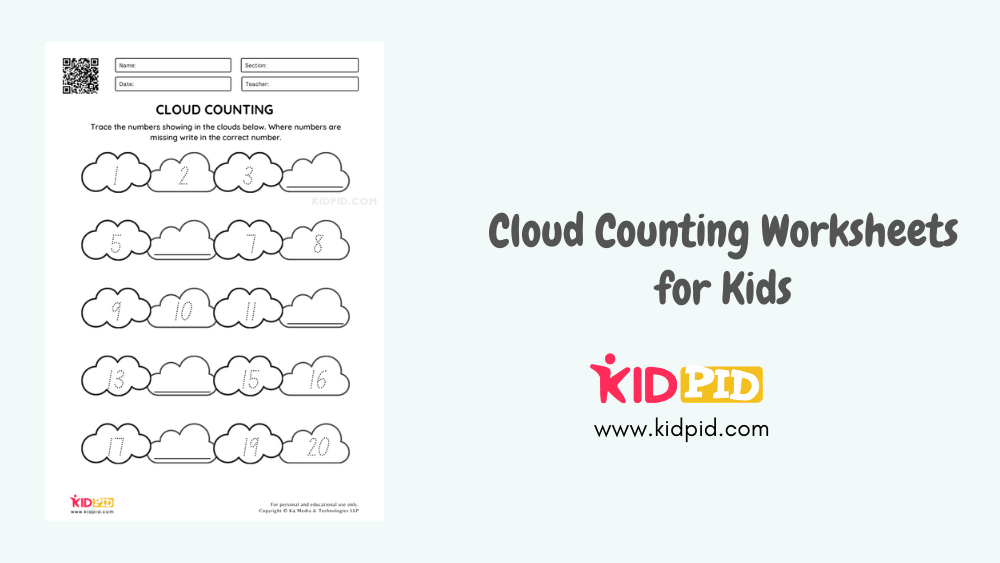
The first worksheet asks the kid to trace the numbers shown in the clouds. Also, they need to write the missing number in the worksheet below. Conjecturing the significance of counting requires experience, and the parents can help in making their child gain experience in that field.
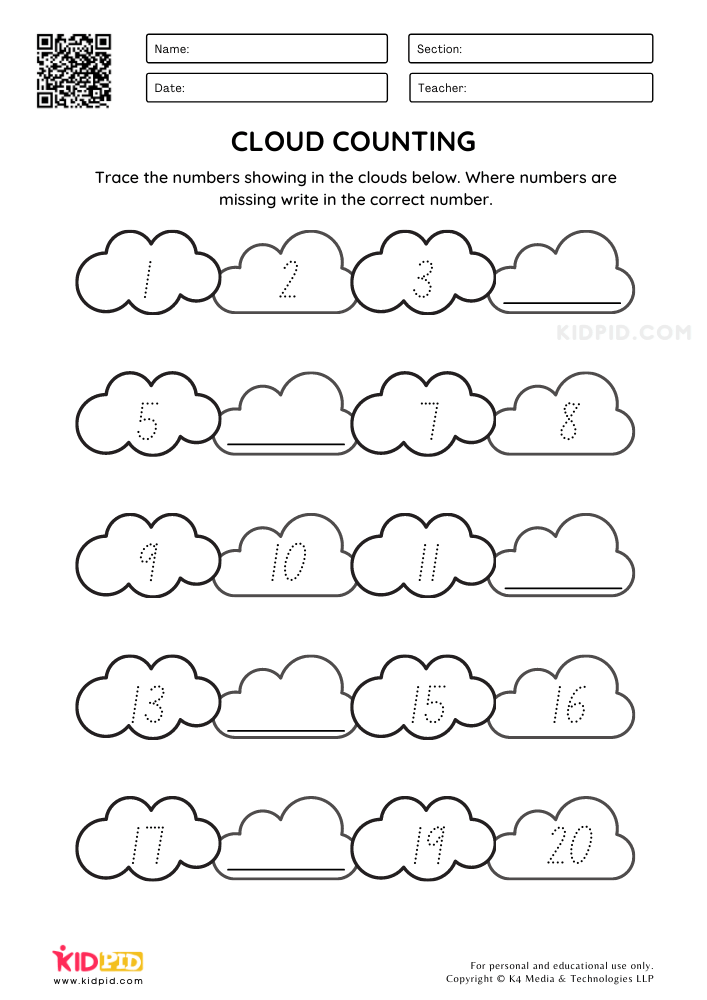
Here, from 21 to 40, all the numbers are given, and the kid needs to find the missing one. You can help your child improve his counting skills when you prepare your dinner. Make your child count the number of vegetables you’re using for dinner.
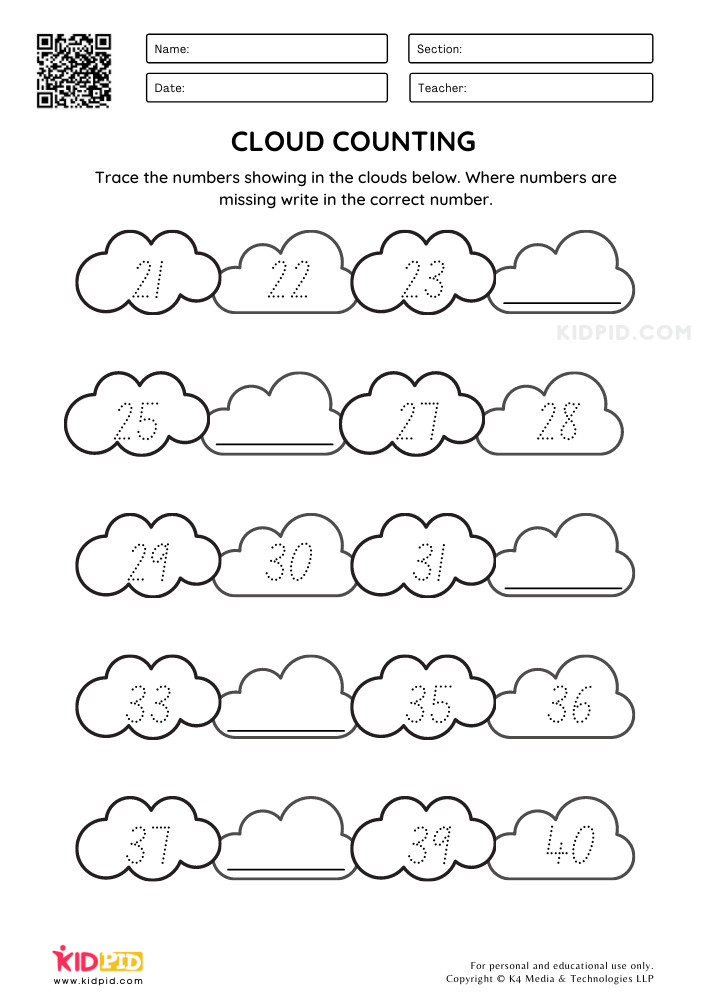
As children grow older, they start to use different ways of finding the answer to the questions. Do not stop them from using their own techniques; it will only benefit them.
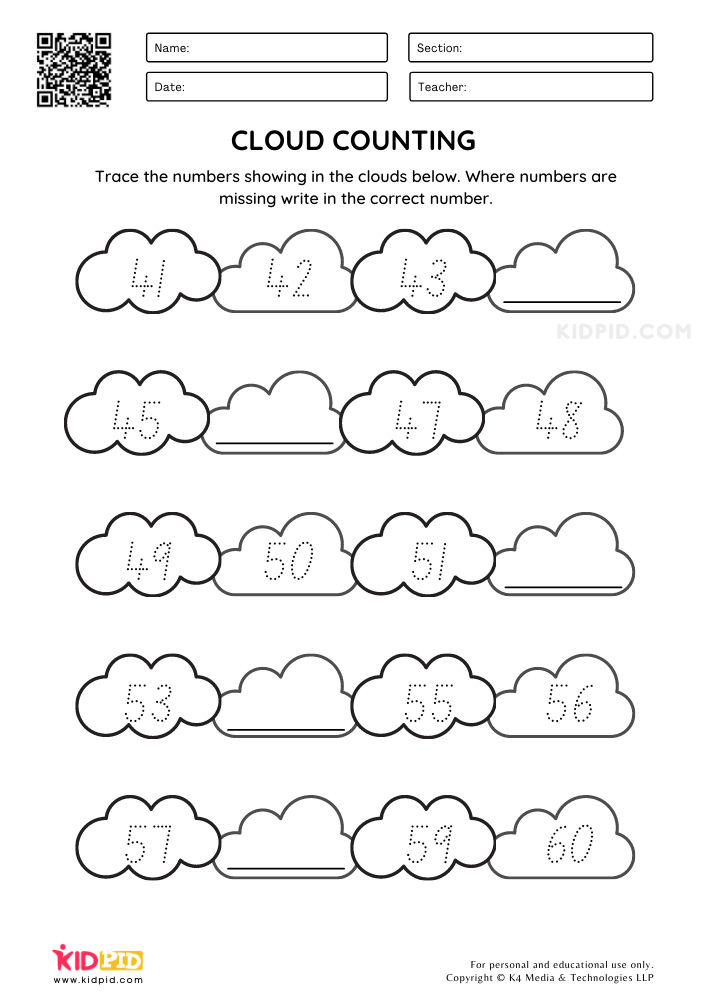
Children are more attracted to something visual than audio. That is why the clouds are designed in the worksheets. The kids solve these problems more because of the clouds than the counting itself.
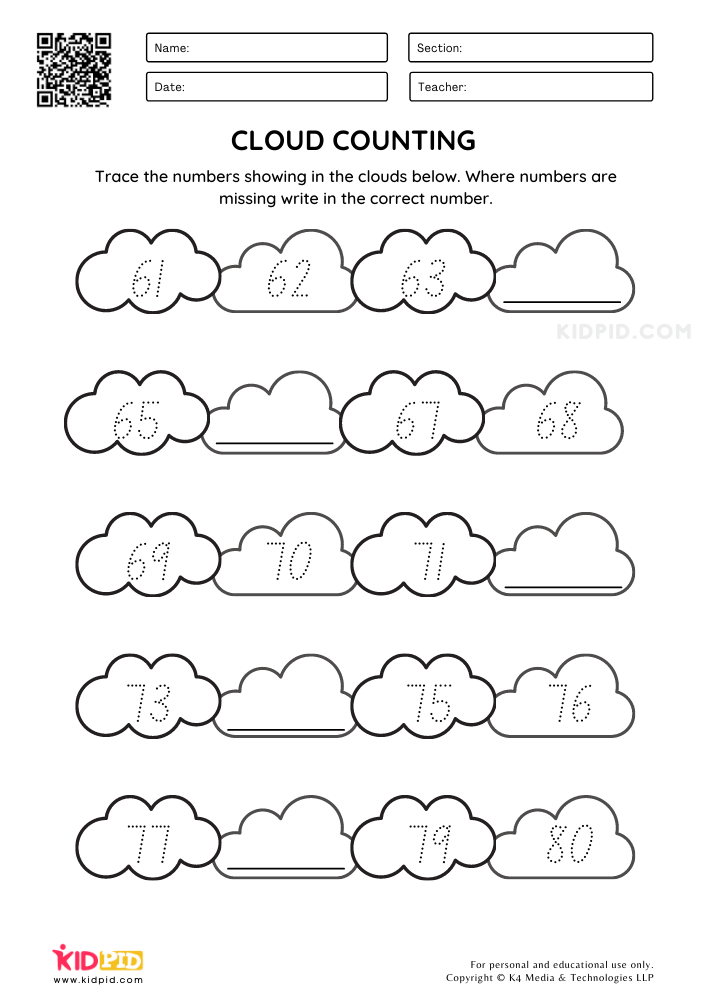
Children learn about numbers and counting, and then they realize what it means in their daily lives. When children understand the concept of these worksheets and start adapting them, the idea of making them work hard is automatically implemented.
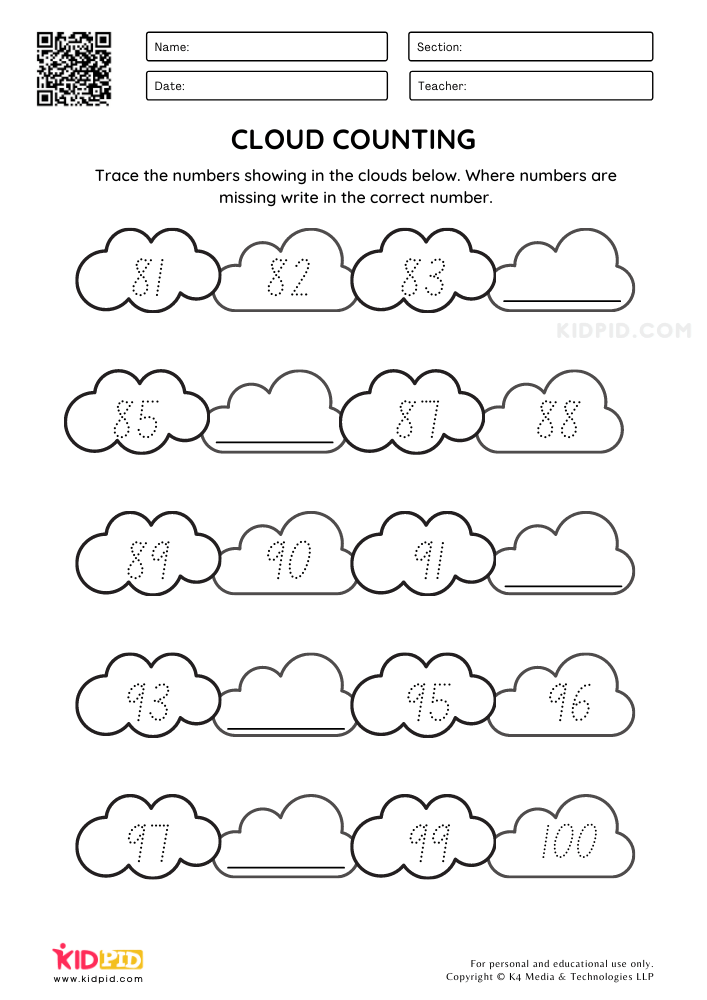
Key Facts About Kidpid’s Cloud Counting Worksheets
Early math development relies heavily on visual association. These worksheets bridge the gap between abstract numbers and concrete, recognizable shapes.
- Target Age Group: Best suited for toddlers, preschoolers, and kindergarteners (ages 2 to 6).
- Focus Area: Sequential counting, number recognition, number tracing, and filling in missing numerical values.
- Skill Range: Covers basic single-digit identification up to advanced early counting from numbers 21 through 40.
- Design Philosophy: Uses friendly, clean cloud graphics to capture attention and reduce the intimidation factor often tied to math drills.
Parts, Types, and Examples of Cloud Counting Exercises
A well-rounded math resource shouldn’t just offer one type of repetition. The Kidpid printable set features several distinct styles of cloud-themed activities to keep young minds engaged:
- Number Tracing Sheets: Clouds featuring faint, dotted guidelines for numbers 1 to 20. These are excellent for building muscle memory and fine motor skills as children trace the shapes of numerals.
- “What’s Missing?” Sequences: A more analytical style where a string of clouds presents a broken sequence (like 21, 22, __, 24, 25). Kids must deduce the missing value to restore order.
- Count and Write Prompts: Pages filled with groups of cute cloud clusters. Children count the total number of clouds in a section and practice writing the correct final sum in the provided answer box.
How Do Cloud Counting Worksheets Work?
The mechanics behind these printables are rooted in scaffolded learning—gradually stripping away aids as a child grows more confident.
First, the worksheets use eye-catching visuals to prompt one-to-one correspondence (the understanding that each object counted represents a specific, single value). As the child moves from one cloud to the next, pointing or coloring them in, they associate the physical touch with a spoken number. Finally, the missing number worksheets challenge their working memory by making them recall what number naturally follows in a sequence without a visual cue to guide them.
Benefits of Learning About Counting with Clouds
Using themed worksheets provides clear cognitive and developmental advantages that set up children for long-term academic success:
- Improves Visual-Spatial Tracking: Following a line of clouds from left to right mirrors the spatial tracking patterns needed for reading words across a page.
- Reduces Math Anxiety: Abstract math symbols can look alien to a four-year-old. Wrapping numbers inside soft, familiar cloud shapes lowers friction and makes learning feel like a game.
- Strengthens Fine Motor Control: Tracing numbers and writing within the boundaries of a cloud requires deliberate hand-eye coordination, which prepares hands for writing complete sentences later on.
Learning Objectives
By completing this worksheet set, young learners will achieve the following developmental milestones aligned with early childhood education standards:
- Identify, read, and write numbers accurately from 1 to 40.
- Demonstrate stable order principles by correctly filling in missing numbers in a sequence.
- Strengthen subitizing skills (the ability to instantly look at a small group of items and know how many there are without counting them one by one).
Worksheet Instructions
To get the most out of this printable packet, guide your student or child using these simple steps:
Interesting Facts About Clouds and Counting
- Nature’s Best Calculator: Long before math worksheets existed, early civilizations used natural elements like stones, shells, and even tracking stars and cloud movements across the horizon to calculate seasons and time.
- Brain Magic: Human brains are hardwired to recognize groups of up to four items instantly without counting. Beyond four objects—like looking at a big group of storm clouds—our minds automatically switch over to rapid serial counting or estimation!
Vocabulary Words
Introduce these key mathematical terms while working through the sheets to help build your child’s educational vocabulary:
- Sequence: An ordered list of numbers that follow a specific, logical pattern.
- Numeral: A symbol or figure used to represent a specific number value (e.g., “7” is the numeral for seven).
- Estimate: Making a smart, educated guess about an amount without taking the time to count every single piece.
- Value: How much a specific number is worth.
Real-Life Applications
Math shouldn’t start and stop at the kitchen table. You can easily extend the lessons from these Kidpid worksheets into everyday routines to cement what your child has learned:
- Weather Watch: On a partly cloudy day, sit by a window or go to a local park. Ask your child to count how many fluffy white clouds they can spot in the sky within a minute.
- Kitchen Helper Math: While prepping meals, have your child count out the vegetables or fruits you need. For example, ask them to count out four potatoes or five carrots to echo the “count and write” worksheet patterns.
- Staircase Counting: Count each step out loud together every time you walk up or down the stairs at home to reinforce structural sequencing.
FAQs
Q1. At what age should my child start using counting worksheets?
Answer: Most children are ready to interact with simple counting worksheets between the ages of 2 and 3, starting with trace lines and one-to-one counting objects.
Q2. What should I do if my child keeps writing numbers backwards?
Answer: Reversing numbers (like writing a 3 or 7 backwards) is completely normal and common for children up to age 7. Use the tracing clouds in our packet to gently correct their hand path without making them feel discouraged.
Q3. How can I make these worksheets reusable?
Answer: Slide the printed sheets into clear plastic sheet protectors or laminate them. Your kids can then use dry-erase markers to practice their cloud numbers over and over again, wiping the pages clean when finished.
These worksheets will encourage them to complete the course of simple mathematics skills in a very simple way. So, give your best to make your kid smart by not letting him get dull or bored. Browse exciting educational activities along with paragraphs, worksheets, flashcards, essays, and quizzes for kids of all ages. Follow us on YouTube & Facebook.
The Content Team designed this worksheet to promote academic success.
Reviewed By Kirti Koshta
Read More:



