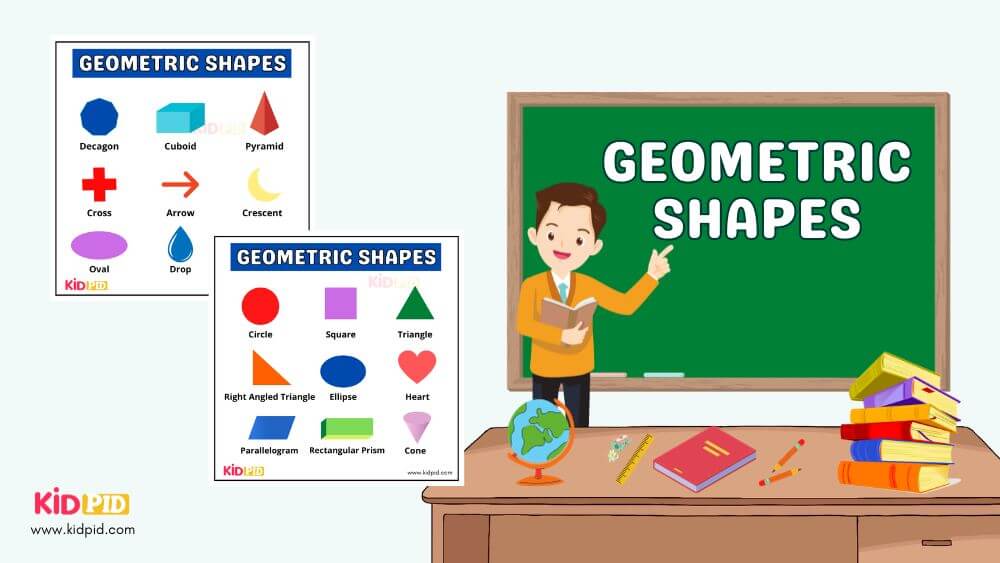
Arranging and understanding different shapes gives children an opportunity to understand the various features of a shape and to balance it with the different things they see in their daily lives. Studying 2D shapes is a fundamental aspect of prospective mathematics education. If children don’t understand the 2D concept, they will not be able to appreciate and realize what 3D shapes are, and will not be able to have control over other concepts.
In this edition, we have brought some fascinating worksheets relating to “2D SHAPE SORTING” for young, energetic learners. Learning about 2D shapes is additionally significant for the determination of various things, as children who cannot realize the sizes of a triangle will not be able to measure it accurately.
Contents
- 2D Shape Sorting Practice Worksheet
- Key Facts About 2D Shape Sorting Worksheets
- Parts, Types, and Examples of 2D Shape Sorting Worksheets
- How Does a 2D Shape Sorting Worksheet Work?
- Benefits of Learning About 2D Shape Sorting Worksheets
- Learning Objectives
- Worksheet Instructions
- Interesting Facts About 2D Shapes
- Real-Life Applications
- FAQs
- Q1. What is a 2D shape sorting worksheet?
- Q2. What age group is suitable for these worksheets?
- Q3. Why is shape sorting important?
- Q4. What shapes are commonly included?
- Q5. Can shape sorting improve problem-solving skills?
- Q6. How can parents use these worksheets at home?
- Q7. Are 2D shape sorting worksheets aligned with early math standards?
- Read More
2D Shape Sorting Practice Worksheet

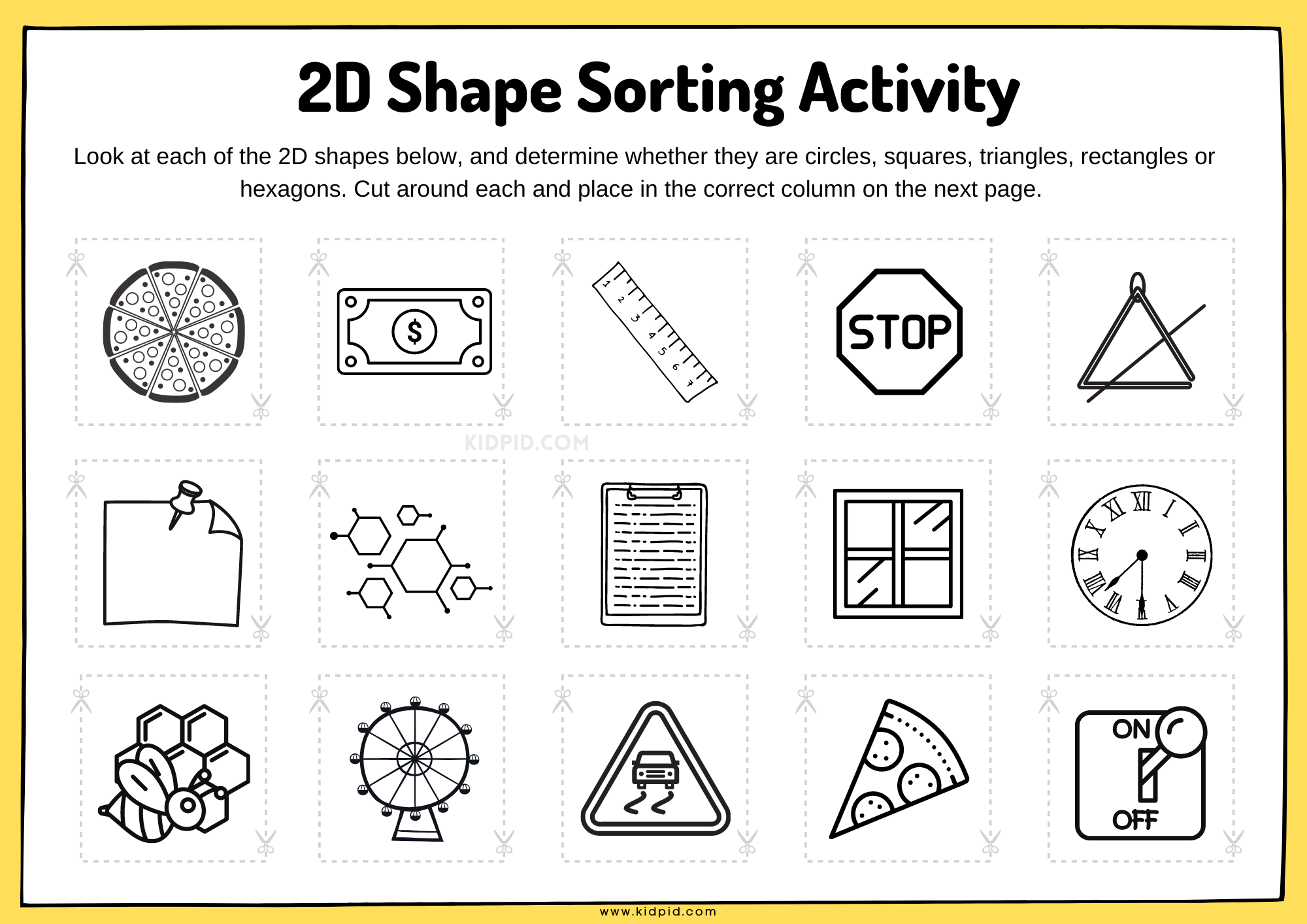
The first sheet below asks the child to look at each 2D shape and determine whether they are circles, squares, triangles, rectangles, or Hexagons. Once they have recognized the shapes, they have to cut them out and paste them on the next worksheet. These worksheets will also help children learn new words like angle, vertex, sides, etc.
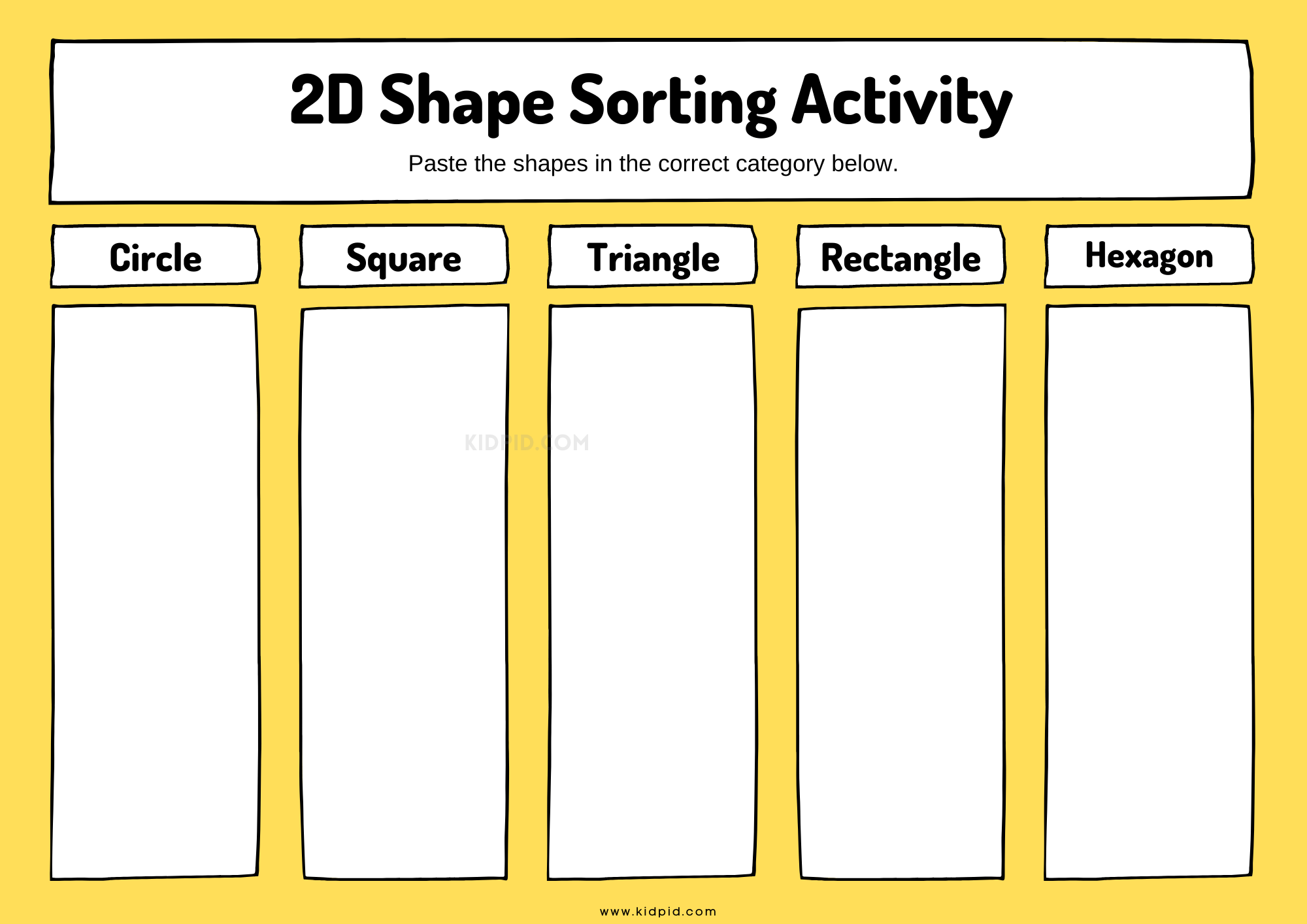
Once the child has understood the shapes of the objects given in the previous sheet, he needs to paste them into the different categories here. In addition to remaining an important aspect of mathematics education, 2D shapes are necessary for creativity and developmental abilities.
The 2D Shapes are the heart of much new design and art education, and also a very good way for people to realize what different objects imply. Children, while working on these worksheets, need to stay attentive and not lose concentration.
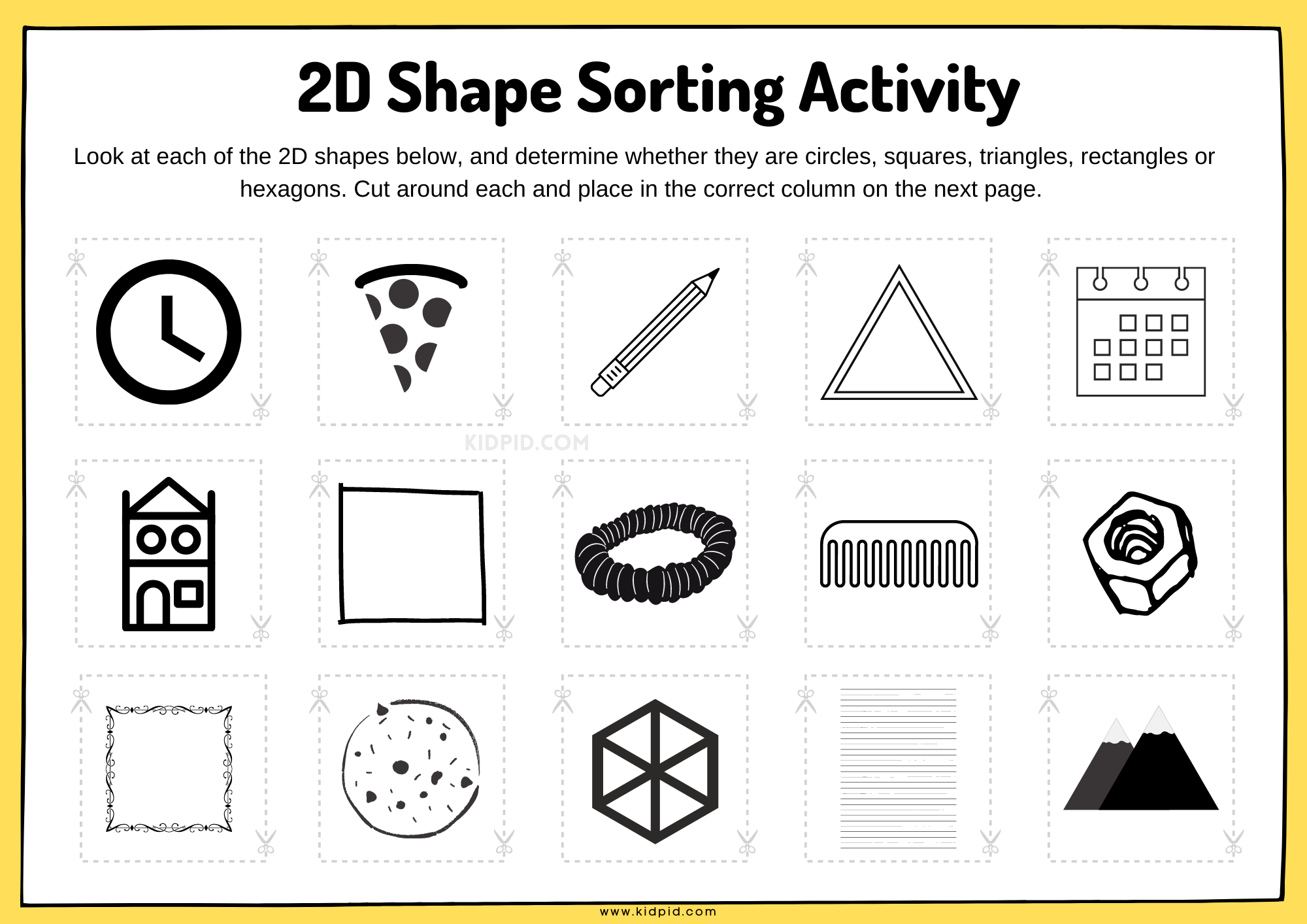
Children who cannot connect with the 2D shapes in this worksheet might have a hard time solving it. The parents and teachers need to stick with them, as these are some of the important concepts in their mathematics journey.
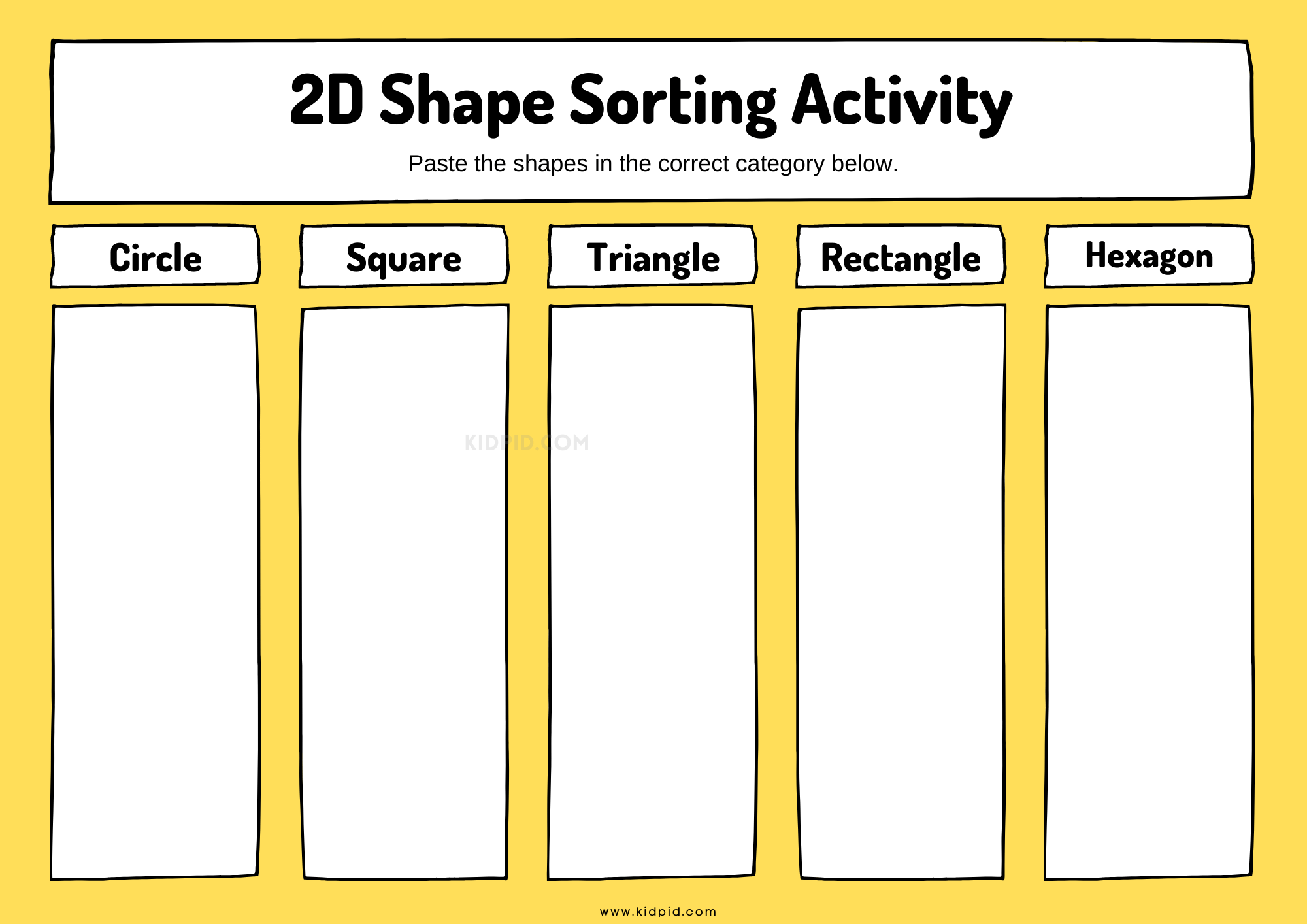
The 2D shapes are those aspects that can only be estimated by length and breadth; they have no base. Customarily, they are photos given in the worksheet below, and the children can measure the different objects.
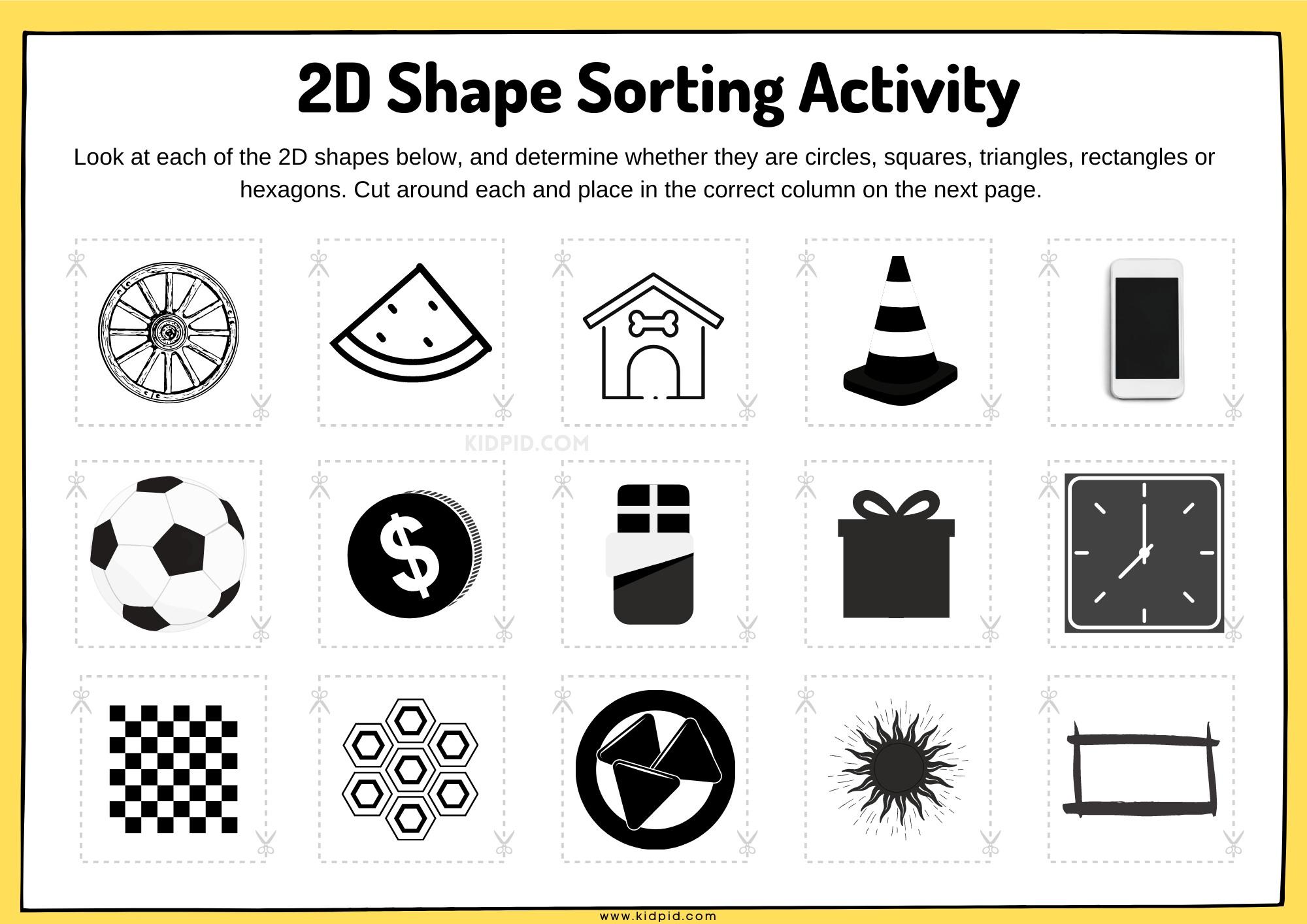
To learn to distinguish different shapes, children must see patterns of them. Unmixed pictures of each 2D shape and reading the name of the shape will prove to be beneficial for the children, so that they can actually understand them.
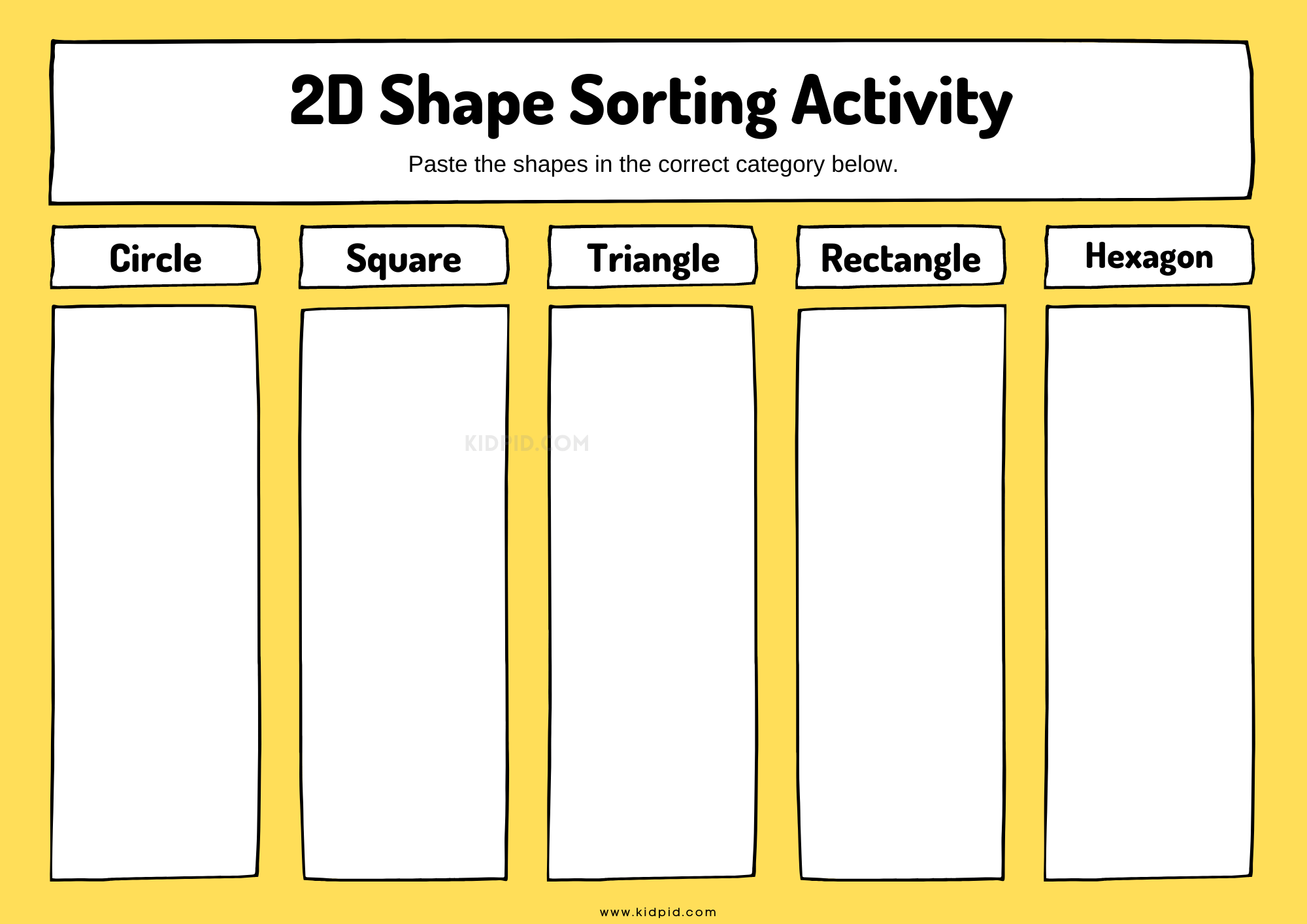
Teachers and parents should consult with the children about the properties and features of every shape, including the different sides the shape has, and whether all the edges and vertices are accurate, rounded, or not.
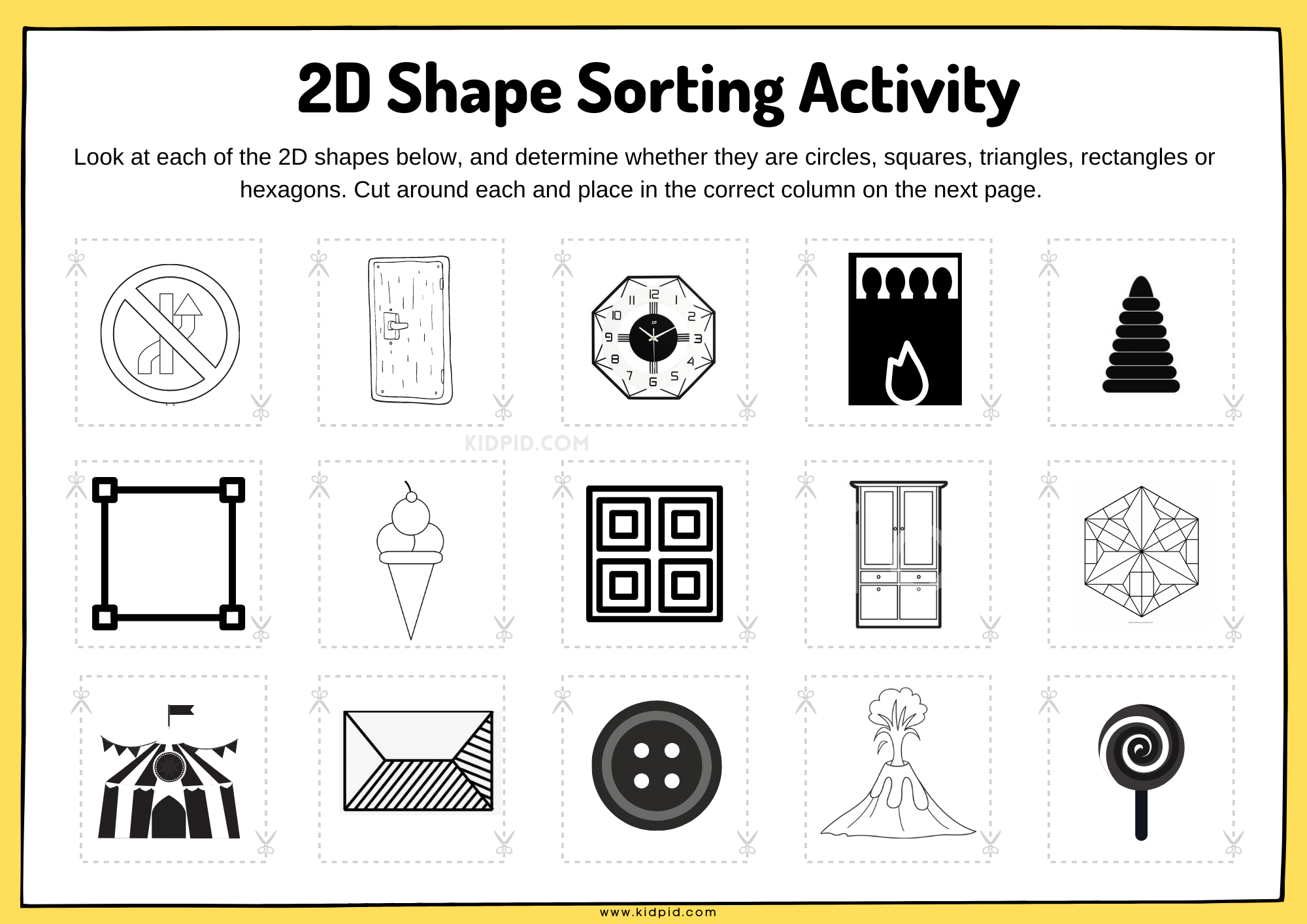
Children can begin by studying the shapes that are most apparent to identify, like the circle, triangle, and rectangle. Subsequently, they can move on to different shapes like squares and Hexagons. This will become a great learning curve for them.
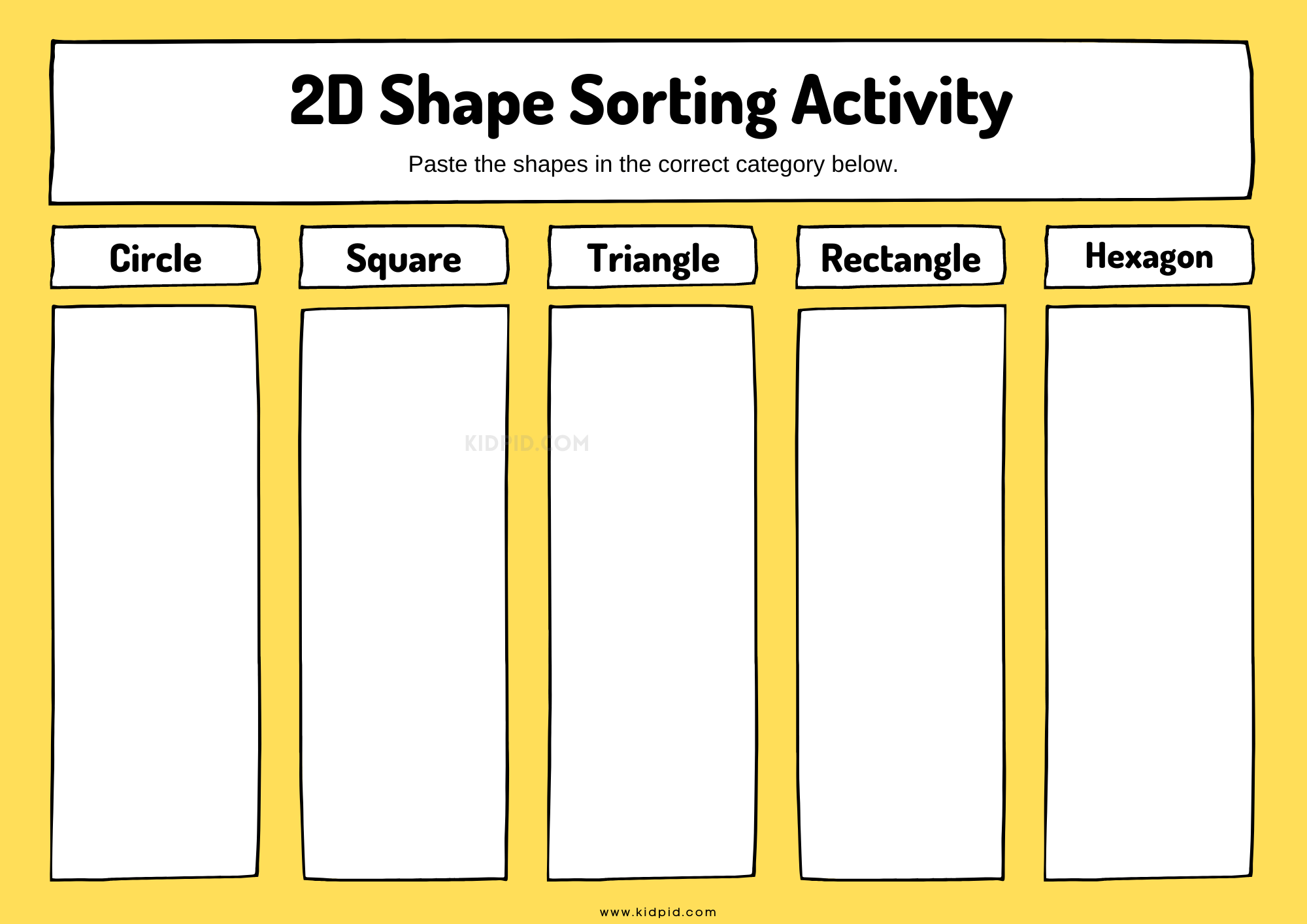
After the children have understood the concept of 2D shapes, they should develop skills to deepen their knowledge. The children should look for the 2D shapes around them, and then create them by using their information and understanding.
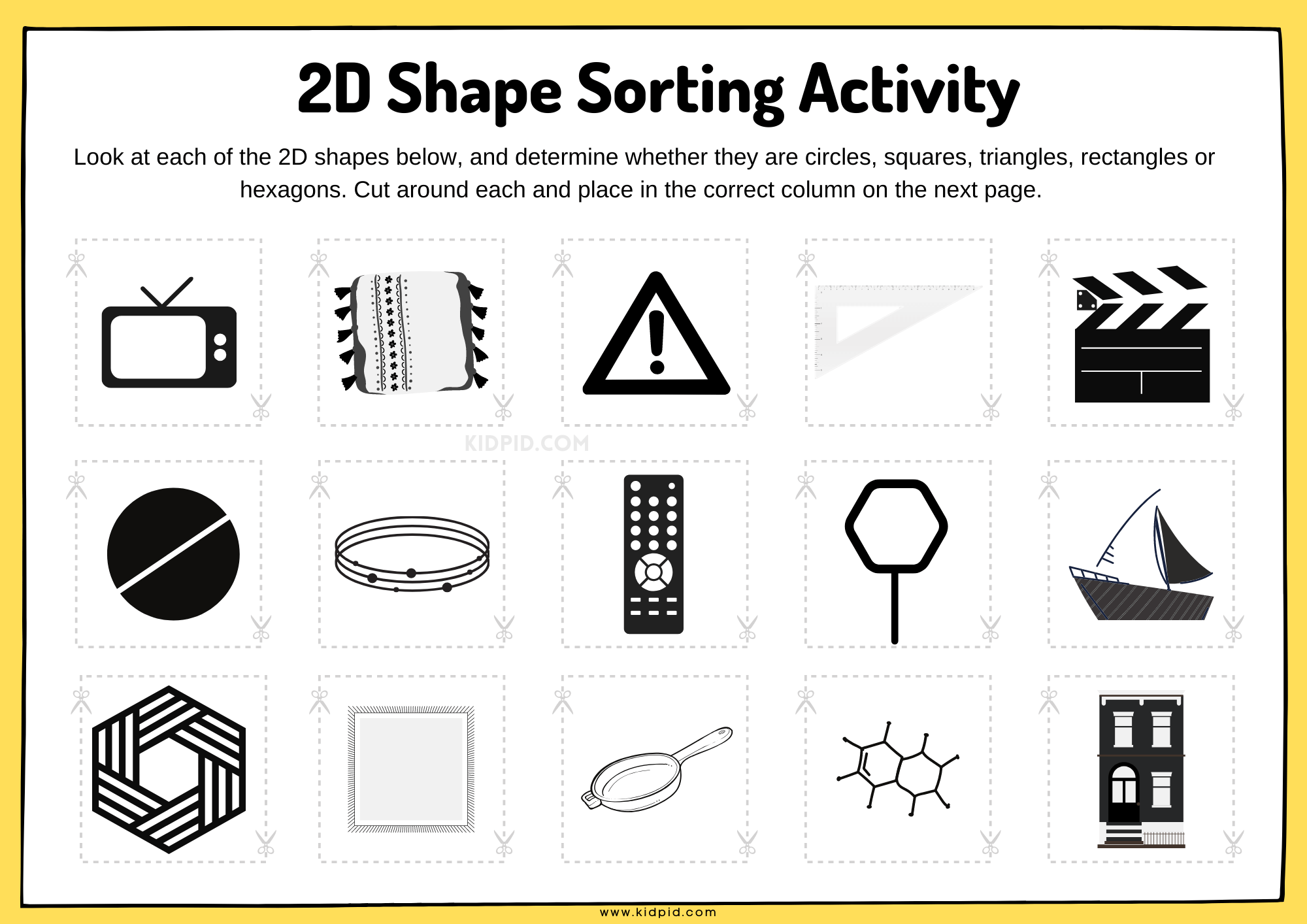
This is the tenth and last worksheet of our session. From an immature stage, the children discern several shapes even if they don’t yet know their names. It takes long-drawn time for young kids to understand the particular characteristics of each shape. And these sheets will definitely help them understand.
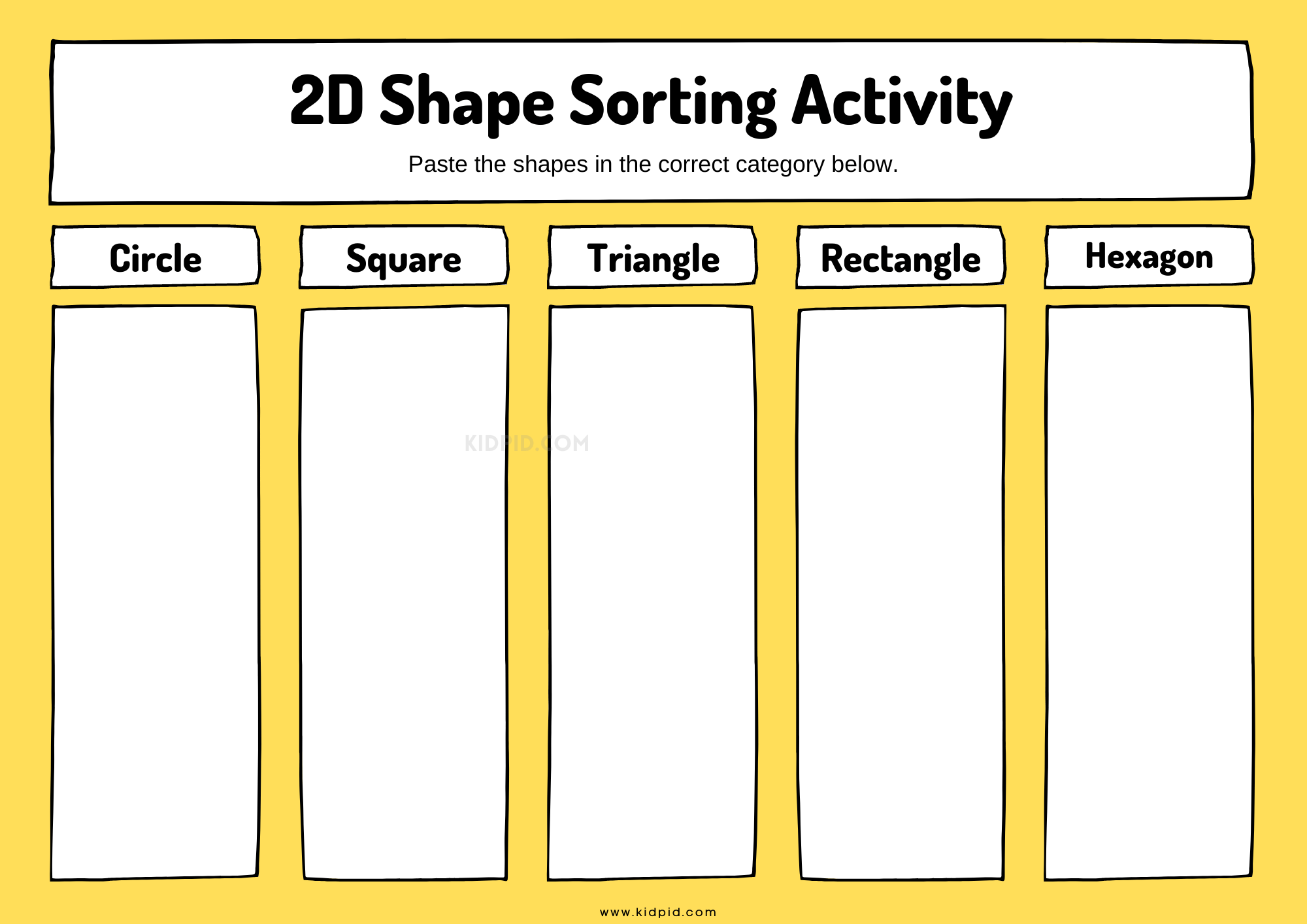
Key Facts About 2D Shape Sorting Worksheets
2D Shape Sorting Worksheets help children identify, classify, and organize flat geometric shapes based on their attributes. These worksheets introduce foundational geometry concepts through engaging sorting activities.
- Designed for preschool, kindergarten, and early elementary learners.
- Focuses on recognizing common 2D shapes such as circles, squares, triangles, rectangles, ovals, and hexagons.
- Encourages critical thinking and visual discrimination skills.
- Helps children compare shapes by sides, corners, and overall appearance.
- Supports early math readiness and problem-solving development.
- Uses hands-on and visual learning techniques for better understanding.
Parts, Types, and Examples of 2D Shape Sorting Worksheets
Parts of a 2D Shape Sorting Worksheet
- Shape Images: Various geometric shapes for identification.
- Sorting Categories: Labels or boxes where shapes are grouped.
- Instructions Section: Directions explaining the sorting task.
- Practice Activities: Exercises that reinforce shape recognition.
Types of 2D Shape Sorting Worksheets
- Shape-to-Shape Matching
- Sorting by Number of Sides
- Sorting by Corners or Vertices
- Color and Shape Sorting
- Real-World Object Shape Sorting
- Cut-and-Paste Shape Classification
Examples
- Place all circles in one group and all squares in another.
- Sort shapes with three sides separately from shapes with four sides.
- Categorize shapes by curved and straight edges.
How Does a 2D Shape Sorting Worksheet Work?
A 2D Shape Sorting Worksheet presents students with different shapes and asks them to classify those shapes according to specific rules. Children examine each shape’s characteristics, such as sides, corners, or curves, and place it into the correct category.
The process helps learners:
- Observe shape attributes.
- Compare similarities and differences.
- Group shapes correctly.
- Strengthen geometric reasoning skills.
- Build confidence in recognizing patterns and classifications.
Benefits of Learning About 2D Shape Sorting Worksheets
- Improves shape recognition skills.
- Develops visual perception and observation abilities.
- Strengthens logical thinking and classification skills.
- Enhances early geometry understanding.
- Encourages independent learning and problem-solving.
- Supports fine motor development in cut-and-paste activities.
- Builds a strong foundation for advanced mathematical concepts.
- Makes learning interactive and enjoyable.
Learning Objectives
By completing 2D Shape Sorting Worksheets, children will be able to:
- Identify common 2D geometric shapes.
- Differentiate between shape attributes.
- Sort shapes based on sides, corners, and curves.
- Improve visual discrimination skills.
- Develop critical thinking and reasoning abilities.
- Apply shape knowledge to everyday situations.
- Build confidence in early mathematics.
Worksheet Instructions
- Look carefully at each shape shown on the worksheet.
- Read the sorting categories provided.
- Identify the characteristics of each shape.
- Place or draw each shape in the correct category.
- Double-check your answers before finishing.
- Discuss why each shape belongs in its group.
- Complete all sorting sections for extra practice.
Interesting Facts About 2D Shapes
- A 2D shape has only length and width.
- Circles have no sides and no corners.
- Triangles always have three sides and three vertices.
- Squares have four equal sides.
- Rectangles have equal and opposite sides.
- Hexagons have six sides.
- Many everyday objects are based on 2D shapes.
- Geometry begins with learning simple 2D shapes.
Real-Life Applications
2D shape recognition is used in many everyday situations:
- Reading road signs and symbols.
- Understanding maps and diagrams.
- Designing buildings and architecture.
- Creating artwork and crafts.
- Organizing objects by shape.
- Learning computer graphics and design.
- Recognizing patterns in nature.
- Developing engineering and construction skills.
Children who understand shapes often find it easier to solve visual and spatial problems later in life.
FAQs
Q1. What is a 2D shape sorting worksheet?
Answer: A 2D Shape Sorting Worksheet is an educational activity that helps children identify and classify flat geometric shapes based on their characteristics.
Q2. What age group is suitable for these worksheets?
Answer: These worksheets are generally suitable for children aged 4–8 years, including preschool, kindergarten, and early elementary students.
Q3. Why is shape sorting important?
Answer: Shape sorting develops visual discrimination, logical thinking, geometry skills, and classification abilities that support future math learning.
Q4. What shapes are commonly included?
Answer: Common shapes include circles, squares, triangles, rectangles, ovals, pentagons, and hexagons.
Q5. Can shape sorting improve problem-solving skills?
Answer: Yes. Shape sorting encourages observation, comparison, analysis, and decision-making, all of which strengthen problem-solving skills.
Q6. How can parents use these worksheets at home?
Answer: Parents can use the worksheets alongside everyday objects, asking children to identify and sort items by shape for additional hands-on learning.
Q7. Are 2D shape sorting worksheets aligned with early math standards?
Answer: Yes. They support foundational geometry concepts commonly included in early childhood and elementary mathematics curricula.
These 2D Shape Sorting Worksheets help children identify, compare, and classify common shapes with confidence. Fun activities strengthen geometry skills, visual recognition, critical thinking, and early math understanding through engaging hands-on practice. Explore our website for exciting worksheets, essays, paragraphs, flashcards, quizzes, and interactive resources that help children learn through fun activities. Stay connected with us on YouTube & Facebook.
The Content Team created this educational worksheet to support academic success.
Reviewed By Nausheen Fatima
Read More