


Matching the correct animal sounds to their corresponding animal pictures is a fun way to explore the diverse vocalizations of the natural world. This worksheet will challenge your ability to associate the unique noises made by different creatures with their identities.
[Scroll Down for Download Link]
Contents
- Match The Animals With Their Sounds Worksheet For Kids
- Key Facts About Animal Sound Match Worksheet
- Parts/Types/Examples of Animal Sound Match Worksheet
- How Does the Animal Sound Match Worksheet Work?
- Benefits of Learning About the Animal Sound Match Worksheet
- Learning Objectives
- Worksheet Instructions
- Interesting Facts About Animal Sound Match Worksheet
- Vocabulary Words
- Real-Life Applications
- FAQs
- Q1. What age group is the Animal Sound Match Worksheet suitable for?
- Q2. What skills does this worksheet develop?
- Q3. Can this worksheet be used at home?
- Q4. Why are animal sounds important for early learners?
- Q5. Can teachers use this worksheet in classrooms?
- Q6. How can I make the activity more interactive?
- Q7. What subjects does this worksheet support?
- Q8. Are animal sound worksheets beneficial for vocabulary growth?
Match The Animals With Their Sounds Worksheet For Kids
Read More: Farm Animal Coloring Printable Worksheets
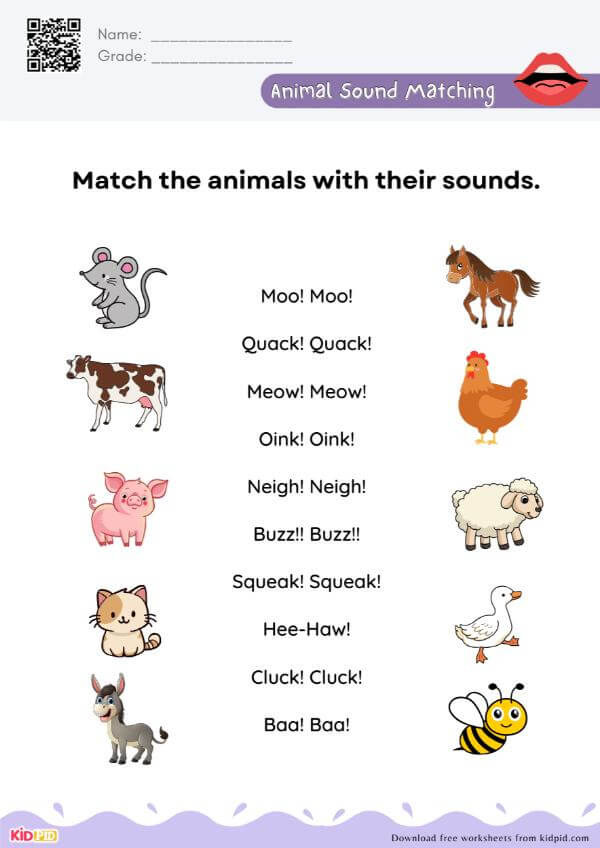
- Mouse – Squeak! Squeak!
- Cow – Moo! Moo!
- Pig – Oink! Oink!
- Cat – Meow! Meow!
- Donkey – Hee – Haw!
- Horse – Neigh! Neigh!
- Hen – Cluck! Cluck!
- Sheep – Baa! Baa!
- Duck – Quack! Quack!
- Bee – Buzz! Buzz!

- Snake – Hiss! Hiss!
- Lion – Roar! Roar!
- Bear – Growl! Growl!
- Crow – Caw! Caw!
- Monkey – Whoop! Whoop!
- Owl – Hoot! Hoot!
- Pigeon – Coo! Coo!
- Dog – Bark! Bark!
- Frog – Ribbit! Ribbit!
- Elephant – Trumpet! Trumpet!
The Animal Sound Match Worksheet is an engaging educational activity designed to help preschoolers and kindergarten learners identify animals and connect them with the sounds they make. Children improve observation skills, vocabulary development, auditory recognition, and early cognitive abilities by matching pictures of animals to their corresponding sounds. These worksheets are commonly used in classrooms, homeschooling environments, and early childhood learning programs. The activity combines visual and auditory learning, making it an effective tool for young learners. It also introduces children to common farm, wild, and domestic animals while strengthening memory and concentration skills.
Parts/Types/Examples of Animal Sound Match Worksheet
Parts of the Worksheet:
- Animal pictures or illustrations
- Sound words (onomatopoeia)
- Matching lines or answer boxes
- Instructions section
- Coloring or extension activities
Types of Animal Sound Match Worksheets:
- Farm animal sound matching
- Wild animal sound matching
- Pet animal sound matching
- Cut-and-paste matching activities
- Picture-to-sound word matching worksheets
Examples:
- Cow → Moo
- Dog → Bark
- Cat → Meow
- Duck → Quack
- Horse → Neigh
How Does the Animal Sound Match Worksheet Work?
The worksheet presents children with images of animals alongside a list of sound words. Learners carefully observe each animal and identify the sound it makes. They then draw lines, circle answers, or write matching letters to connect animals with their sounds. Teachers and parents may discuss each animal before or after the activity to reinforce learning. This interactive process helps children recognize animal characteristics while improving language and listening skills.
Benefits of Learning About the Animal Sound Match Worksheet
- Enhances animal recognition skills
- Builds vocabulary and language development
- Strengthens memory and concentration
- Improves visual discrimination abilities
- Encourages auditory awareness
- Supports early reading readiness
- Develops problem-solving skills
- Makes learning fun and interactive
- Promotes curiosity about animals and nature
- Increases confidence through independent learning
Learning Objectives
By completing this worksheet, children will be able to:
- Identify common animals accurately
- Match animals with their corresponding sounds
- Improve listening and observation skills
- Expand animal-related vocabulary
- Develop fine motor skills through drawing lines
- Strengthen memory retention
- Enhance cognitive matching abilities
- Build foundational science knowledge about animals
Worksheet Instructions
- Look carefully at each animal picture.
- Read or listen to the listed animal sounds.
- Think about which sound belongs to each animal.
- Draw a line connecting the animal to its correct sound.
- Check your answers with a teacher or parent.
- Say each animal name and sound aloud for extra practice.
- Complete any additional coloring or discussion activities.
Interesting Facts About Animal Sound Match Worksheet
- Animal sounds are called vocalizations.
- Different languages often represent animal sounds differently.
- Learning animal sounds helps improve phonemic awareness in young children.
- Farm animal sounds are usually among the first sounds children learn.
- Matching activities support brain development by encouraging pattern recognition.
- Animal sound games are widely used in early childhood education worldwide.
- Some animals, like parrots, can imitate sounds they hear.
Vocabulary Words
- Animal
- Sound
- Match
- Moo
- Bark
- Meow
- Quack
- Neigh
- Roar
- Chirp
- Bleat
- Oink
- Growl
- Vocalization
- Farm Animal
- Wild Animal
- Pet
- Listen
- Observe
- Recognize
Real-Life Applications
- Recognizing pets and farm animals in daily life
- Understanding animal communication
- Improving listening skills during classroom activities
- Building vocabulary used in books and conversations
- Supporting science and nature studies
- Enhancing memory and matching skills for future learning
- Helping children identify animals during zoo visits and outdoor experiences
- Encouraging curiosity about wildlife and animal behavior
FAQs
Q1. What age group is the Animal Sound Match Worksheet suitable for?
Answer: It is ideal for preschool, pre-kindergarten, and kindergarten children, typically ages 3–6 years.
Q2. What skills does this worksheet develop?
Answer: It develops vocabulary, listening skills, memory, concentration, animal recognition, and early cognitive abilities.
Q3. Can this worksheet be used at home?
Answer: Yes. Parents can use it as a fun educational activity for home learning and practice.
Q4. Why are animal sounds important for early learners?
Answer: Animal sounds help children develop phonemic awareness, language skills, and sound recognition abilities.
Q5. Can teachers use this worksheet in classrooms?
Answer: Absolutely. It works well for individual practice, small-group activities, and whole-class lessons.
Q6. How can I make the activity more interactive?
Answer: Encourage children to imitate animal sounds, discuss animal habitats, and share experiences with animals.
Q7. What subjects does this worksheet support?
Answer: It supports early literacy, science, language development, and cognitive learning.
Q8. Are animal sound worksheets beneficial for vocabulary growth?
Answer: Yes. Children learn new animal names and sound words, helping expand their language and communication skills.

Completing the “Animal Sound Match” worksheet has strengthened your familiarity with the characteristic sounds produced by a variety of animals. Making these connections is an entertaining yet educational way to expand your knowledge of the rich soundscape of the animal kingdom. Browse fun educational resources, including worksheets, essays, paragraphs, flashcards, quizzes, and interactive resources, designed for children of all ages. Follow YouTube & Facebook for more.
This worksheet was developed by the Content Team to improve learning.
Reviewed By Nausheen Fatima
Read More:



