Build 4-Digit Numbers from Parts is a simple addition activity where kids will learn how to add more than two numbers in a fun way. This combination of fun and math will keep kids excited about learning. All the activities are elementary exercises that kids need to build 4-digit numbers from a combination of ones, tens, hundreds, and thousands.
[Scroll Down for Download Link]
Contents
- Four-Digit Numbers Place Value Worksheet For Grade 4
- Key Facts About Building 4-Digit Numbers from Parts Worksheets
- Parts, Types, and Examples
- How Does This Worksheet Work?
- Benefits of Learning About 4-Digit Place Value
- Learning Objectives
- Worksheet Instructions
- Interesting Facts About Place Value Vocabulary
- Real-Life Applications
- FAQs
Four-Digit Numbers Place Value Worksheet For Grade 4
Read More: Build 5-Digit Numbers from Parts – Place Value Worksheets For Grade 3
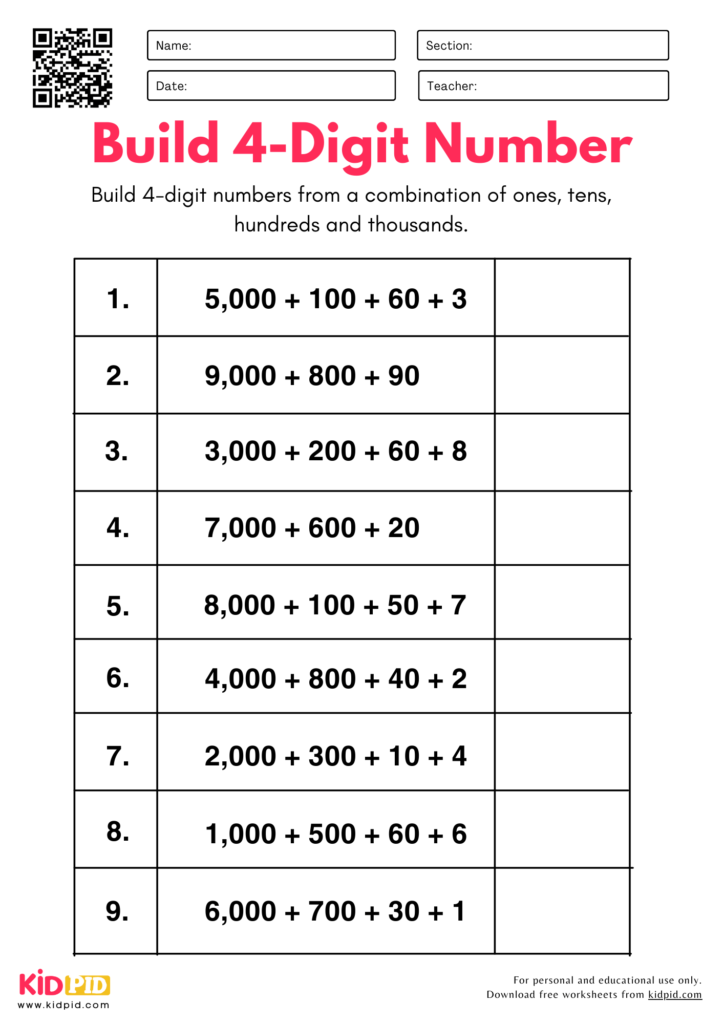
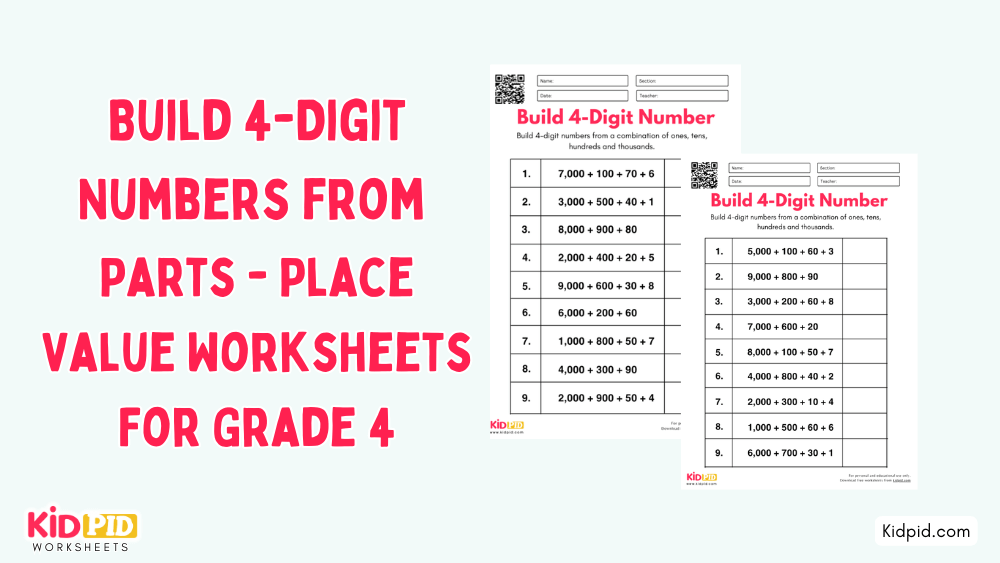
- 5,000 + 100 + 60 + 3 = 5,163
- 9,000 + 800 + 90 = 9,890
- 3,000 + 200 + 60 + 8 = 3,268
- 7,000 + 600 + 20 = 7,620
- 8,000 + 100 + 50 + 7 = 8,157
- 4,000 + 800 + 40 + 2 = 4,842
- 2,000 + 300 + 10 + 4 = 2,314
- 1,000 + 500 + 60 + 6 = 1,566
- 6,000 + 700 + 30 + 1 = 6,731
This 4-digit number exercise will help kids to increase their organization of number sense. In this exercise, kids need to calculate every combination of ones, tens, hundreds, and thousands that is shown in the table and fill in the answer. For the first segment, kids need to add all the numbers and fill in the answers in the table.
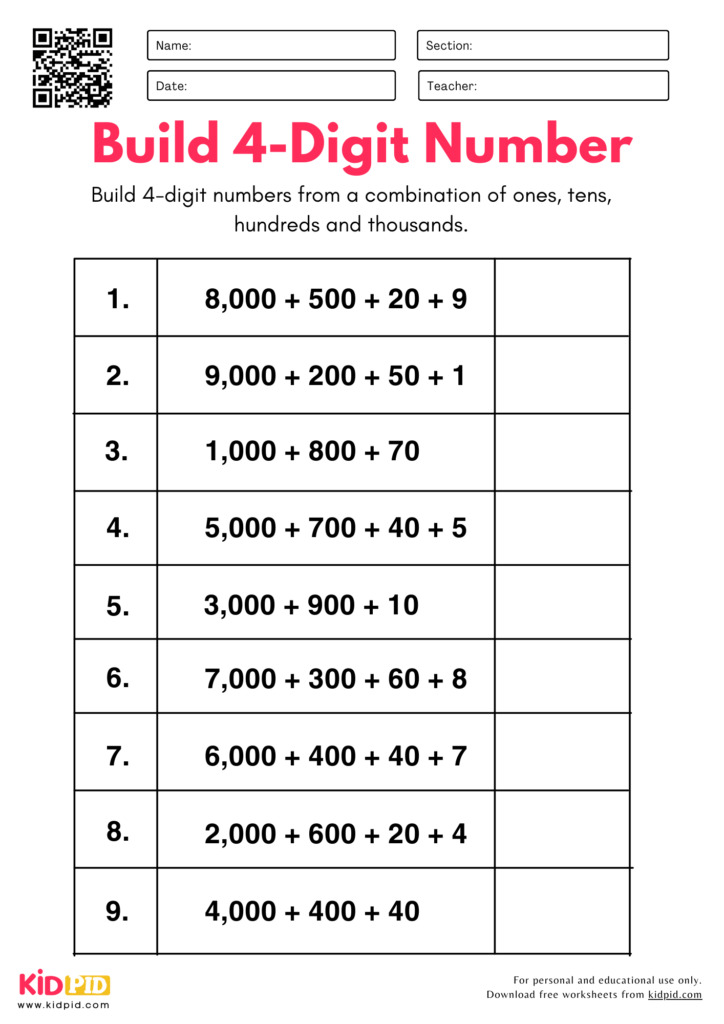
- 8,000 + 500 + 20 + 9 = 8,529
- 9,000 + 200 + 50 + 1 = 9,251
- 1,000 + 800 + 70 = 1,870
- 5,000 + 700 + 40 + 5 = 5,745
- 3,000 + 900 + 10 = 3,910
- 7,000 + 300 + 60 + 8 = 7,368
- 6,000 + 400 + 40 + 7 = 6,447
- 2,000 + 600 + 20 + 4 = 2,624
- 4,000 + 400 + 40 = 4,440
By solving these activities, kids will feel math is more interesting and relatable. It will encourage them to solve more questions because they’re not just doing math on paper—they’re having fun with it. 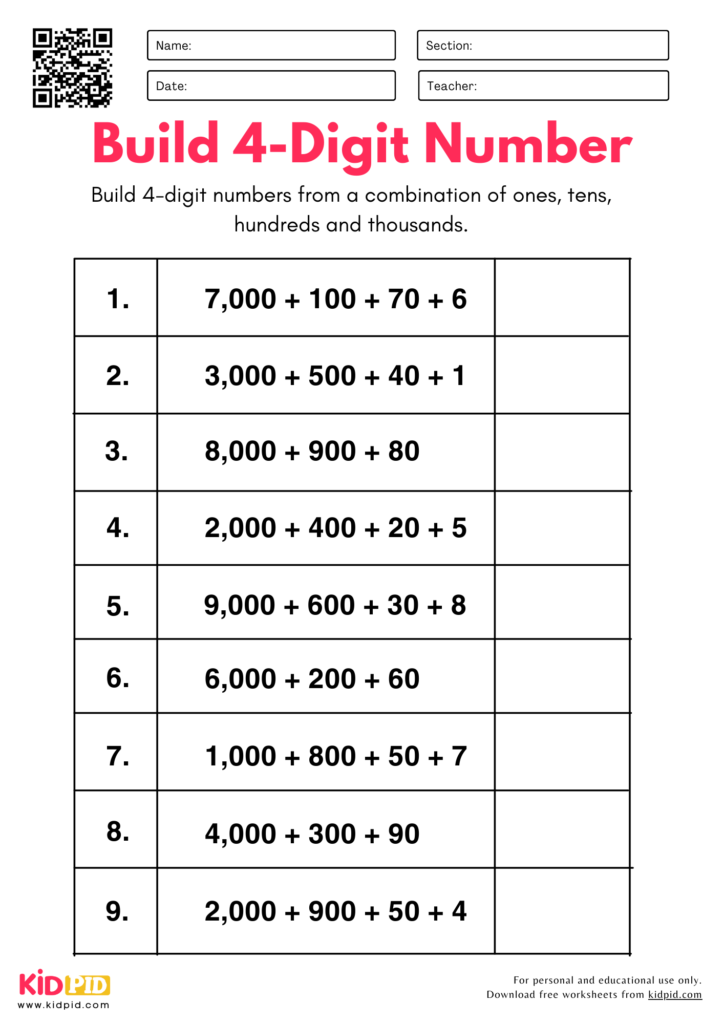
- 7,000 + 100 + 70 + 6 = 7,176
- 3,000 + 500 + 40 + 1 = 3,541
- 8,000 + 900 + 80 = 8,980
- 2,000 + 400 + 20 + 5 = 2,425
- 9,000 + 600 + 30 + 8 = 9,638
- 6,000 + 200 + 60 = 6,260
- 1,000 + 800 + 50 + 7 = 1,857
- 4,000 + 300 + 90 = 4,390
- 2,000 + 900 + 50 + 4 = 2,954
This 4-digit number activity is specially built for 4th graders because it will help them build a good knowledge of math. It will develop math concepts such as addition, subtraction, and place value. This activity will enhance their problem-solving skills, which are necessary for next-level math.
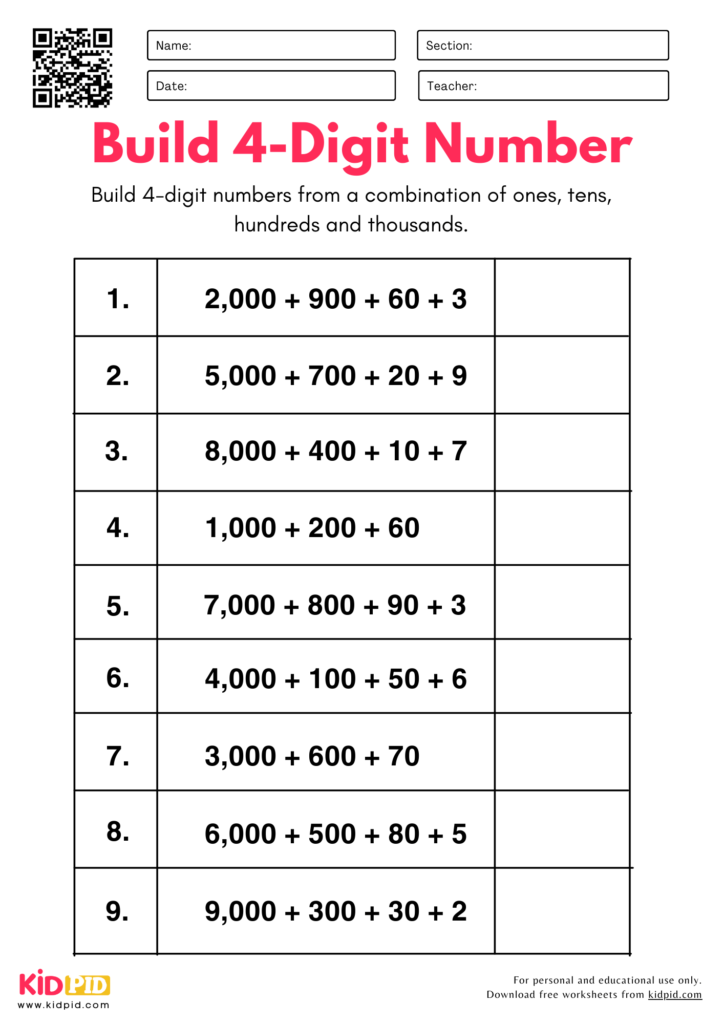
- 2,000 + 900 + 60 + 3 = 2,963
- 5,000 + 700 + 20 + 9 = 5,729
- 8,000 + 400 + 10 + 7 = 8,417
- 1,000 + 200 + 60 = 1,260
- 7,000 + 800 + 90 + 3 = 7,893
- 4,000 + 100 + 50 + 6 = 4,156
- 3,000 + 600 + 70 = 3,670
- 6,000 + 500 + 80 + 5 = 6,585
- 9,000 + 300 + 30 + 2 = 9,332
So we hope this topic will be helpful for kids to understand basic calculations and also for their confidence in math. And we hope kids will solve all these queries within a short time.
This worksheet acts as a structural exercise in decomposing and recomposing numbers. Students are presented with a series of addition equations where the values for each place value are separated. By adding these parts together, they learn to translate expanded form into standard form. The structured table format requires students to systematically calculate each sum, reinforcing the sequence of place values from left to right.
Answer: It may be due to difficulty with zeros in the middle of numbers (e.g., 5,004). Remind them that a missing part means that the specific place value is zero.
Answer: While geared toward 4th grade, students who have mastered 3-digit numbers can use these as an advanced challenge.
Answer: Use base-ten blocks, playing cards, or dice to create the “parts” and have your child combine them into the final number.
Key Facts About Building 4-Digit Numbers from Parts Worksheets
Parts, Types, and Examples
Parts:
Examples:
How Does This Worksheet Work?
Benefits of Learning About 4-Digit Place Value
Learning Objectives
Worksheet Instructions
Interesting Facts About Place Value Vocabulary
Real-Life Applications
FAQs
Q1. Why is my child struggling to add these parts?
Q2. Are these worksheets suitable for younger students?
Q3. How can I make this more fun?

Develop place value mastery with this Grade 4 worksheet on building 4-digit numbers from given parts. Students improve number sense, strengthen logical thinking, and gain confidence in understanding larger numbers through engaging practice. Discover fun classroom resources, including printable paragraphs, quizzes, worksheets, essays, flashcards, and interactive resources. Follow us on YouTube, Facebook, & Telegram.
Our Content Team designed this worksheet with students’ learning in mind.
Reviewed By Muskan Bhardwaj
Read More: