

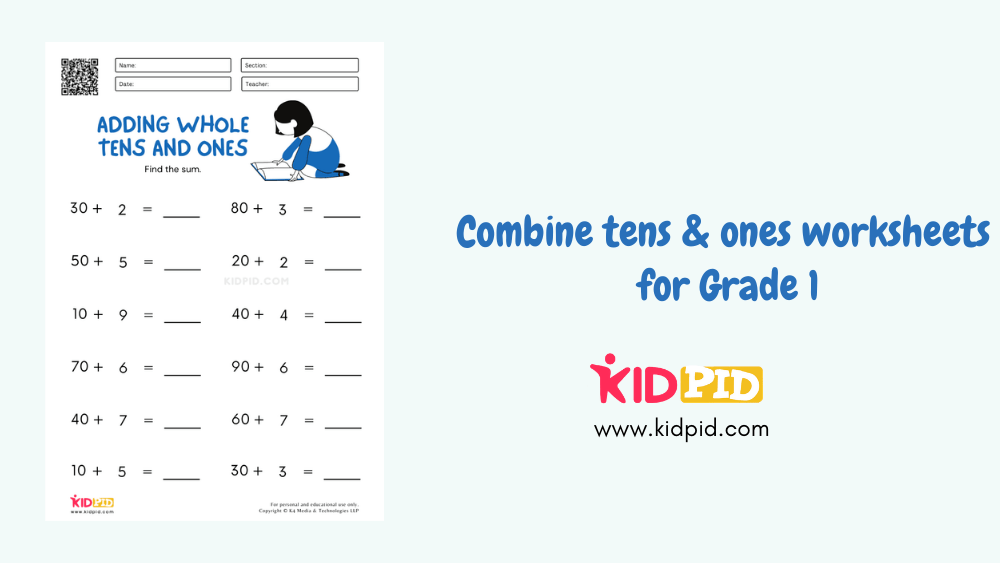
In the abstract science of number and quantity – mathematics, addition is one of the four basic operations. The addition of two numbers results in the sum of those values combined. The addition is usually signified by the “+” symbol, hence the sum of two numbers ‘a ‘ and ‘b’ would be represented as a+b.
The addition is one of the most fundamental concepts of mathematics. 1+1 is 2. This is the very first addition that we learn. It is a concept that is not only important in mathematics but is essential for a basic understanding of our lives. Take, for instance, a person who goes to a grocery shop to buy some groceries. He’ll then have to use addition to calculate the price he has to pay for the things he bought.
The worksheet allows for practicing the addition of whole numbers. It is meant for beginners who are just getting started with it.
Contents
- Combine Tens & Ones Practice Worksheets
- Key Facts About Grade 1 Combine Tens and Ones Worksheets
- Parts, Types, and Examples of Tens and Ones Worksheets
- How Does Combining Tens and Ones Work?
- Benefits of Learning About Tens and Ones
- Learning Objectives
- Worksheet Instructions
- Interesting Facts About Tens and Ones
- Vocabulary Words
- Real-Life Applications
- FAQs
- You may like this:
Combine Tens & Ones Practice Worksheets

Hence, none of the sums in the worksheet use the concept of regrouping since we’ll be adding tens and ones in the following worksheets.
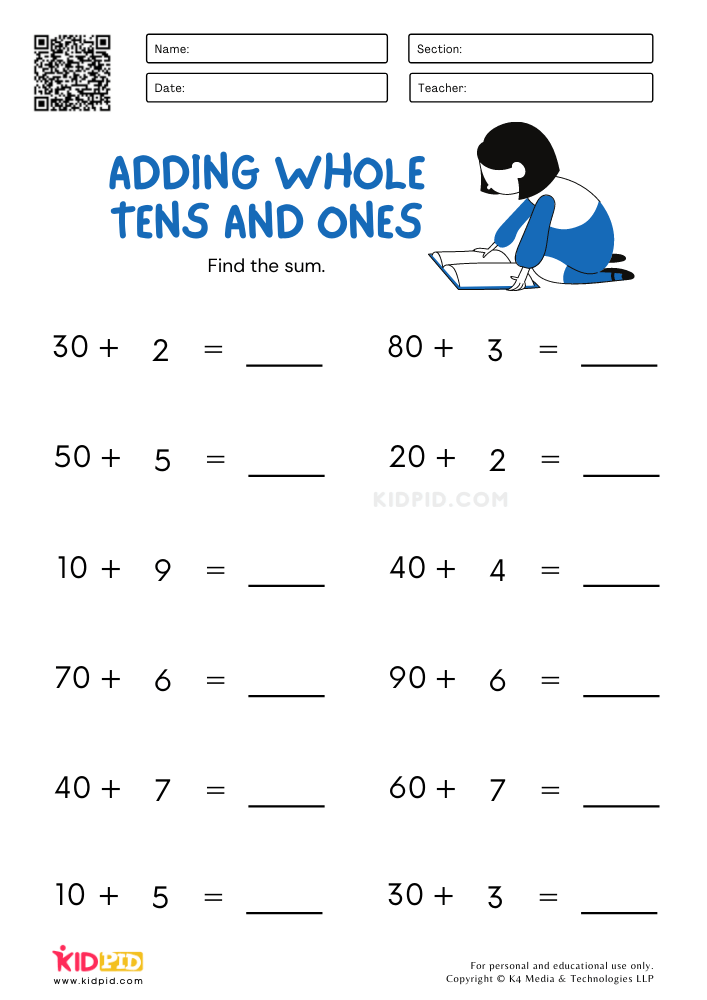
This is the second sheet. All of the worksheets consist of 12 questions. Allow your students ample time to learn easily. Learning is a process, and it isn’t complete without making mistakes. Mistakes often result in a better understanding of what is being taught.
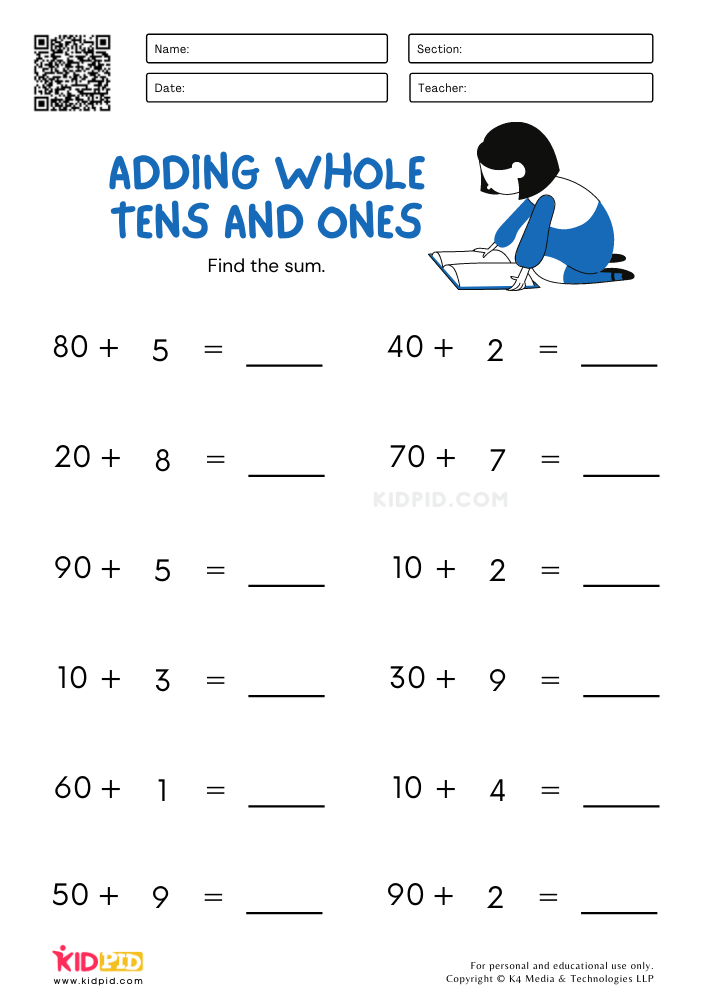
It is a general assumption that mathematics is hard. Many kids fear and hesitate to try solving sums for the fear of making mistakes. It is necessary that they understand that to err is human. The third sheet allows them to make mistakes and learn from them.
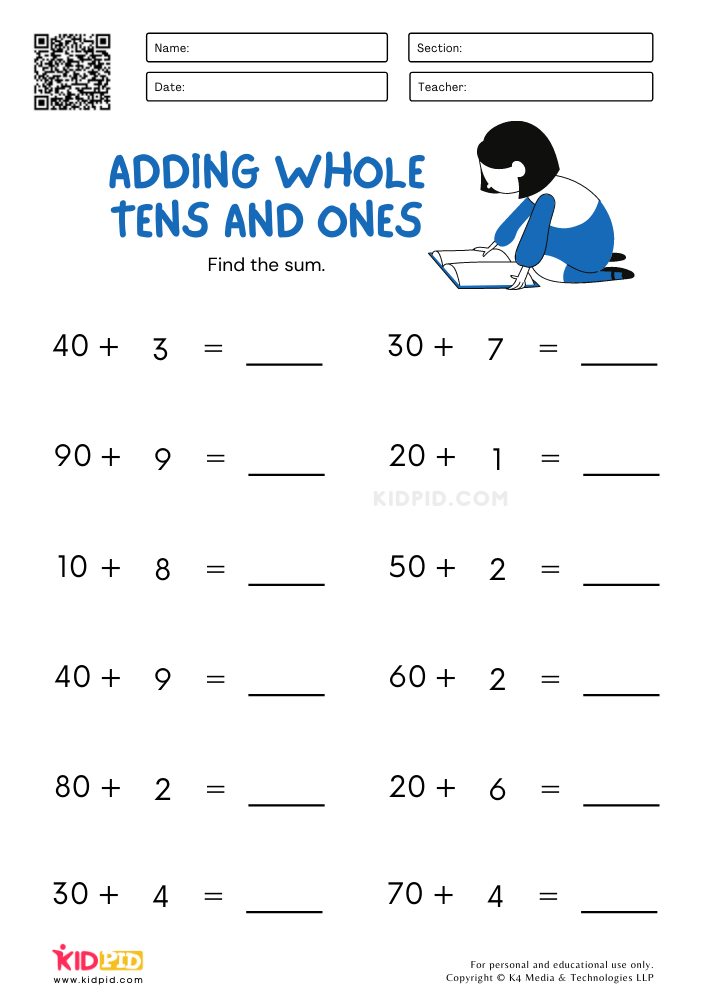
If you think your student is getting good at doing sums, challenge him by asking him to perform the calculations in a limited amount of time. It will challenge him and allow for better concentration and learning, as kids, by nature, are competitive and keen on learning.
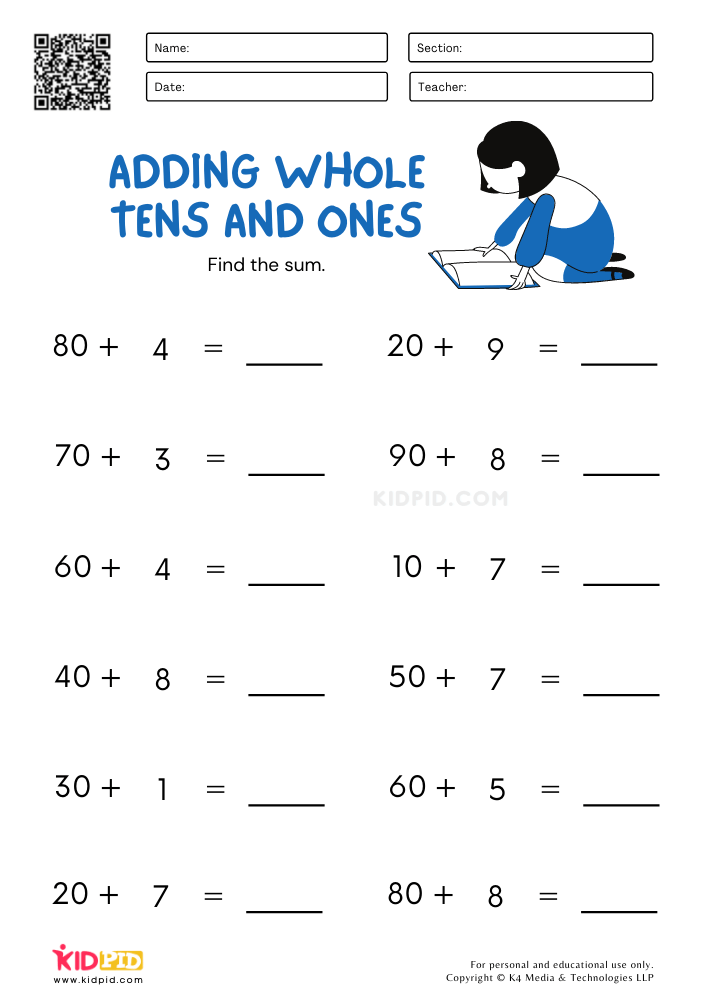
This is the final sheet of the worksheet. By now, your student must have a grasp of the fundamentals of addition. Test his understanding with this worksheet.
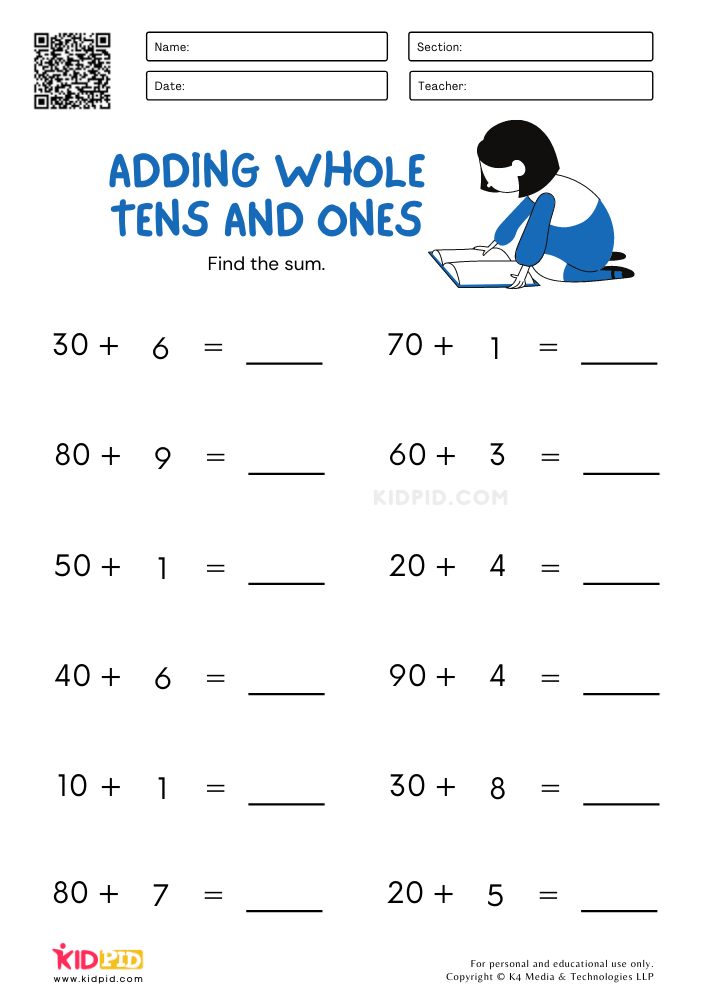
Download and print our worksheet to help your students cope with the increasing pressure of standardized tests in academics by helping them understand the fundamentals of addition of whole numbers.
Key Facts About Grade 1 Combine Tens and Ones Worksheets
- Target Audience: Specifically designed for Grade 1 students (typically ages 6–7) who are transitioning from basic counting to foundational place value concepts.
- Core Skill Developed: Mastery of the Base-10 numbering system, focusing on decomposing and composing two-digit numbers up to 99.
- Curriculum Alignment: Fully aligned with early elementary mathematics curriculum standards, including CCSS.Math.Content. 1. NBT.B.2 (understanding that the two digits of a two-digit number represent amounts of tens and ones).
- Format Availability: Usually accessible as print-ready PDFs, featuring large, legible text and visual elements (like base-ten blocks) tailored for early learners.
Parts, Types, and Examples of Tens and Ones Worksheets
To provide a comprehensive learning path, these worksheets are structured into distinct activity types:
- Visual Place Value Representation (Base-Ten Blocks): Students count physical or illustrative representations of “rods” (tens) and “units” (ones).
- Example: An image displays 3 vertical rods and 4 individual blocks. The student writes:
3 tens + 4 ones = 34.
- Example: An image displays 3 vertical rods and 4 individual blocks. The student writes:
- Fill-in-the-Blank Composing (Combining): Students are given the standard structural components of a number and must find the total value.
- Example:
6 tens + 2 ones = ____(Answer: 62) - Example:
9 tens + 0 ones = ____(Answer: 90)
- Example:
- Decomposing Numbers: The inverse activity where a whole two-digit number is provided, and students break it back down into its values.
- Example:
57 = ____ tens + ____ ones(Answer: 5 tens and 7 ones)
- Example:
- Matching and Multiple Choice Activities: Interactive matching columns designed to build mental agility.
- Example: Match Column A (
1 ten + 8 ones) to Column B (18).
- Example: Match Column A (
How Does Combining Tens and Ones Work?
Combining tens and ones relies on understanding structural place value rather than simple linear counting. The process operates in three mathematical steps:
- Identify the Value of Tens: Each “ten” represents a packed group of ten individual items. Therefore, multiplying or skip-counting the tens digit by 10 gives its absolute value (e.g., 4 tens = 40).
- Identify the Value of Ones: The “ones” digit represents single units that have not yet formed a complete group of ten (e.g., 5 ones = 5).
- Execute Addition: The values are added together to construct the final standard form number.
Mathematical equation: 40 + 5 = 45
Benefits of Learning About Tens and Ones
- Eliminates “Rote” Memorization: Instead of memorizing that the symbol “25” comes after “24”, children understand that “25” is literally two whole bundles of ten items and five leftover single items.
- Prepares for Regrouping (Carrying): A rock-solid understanding of tens and ones is a mandatory prerequisite for learning double-digit addition and subtraction with regrouping later in Grade 2.
- Boosts Mental Math Skills: Children learn to skip-count by 10 swiftly, allowing them to visualize numbers quickly in everyday contexts.
- Enhances Number Sense: It builds an intuitive understanding of the size and scale of numbers, preventing common mistakes like writing “forty-five” as “405”.
Learning Objectives
By completing these worksheets, Grade 1 students will achieve the following academic milestones:
- Objective 1: Accurately identify the “tens” place and “ones” place in any given two-digit number up to 99.
- Objective 2: Convert standard numbers (e.g., 73) into expanded form words (7 tens and 3 ones) and vice versa.
- Objective 3: Use visual models, such as base-ten rods and unit cubes, to demonstrate the quantitative value of a number.
- Objective 4: Understand the mathematical significance of the number zero as a placeholder in multiples of ten (e.g., 50 is exactly 5 tens and 0 ones).
Worksheet Instructions
- Look at the Problem: Read whether the question is asking you to put numbers together (combine) or break them apart (decompose).
- Count the Groups First: If there are pictures, always count the long towers (tens rods) first by tens (10, 20, 30…).
- Count the Single Blocks: Next, count the small individual blocks (ones) one by one (1, 2, 3…).
- Write Neatly: Write your final numbers clearly in the blank spaces provided. Ensure your tens digit is written on the left and your ones digit is on the right!
Interesting Facts About Tens and Ones
- The Power of Ten Fingers: The entire reason human civilization uses a “Base-10” system (tens and ones) is simply that early humans used their ten fingers to count! If we had eight fingers, we would likely be learning a “Base-8” system instead.
- The Zero Hero: The zero in numbers like 10, 20, or 30 is called a “placeholder.” Without it, 3 tens and 0 ones would just look like the number 3!
- A Global Math Language: No matter what language people speak around the world, almost every country organizes its written numbers using the same system of tens and ones.
Vocabulary Words
- Place Value: The value of where a digit sits in a number.
- Digit: The individual symbols from 0 to 9 used to make numbers (e.g., the number 45 has two digits: 4 and 5).
- Tens: A group containing exactly ten single units bound together.
- Ones: Individual unit pieces that are less than ten.
- Combine: To join or add parts together to make a whole new number.
- Decompose: To break a whole number down into smaller, organized pieces.
Real-Life Applications
Place value isn’t just an abstract school subject; children interact with it daily:
- Handling Money: Pocket money is built on tens and ones. A $10 bill represents a “ten,” while $1 copper coins represent the “ones.” Buying a toy for $23 means handing over 2 ten-dollar bills and 3 one-dollar coins.
- Reading Scoreboards and Clocks: When tracking sports scores (e.g., a basketball score of 42) or tracking minutes on a digital clock (e.g., 3:55), children are instantly decoding tens and ones.
- Organizing Classroom Supplies: Teachers routinely group crayons, markers, or pencils into rubber-banded packs of 10 for easy inventory control.
FAQs
Q1: Why is my child writing “4 tens and 5 ones” as 405 instead of 45?
Answer: This is a very common developmental stage in Grade 1 called “expanded notation confusion.” The child is listening to the literal value of the tens (4 tens = 40) and writing 40, then pasting the 5 next to it. Use base-ten blocks or a physical place-value mat to visually show them how the 5 slides over to sit right on top of the zero in the number 40.
Q2: At what age should a child master combining tens and ones?
Answer: Children typically begin exploring this concept at the end of Kindergarten (ages 5–6) and are expected to master two-digit combinations fluently by the conclusion of Grade 1 (ages 6–7).
Q3: What materials can I use at home if I don’t have plastic base-ten blocks?
Answer: You can easily create household alternatives! Use bundles of 10 popsicle sticks, straws, or crayons bound tightly with a rubber band to represent “tens,” and use loose individual sticks or pieces of cereal to represent “ones.”
Mastering tens and ones becomes easier through consistent practice with these Grade 1 worksheets. Each activity reinforces place value concepts, encourages logical thinking, and prepares young learners for advanced math lessons. Keep learning with our educational resources, including Quizzes, flashcards, essays, paragraphs, worksheets, and fun classroom activities. Join us on YouTube & Facebook for new ideas every day.
This worksheet was created by the Content Team to advance learning attainment.
Reviewed By Ishika
You may like this:
Part-Whole Model Activities for Teaching Tens and Ones in Grade 1
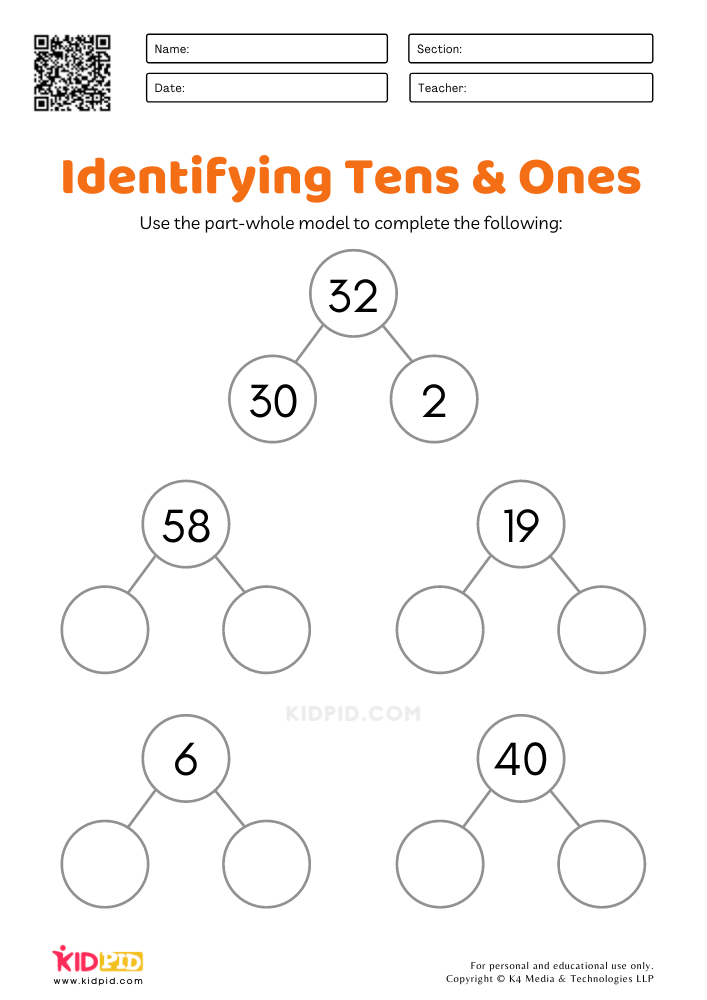
These activities utilize the part-whole model to teach first graders about tens and ones. Engaging exercises help students visualize numbers, effectively enhancing their understanding of place value concepts.
Underlined Digit Place Value Worksheets for 1st Grade Kids
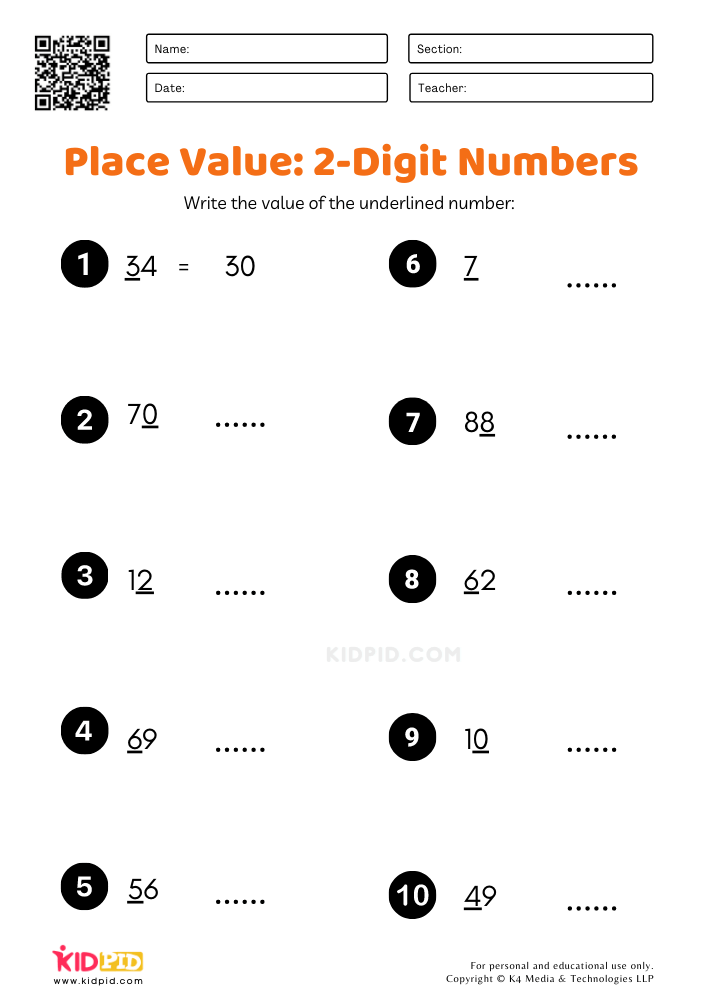
These worksheets focus on identifying underlined digits in numbers to teach place value. Fun exercises promote interactive learning, helping first graders strengthen their understanding of tens and ones concepts.
Learn Math with Expanded Form Exercises for Grade 1 Students
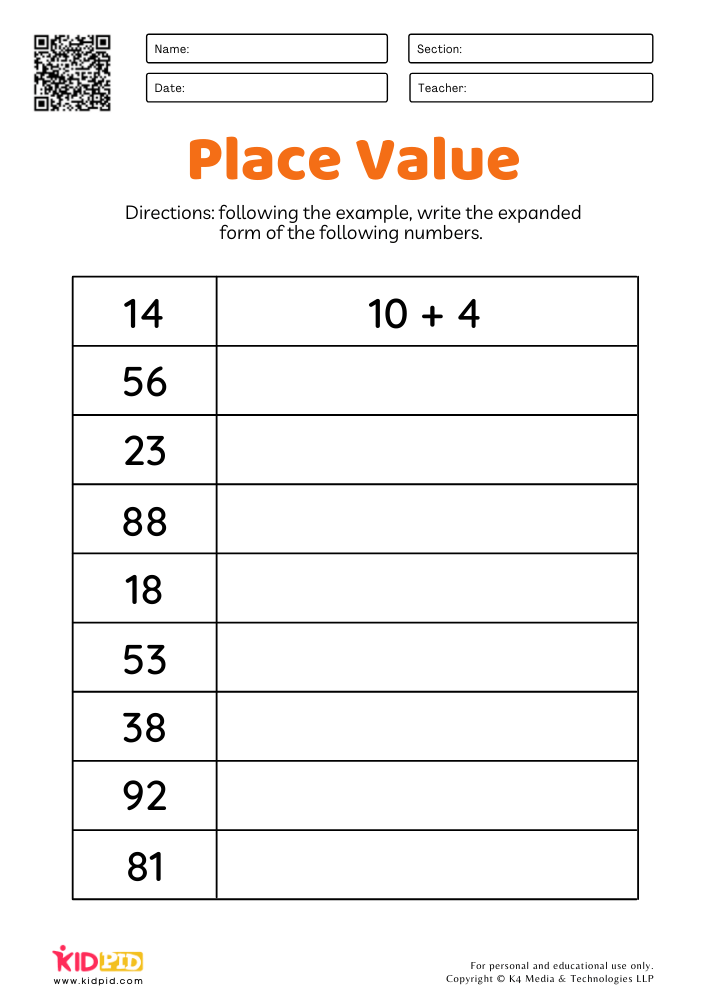
These expanded form exercises engage first graders in breaking down numbers. Fun activities reinforce place value understanding, making math enjoyable and helping students develop essential skills for future success.
Combining Tens and Ones: Engaging Place Value Activities for Grade 1 Kids
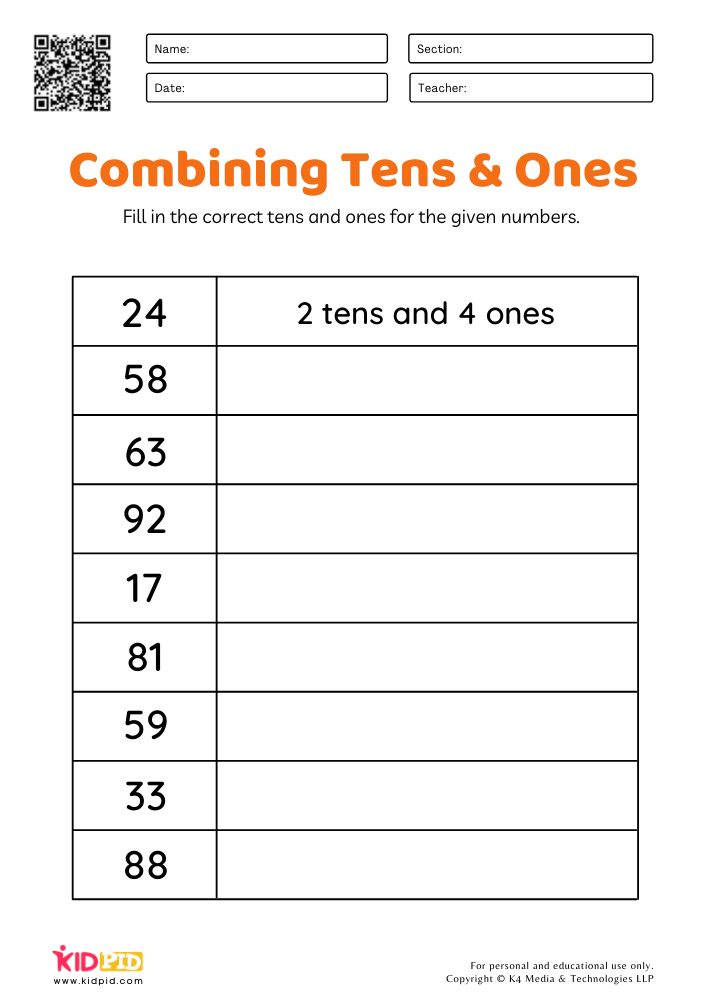
These activities focus on combining tens and ones to reinforce place value understanding. Interactive and fun, they encourage grade 1 kids to explore numbers, enhancing their mathematical skills and confidence.



