Hello Everyone! In this edition, we have brought some worksheets to brush up on the speaking and listening skills of your child. In these worksheets, the child will have to write the first letter of the alphabet from which the word begins. A lot can be said about a kid by looking at the way he writes. In primary classes, children are more conscious about their surroundings than we think they are. At a very young age, it is important to be attentive and careful about the knowledge being transferred to them.
[Scroll Down for Download Link]
Contents
- Beginning Sound Practice Worksheets
- Key Facts About Beginning Sounds Worksheets for Kids
- Parts, Types, and Examples of Beginning Sounds Worksheets
- How Do Beginning Sounds Worksheets Work?
- Benefits of Learning About Beginning Sounds
- Learning Objectives
- Worksheet Instructions
- Interesting Facts About Beginning Sounds
- Vocabulary Words
- Real-Life Applications
- FAQs
- Q1: At what age should my child start working on beginning sounds worksheets?
- Q2: My child keeps writing the wrong letter even though they know the alphabet. Is this normal?
- Q3: Should my child write in uppercase or lowercase on these worksheets?
- Q4: How long should a child practice phonics worksheets each day?
Beginning Sound Practice Worksheets
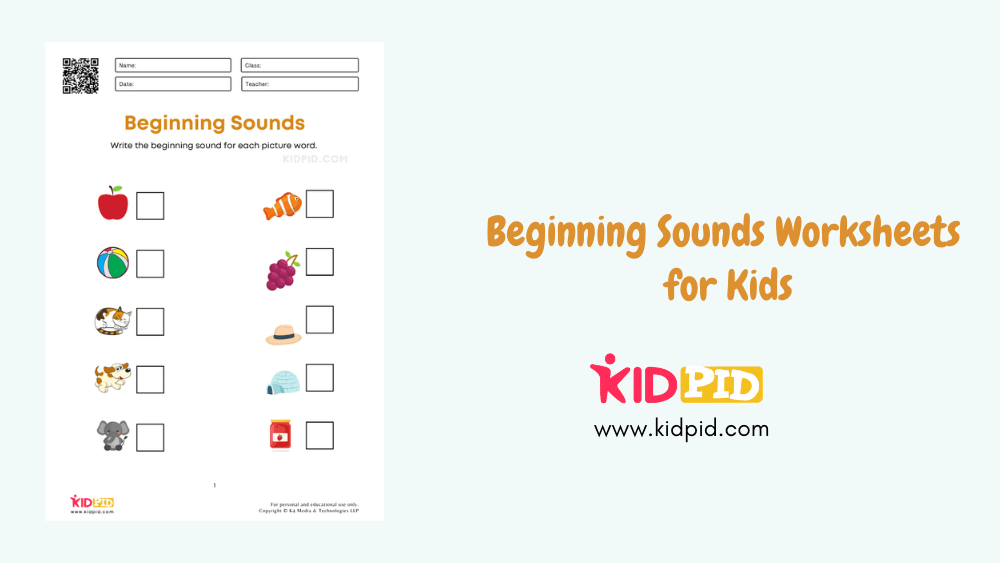
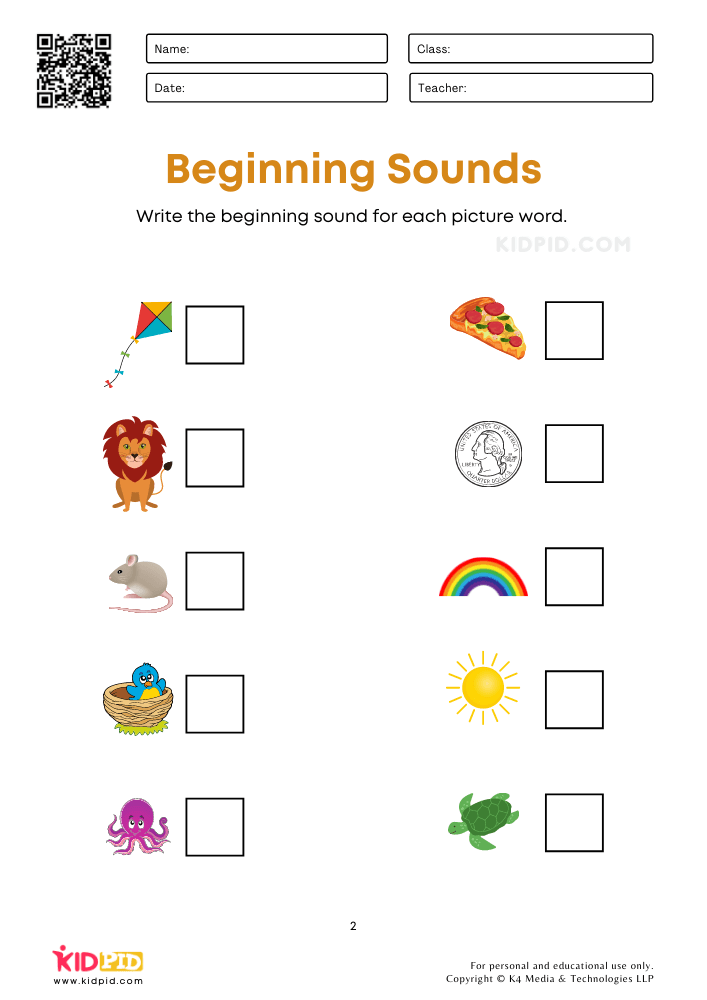
The first worksheet will ask the child to write the beginning sound for each picture given below. For example, A for Apple and F for Fish. This worksheet represents a variety of alphabets that kids of this generation are familiar with. A child will only feel confident when they know how to write down the alphabet, which they can understand fully. This is a great way to help them with the first worksheet and then leave them with the rest.
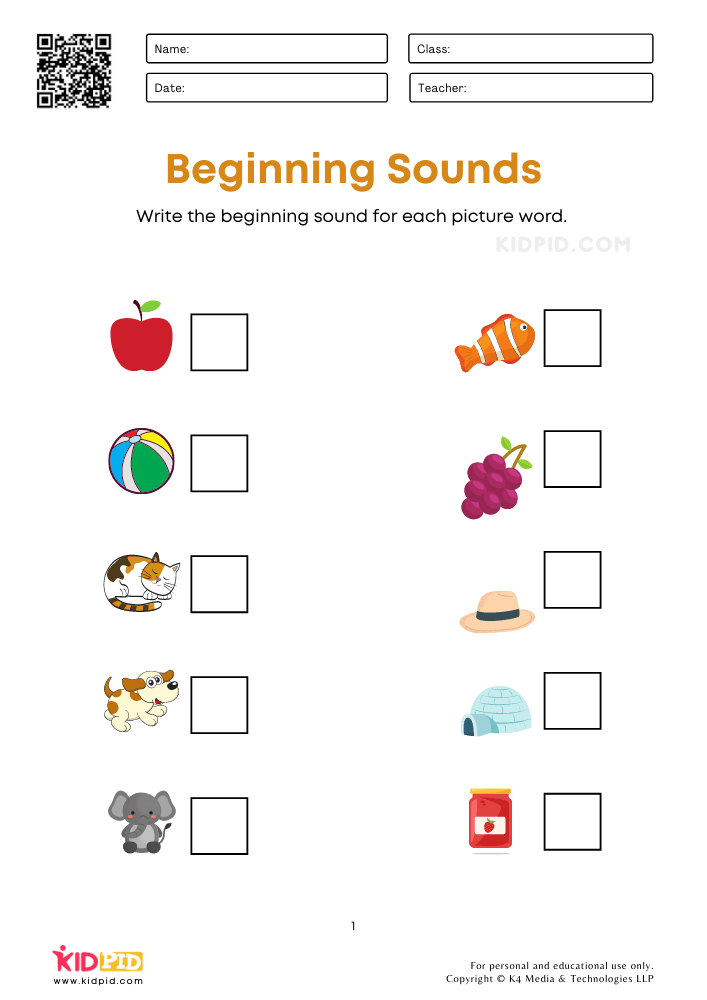
The second worksheet will work on the same, asking the child to write down the beginning sound for each item in the given picture. It is important to make sure that children keep themselves engaged in the worksheets and do not lose their attention. This becomes easy for the kids to pronounce after finishing the above worksheet.
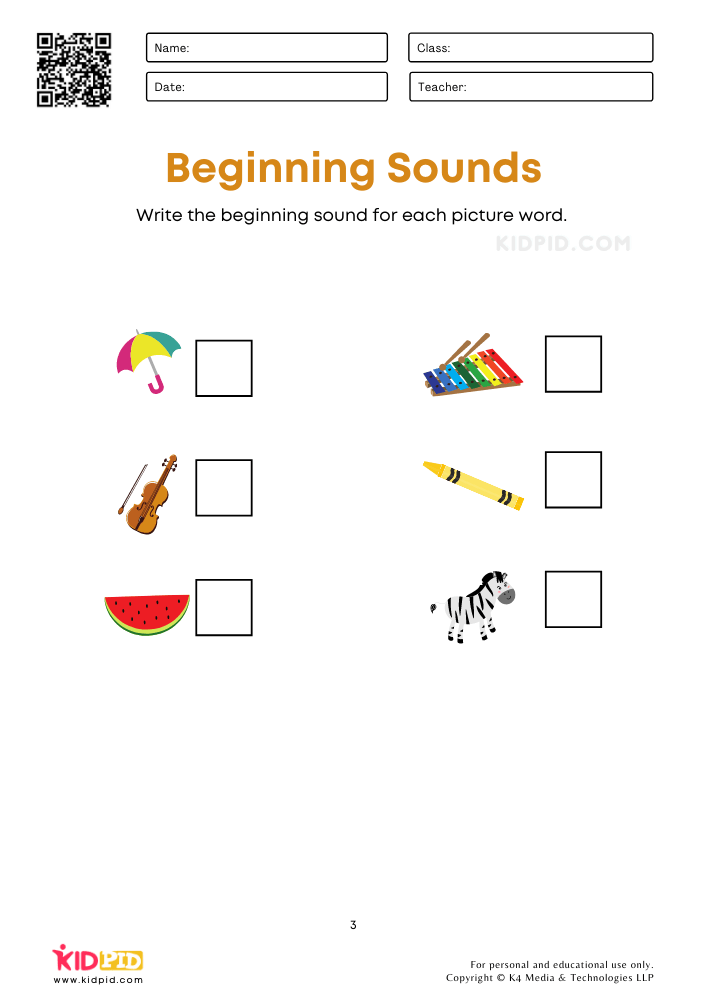
Unlike the first two, this worksheet brings modification to the understanding levels of a child. Just like the previous worksheets, it’ll help children learn the concept and improve their ability to understand it. This worksheet has new items like an umbrella, a pencil, a watermelon, etc.
This is all a kid needs in his early days before going to school. If the child is already ready to go to school, he should be well prepared; these worksheets help him to be so. These are very helpful as they don’t let the child get dull. So, do your best to make your kid smart by not letting him get dull or bored.
Key Facts About Beginning Sounds Worksheets for Kids
- Target Age Group: Best suited for preschoolers, kindergarteners, and early Grade 1 students (ages 3 to 6 years old).
- Core Skill Focus: Phonemic awareness, specifically isolating the initial phoneme (the first individual sound) in spoken words and mapping it to the correct grapheme (written letter).
- Content Delivery: High-quality, printable visual worksheets featuring familiar, everyday objects (like an apple, a fish, or an umbrella) to keep young learners engaged.
- Instructional Approach: Scaffolded learning that transitions children from simple oral recognition to independent letter writing.
Parts, Types, and Examples of Beginning Sounds Worksheets
Phonics instruction works best when it targets a child’s specific developmental stage. These worksheets are categorized by the following core layouts:
- Letter-to-Object Matching Worksheets: Children draw lines to connect a starting letter to an object that begins with that sound (e.g., matching the letter B to a picture of a bee).
- Fill-in-the-Blank Letter Writing: The primary format used in this Kidpid pack, where students look at a clear illustration (such as a watermelon or a pencil) and write the single correct starting letter in the space provided.
- Multiple Choice / Circle the Sound: Worksheets that present an image alongside 3 or 4 random letter options, asking the child to identify and circle the correct initial sound.
- Phonetic Theme Variations: Grouped worksheets focusing strictly on short vowels (a, e, i, o, u), hard consonants (c, k, g), or continuous sounds (m, s, f, l), which are traditionally easier for beginners to pronounce.
How Do Beginning Sounds Worksheets Work?
These worksheets bridge the gap between abstract audio sounds and physical, written letters. The learning cycle operates in three sequential steps:
- Visual Stimulus: The child encounters an isolated, recognizable image (e.g., a fish).
- Auditory Retrieval & Segmentation: The child says the word aloud (“Fish“) and isolates the very first sound they make with their mouth:
[f]. - Graphological Motor Response: The student retrieves the letter F from their memory and uses their fine motor skills to physically write the alphabet character next to the picture.
This process successfully strengthens the neural pathways responsible for early reading and decoding.
Benefits of Learning About Beginning Sounds
Mastering initial letter sounds provides foundational building blocks for later academic success:
- Accelerates Literacy Development: Recognizing beginning sounds is the literal entryway into sounding out full words, leading smoothly into reading complex CVC (Consonant-Vowel-Consonant) words like cat or pig.
- Boosts Speaking and Pronunciation: As children consciously slow down to isolate the first letter sound of an object, they improve their speech clarity and articulation.
- Develops Pencil Grip and Fine Motor Skills: The act of carefully writing the individual letters within structured worksheet grids helps build hand strength and coordination.
- Encourages Independent Learning: The intuitive layout allows young children to recognize the images and complete pages on their own, drastically building their confidence before entering formal schooling.
Learning Objectives
By using these beginning sounds printables, young learners aim to achieve the following educational milestones:
- Isolate Initial Sounds: Demonstrate the ability to orally identify the initial sound of a one-syllable spoken word with 90% accuracy.
- Apply Grapheme-Phoneme Correspondence: Accurately match the spoken sound to its corresponding written letter from A to Z.
- Execute Letter Formation: Practice proper, legible uppercase or lowercase letter strokes within the designated writing lines.
- Expand Practical Vocabulary: Recognize, name, and categorize everyday objects and animals displayed across the worksheets.
Worksheet Instructions
To make sure your child gets the absolute most out of their practice time, follow these simple, step-by-step instructions:
- Point and Name: Sit with your child and look at the first picture together. Ask them to point to the image and say the word aloud clearly (e.g., “Apple”).
- Listen for the First Sound: Ask your child, “What is the very first sound your mouth makes when you say that word?” Emphasize it together if needed (“A-A-Apple”).
- Identify the Letter: Help them connect that sound to its letter name (“The sound [æ] belongs to the letter A”).
- Write it Down: Guide your child to write the letter neatly in the space provided.
- Praise and Pivot: Offer positive reinforcement for their effort, then encourage them to try the next image on their own!
Interesting Facts About Beginning Sounds
- The “Continuous” Advantage: Young brains find it significantly easier to identify beginning sounds that can be stretched out or hold a continuous hum (like
/s/,/m/, or/f/) compared to “stop” sounds, which clip off instantly. - Phonemic Awareness Predicts Success: According to leading literacy research, a child’s early phonemic awareness (like knowing initial sounds) is one of the strongest statistical predictors of how well they will read by the end of third grade.
- It’s an Auditory Skill First: Long before children learn what a printed letter looks like, they have the innate capacity to hear and slice up words into individual sounds purely by listening.
Vocabulary Words
Introduce these key words during your worksheet sessions to enrich your child’s developing vocabulary:
- Alphabet: The standard set of 26 letters (from A to Z) used to write down the English language.
- Phonics: A method of learning to read by learning the specific sounds that letters or groups of letters make.
- Initial Sound: The absolute first phonetic sound you hear at the very start of a spoken word.
- Scaffolding: A teaching technique that offers temporary support to a child as they learn a new concept, slowly stepping back as they get independent.
- Conscious: Being fully aware of, attentive to, and noticing things happening in the environment around you.
Real-Life Applications
Learning phonics shouldn’t stop when the worksheet is put away! Here is how to apply this skill in the real world:
- The I-Spy Grocery Game: While walking down supermarket aisles, keep your child engaged by saying, “I spy with my little eye something crunchy that starts with the letter C!” (Carrots).
- The Morning Routine Check: Turn getting dressed into a quick game: “We are putting on your s-s-shoes. What letter makes that starting sound?”
- Storybook Initial Tracking: When reading bedtime stories, point to big bold letters on the page and ask them to sound out the first letter of a character’s name before you read the text.
FAQs
Q1: At what age should my child start working on beginning sounds worksheets?
Answer: Most children are ready to explore beginning sounds around ages 3.5 to 4. Introduce them once your child can comfortably sing the alphabet song and shows a general curiosity about signs, books, and labels in their environment.
Q2: My child keeps writing the wrong letter even though they know the alphabet. Is this normal?
Answer: Absolutely. Hearing a sound and translating it into a physical letter requires complex cognitive processing. If they struggle, model the answer for them: say the word slowly, write the letter down yourself while describing the lines, and let them trace over it.
Q3: Should my child write in uppercase or lowercase on these worksheets?
Answer: While both are acceptable for beginners, early literacy experts generally recommend prioritizing lowercase letters first. Over 90% of the print your child will read in storybooks and real-life signs consists of lowercase letters, making it a more practical starting point.
Q4: How long should a child practice phonics worksheets each day?
Answer: Keep sessions short, positive, and sweet! For preschoolers and kindergarteners, 5 to 10 minutes of focused worksheet practice per day is plenty to prevent fatigue and keep their love of learning alive.

Recognizing beginning sounds is an important step toward reading success. These worksheets make early phonics practice engaging, helping children identify letter sounds, expand vocabulary, and strengthen foundational literacy skills. Browse our website for educational flashcards, essays, Quizzes, worksheets, paragraphs, and hands-on learning activities. Follow us on YouTube & Facebook for daily educational inspiration.
The Content Team designed this worksheet to strengthen learning outcomes.
Reviewed By Kirti Koshta
Read More: