
Welcome to the animal homes matching worksheet! In these worksheets, kindergarten kids have to match each animal to its home where they live. It will generate interest among kids, and they will learn faster. So check out these worksheets and learn about the homes of different animals. Build your general knowledge from an early age.
Contents
- Matching Animal Home Worksheets For Kindergarten
- Key Facts About Animal Homes Matching Worksheets
- Parts, Types, and Examples of Animal Homes
- How Does the Animal Homes Matching Worksheet Work?
- Benefits of Learning About Animal Homes
- Learning Objectives
- Worksheet Instructions
- Interesting Facts About Animal Homes
- Vocabulary Words
- Real-Life Applications
- FAQs
Matching Animal Home Worksheets For Kindergarten
[Scroll Down for Download Link]
Read More: Shape and Real Object Matching Practice Worksheet for Kindergarten
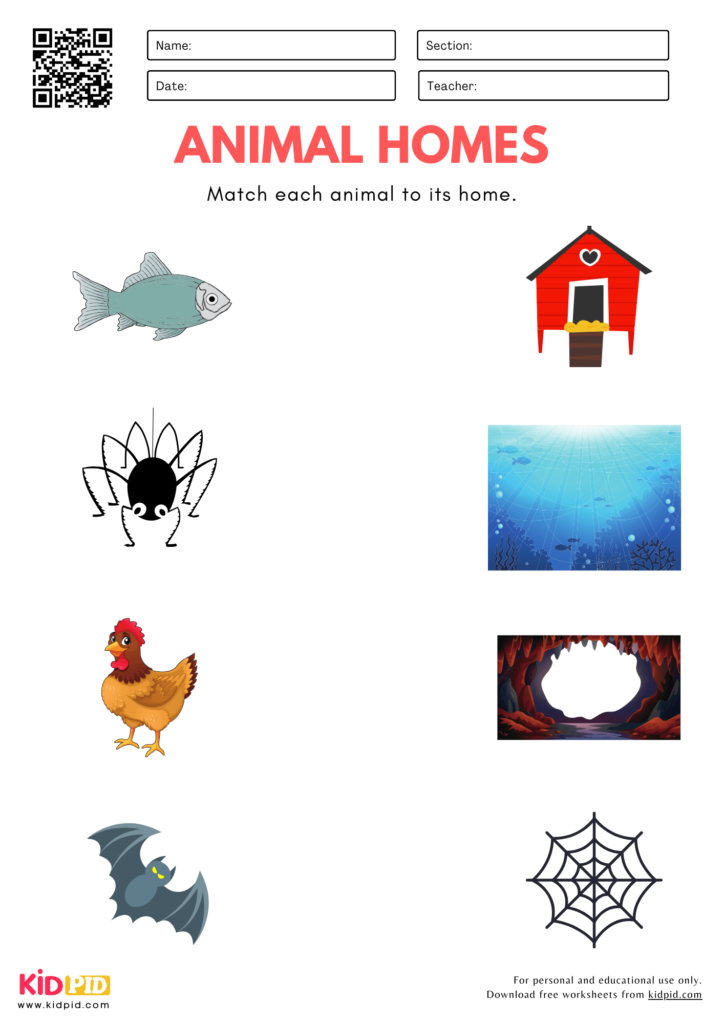
In this animal home matching worksheet, kindergarten kids have to match each animal to its specific home in which they live. It includes four animals: a fish, a spider, a chicken, and a bat. So match their home accurately. It would be both enjoyable and educational.

This is the second worksheet on animal homes. It includes four animals: an ant, a bee, a cow, and a squirrel, and the students have to match these animals with their homes.

This is the third worksheet in which the students have to match the animals with their homes. It includes animals called a bear, a dog, a rabbit, a bear, and a bird. Students have to match them with their homes correctly. By practicing these types of questions, they will gain general knowledge.
Key Facts About Animal Homes Matching Worksheets
- Purpose: Designed to help kindergarten-aged children associate specific animals with their natural habitats or shelters.
- Educational Foundation: Aligns with early childhood science curricula focusing on animal biology and environmental awareness.
- Format: Typically uses visual matching (connecting lines between images) to support pre-literacy and cognitive development.
- Target Age Group: Specifically curated for 4–6-year-olds in Preschool and Kindergarten.
- Accessibility: These are free, printable resources developed by educational experts to encourage home-based and classroom learning.
Parts, Types, and Examples of Animal Homes
These worksheets categorize animal habitats into easily recognizable groups for young learners:
- Domesticated Habitats: Barn (cow/chicken), Kennel (dog), Coop (chicken).
- Wild Habitats: Web (spider), Cave (bear), Nest (bird/bat), Hive (bee), Burrow (rabbit/squirrel), Anthill (ant), Water/Tank (fish).
- Categorization: Worksheets often group animals by environment—such as farm animals, forest animals, or aquatic creatures—to help children understand ecological relationships.
How Does the Animal Homes Matching Worksheet Work?
The worksheet utilizes cognitive association exercises. By placing an image of an animal on one side and its corresponding home on the other, children must:
- Observe and Identify: Recognize the animal and recall facts about where it lives.
- Visual Processing: Use spatial reasoning to draw a line connecting the two items.
- Reinforcement: Repeated practice with these worksheets solidifies the connection between the organism and its environment, moving knowledge from short-term to long-term memory.
Benefits of Learning About Animal Homes
- Cognitive Development: Strengthens critical thinking and problem-solving skills through logical deduction.
- Vocabulary Expansion: Introduces nature-based vocabulary (e.g., habitat, hive, burrow, den).
- Scientific Inquiry: Sparks early interest in biology and environmental science, encouraging children to observe the world around them.
- Fine Motor Skills: The act of drawing lines between items helps develop the hand-eye coordination necessary for future writing.
Learning Objectives
Upon completing these worksheets, students should be able to:
- Correctly identify at least 5–8 common animals and their respective homes.
- Articulate why certain animals need specific environments (e.g., protection from weather or predators).
- Demonstrate improved visual discrimination and focus.
Worksheet Instructions
- Print: Download the high-resolution PDF for the best visual quality.
- Observe: Sit with your child and ask them to name the animals they see on the page.
- Match: Encourage them to use a crayon or pencil to draw a straight line from the animal to its correct home.
- Discuss: Once finished, ask, “Why do you think a bird lives in a nest?” or “What do you think would happen if a fish lived in a hive?” to extend the learning.
Interesting Facts About Animal Homes
- Architecture in Nature: Some animal homes, like the honeycomb of a bee, are geometric marvels that are incredibly strong.
- Adaptability: Animals choose homes based on safety; for example, birds build nests high in trees to stay away from predators.
- Change Over Time: Some animals, like hermit crabs, don’t build their own homes but move into the empty shells of other sea creatures!
Vocabulary Words
- Habitat: The natural home or environment of an animal.
- Shelter: A place that protects from the weather and danger.
- Burrow: A hole or tunnel dug by a small animal as a dwelling.
- Colony: A group of animals living together (like ants or bees).
Real-Life Applications
- Nature Walks: Visit a local park and look for bird nests or anthills to see these “homes” in the real world.
- Pet Care: Use the concept to discuss the importance of providing a clean and safe home for domestic pets (e.g., a cage for a hamster or a bed for a dog).
FAQs
Q1. At what age should a child start these worksheets?
Answer: These are ideal for children aged 4–6, typically in Pre-K or Kindergarten.
Q2. Are these worksheets aligned with curriculum standards?
Answer: Yes, they are designed by experienced educators to complement early childhood science and foundational cognitive standards.
Q3. Can I use these for homeschooling?
Answer: Absolutely! They are excellent supplementary tools for homeschooling or as a fun, educational activity at home to build general knowledge.

Finding the correct homes for different animals helps kindergarten learners strengthen matching skills, expand vocabulary, improve observation, and understand how animals live safely in their natural environments through enjoyable practice. Explore educational worksheets, essays, flashcards, quizzes, paragraphs, and interactive resources that make learning exciting every day. Follow us on YouTube & Facebook.
This worksheet was thoughtfully created by the Content Team to promote practical learning.
Reviewed By Madhulika
Read More: