

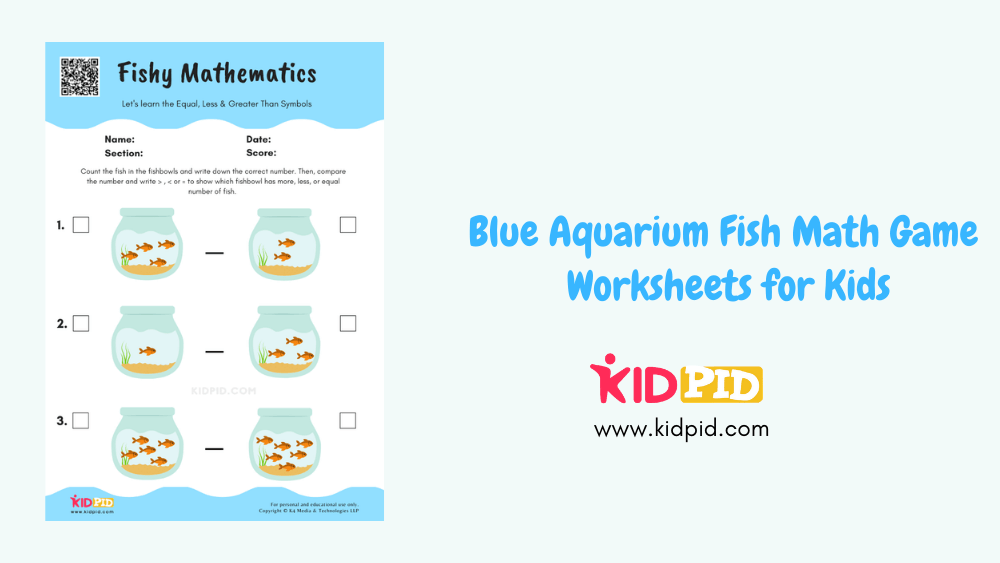
Kids understand the language of pictures and colors more than words. The colors can add spark to their curiosity in learning. Along with books, some practical activities and lessons are more effective for their learning and education. Lessons can be taught in the form of simple games and activities that kids love to do. Their enjoyment and education go hand in hand.
Worksheets are the best example of joyful and easy learning. Practice on the worksheets makes children more focused because small activities grab their attention and make them concentrate, which therefore results in better understanding and easy learning.
The First thing taught to kids in maths is numbers. Kids often find the comparison of numbers a bit confusing because it’s a little difficult for them to remember the order. Here are some worksheets regarding the comparison of numbers, which will help them to overcome this confusion.
Contents
- Blue Aquarium Fish Math Game Worksheets for Kids
- Key Facts About Blue Aquarium Fish Math Game Worksheets
- Parts, Types, and Examples of Blue Aquarium Fish Math Game Worksheets
- How Does Blue Aquarium Fish Math Game Worksheets for Kids Work?
- Benefits of Learning About Blue Aquarium Fish Math Game Worksheets
- Learning Objectives
- Worksheet Instructions
- Interesting Facts About Blue Aquarium Fish Math Game Worksheets for Kids
- Vocabulary Words
- Real-Life Applications
- FAQs
- Q1. What age group are Blue Aquarium Fish Math Game Worksheets suitable for?
- Q2. What math skills do these worksheets teach?
- Q3. Can these worksheets be used at home?
- Q4. Why is the aquarium theme effective for learning?
- Q5. Are these worksheets useful for beginners?
- Q6. How often should children practice with these worksheets?
- Q7. Do these worksheets support visual learners?
- Q8.Can teachers use these worksheets in classrooms?
- Read More:
Blue Aquarium Fish Math Game Worksheets for Kids

Blue Aquarium Fish Math Game Worksheet:1
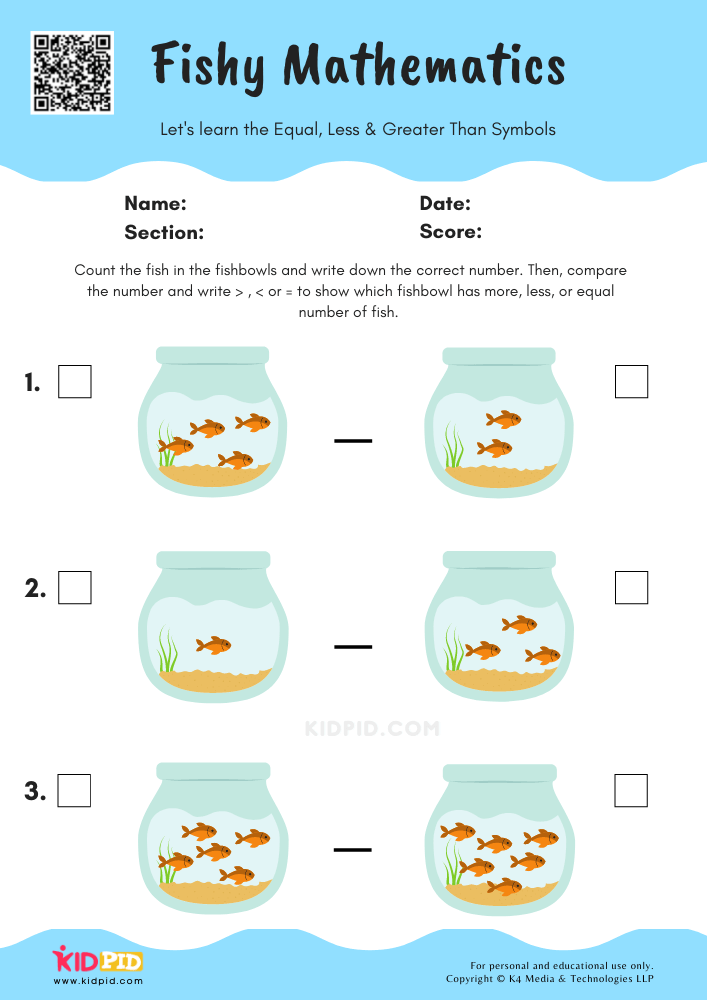
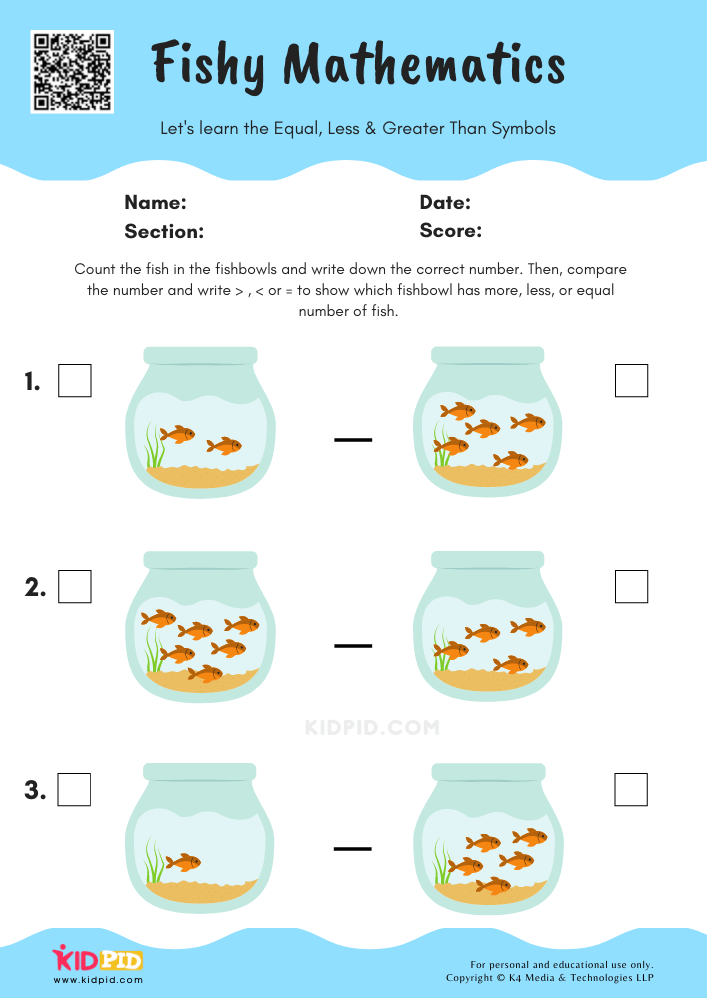
In this worksheet, kids have to do a simple activity in which they have to use counting. As can be seen in the worksheet, two fishbowls with fish in them are there for comparison in each question. Count the number of fish in both bowls and write the number of fish in each bowl in their respective brackets. Then compare both the numbers and fill the blank in between the bowls with signs to show which fishbowl has a more, less, or an equal number of fish.
Blue Aquarium Fish Math Game Worksheet:2
By counting and looking at the number of fish, it will become easy for kids to identify the value of numbers. Mathematics is all about numbers, but simply memorizing the numbers isn’t going to help unless the value of the numbers is known. Complete knowledge of numbers is the first step in learning mathematics.
Blue Aquarium Fish Math Game Worksheet:3
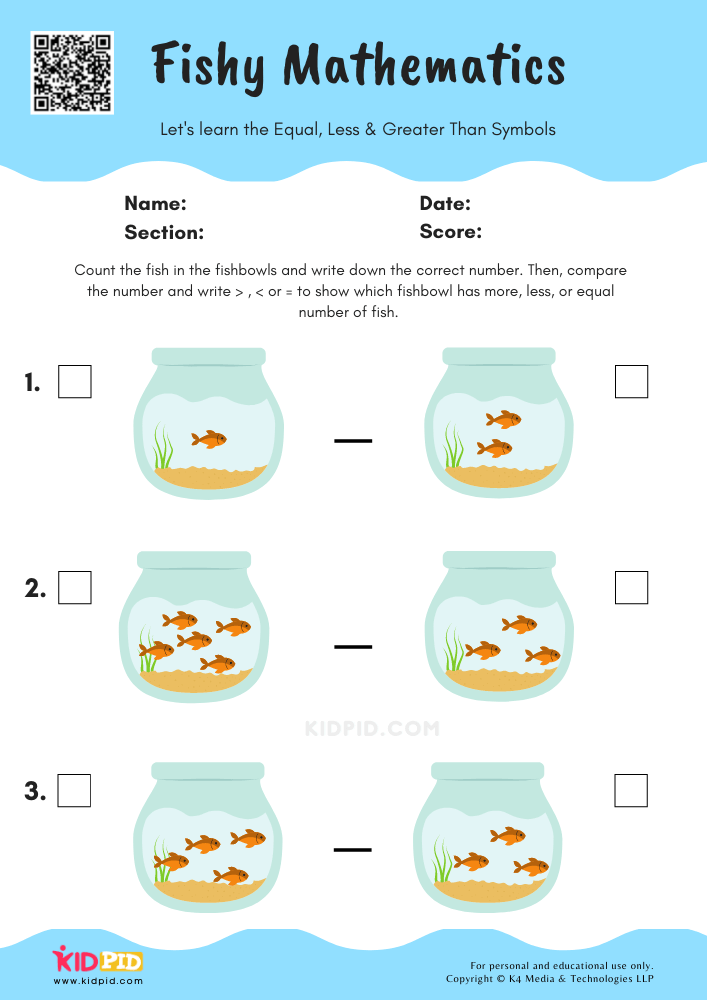
Let us shed some light on the symbols used for comparison. As you can see in this worksheet, the symbols are equal (=), less than (<), and greater than (>). If the number of fish in both the bowls is the same, then the equal-to symbol (=) will be used. If the number of fish in the left-hand fishbowl is more than the number of fish in the right-hand bowl, then the symbol of greater than (>) will be used. If the number of fish in the left-hand bowl is less than the number of fish in the right-hand bowl, then the symbol of less than will be used (<).
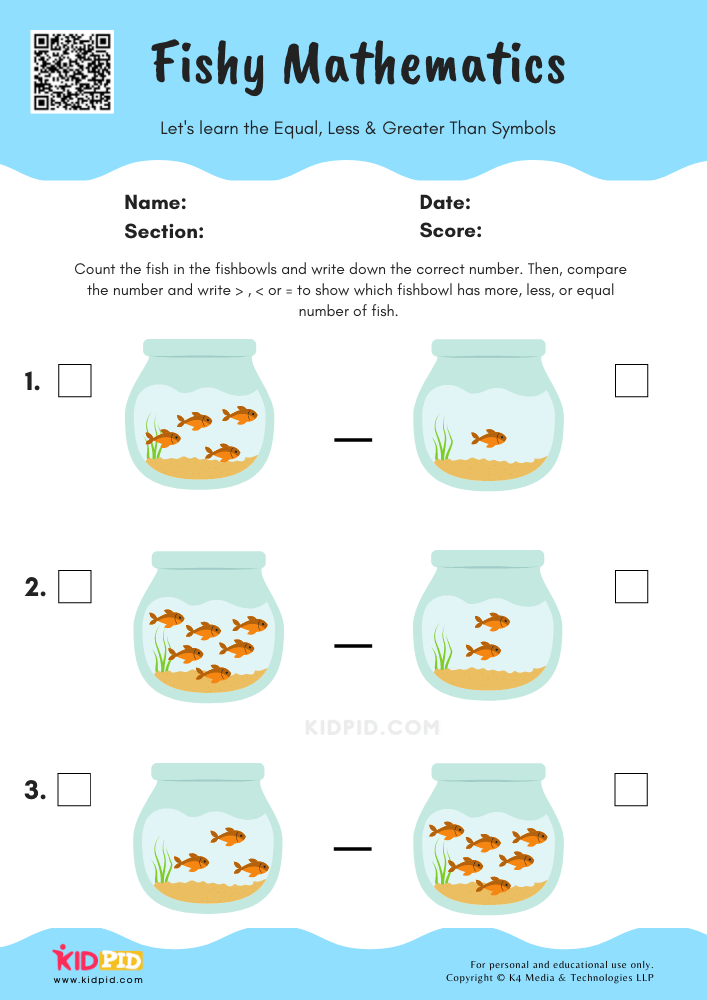
Comparison in mathematics means finding out the difference between the numbers. By examining the difference, one can easily find how much greater or how much smaller the number is when compared to another number.
Blue Aquarium Fish Math Game Worksheet:4
Ask your kids to count the numbers by saying them out loud, putting your finger on the fish while counting, because it will be more helpful for them to memorize and make them stay focused on the topic. Give some of the worksheets to kids to solve on their own. This will make them responsible for their studies.
Kids have very curious minds filled with lots of questions. Some make sense, some don’t, but what matters is that they eagerly want to find out the answers and grab knowledge, and if knowledge is provided interestingly, then they will understand better.
Key Facts About Blue Aquarium Fish Math Game Worksheets
Blue Aquarium Fish Math Game Worksheets for Kids combine fun underwater themes with educational math activities. These worksheets help children practice basic arithmetic skills such as addition, subtraction, counting, and number recognition while engaging with colorful fish illustrations. Designed for preschool and elementary learners, they encourage active participation through game-based learning. The aquarium theme captures children’s attention and makes mathematical concepts easier to understand. These worksheets can be used in classrooms, homeschooling environments, learning centers, or as extra practice at home. By turning math into an interactive game, children develop confidence and enjoyably improve their problem-solving abilities.
Parts, Types, and Examples of Blue Aquarium Fish Math Game Worksheets
Parts of the Worksheets
- Colorful blue aquarium fish illustrations
- Number and counting activities
- Addition and subtraction exercises
- Matching and sorting tasks
- Answer spaces for student responses
Types of Worksheets
- Fish counting worksheets
- Addition aquarium games
- Subtraction fish puzzles
- Number matching activities
- Color-by-number fish worksheets
- Missing number challenges
Examples
- Count the fish and write the total.
- Add the numbers shown on the two fish.
- Match the fish with the correct answer bubble.
- Find the missing number in the aquarium sequence.
How Does Blue Aquarium Fish Math Game Worksheets for Kids Work?
These worksheets use visual learning and interactive game elements to teach math concepts. Children observe fish, count objects, solve arithmetic problems, and complete challenges related to the aquarium theme. Each activity encourages learners to think critically while practicing foundational math skills. The colorful designs help maintain attention, making learning more engaging and less intimidating. Repeated practice through fun activities strengthens number sense and mathematical understanding.
Benefits of Learning About Blue Aquarium Fish Math Game Worksheets
- Improves counting and number recognition skills.
- Strengthens addition and subtraction abilities.
- Enhances concentration and attention to detail.
- Encourages independent learning and confidence.
- Supports visual and hands-on learning styles.
- Develops critical thinking and problem-solving skills.
- Creates positive attitudes toward mathematics.
Learning Objectives
By completing these worksheets, children will be able to:
- Count objects accurately.
- Identify and recognize numbers.
- Perform basic addition and subtraction.
- Match numbers with corresponding quantities.
- Improve logical reasoning skills.
- Follow instructions independently.
- Build confidence in solving math problems.
- Develop early mathematical fluency.
Worksheet Instructions
- Carefully read each question before starting.
- Count the fish or objects shown in the aquarium.
- Solve the math problem provided.
- Write your answer in the designated space.
- Match fish with the correct numerical answers when required.
- Complete all activities neatly and accurately.
- Review your answers after finishing.
- Have fun while learning and exploring math concepts.
Interesting Facts About Blue Aquarium Fish Math Game Worksheets for Kids
- Children learn more effectively when educational content includes visual themes and games.
- Aquarium-themed worksheets increase engagement by connecting learning with nature.
- Math games help improve memory retention and problem-solving abilities.
- Colorful illustrations support visual learning and comprehension.
- Interactive worksheets encourage active participation rather than passive learning.
- Game-based learning has been shown to increase student motivation and confidence.
- Fish-themed activities can spark curiosity about marine life and ocean ecosystems.
Vocabulary Words
Understanding these terms can help children complete the worksheets successfully:
- Aquarium – A tank where fish and aquatic animals live.
- Fish – An aquatic animal that lives in water.
- Count – To determine the total number of objects.
- Number – A symbol used to represent a quantity.
- Addition – Combining numbers to find a total.
- Subtraction – Taking away one quantity from another.
- Match – Pairing related items together.
- Quantity – The amount or number of objects.
- Puzzle – A problem designed to test thinking skills.
- Sequence – Numbers arranged in a specific order.
Real-Life Applications
The skills developed through Blue Aquarium Fish Math Game Worksheets can be applied in everyday situations, including:
- Counting toys and household objects.
- Calculating simple totals while shopping.
- Organizing collections by number or quantity.
- Understanding basic measurements and quantities.
- Solving everyday math problems.
- Developing financial literacy through number awareness.
- Building a strong foundation for future mathematics learning.
- Enhancing observation and analytical skills used in daily life.
FAQs
Q1. What age group are Blue Aquarium Fish Math Game Worksheets suitable for?
Answer: These worksheets are generally designed for preschool, kindergarten, and early elementary students, typically ages 4–8.
Q2. What math skills do these worksheets teach?
Answer: They help children practice counting, number recognition, addition, subtraction, matching, and basic problem-solving skills.
Q3. Can these worksheets be used at home?
Answer: Yes. They are ideal for homeschooling, after-school practice, tutoring sessions, and independent learning.
Q4. Why is the aquarium theme effective for learning?
Answer: The colorful fish and underwater visuals make learning more engaging, helping children stay motivated and focused.
Q5. Are these worksheets useful for beginners?
Answer: Absolutely. The activities are designed to introduce foundational math concepts simply and enjoyably.
Q6. How often should children practice with these worksheets?
Answer: Regular practice, even 10–15 minutes a day, can significantly improve math confidence and skill development.
Q7. Do these worksheets support visual learners?
Answer: Yes. The bright illustrations and interactive activities are especially beneficial for visual and hands-on learners.
Q8.Can teachers use these worksheets in classrooms?
Answer: Yes. Teachers can incorporate them into math centers, group activities, homework assignments, or independent practice sessions.
Whether it is the early stage of learning or the higher stage, practical activity is always considered the best way to teach. The small activities in the worksheets satisfy their curious minds, as they can figure out the answers to their questions by themselves, with those colorful pictures. Enjoy educational worksheets alongside flashcards, essays, paragraphs, quizzes, and exciting activities for children. Follow us on YouTube & Facebook every day.
The Content Team prepared this worksheet to support educational success.
Reviewed By Chaitrali Shelar
Read More:



