
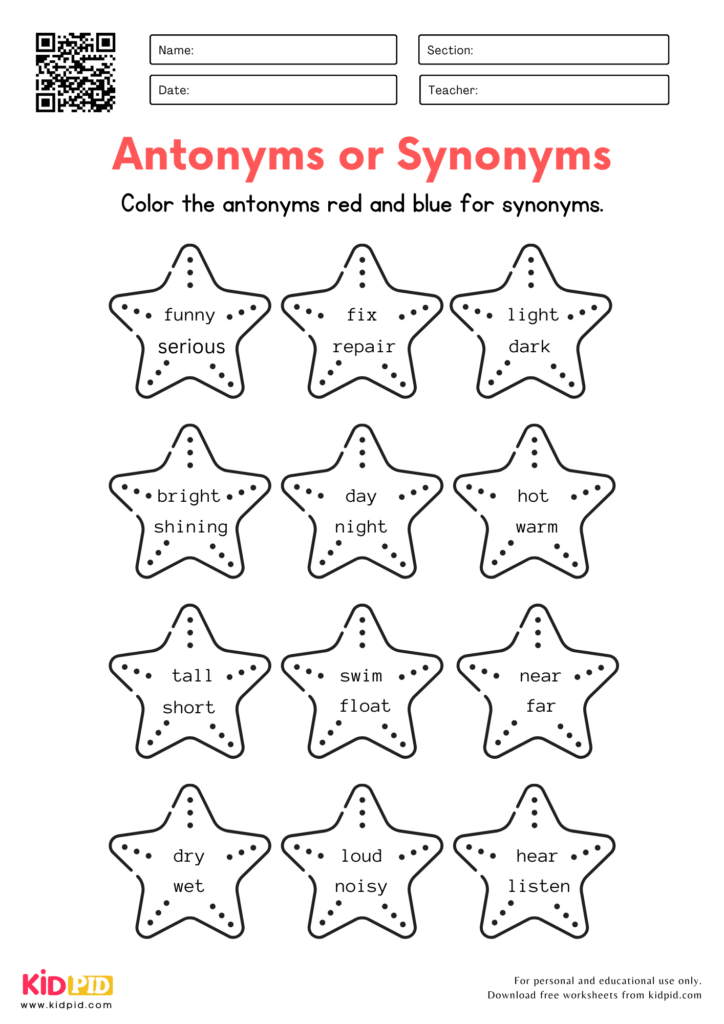
In this worksheet, you’ll have fun coloring words. Color the antonyms (words with opposite meanings) in red, and color the synonyms (words with similar meanings) in blue. This activity will help you learn more about how words can be different or the same. Grab your crayons and get ready to explore the world of words through colors!
[Scroll Down for Download Link]
Contents
- Color The Antonyms And Synonyms Vocabulary Worksheets
- Key Facts About the Worksheet
- Parts/Types/Examples of the Worksheet
- How Does the Worksheet Work?
- Benefits of Learning About Antonyms & Synonyms
- Learning Objectives
- Worksheet Instructions
- Interesting Facts About Vocabulary Words
- Real-Life Applications
- FAQs
Color The Antonyms And Synonyms Vocabulary Worksheets
Read More: Synonyms Words – Same Word Many Slang

Key Facts About the Worksheet
- Target Audience: Kindergarten students (ages 4–6).
- Core Skill: English vocabulary development focusing on lexical relationships.
- Activity Type: Multisensory, combining fine motor skills (coloring) with linguistic analysis.
- Color Coding: Uses visual cues (red for antonyms, blue for synonyms) to reinforce concept retention.
- Purpose: To make abstract language concepts concrete and engaging for young learners.
Parts/Types/Examples of the Worksheet
This activity is broken down into two core linguistic components:
- Antonyms (Opposites): Words that have contrasting meanings (e.g., Hot/Cold, Big/Small, Up/Down). In this worksheet, these are categorized by the color Red.
- Synonyms (Similarities): Words that have the same or very similar meanings (e.g., Happy/Glad, Big/Large, Fast/Quick). In this worksheet, these are categorized by the color Blue.
How Does the Worksheet Work?
The “Color the Antonyms & Synonyms” activity utilizes the Cognitive Association Method. By assigning a specific color to a linguistic category, the brain creates a stronger neural pathway between the visual cue and the word’s definition. The child is tasked with reading (or having a teacher read) a list of words, identifying the relationship, and then coloring the corresponding box. This process shifts the focus from rote memorization to active, gamified learning.
Benefits of Learning About Antonyms & Synonyms
- Vocabulary Expansion: Encourages children to find alternative ways to express their thoughts.
- Critical Thinking: Requires children to analyze the relationship between words rather than just reading them.
- Improved Writing Skills: A strong foundation in antonyms and synonyms leads to more descriptive and expressive writing in later grades.
- Confidence Building: Mastering word relationships provides a sense of accomplishment, encouraging a positive attitude toward English language studies.
Learning Objectives
By completing this worksheet, students will:
- Define and identify the difference between antonyms and synonyms.
- Practice color recognition and fine motor control.
- Categorize vocabulary words based on their semantic relationships.
- Develop a deeper understanding of how synonyms and antonyms enrich communication.
Worksheet Instructions
- Preparation: Print the worksheet and provide a set of crayons or colored pencils (specifically Red and Blue).
- Guided Practice: Review the list of words with the student to ensure they understand the meanings.
- The Task:
- Find the word pairs that are opposites. Color them Red.
- Find the word pairs that mean the same thing. Color them Blue.
- Review: Once finished, ask the child to say the words aloud and explain why they chose a specific color for that pair.
Interesting Facts About Vocabulary Words
- The Power of Synonyms: Using synonyms (e.g., saying “enormous” instead of “big”) makes a story much more interesting and vivid.
- The Utility of Antonyms: Antonyms are essential for describing change, like how the weather goes from “sunny” to “rainy” or a mood shifts from “sad” to “happy.”
- Early Foundations: Kindergarten is the “golden age” for language acquisition; children who interact with these concepts early often develop better reading comprehension later on.
Real-Life Applications
- Better Communication: Being able to choose the “right” word helps kids express exactly how they feel.
- Reading Fluency: When children encounter a word they don’t know in a story, knowing its synonym helps them understand the context of the sentence.
- Problem Solving: Understanding antonyms helps in logical reasoning—understanding what is by understanding what it is not.
FAQs
Q1. At what age should a child start learning synonyms and antonyms?
Answer: Kindergarten is the ideal time to introduce these concepts through play-based activities like this coloring worksheet.
Q2. Why use coloring as a learning method?
Answer: Coloring keeps the student engaged and allows them to take a break from traditional writing, making the learning process less daunting and more enjoyable.
Q3. Can I use this for homeschool?
Answer: Absolutely! This worksheet is designed by educators to be easily implemented in both classroom settings and individual home learning environments.
Q4. How can I help my child if they struggle to identify the pairs?
Answer: Use physical objects or images to demonstrate. For example, show a large ball and a small ball to explain the antonym pair “Big/Small.”
 Coloring antonyms and synonyms makes vocabulary learning enjoyable for kindergarten children. These interactive worksheets develop word recognition, language understanding, observation skills, early reading abilities, and confidence through playful learning experiences. Explore interactive learning with worksheets, essays, paragraphs, flashcards, quizzes, and interactive resources, and more on our website. Connect with us on YouTube & Facebook.
The Content Team designed this worksheet to aid academic understanding.
Reviewed By Shreyasi Desai
Read More: