


This is a normal-to-expanded notation place value worksheet for third-grade students. They will convert the numbers from normal to expanded form and write numbers up to 9999 using expanded notation. Students can take hints from an example. So check out these worksheets and build your knowledge about the formation of numbers. Enjoy the activity and have fun!
[Scroll Down for Download Link]
Contents
Write Numbers Up to 9,999 Using Expanded Notation
Read More: Math Expanded Form Worksheets for Grade 2

- 2,637 = 2 x 1000 + 6 x 100 + 3 x 10 + 7 x 1
- 792 = 7 x 100 + 9 x 10 + 2 x 1
- 3,691 = 3 x 1000 + 6 x 100 + 9 x 10 + 1 x 1
- 8,546 = 8 x 1000 + 5 x 100 + 4 x 10 + 6 x 1
- 932 = 9 x 100 + 3 x 10 + 2 x 1
- 8,278 = 8 x 1000 + 2 x 100 + 7 x 10 + 8 x 1
- 463 = 4 x 100 + 6 x 10 + 3 x 1
- 84 = 8 x 10 + 4 x 1
- 1,093 = 1 x 1000 + 9 x 10 + 3 x 1
Students have to convert normal to expanded notation place value, and they have to write numbers up to 9,999 using expanded notation. An example is given to take hints, and the answer key is given to correct their mistakes and complete the worksheet accurately.
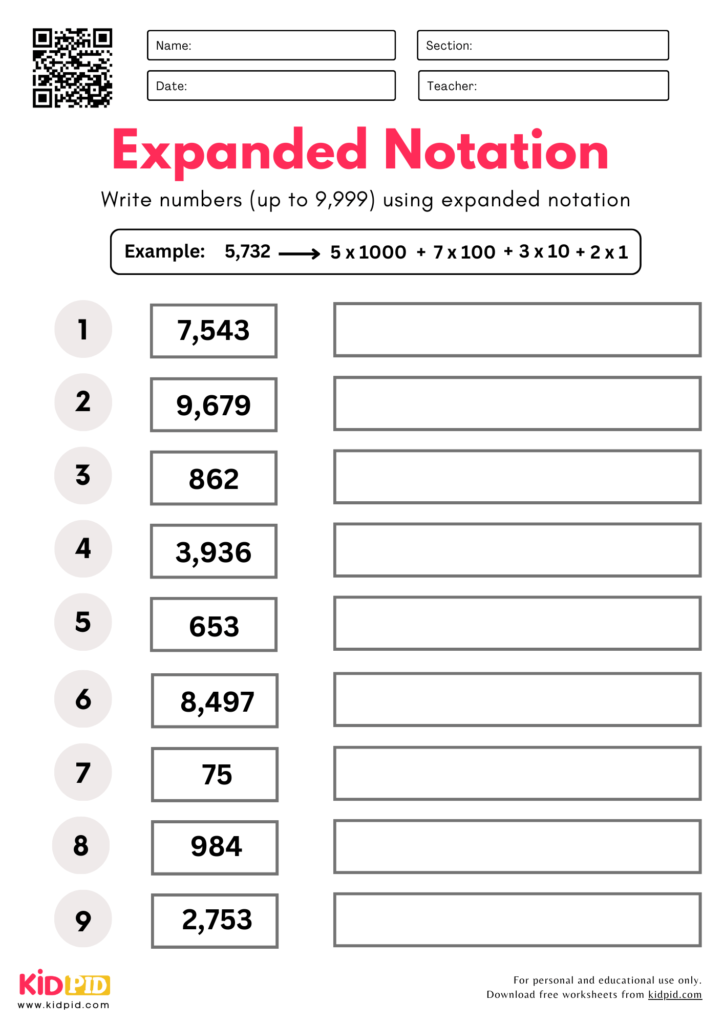
- 7,543 = 7 x 1000 + 5 x 100 + 4 x 10 + 3 x 1
- 9,679 = 9 x 1000 + 6 x 100 + 7 x 10 + 9 x 1
- 862 = 8 x 100 + 6 x 10 + 2 x 1
- 3,936 = 3 x 1000 + 9 x 100 + 3 x 10 + 6 x 1
- 653 = 6 x 100 + 5 x 10 + 3 x 1
- 8,497 = 8 x 1000 + 4 x 100 + 9 x 10 + 7 x 1
- 75 = 7 x 10 + 5 x 1
- 984 = 9 x 100 + 8 x 10 + 4 x 1
- 2,753 = 2 x 1000 + 7 x 100 + 5 x 10 + 3 x 1
This is an expanded notation worksheet in which the students will convert normal to expanded notation place value, and they have to write numbers up to 9,999 using expanded notation. It includes an answer key for the correction and completion of the worksheet.
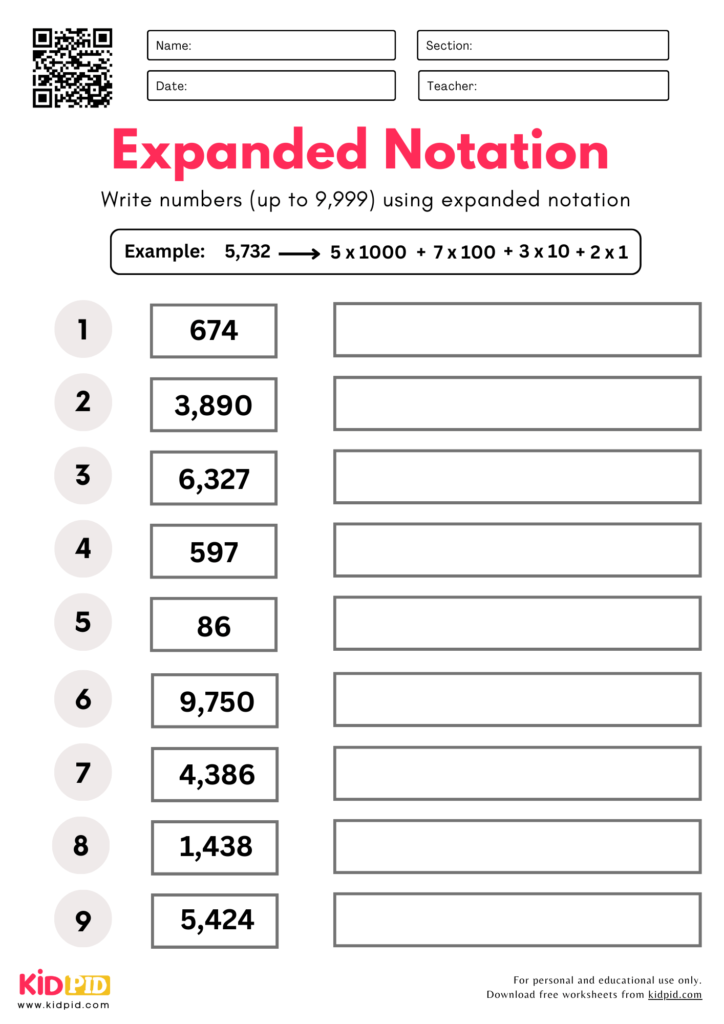
- 674 = 6 x 100 + 7 x 10 + 4 x 1
- 3,890 = 3 x 1000 + 8 x 100 + 9 x 10
- 6,327 = 6 x 1000 + 3 x 100 + 2 x 10 + 7 x 1
- 597 = 5 x 100 + 9 x 10 + 7 x 1
- 86 = 8 x 10 + 6 x 1
- 9,750 = 9 x 1000 + 7 x 100 + 5 x 10
- 4,386 = 4 x 1000 + 3 x 100 + 8 x 10 + 6 x 1
- 1,438 = 1 x 1000 + 4 x 100 + 3 x 10 + 8 x 1
- 5,424 = 5 x 1000 + 4 x 100 + 2 x 10 + 4 x 1
In this expanded notation worksheet, students will learn to convert a standard number to an expanded form. They will write numbers up to 9,999 using expanded notation. It consists of an answer key for the correction and completion of the worksheet.
Key Facts About Expanded Notation
- Definition: Expanded notation (or expanded form) is a mathematical way of writing a number to show the value of each digit based on its position (place value).
- The Foundation: It relies entirely on our base-10 number system, where each position to the left is worth ten times more than the position to its right (ones, tens, hundreds, thousands, etc.).
- No Value Digits: Digits with a value of zero (e.g., in 405, the tens place is zero) do not need to be written in the expanded expression, as they do not add to the total.
- Beyond Addition: While often taught as simple addition (e.g., 400 + 50 + 6), it can also be expressed using multiplication to emphasize place value (e.g., (4 × 100) + (5 × 10) + (6 × 1)).
Parts/Types/Examples
- Standard Form: The typical way we write numbers (e.g., 4,582).
- Expanded Form (Addition): Expressing the number as a sum of its parts.
- Example: 4,582 = 4,000 + 500 + 80 + 2.
- Expanded Notation (Multiplication): Expressing the number as the product of the digit and its place value.
- Example: 4,582 = (4 × 1,000) + (5 × 100) + (8 × 10) + (2 × 1).
How Does Expanded Notation Work?
Expanded notation works by “stretching out” a number to reveal its hidden structure.
- Identify the position: Look at each digit starting from the left.
- Determine the value: Decide if the digit is in the ones, tens, hundreds, or thousands place.
- Calculate the value: Multiply the digit by its place value (e.g., a ‘5’ in the hundreds place is 5 × 100 = 500).
- Combine: Join these values with addition signs to create the full expanded expression.
Benefits of Learning About Expanded Notation
- Strengthens Number Sense: It moves students beyond rote memorization of digits to understanding what those digits actually represent.
- Improves Arithmetic Accuracy: Understanding that “4” in 45 stands for 40 prevents common errors in multi-digit addition and subtraction.
- Foundation for Algebra: It serves as a precursor to the distributive property and more complex algebraic thinking.
- Reduces Calculation Errors: By breaking numbers into manageable parts, students are less likely to make mental math mistakes.
Learning Objectives
By the end of these lessons, students will be able to:
- Identify the place value of any digit in a multi-digit number.
- Convert numbers from standard form to expanded form accurately.
- Translate expanded notation expressions back into standard form.
- Explain why a digit’s position changes its numerical value.
Worksheet Instructions
- Read carefully: Identify the standard number provided on the worksheet.
- Use a chart: If you are unsure, draw a quick place-value table (Thousands | Hundreds | Tens | Ones) to line up your digits.
- Expand: Write the value of each non-zero digit separated by plus signs.
- Double-check: Add your expanded components together. If the sum equals your original number, you have the correct answer!
Interesting Facts About Vocabulary Words
- Digit: The individual symbols used to write numbers (0, 1, 2, 3, 4, 5, 6, 7, 8, 9).
- Place Value: The value assigned to a digit based on its position in a number.
- Base-10: Our number system, which uses ten digits and place values of powers of ten.
- Standard Form: The standard, shorthand way we write numbers every day.
Real-Life Applications
- Money: Understanding that $1,250 is one thousand-dollar bill, two hundred-dollar bills, and five ten-dollar bills (1000 + 200 + 50).
- Shopping: Reading prices on tags and comparing the value of different items.
- Measurement: Calculating distances in kilometers or meters where place value is essential for accuracy.
- Coding/Computers: Understanding how numbers are stored and processed by machines.
FAQs
Q1. Are expanded form and expanded notation the same?
Answer: Often used interchangeably in elementary school, though “expanded notation” technically refers to using multiplication (e.g., 4 × 100), whereas “expanded form” usually refers to simple addition (e.g., 400).
Q2. Why do we have to learn this?
Answer: It is the “why” behind the “how” of math. It makes multi-digit addition, subtraction, and long multiplication much easier to understand later.
Q3. Does it work with decimals?
Answer: Yes! You can expand decimals by using fractions or decimals (e.g., 0.5 = 5 × 0.1).

Develop a deeper understanding of place value with these Grade 3 worksheets. Converting standard numbers into expanded notation improves number sense, digit value recognition, mathematical accuracy, and problem-solving confidence. Discover exciting educational printables, including worksheets, paragraphs, quizzes, essays, flashcards, and interactive resources and tools. Follow us on YouTube, Facebook, and Telegram.
Developed by our Content Team, this worksheet supports learning improvement.
Reviewed By Poornima Ravi
Read More:



