

Looking for place value worksheets for grade 1? Check out our place value worksheets that help first-grade kids count places to hundreds.
Place value refers to the numerical value that a digit has by its position in any given number. In mathematics, every digit in a number has a place value. Depending on its position, it can be ones, tens, hundreds, thousands, and so on. In simpler terms, place value can be defined as the value represented by a digit in a number based on its position in the number.
Contents
- Identifying Place Value Worksheets for Class 1
- Box Method Multiplication | 2-Digits x 2-Digits
- Key Facts About Identifying Place Value Worksheets for Grade 1
- Parts, Types, and Examples of First Grade Place Value Exercises
- How Do Grade 1 Place Value Worksheets Work?
- Benefits of Learning About Place Value in First Grade
- Learning Objectives
- Worksheet Instructions
- Interesting Facts About Place Value
- Vocabulary Words
- Real-Life Applications
- FAQs
- You may like these:
Identifying Place Value Worksheets for Class 1

The worksheet allows first graders to understand the basics of the number system. It comprises several sheets consisting of multiple exercises to help identify and understand the place value of numbers.
Determine the place value of the underlined digit
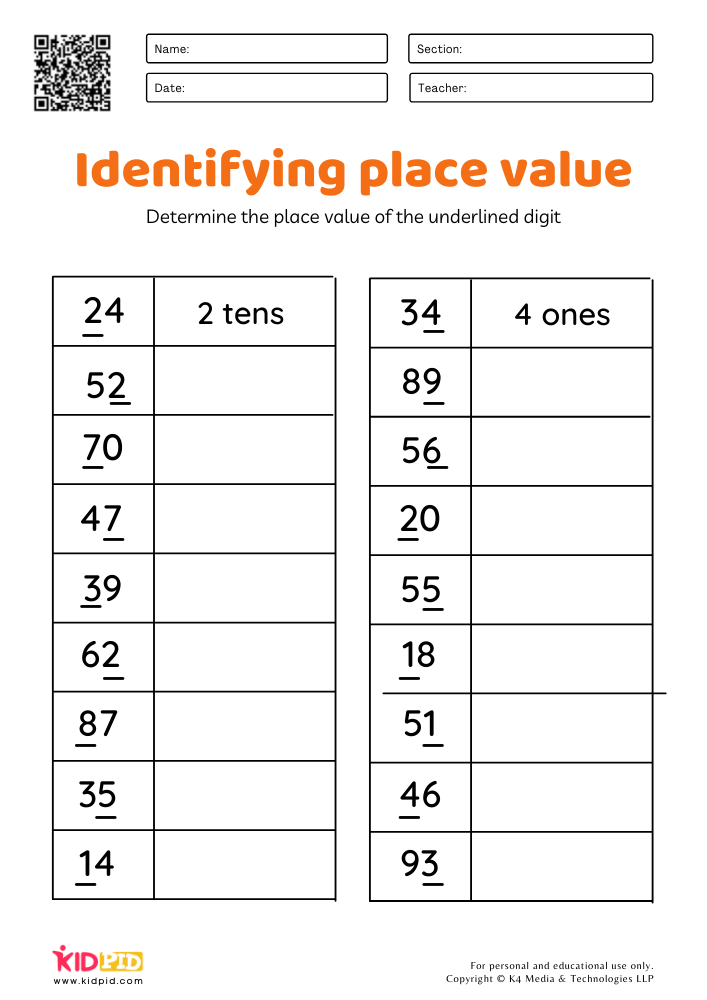
The task at hand is simple. Students need to determine the place value of the underlined digits in the numbers given below and write them in the space provided. For example, in the first question of the second sheet, the number 2 is underlined, and it is in the tens position; the correct answer to be written in the space provided is 2 tens.
Reveal the place value of the digit marked below
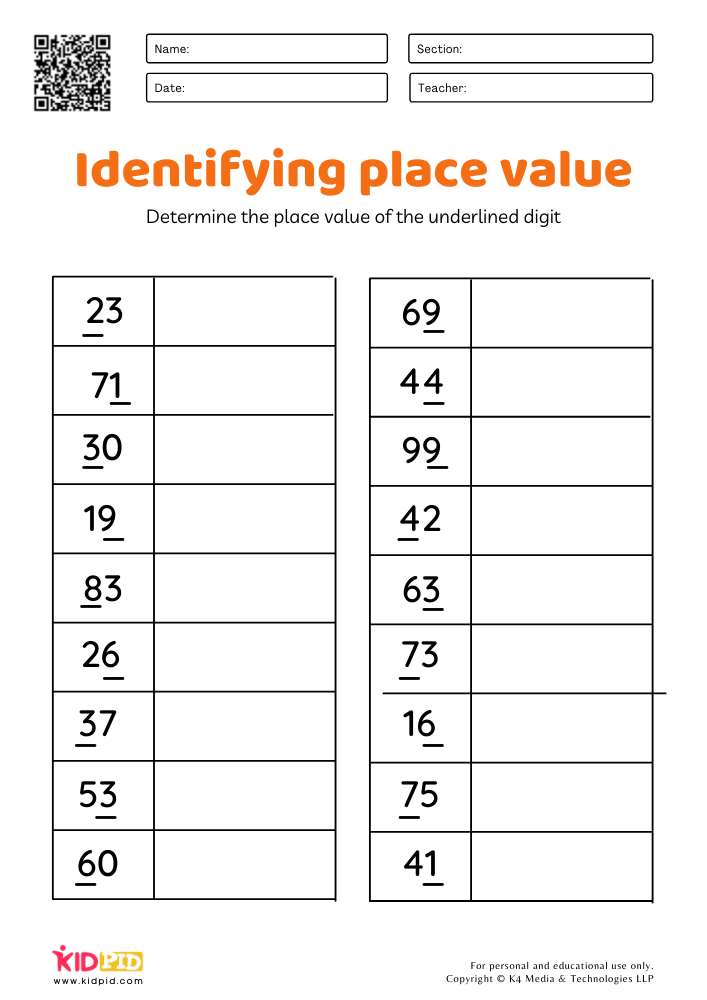
While tutoring your first grader, it is important to remember that it is one of the fundamental concepts of mathematics, and it is essential that it is taught in a manner that focuses on the basics. For kids who are just getting started with mathematics, our worksheets consist of exercises that focus on tens and ones only.
Find out the place value of the underlined number
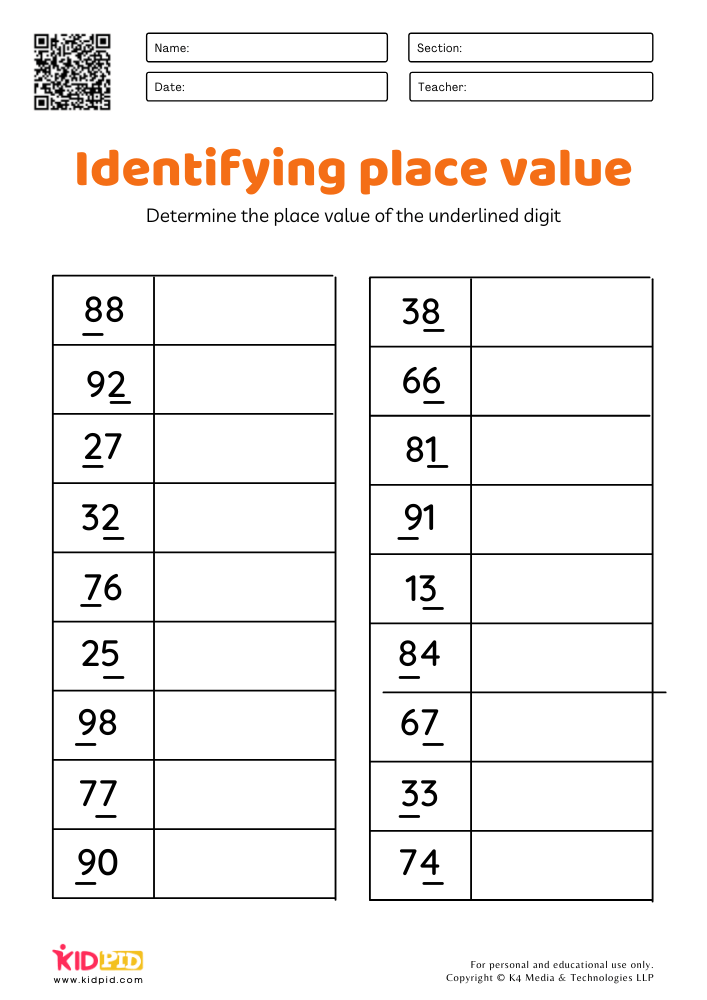
This is the fourth worksheet. You can use it to test if your student is able to discern place values correctly or not. If he is still making mistakes, try going over the basic concept of place values once again and then ask him to do these worksheets again. Learning is a time-consuming process. It requires patience and resilience.
What is the place value of the digit that is underlined?
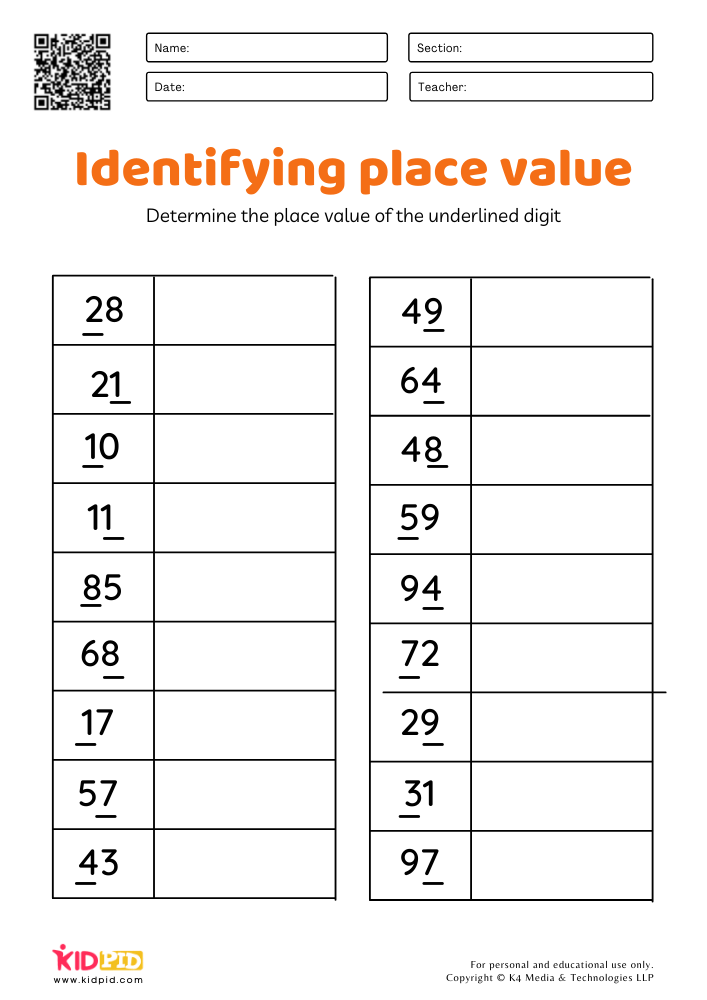
The final sheet provides 18 more questions for practice. Learning the difference between ones and tens place value is essential, since it is only after learning this that children can move to understand bigger place values, such as hundreds and thousands.
Assess the place value for the digit shown in the underlined
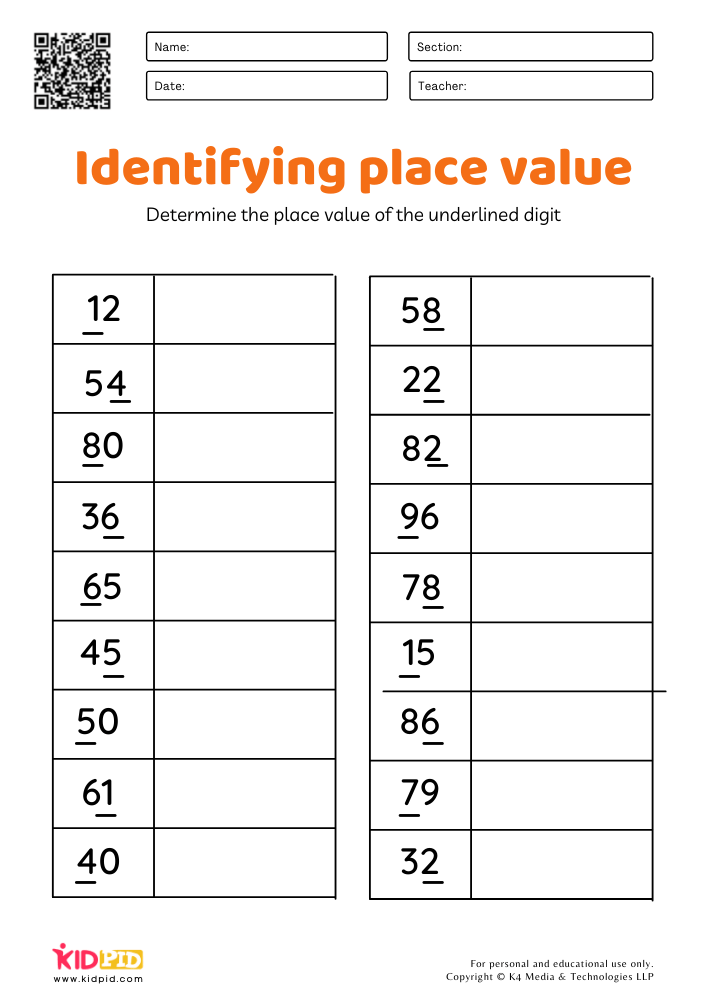
Understanding place value is essential for kids as it is the foundation for mathematics. Without a proper understanding of it, operations such as addition, subtraction, and others are impossible.
This video may help you to understand place value in a better way.
Box Method Multiplication | 2-Digits x 2-Digits
Download the worksheets now and start learning!
To keep young minds engaged, our printable bundle incorporates different structural layouts that approach the concept from multiple angles:
Students look at a two-digit number where one digit is emphasized. They must determine if it represents a unit of ten or a single unit.
Straightforward fill-in-the-blank problems designed to build rapid recognition and confidence without overwhelming visual clutter.
The final pages mix underlined ones and tens unpredictably, serving as an excellent assessment tool to verify that the student isn’t just guessing patterns.
These worksheets use a proven pedagogical method called targeted isolation. Instead of asking a child to do multiple math steps at once, they isolate just one skill: recognizing position.
Mastering this math milestone early pays massive dividends throughout an elementary school education. Working through these printables offers several distinct benefits:
By the time a student completes this workbook bundle, they will be able to:
Parents and teachers can read these directions aloud to students before beginning:
“Look at each number on the page carefully. Find the digit that has a straight line drawn underneath it. Think about its home: is it in the Tens house on the left, or the Ones house on the right? Write down its place value in the empty blank line next to the number. Take your time, and remember to look closely at which number is underlined!” To build strong math communication skills, ensure your first grader understands these key terms:
Place value isn’t just an abstract school topic—kids see and use it in the real world every single day:
Key Facts About Identifying Place Value Worksheets for Grade 1
Parts, Types, and Examples of First Grade Place Value Exercises
1. Underlined Digit Identification (The Core Exercise)
3 tens or 30.7 ones or 7.2. The Direct Identification Layout
3. Mixed Practice Review Sheets
How Do Grade 1 Place Value Worksheets Work?
Benefits of Learning About Place Value in First Grade
Learning Objectives
Worksheet Instructions
Interesting Facts About Place Value
Vocabulary Words
Real-Life Applications
FAQs
Q1. What is Place Value?
Answer: Place value is the numerical value of a number based on its position in a number system. It is the value of the digit itself and its position relative to the decimal point. In the decimal system of numbers, each digit in a number has a specific place value, and the value of the entire number is determined by the sum of each digit and its corresponding place value. For example, the number 324 has a 3 in the hundreds place, a 2 in the tens place, and a 4 in the ones place. The place values of the three digits are 300 (3 x 100), 20 (2 x 10), and 4 (4 x 1), so the total value of the number is 324 (300 + 20 + 4).
Q2. What is the difference between ones, tens, and hundreds?
Answer: The difference between ones, tens, and hundreds is the place value of the numbers. Ones are the units of a number, tens are the tens place value, and hundreds are the hundreds place value. For example, in the number 745, 7 is in the hundreds place, 4 is in the tens place, and 5 is in the ones place.
Q3. What are the most important Place Value concepts for a Grade 1 student to learn?
Answer: The most important place value concepts for a Grade 1 student to learn are: understanding the base-10 system, counting by 1s, 10s, and 100s, recognizing place value from ones to thousands, and being able to compare and order numbers. It is also important for them to understand the concept of rounding numbers, adding and subtracting numbers, and being able to identify patterns in numbers. Lastly, they need to understand the concept of expanded form and how it can help them solve problems.
We trust you enjoyed these ‘Place Value Worksheets for Grade 1’! Explore more free worksheets on Kidpid. Practice daily to improve your learning. Make daily practice a habit to boost your learning. Follow us on Facebook, Pinterest, YouTube & Telegram. Join our Telegram group for free printables. Thank you, and visit us again soon!
This worksheet was crafted by the Content Team to foster academic success.
Reviewed By Kartik
You may like these:
Tens and Ones Practice: Free Place Value Worksheets for First Graders
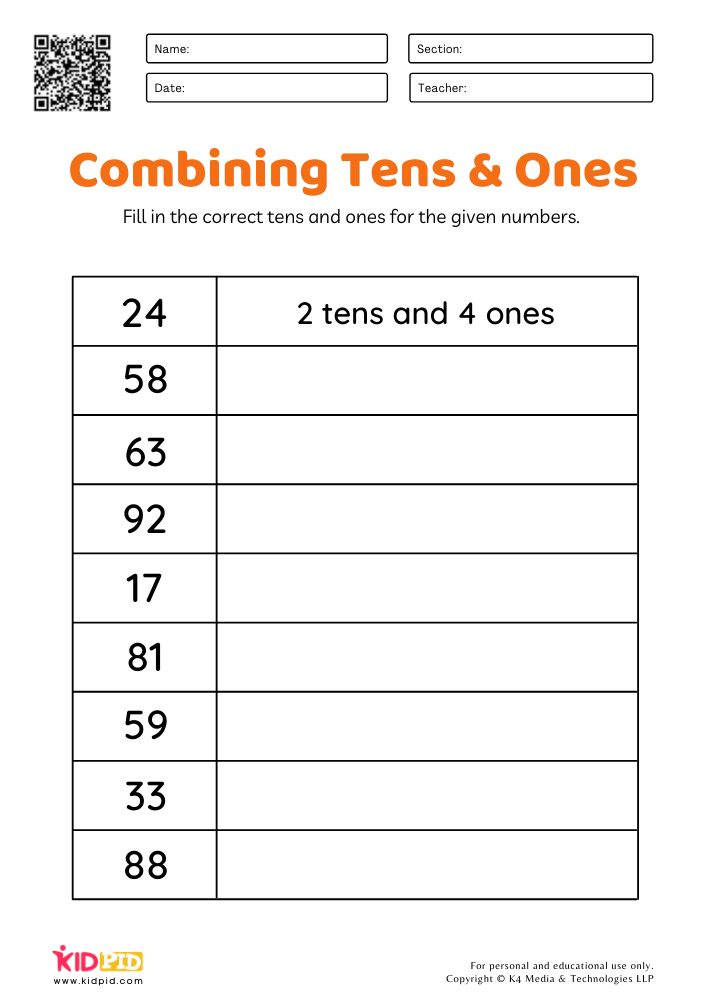
These free worksheets provide first graders with practice on tens and ones. Engaging activities simplify place value concepts, helping students build confidence and essential skills in early mathematics.
Grade 1 Place Value Activities: Mastering 2-Digit Numbers with Fun Worksheets
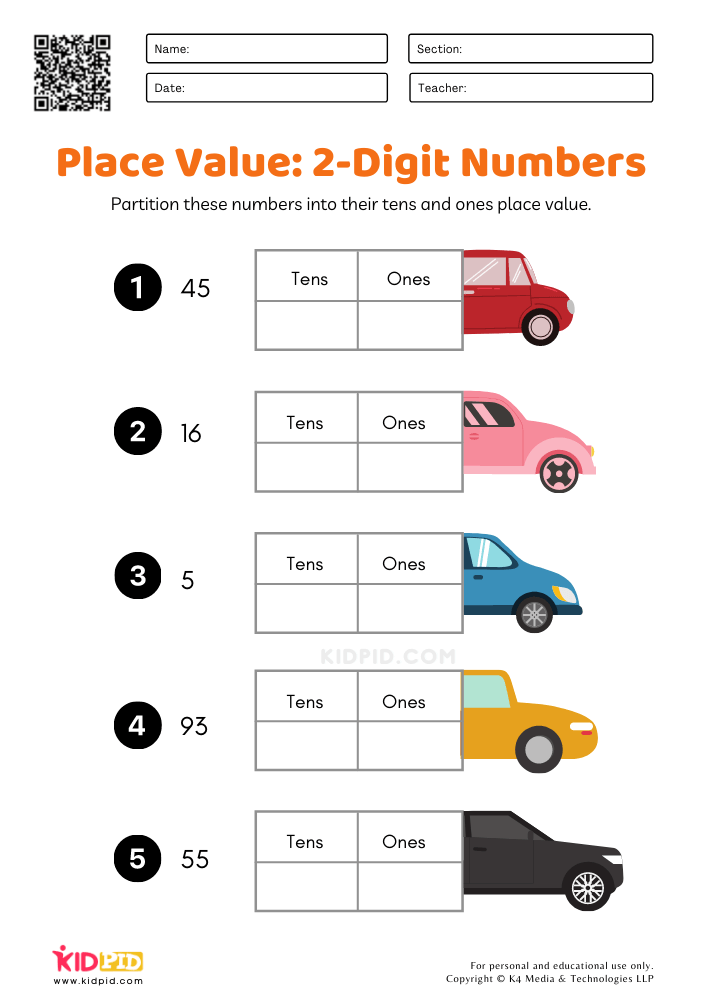
These fun worksheets help first graders master 2-digit numbers through engaging activities. Interactive exercises promote understanding of place value, ensuring a solid foundation for future mathematical success.
First Grade Math Worksheets: Tens and Ones Using the Part-Whole Model
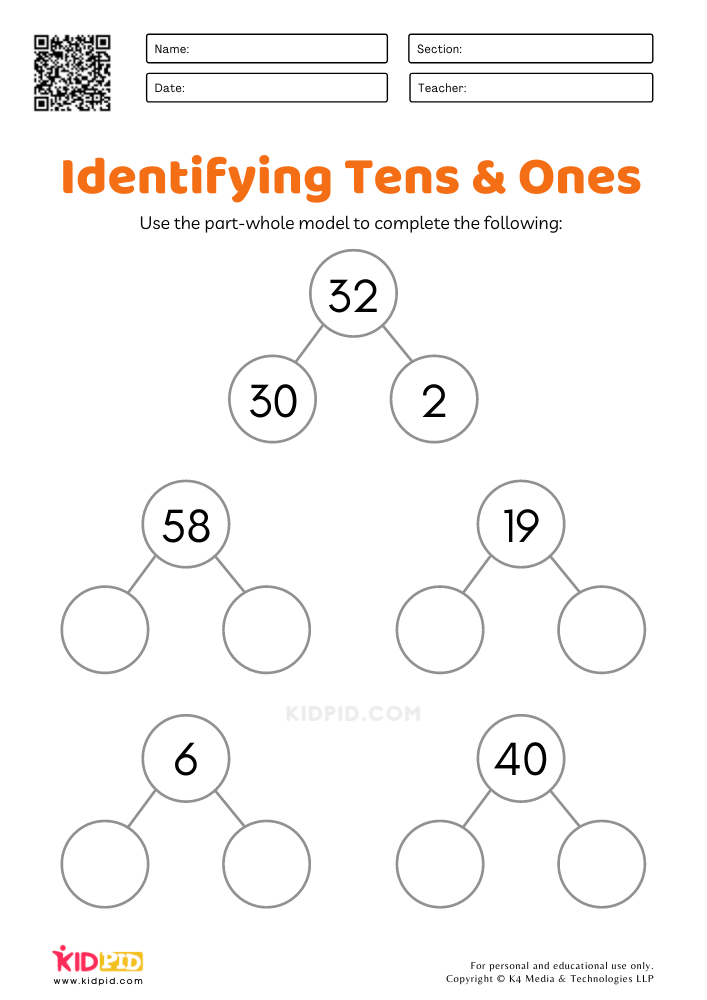
These worksheets utilize the part-whole model to teach first graders about tens and ones. Fun exercises enhance understanding of place value, making math relatable and enjoyable for young learners.
First Grade Math Activities: Focus on Underlined Digit Place Values
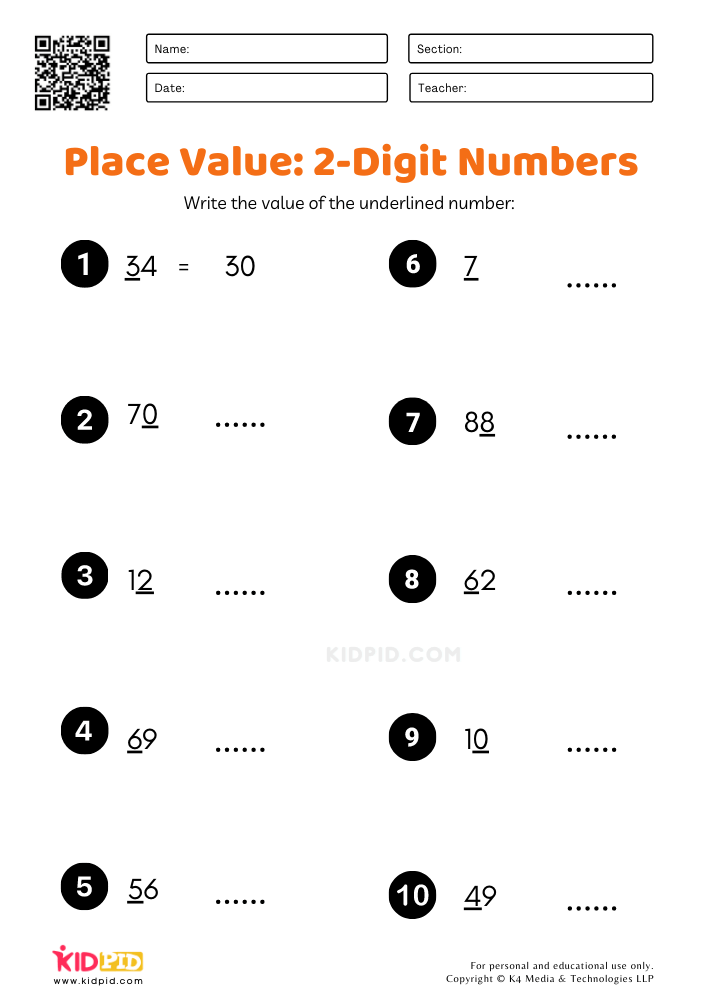
These engaging activities focus on identifying underlined digit place values for first graders. Interactive exercises reinforce understanding of tens and ones, helping students develop essential skills in a fun manner.



