Learning is an essential aspect of every child’s education journey. Children must have a solid hold of the various topics because they will have to apply their learning as well as face other new obstacles in the future. The method is the same as in the previous worksheets – start by counting the numbers and then coloring the respective items. Once the tone is set, all the worksheets will be a piece of cake.
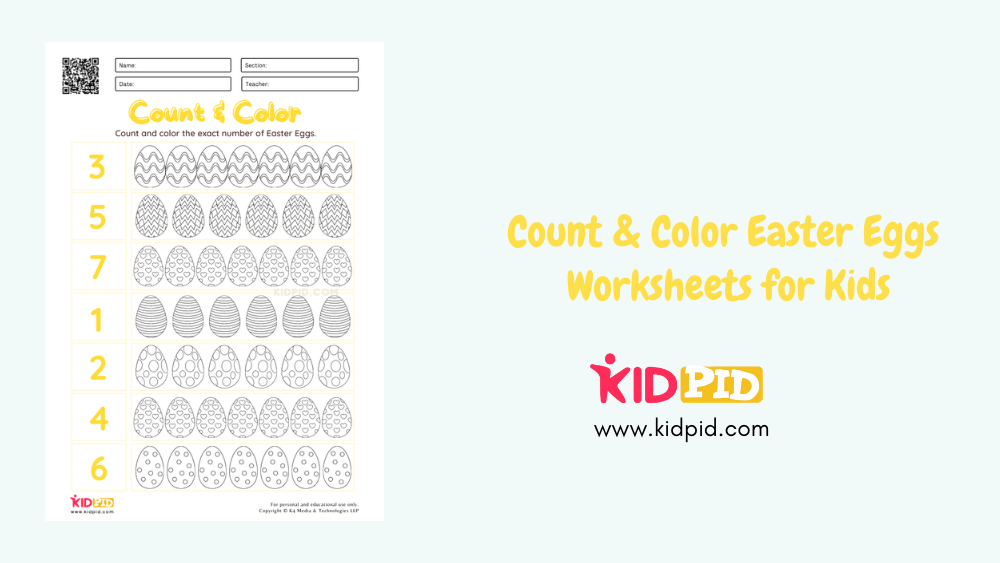
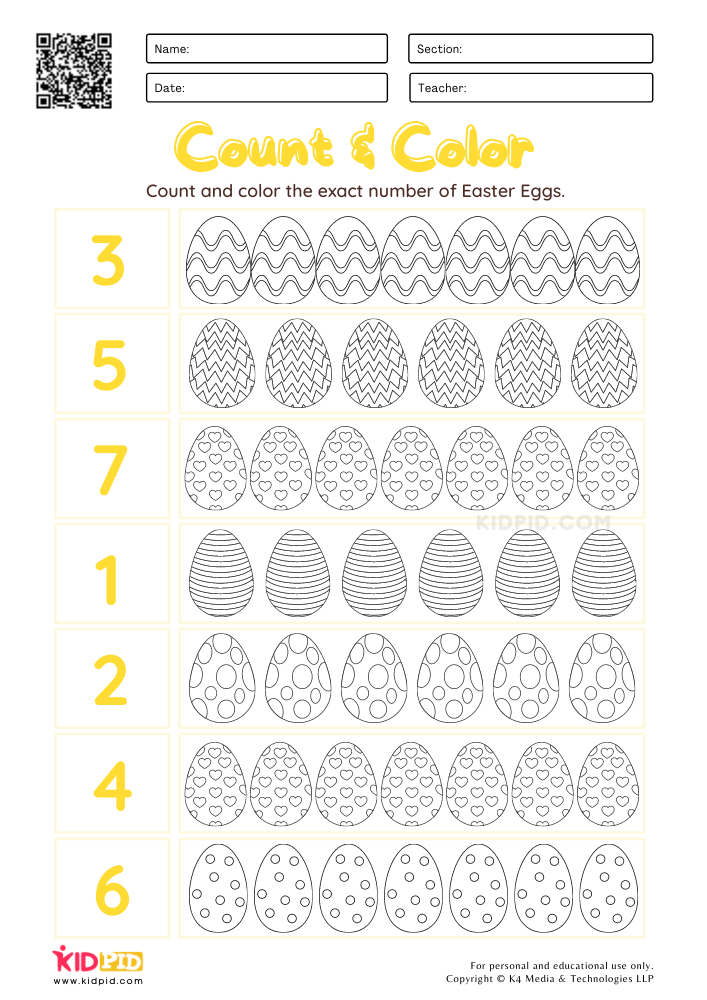
The first worksheet will ask the child to count the number and then color the exact number of easter eggs. Kids will enjoy doing this worksheet because they’ll get to color the items. This will not only make it fun to solve the worksheet but also help young students understand the concept of Easter eggs.
[Scroll Down for Download Link]
Contents
- Count & Color Easter Eggs Worksheets
- Key Facts About Count & Color Easter Eggs Worksheets for Kids
- Parts, Types, and Examples of Count & Color Easter Eggs Worksheets
- How Does Count & Color Easter Eggs Worksheets Work?
- Benefits of Learning About Count & Color Easter Eggs Worksheets
- Learning Objectives
- Worksheet Instructions
- Interesting Facts About Easter Eggs and Counting Activities
- Vocabulary Words
- Real-Life Applications
- FAQs
- Q1. What age group are Count & Color Easter Eggs Worksheets suitable for?
- Q2. What skills do these worksheets develop?
- Q3. Can these worksheets be used at home?
- Q4. Are these worksheets useful for classroom teaching?
- Q5. Why combine counting with coloring?
- Q6. Do children need advanced math knowledge to complete these worksheets?
- Q7. How often should children practice counting worksheets?
- Q8. Are Easter-themed worksheets educational?
Count & Color Easter Eggs Worksheets
WORKSHEET 1
WORKSHEET 2
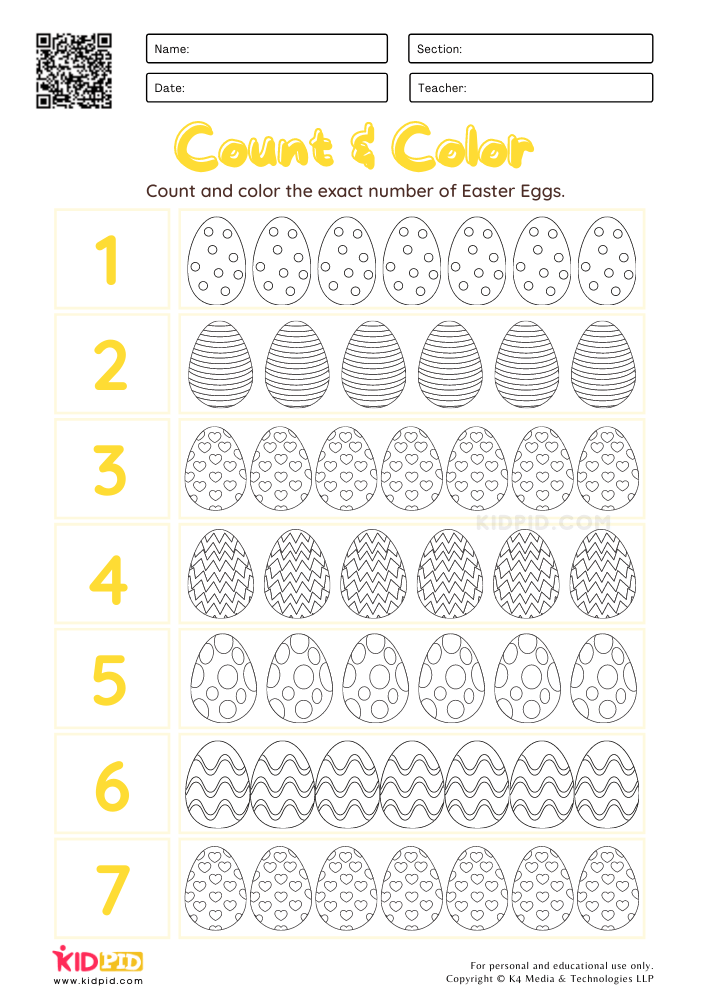
The second worksheet will ask the child to do the same. Solving these worksheets can be tiresome and wearying. If your child spends too much time on one worksheet, then make him move on to the next one. This method will help them stay accurate and excited during their assignment.
WORKSHEET 3
This is the third and final worksheet, where, just like the above two worksheets, the child will have to count the numbers and then color the respective easter eggs. Children always want to close their work and study as soon as possible, and as a result, are likely to make mistakes. But with consistent habit with these worksheets, they will certainly develop and become more comfortable with working out these problems with success.
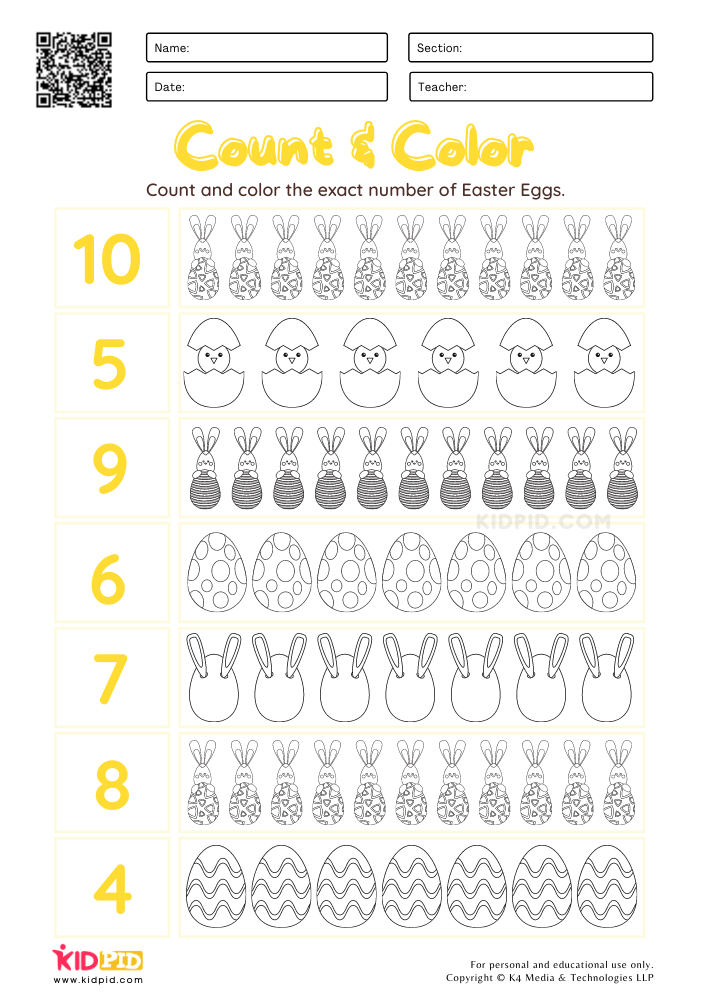
Worksheets are an excellent way to acquire knowledge as it not only enables kids to discover things in a different way but also help keep a record of their progress. This is all a kid needs in his early days before going to school. It will also encourage them to complete the course of simple calculations in a very simple way. So, give your best to make your kid smart by not letting him get dull or bored.
Key Facts About Count & Color Easter Eggs Worksheets for Kids
Count & Color Easter Eggs Worksheets are engaging educational activities designed to help children practice counting, number recognition, and coloring skills. These worksheets combine early math learning with creative coloring exercises, making them ideal for preschoolers, kindergarteners, and early elementary students. Children count the Easter eggs shown in each section and color them according to the instructions, helping them improve concentration, visual discrimination, and fine motor development.
Quick Facts
- Suitable for ages 3–7 years.
- Focuses on counting, number recognition, and coloring.
- Encourages hands-on learning.
- Supports early math readiness.
- Improves pencil control and hand-eye coordination.
Parts, Types, and Examples of Count & Color Easter Eggs Worksheets
Parts of the Worksheet
- Easter Egg Images: Colorful illustrations for counting.
- Number Prompts: Instructions indicating how many eggs to count or color.
- Coloring Section: Space for children to apply colors.
- Answer Area: Sometimes includes boxes or spaces for recording answers.
Types of Worksheets
- Basic Counting Worksheets
- Count and Match Activities
- Color-by-Number Easter Eggs
- Count and Circle Worksheets
- Counting with Patterns
- Addition-Based Easter Egg Counting
Examples
- Count 5 Easter eggs and color them blue.
- Count the eggs in each basket and write the number.
- Color the eggs according to the number key.
- Match groups of Easter eggs to the correct number.
How Does Count & Color Easter Eggs Worksheets Work?
These worksheets present children with Easter egg illustrations arranged in groups or patterns. Students carefully count the eggs, identify the correct number, and then color the eggs based on specific instructions. The activity combines visual learning, counting practice, and creative expression.
Learning Process
- Observe the Easter egg images.
- Count the total number of eggs.
- Identify the correct number or answer.
- Follow the coloring instructions.
- Review completed work for accuracy.
This multi-step process strengthens both mathematical and artistic skills simultaneously.
Benefits of Learning About Count & Color Easter Eggs Worksheets
These worksheets provide a fun way to introduce foundational math concepts while keeping children engaged.
Educational Benefits
- Develops counting accuracy.
- Strengthens number recognition.
- Improves attention to detail.
- Encourages logical thinking.
- Supports early problem-solving skills.
Developmental Benefits
- Enhances fine motor skills.
- Builds hand-eye coordination.
- Improves focus and concentration.
- Encourages creativity through coloring.
- Increases confidence in early math tasks.
Learning Objectives
By completing Count & Color Easter Eggs Worksheets, children will be able to:
- Count objects accurately.
- Recognize and identify numbers.
- Follow written and visual instructions.
- Improve coloring and pencil-control skills.
- Develop observation skills.
- Strengthen visual discrimination abilities.
- Practice early mathematical thinking.
- Enhance concentration and task completion.
Worksheet Instructions
How to Complete the Worksheet
- Look carefully at the Easter eggs shown.
- Count the total number of eggs in each group.
- Read the coloring instructions.
- Use the correct colors as directed.
- Write the correct number if required.
- Check your answers after completing the worksheet.
- Keep coloring neatly within the outlines.
Interesting Facts About Easter Eggs and Counting Activities
- Easter eggs are popular symbols of spring and new beginnings.
- Decorating Easter eggs has been a tradition in many cultures for centuries.
- Counting activities help build strong foundations for future math learning.
- Coloring exercises support the development of hand muscles used for writing.
- Combining math and art increases student engagement and retention.
- Visual counting activities are especially effective for young learners.
Vocabulary Words
Understanding these terms can help children complete the worksheets successfully:
| Word | Meaning |
|---|---|
| Count | To determine how many items there are |
| Number | A symbol used to represent quantity |
| Easter Egg | A decorated egg is often associated with Easter celebrations |
| Color | To fill a picture using crayons, markers, or pencils |
| Group | A collection of objects together |
| Pattern | A repeated arrangement of objects or colors |
| Match | To connect items that belong together |
| Quantity | The amount or number of something |
| Observe | To look at something carefully |
| Worksheet | A learning activity sheet |
Real-Life Applications
Count & Color Easter Eggs Worksheets teach skills that children use in everyday situations.
Practical Uses
- Counting toys during cleanup.
- Identifying numbers on clocks and calendars.
- Sorting and organizing household items.
- Following instructions in school activities.
- Counting snacks, fruits, or classroom supplies.
- Developing attention to detail for future academic tasks.
These activities build foundational skills that support success in mathematics, science, and daily life.
FAQs
Q1. What age group are Count & Color Easter Eggs Worksheets suitable for?
Answer: These worksheets are typically designed for children aged 3–7 years, including preschool and kindergarten students.
Q2. What skills do these worksheets develop?
Answer: They help improve counting, number recognition, fine motor skills, hand-eye coordination, concentration, and creativity.
Q3. Can these worksheets be used at home?
Answer: Yes. Parents can easily use them for homeschooling, after-school practice, or holiday-themed learning activities.
Q4. Are these worksheets useful for classroom teaching?
Answer: Absolutely. Teachers often use them as math centers, holiday activities, independent practice, or assessment tools.
Q5. Why combine counting with coloring?
Answer: Combining math and coloring keeps children engaged while strengthening both cognitive and motor skills.
Q6. Do children need advanced math knowledge to complete these worksheets?
Answer: No. Most activities focus on beginner-level counting and number recognition, suitable for early learners.
Q7. How often should children practice counting worksheets?
Answer: Regular practice a few times each week can help reinforce number concepts and improve confidence in math skills.
Q8. Are Easter-themed worksheets educational?
Answer: Yes. Holiday-themed worksheets make learning more enjoyable while teaching essential academic skills in a fun context.
Festive Easter egg activities transform counting into an exciting learning adventure. Children practice numbers, develop coloring precision, strengthen attention to detail, and enjoy meaningful educational fun during the holiday season. Learn through engaging flashcards, educational worksheets, informative essays, creative paragraphs, and fun quizzes. Follow us on YouTube & Facebook for more resources.
This worksheet was crafted by the Content Team to strengthen student progress.
Reviewed By Sandra K Udayan
Read More: