


Cursive letter handwriting is a kind of practice by which kids learn to write words in cursive. It is like an art, where we create something with our creativity. The worksheet aims to allow students to become familiar with basic cursive exercises and learn how the alphabet letters are written in both lowercase and uppercase forms, with flow, and in an artistic way. To write letters in cursive, children have to be very attentive, and when they are slow, it brings in a better flow. Practicing this worksheet has been proven to help the kids improve their handwriting and increase confidence levels in writing neatly without jerking. This worksheet will help them with their school project work and homework assignments, also. Below, we have some exercises from the alphabet letters “Aa” to “Zz,” and hopefully, the kids will be ready to practice our worksheet.
[Scroll Down for Download Link]
Contents
- Cursive Handwriting Practice Worksheets
- Cursive Letter Aa
- Cursive Letter Bb
- Cursive Letter Cc
- Cursive Letter Dd
- Cursive Letter Ee
- Cursive Letter Ff
- Cursive Letter Gg
- Cursive Letter Hh
- Cursive Letter Ii
- Cursive Letter Jj
- Cursive Letter Kk
- Cursive Letter Ll
- Cursive Letter Mm
- Cursive Letter Nn
- Cursive Letter Oo
- Cursive Letter Pp
- Cursive Letter Qq
- Cursive Letter Rr
- Cursive Letter Ss
- Cursive Letter Tt
- Cursive Letter Uu
- Cursive Letter Vv
- Cursive Letter Ww
- Cursive Letter Xx
- Cursive Letter Yy
- Cursive Letter Zz
- Key Facts About Cursive Letters Handwriting Worksheet
- Parts/Types/Examples of Cursive Letters Handwriting Worksheet
- How Does the Cursive Letters Handwriting Worksheet Work?
- Benefits of Learning About Cursive Letters Handwriting Worksheet
- Learning Objectives
- Worksheet Instructions
- Interesting Facts About Cursive Letters Handwriting Worksheet
- Vocabulary Words
- Real-Life Applications
- FAQs
- Q1. What is a cursive letter handwriting worksheet?
- Q2. At what age should children learn cursive writing?
- Q3. Why is cursive handwriting important?
- Q4. How often should students practice cursive writing?
- Q5. Can beginners use these worksheets?
- Q6. Do cursive worksheets improve handwriting?
- Q7. Are cursive handwriting worksheets suitable for homeschooling?
Cursive Handwriting Practice Worksheets
Read More: Alphabet Handwriting and Sentence Structure Worksheet
Cursive Letter Aa

A Words For Kids
- Apple
- Ant
- Ape
- Airplane
Cursive Letter Bb

B Words For Kids
- Ball
- Bed
- Bird
- Book
Cursive Letter Cc
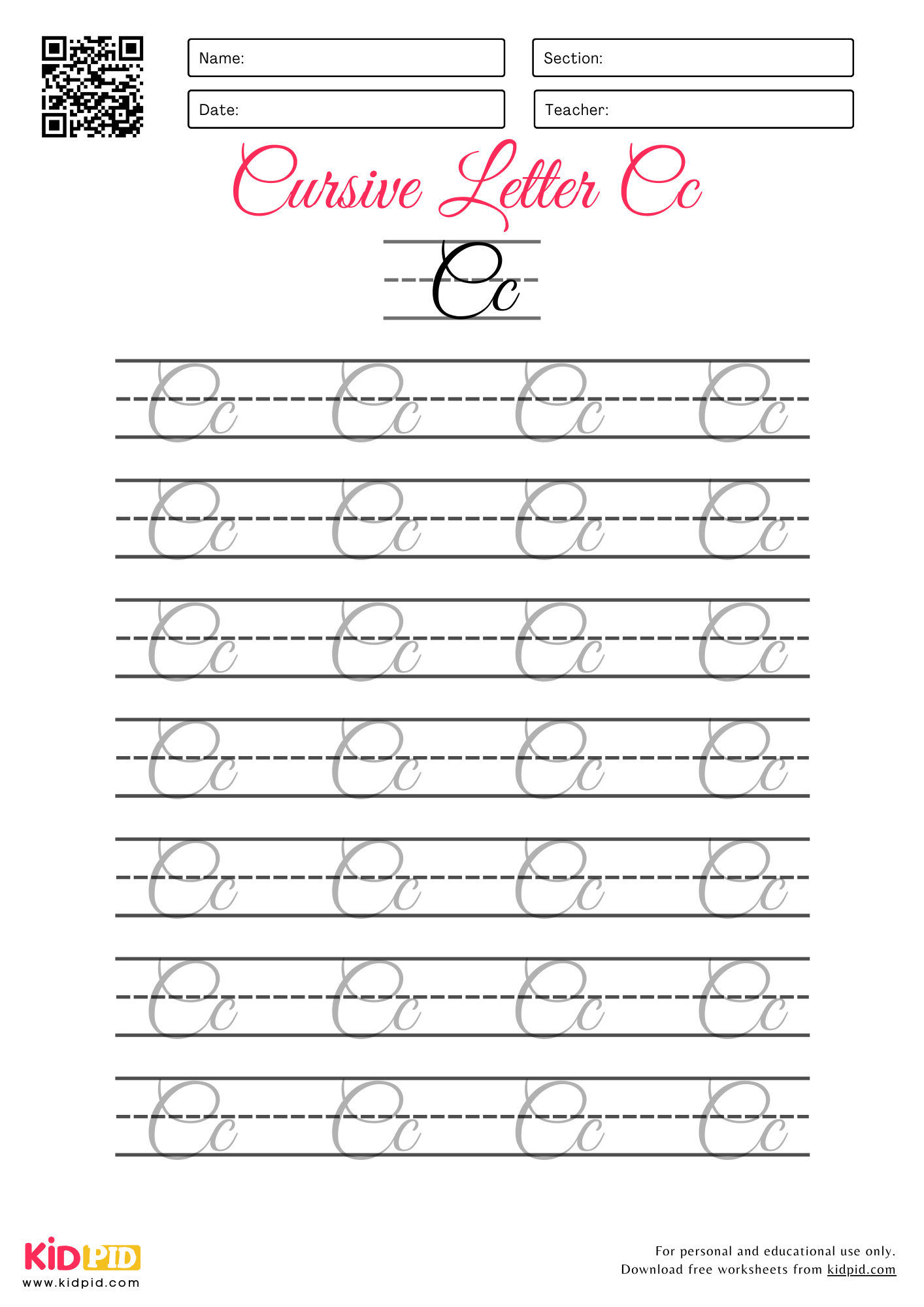
C Words For Kids
- Car
- Cake
- Cup
- Camel
Cursive Letter Dd

D Words For Kids
- Duck
- Dog
- Doll
- Desk
Cursive Letter Ee

E Words For Kids
- Ear
- Egg
- Eye
- Elephant
Cursive Letter Ff

F Words For Kids
- Frog
- Fan
- Fox
- Fish
Cursive Letter Gg

G Words For Kids
- Goat
- Grapes
- Girl
- Game
Cursive Letter Hh

H Words For Kids
- Hen
- Hand
- House
- Hat
Cursive Letter Ii

I Words For Kids
- Ice Cream
- Iron
- Insect
- Ice
Cursive Letter Jj

J Words For Kids
- Jug
- Jelly
- Jar
- Jeep
Cursive Letter Kk

K Words For Kids
- Kite
- King
- Kitten
- Koala
Cursive Letter Ll

L Words For Kids
- Ladybug
- Lamp
- Lizard
- Lion
Cursive Letter Mm

M Words For Kids
- Moon
- Mask
- Monkey
- Mouse
Cursive Letter Nn

N Words For Kids
- Newspaper
- Nest
- Nine
- Nut
Cursive Letter Oo

O Words For Kids
- Octopus
- Orange
- Owl
- Ostrich
Cursive Letter Pp

P Words For Kids
- Pumpkin
- Pig
- Parrot
- Pineapple
Cursive Letter Qq

Q Words For Kids
- Queen
- Question
- Quack
Cursive Letter Rr

R Words For Kids
- Rabbit
- Rocket
- Rainbow
- Rock
Cursive Letter Ss

S Words For Kids
- Snail
- Socks
- Star
- Snowflake
Cursive Letter Tt

T Words For Kids
- Tree
- Table
- Top
- Tiger
Cursive Letter Uu

U Words For Kids
- Unicorn
- Umbrella
Cursive Letter Vv

V Words For Kids
- Van
- Vegetables
Cursive Letter Ww

W Words For Kids
- Watermelon
- Window
- Wind
Cursive Letter Xx

X Words For Kids
- X-ray
- X-mas tree
Cursive Letter Yy

Y Words For Kids
- Yo-yo
Cursive Letter Zz

Z Words For Kids
- Zebra
- Zero
- Zoo
Key Facts About Cursive Letters Handwriting Worksheet
A Cursive Letters Handwriting Worksheet is a learning resource designed to help children practice writing letters in a smooth, connected style. These worksheets guide students through tracing, copying, and independently writing uppercase and lowercase cursive letters. They improve handwriting fluency, letter formation, fine motor skills, and writing confidence. Cursive worksheets are commonly used in classrooms, homeschooling programs, and handwriting practice sessions for elementary students.
Key Facts:
- Focuses on uppercase and lowercase cursive letters.
- Improves pencil control and hand-eye coordination.
- Encourages neat and legible handwriting.
- Helps children develop muscle memory for letter formation.
- Suitable for beginners and advanced handwriting learners.
Parts/Types/Examples of Cursive Letters Handwriting Worksheet
Cursive handwriting worksheets come in different formats to support progressive learning.
Parts
- Letter tracing section
- Guided practice lines
- Independent writing space
- Uppercase letter examples
- Lowercase letter examples
- Word and sentence practice
Types
- Uppercase cursive letter worksheets
- Lowercase cursive letter worksheets
- Alphabet practice worksheets
- Word-writing worksheets
- Sentence-writing worksheets
- Cursive tracing worksheets
Examples
- Tracing cursive A–Z
- Practicing cursive a–z
- Writing simple words like “cat,” “tree,” and “book”
- Copying short cursive sentences
- Alphabet review activities
How Does the Cursive Letters Handwriting Worksheet Work?
These worksheets provide visual models of cursive letters that students can trace and copy. Learners begin by tracing dotted letters to understand proper strokes and connections. After gaining confidence, they write letters independently on practice lines. As skills improve, children move on to writing words and complete sentences in cursive.
The step-by-step approach helps students develop consistency, speed, and accuracy while reinforcing correct handwriting habits.
Benefits of Learning About Cursive Letters Handwriting Worksheet
Learning cursive handwriting offers several educational advantages:
- Strengthens fine motor development.
- Improves handwriting speed and efficiency.
- Enhances letter recognition and formation.
- Builds concentration and patience.
- Encourages neat presentation of written work.
- Supports cognitive development through coordinated movements.
- Boosts confidence in written communication.
Learning Objectives
By completing this worksheet, students will:
- Identify uppercase and lowercase cursive letters.
- Trace and write cursive letters accurately.
- Develop proper letter connections and strokes.
- Improve handwriting fluency and legibility.
- Strengthen hand muscles and pencil control.
- Apply cursive writing skills to words and sentences.
- Build confidence in everyday writing tasks.
Worksheet Instructions
- Hold your pencil comfortably and sit with proper posture.
- Observe the example cursive letter.
- Trace the dotted letters following the correct stroke direction.
- Practice writing the letter independently on the provided lines.
- Repeat each letter several times for consistency.
- Maintain uniform size and spacing between letters.
- Complete all letter exercises before moving to words and sentences.
- Review your work and correct any grammatical errors.
Interesting Facts About Cursive Letters Handwriting Worksheet
- Cursive writing connects letters without lifting the pencil frequently.
- Many historical documents were originally written in cursive.
- Practicing cursive can improve hand coordination and writing rhythm.
- Cursive handwriting often allows faster writing than print.
- Learning cursive engages multiple areas of the brain.
- Different countries may teach slightly different cursive styles.
- Regular practice helps create smoother and more natural handwriting.
Vocabulary Words
| Word | Meaning |
|---|---|
| Cursive | A style of handwriting with connected letters |
| Trace | To follow over existing lines |
| Stroke | A movement used to form a letter |
| Alphabet | A set of letters used in a language |
| Handwriting | Writing created by hand |
| Legibility | How easy is handwriting to read |
| Formation | The correct way to create a letter |
| Practice | Repeating an activity to improve skills |
| Connection | Joining letters together in cursive |
| Fluency | Writing smoothly and efficiently |
Real-Life Applications
Cursive handwriting skills are useful in many everyday situations:
- Writing personal notes and letters.
- Signing names and official documents.
- Taking quick handwritten notes.
- Completing school assignments neatly.
- Reading historical manuscripts and documents.
- Creating journals, diaries, and creative writing projects.
- Improving overall handwriting presentation.
FAQs
Q1. What is a cursive letter handwriting worksheet?
Answer: A cursive letter handwriting worksheet is a practice sheet that helps students learn and improve cursive letter formation through tracing and writing exercises.
Q2. At what age should children learn cursive writing?
Answer: Many children begin learning cursive between ages 7 and 10, depending on their handwriting readiness and school curriculum.
Q3. Why is cursive handwriting important?
Answer: Cursive improves writing fluency, fine motor skills, coordination, and overall handwriting quality.
Q4. How often should students practice cursive writing?
Answer: Short daily practice sessions of 10–15 minutes are effective for building strong handwriting habits.
Q5. Can beginners use these worksheets?
Answer: Yes. Most cursive worksheets start with tracing activities, making them ideal for beginners.
Q6. Do cursive worksheets improve handwriting?
Answer: Yes. Consistent practice helps students develop better letter formation, spacing, legibility, and writing confidence.
Q7. Are cursive handwriting worksheets suitable for homeschooling?
Answer: Absolutely. They are excellent resources for homeschooling, classroom learning, and independent practice.

Good job! Kids, we are glad to know that you have completed all the exercises, and we assume this worksheet will be helpful for your handwriting skills and make your writing more expressive. This worksheet is not just for one-time practice; kids need to practice daily, which will further improve their handwriting. We hope this worksheet proves effective and helps kids understand the importance of the art of writing. We want kids to practice this worksheet daily, which will help them in their future growth. Browse our collection of worksheets, essays, paragraphs, flashcards, quizzes, and learning tools online. Join us on YouTube & Facebook.
This worksheet is thoughtfully designed by our Content Team to aid learning.
Reviewed By Manpreet Kaur
Read More:



