
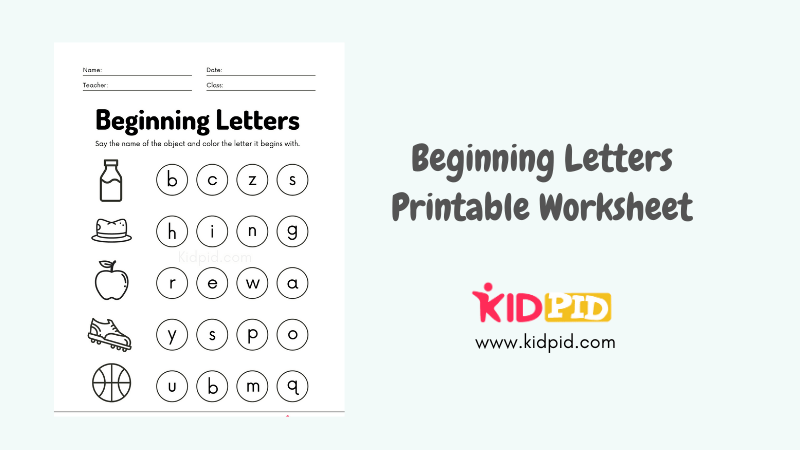
If you want your kids to practice multiple things in a single worksheet, this printable will be perfect for you. Kids can learn to identify the objects, color them, and identify the letters. Children in Preschool and Kindergarten can practice with these printables.
Contents
- Beginning Letters Printable Worksheet
- Key Facts About the Beginning Letters Foundational Worksheet
- Parts, Types, and Examples of Beginning Letter Worksheets
- How Does the Beginning Letters Foundational Worksheet Work?
- Benefits of Learning About Beginning Letters
- Learning Objectives
- Worksheet Instructions
- Interesting Facts About Beginning Letters & Early Literacy
- Vocabulary Words
- Real-Life Applications
- FAQs
Beginning Letters Printable Worksheet
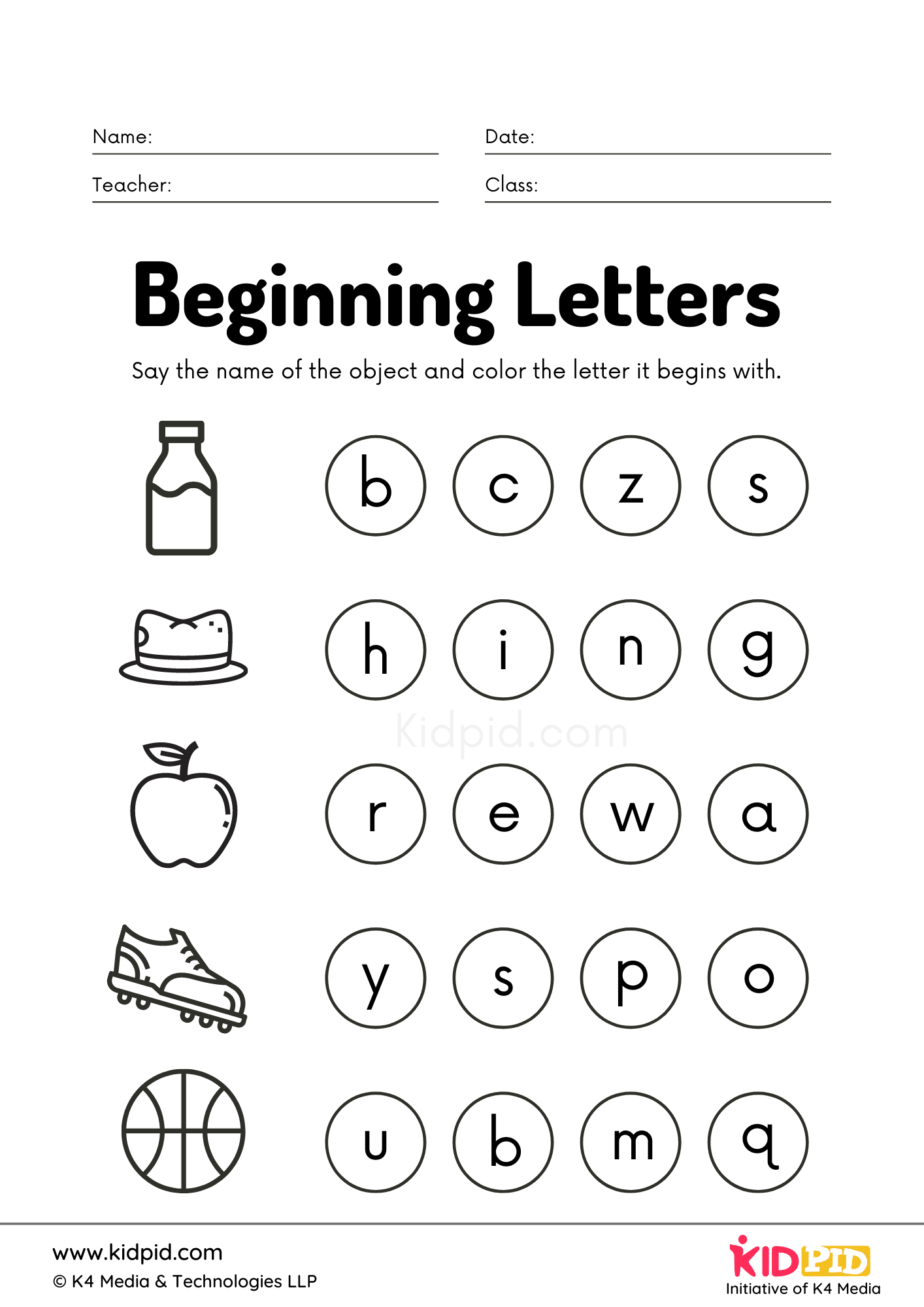
Say the name of the object and color the letter it begins with. Such kind of worksheets help kids to remember the objects, and they make a start to pronounce and write the names of different objects. These Beginning Letters Foundational Worksheets are ideal for helping kids in their early years of education.

Skills
“Reading” pictures, Coloring, identifying objects, learning letters, learning the alphabet, and practicing letter sounds.
Click here for more printable worksheets.
Answer
- Bottle
- Hat
- Apple
- Shoe
- Ball
Name That Polygon Free Printable Worksheet
Key Facts About the Beginning Letters Foundational Worksheet
- Target Age Group: Ideal for Preschoolers, Kindergarteners, and early Reception-stage learners (Ages 3 to 6).
- Core Focus Area: Initial sound identification, also known as phonemic awareness (the ability to hear and manipulate individual sounds in spoken words).
- Format: Free, downloadable, and printer-friendly PDF featuring high-quality black-and-white illustrations that double as coloring pages.
- Skill Synergy: Combines visual, auditory, and fine motor tracking exercises into a single, cohesive activity page.
Parts, Types, and Examples of Beginning Letter Worksheets
To keep young minds engaged, initial sound worksheets are structured around multi-sensory activities. A comprehensive package typically features several variations:
- The “Color the Letter” Activity: Children look at a picture (e.g., a Bottle or an Apple), say the word aloud, and fill in the correct bubble or letter box matching the starting sound.
BorA). - Letter-to-Object Matching: A variation where lines are drawn to connect uppercase or lowercase letters to their corresponding real-world objects.
- Trace and Identify: Combining phonics with handwriting by having kids trace the correct starting letter right next to the picture.
Examples of Core Vocabulary Included:
- B is for Ball / Bottle
- H is for Hat
- A is for Apple
- S is for Shoe
How Does the Beginning Letters Foundational Worksheet Work?
This worksheet operates on a psychological and educational principle known as dual coding—combining visual images with verbal sounds to help a child store information more effectively in their long-term memory.
When a student interacts with the page, their brain moves through a 3-step cognitive process:
- Visual Recognition: The child identifies the illustration (e.g., a picture of a hat).
- Phonetic Retrieval (Phonation): The child says the word aloud, isolating the very first sound they make: /h/.
- Grapheme Mapping: The child scans the provided letter options, recognizes the letter H, and anchors the sound to the symbol by coloring it in.
Benefits of Learning About Beginning Letters
Mastering initial letter sounds is one of the earliest and most accurate predictors of a child’s future reading success.
- Prevents Reading Frustration: Before a child can decode full words (like c-a-t), they must understand that words are built from individual units of sound.
- Expands Expressive Vocabulary: Labeling diverse objects on a worksheet teaches children the names of items they see every day but may not frequently say.
- Builds Fine Motor Skills: Holding crayons or pencils to color tiny letter bubbles strengthens the hand muscles needed for future penmanship.
- Boosts Print Awareness: It reinforces the concept that letters aren’t just random shapes—they hold real meaning and power.
Learning Objectives
By completing these foundational phonics sheets, young learners will achieve the following milestones in alignment with early childhood education standards:
- Objective 1: Demonstrate phonemic awareness by isolating and pronouncing the initial sounds in spoken words.
- Objective 2: Recognize and associate uppercase and lowercase letters with their respective phonetic sounds.
- Objective 3: Enhance tracking skills by scanning from left to right across the page.
- Objective 4: Strengthen cognitive focus and hand-eye coordination through targeted coloring.
Worksheet Instructions
Parents and educators can read these simple guidelines aloud to guide children seamlessly through the activity:
- Look and Identify: Point to the first picture on the worksheet. Ask your child, “What is this object?”
- Say It Out Loud: Have the child say the word clearly and stretch out the first sound (e.g., “B-b-b-bottle”).
- Find the Match: Look at the letters listed next to the image. Ask, “Which letter makes that exact sound?”
- Color and Celebrate: Let your child use their favorite crayon to color in the correct letter. Repeat for the rest of the page!
Interesting Facts About Beginning Letters & Early Literacy
- The “Alphabet Soup” Concept: Children often learn the names of letters before they learn the sounds letters make. Worksheets like this shift the focus to sounds, which is what actually teaches them to read.
- Brain Rewiring: Humans are naturally wired to speak, but we are not naturally wired to read. Identifying beginning letters is a primary step in training the brain’s visual processing center to connect symbols with vocalizations.
- The Power of Plosives: Sounds made by letters like B, P, and T (called plosives) are usually the easiest for children to isolate first because they require a physical “puff” of air to say.
Vocabulary Words
Here are the core vocabulary terms used in this worksheet pack that you can review with your child to build their language bank:
- Alphabet: The standard set of 26 letters we use to write and speak in English.
- Phonics: A method of teaching people to read by correlating sounds with letters or groups of letters.
- Initial Sound: The very first sound you hear when you say a word out loud.
- Vocalize: To form a sound or word with your voice.
- Grapheme: The written symbol or letter that represents a specific sound.
Real-Life Applications
Phonics doesn’t stop when the worksheet is put away! Parents can turn initial sound practice into everyday, real-world games:
- The Grocery Store Safari: While shopping, challenge your child to find items starting with a specific letter sound. “Can you find something that starts with the /a/ sound like Apple?”
- I-Spy Around the House: Play a classic game of I-Spy during downtime. “I spy with my little eye, something in this room that starts with the /b/ sound.” (e.g., Bed, Blanket, Book).
- The Name Game: Use family names to practice. Point out that “Mom starts with M, and Daddy starts with D.”
FAQs
Q1. At what age should my child start learning beginning letter sounds?
Answer: Most children begin exploring letter sounds between the ages of 3 and 5. If your child can recognize basic objects in picture books and mimic spoken words, they are ready to try foundational beginning letter worksheets.
Q2. Why is my child struggling to match the letter sound to the picture?
Answer: This is completely normal! Young children often focus on the whole word rather than its individual sounds. Try elongating the first sound for them (e.g., “Sssss-shoe”) to help their ears pick up the isolated starting sound.
Q3. Is it better to teach uppercase or lowercase letters first?
Answer: Many educators recommend focusing on lowercase letters first because they make up over 90% of the text we see in books. However, using worksheets that feature clear, easily identifiable fonts is the best way to avoid confusion for beginners.
Q4. Can I reuse this printable worksheet?
Answer: Absolutely! To save paper and get multiple uses out of it, place the printed worksheet inside a plastic dry-erase sleeve. Your child can use dry-erase markers to circle the letters, wipe them clean, and practice again later.
These Beginning Letters Foundational worksheets help children identify the first letter sounds of words, strengthen phonics awareness, and improve alphabet recognition. Engaging activities build early reading skills, vocabulary, and confidence in language learning. Visit our website for worksheets, essays, paragraphs, flashcards, quizzes, and interactive resources. Follow us on YouTube & Facebook.
This educational worksheet was created by the Content Team to encourage learning improvement.
Reviewed By Gargy
Related Posts



