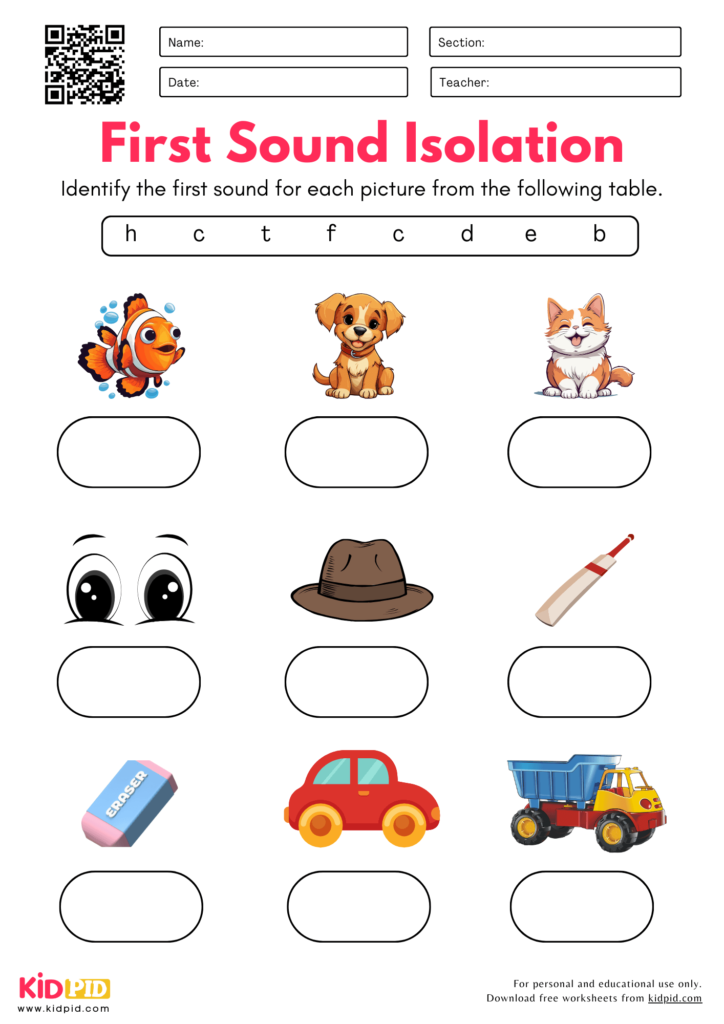
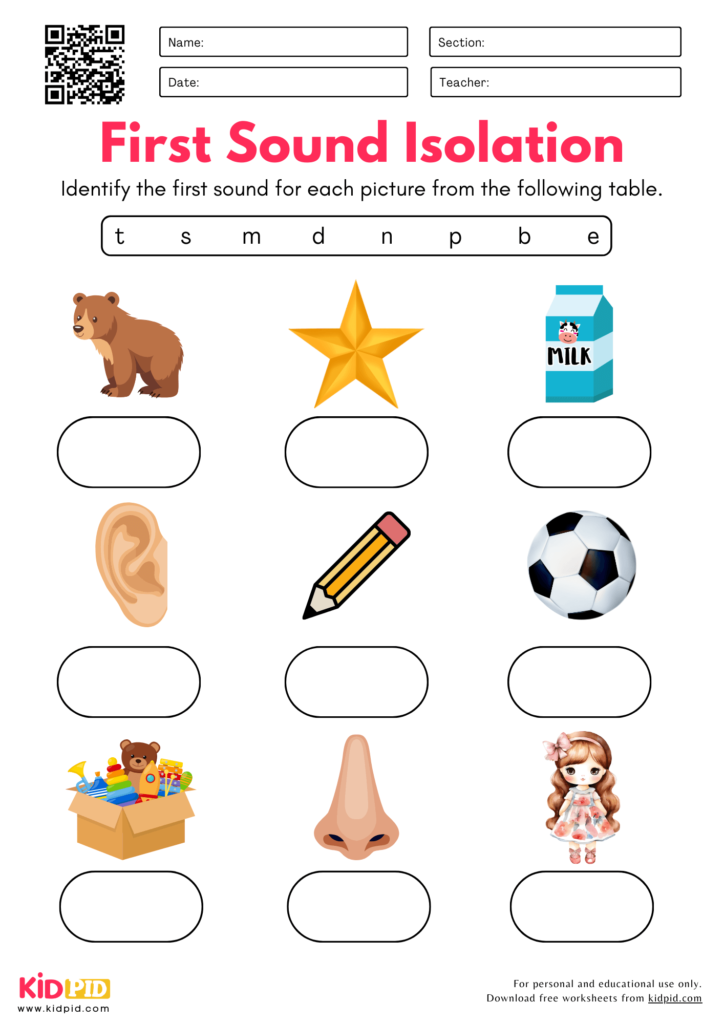
This is an initial phoneme isolation worksheet for kindergarten kids in which the students have to isolate the first sound. Students have to identify the first sound for each word after recognizing the picture from the worksheet and write the letter in the box. It includes a letter box through which students can take some clues. Enjoy the activity!
[Scroll Down for Download Link]
Identify The First Sound Isolation Worksheets For Kindergarten
Read More: Initial Sounds Worksheets for Kindergarten

- Fish
- Dog
- Cat
- Eyes
- Hat
- Bat
- Eraser
- Car
- Truck
In this first sound isolation worksheet, students will identify the first sound for each word after recognizing the image from the following table and write the letter in the box. It also includes an answer key for the students to complete.
- Bear
- Star
- Milk
- Ear
- Pencil
- Football
- Toys
- Nose
- Doll
This worksheet includes words such as bear, star, milk, ear, etc. Students will practice them by identifying the first sound for each word after recognizing the image from the following table and writing the letter in the worksheet. It also includes an answer key for correction.
Key Facts About Initial Phoneme Isolation Worksheets
- Definition: These worksheets focus on the foundational literacy skill of phonemic awareness, specifically teaching children to identify and isolate the very first sound (phoneme) heard in a spoken word.
- Target Audience: Designed specifically for kindergarten-aged children (typically 5–6 years old) who are beginning their journey into phonics and reading.
- Cognitive Goal: To move beyond simple letter recognition and help children understand that words are composed of individual, distinct sounds.
- Core Methodology: The activity pairs visual stimuli (pictures) with auditory processing, requiring the child to name the object and then isolate the initial sound before mapping it to the corresponding letter.
Parts/Types/Examples of Initial Phoneme Isolation Worksheets
- Picture-to-Letter Matching: The most common type, where students identify an image (e.g., a “Fish”) and write the initial letter (“F”) in a designated box.
- Letter Box/Cueing Systems: These worksheets often include visual scaffolds, such as letter boxes or word banks, to provide clues for children who may be transitioning from basic letter recognition to phonemic blending.
- Categorization Activities: Examples include sorting pictures into groups based on their starting sounds (e.g., placing all images that start with the “B” sound under a “B” header).
- Tracing and Writing: Some worksheets incorporate fine motor skill development by asking students to trace the letter alongside the sound isolation task.
How Does This Worksheet Work?
- Visual Recognition: The child identifies the image displayed on the worksheet (e.g., an “Eraser”).
- Auditory Analysis: The child says the word aloud, consciously stretching out the word to “hear” the very first sound at the beginning.
- Phoneme-Grapheme Mapping: The child translates that auditory sound into a written symbol (grapheme) and writes the corresponding letter in the provided space.
- Verification: The inclusion of an answer key allows students or parents to immediately check the work, reinforcing correct sound-letter correspondence through instant feedback.
Benefits of Learning About Initial Phoneme Isolation
- Builds Phonemic Awareness: It is the primary step in developing the phonemic awareness necessary for decoding and reading fluently.
- Prepares for Decoding: By isolating the first sound, children learn the mechanics of how to blend sounds together to read entire words.
- Supports Spelling: Recognizing the initial phoneme is a crucial prerequisite for phonetic spelling in early writing.
- Improves Vocabulary: Engaging with a variety of pictures across these worksheets naturally exposes children to new words, strengthening their oral vocabulary.
Learning Objectives
- Identify: Recognize and name common objects presented in images.
- Isolate: Clearly distinguish the initial phoneme of a spoken word.
- Map: Accurately match the isolated sound to its corresponding written alphabet letter.
- Apply: Demonstrate the ability to independently apply phoneme isolation skills to new vocabulary words.
Worksheet Instructions
- Preparation: Print the worksheet and ensure the child has a pencil and an eraser.
- Model: Start by doing the first example together. Point to the picture, say the word clearly, and emphasize the initial sound.
- Independence: Encourage the child to say the name of the image aloud to themselves before attempting to write the letter.
- Clues: If the child struggles, guide them to use the provided letter boxes or sound hints.
- Review: Use the answer key to review the completed worksheet, discussing any sounds that were challenging to identify.
Interesting Facts About Phoneme Isolation Vocabulary
- Consistency is Key: Words selected for these worksheets typically feature “continuous sounds” (like /s/ or /m/) or “stop sounds” (like /b/ or /t/), helping children understand the variety in how our mouths produce speech.
- The “Picture-First” Advantage: Using pictures instead of words avoids early frustration, as children can process the sound of the word without needing the reading skill of decoding the written word itself.
- Foundation for Fluency: Research in early childhood education shows that phonemic awareness is the strongest predictor of later reading success.
Real-Life Applications
- Early Literacy: Directly translates to a child’s ability to “sound out” words in early reader books.
- Communication Skills: Improves pronunciation and confidence in articulating clear sounds.
- Writing Development: Assists children in early creative writing when they attempt to spell words based on the sounds they hear.
FAQs
Q1. At what age should a child start these worksheets?
Answer: These are typically most effective for kindergarteners, though older preschoolers who have mastered basic letter recognition can also benefit.
Q2. My child is struggling to hear the initial sound. What should I do?
Answer: Try “stretching” the word. Say the word slowly, emphasizing the first sound (e.g., “M-m-m-milk”). This helps the child distinguish the initial phoneme from the rest of the word.
Q3. Should I use these worksheets every day?
Answer: Short, consistent practice is better than long, infrequent sessions. 5–10 minutes a few times a week is often sufficient to help children build proficiency.
Completing these Initial Phoneme Isolation worksheets helps Kindergarten children recognize beginning sounds, strengthen phonemic awareness, improve early literacy skills, and gain confidence in reading, spelling, and word recognition activities. Enhance everyday learning with printable interactive resources, quizzes, paragraphs, worksheets, flashcards, and essays for children. Join our Telegram, YouTube, and Facebook communities.
Our Content Team has designed this worksheet to support better learning outcomes for students.
Reviewed By Madhulika
Read More: