
Welcome to the worksheet. This worksheet is specially designed for 5th graders. In this, kids will learn to convert decimal numbers to their expanded version. We are very excited to share this worksheet with you. It will help kids by making them confident in math. We want kids to solve the following exercises with high enthusiasm.
[Scroll Down for Download Link]
Contents
- Convert The Decimal Numbers In Normal Form To Expanded Form
- Key Facts About Convert Decimal Numbers Normal to Expanded Form
- Parts/Types/Examples of Convert Decimal Numbers Normal to Expanded Form
- How Does Convert Decimal Numbers Normal to Expanded Form?
- Benefits of Learning About Converting Decimal Numbers from Normal to Expanded Form
- Learning Objectives
- Worksheet Instructions
- Interesting Facts About Decimal Expanded Form
- Vocabulary Words
- Real-Life Applications
- FAQs
- Q1. What is the expanded form for decimal numbers?
- Q2. Why is learning decimal place value important?
- Q3. How do I convert a decimal to expanded form?
- Q4. What place values come after the decimal point?
- Q5. Can expanded form help with other math topics?
- Q6. Who can use this worksheet?
- Q7. How often should students practice decimal expanded form?
Convert The Decimal Numbers In Normal Form To Expanded Form
Read More: Convert Expanded to Standard Notation Place Value Worksheet For Grade 4
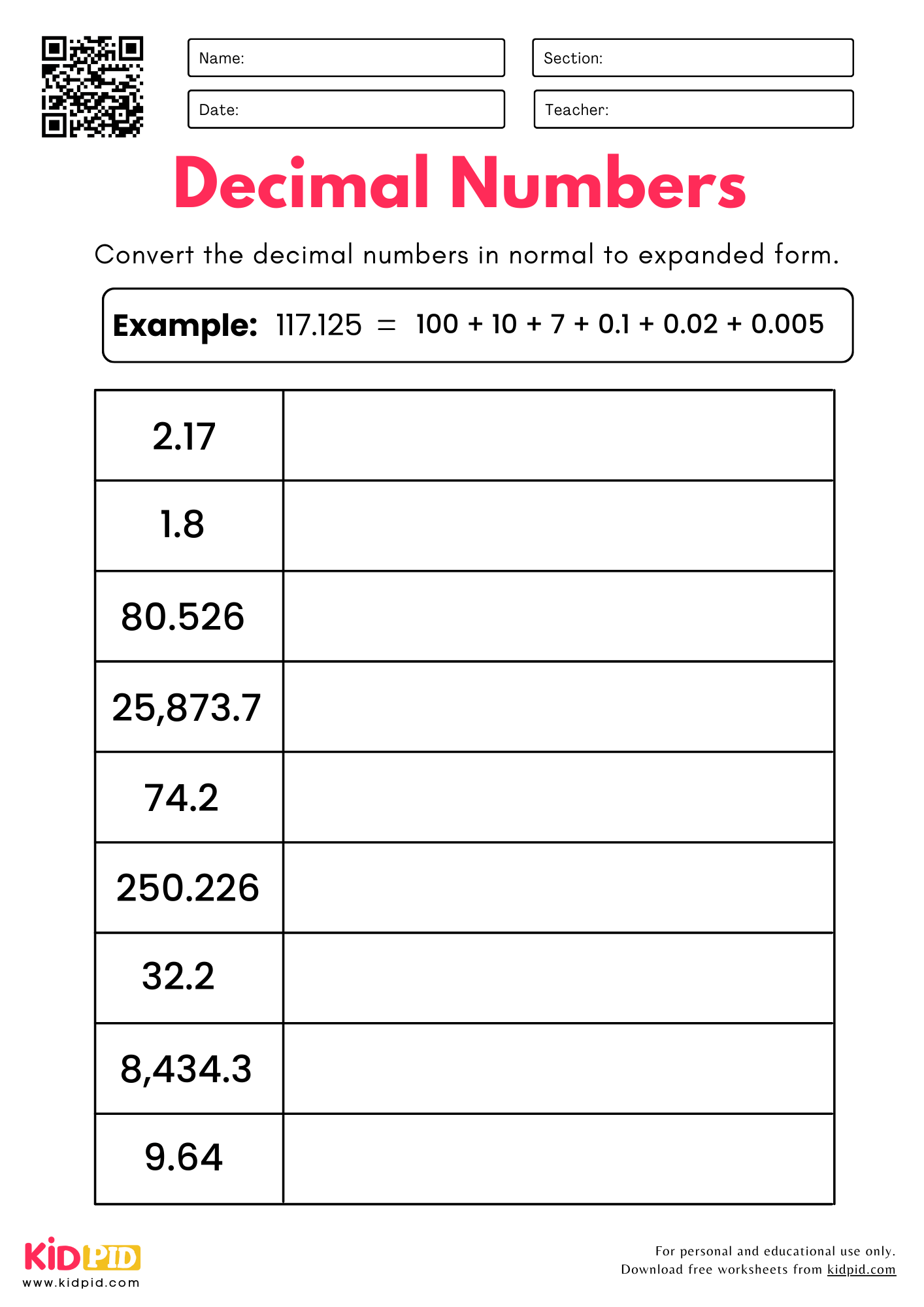
- 2.17 = 2 + 0.1 + 0.07
- 1.8 = 1 + 0.8
- 80.526 = 80 + 0.5 + 0.02 + 0.006
- 25,873.7 = 20,000 + 5,000 + 800 + 70 + 3 + 0.7
- 74.2 = 70 + 4 + 0.2
- 240.126 = 200 + 40 + 0.1 + 0.02 + 0.006
- 32.2 = 30 + 2 + 0.2
- 8,434.3 = 8,000 + 400 + 30 + 4 + 0.3
- 9.64 = 9 + 0.6 + 0.04
This is the first exercise that we need to perform. In the above table, we have a total of nine queries, which can be solved by following some rules. Let’s have a look at the rules. So the first step is to multiply numbers before decimals according to their place value, and multiply numbers after decimals by 0.1 and their place value. Let’s understand through an example: 2.17. As we can see before, decimal 2 is in one place, so multiply 2 by 1. And now look at the numbers before decimals, and we can see 1 is in one place and 7 is in tenth place. So multiply 0.1 x 1, and 0.01 x 7. Now add and combine all the resulting numbers: 2 x 1 + 0.1 x 1 + 7 x 0.01. So the final answer is 2 + 0.1 + 0.07.

- 0.311 = 0.3 + 0.01 + 0.001
- 18.6 = 10 + 8 + 0.6
- 912.647 = 900 + 10 + 2 + 0.6 + 0.04 + 0.007
- 3,741.2 = 3,000 + 700 + 40 + 1 + 0.2
- 982.13 = 900 + 80 + 2 + 0.1 + 0.03
- 25.5 = 20 + 5 + 0.5
- 1.31 = 1 + 0.3 + 0.01
- 0.936 = 0.9 + 0.03 + 0.006
- 9,516.2 = 9,000 + 500 + 10 + 6 + 0.2
This concept exercise will help kids learn more about decimal numbers. In this exercise, we have a total of nine queries that need to be performed. These queries also follow the same rules. We need to multiply numbers according to their place value and then put the answer into the answer box. We hope kids will perform this exercise with the same energy.
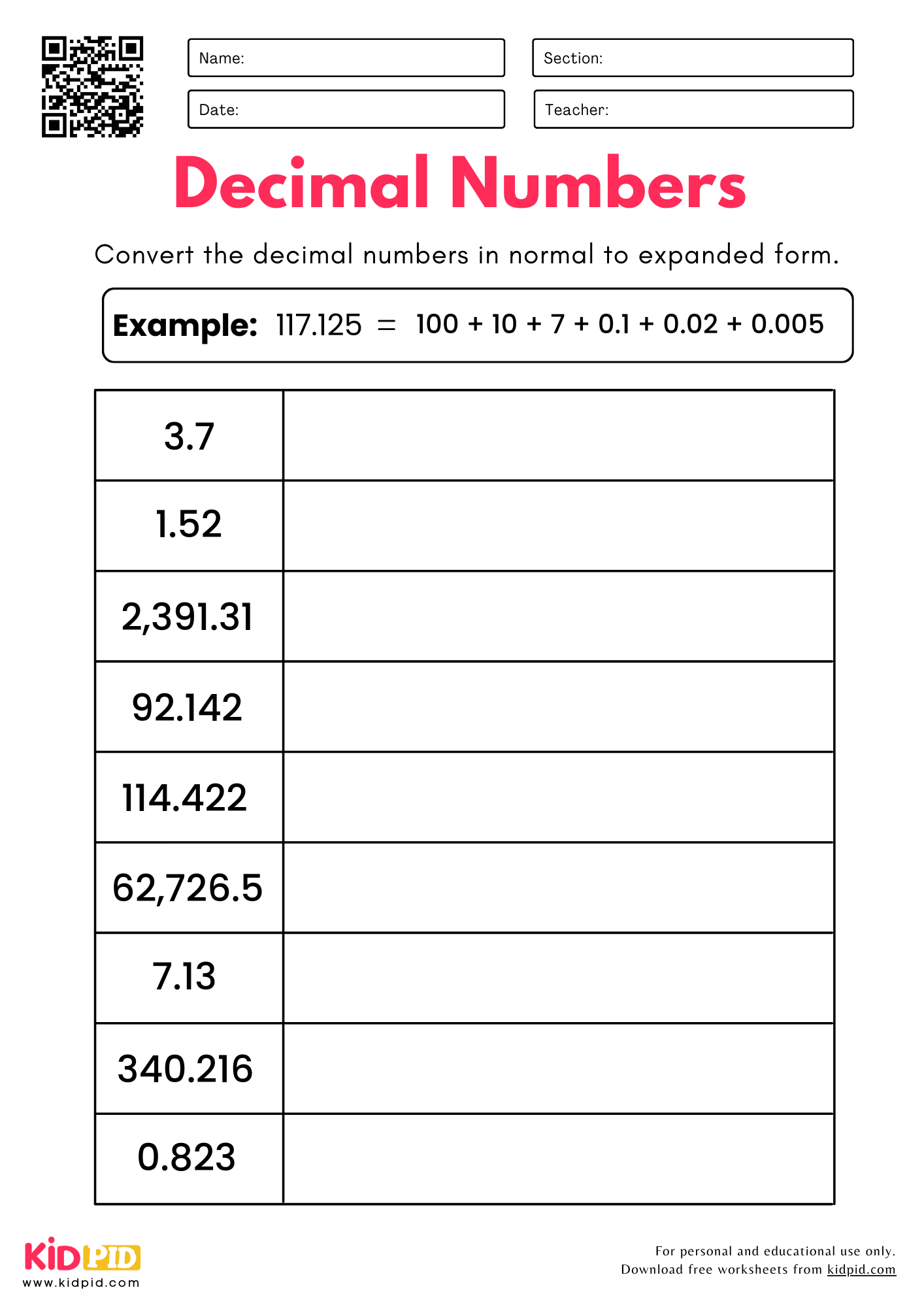
- 3.7 = 3 + 0.7
- 1.52 = 1 + 0.5 + 0.02
- 2,391.31 = 2,000 + 300 + 90 + 1 + 0.3 + 0.01
- 92.142 = 90 + 2 + 0.1 + 0.04 + 0.002
- 114.422 = 100 + 10 + 4 + 0.4 + 0.02 + 0.002
- 62,726.5 = 60,000 + 2,000 + 700 + 20 + 6 + 0.5
- 7.13 = 7 + 0.1 + 0.03
- 340.216 = 300 + 40 + 0.2 + 0.01 + 0.006
- 0.823 = 0.8 + 0.02 + 0.003
Solving queries again and again will help kids boost their confidence. In this exercise, kids have to complete the above-mentioned task. We believe kids are ready to do this exercise. If they get stuck while solving this exercise, they can see the solved example, which helps them to understand the process.

- 2,203.01 = 2,000 + 200 + 3 + 0.01
- 2.22 = 2 + 0.2 + 0.02
- 5,035.73 = 5,000 + 30 + 5 + 0.7 + 0.03
- 31.4 = 30 + 1 + 0.4
- 67.1 = 60 + 7 + 0.1
- 60.546 = 60 + 0.5 + 0.04 + 0.006
- 404.112 = 400 + 4 + 0.1 + 0.01 + 0.002
- 3.79 = 3 + 0.7 + 0.09
- 6,619.16 = 6,000 + 600 + 10 + 9 + 0.1 + 0.06
We hope the kids have solved the above query. We have a challenge for them. In this exercise, the numbers are harder than the previous ones. But we believe kids have understood the process, and now they are ready to accept this challenge. We will be very happy to see if kids solve this exercise without any help.
Key Facts About Convert Decimal Numbers Normal to Expanded Form
- Designed for Grade 5 students to strengthen place value understanding.
- Focuses on converting decimal numbers from standard form to expanded form.
- Helps learners identify the value of each digit in whole numbers and decimals.
- Reinforces concepts such as tenths, hundredths, and thousandths.
- Improves number sense and mathematical reasoning skills.
- Supports curriculum standards related to decimals and place value.
- Suitable for classroom practice, homework, and independent learning.
Parts/Types/Examples of Convert Decimal Numbers Normal to Expanded Form
Parts of the Worksheet
- Decimal numbers in standard form
- Place value charts
- Expanded form conversion exercises
- Practice questions with varying difficulty levels
- Answer key for self-checking
Types of Activities
- Convert decimals to expanded form
- Match decimal numbers with their expanded forms
- Fill-in-the-blank place value exercises
- Word problems involving decimal place values
Examples
- 5.7 = 5 + 0.7
- 12.34 = 10 + 2 + 0.3 + 0.04
- 105.678 = 100 + 5 + 0.6 + 0.07 + 0.008
How Does Convert Decimal Numbers Normal to Expanded Form?
This worksheet presents decimal numbers in standard form and asks students to break them down according to the value of each digit. Learners identify the place value positions, such as ones, tenths, hundredths, and thousandths, and write each digit as a separate value. Through repeated practice, students develop a deeper understanding of how decimals are structured and how each digit contributes to the overall number. The exercises gradually increase in complexity, allowing students to build confidence while mastering decimal place value concepts.
Benefits of Learning About Converting Decimal Numbers from Normal to Expanded Form
- Strengthens understanding of decimal place values.
- Improves accuracy in reading and writing decimals.
- Builds a strong foundation for advanced math concepts.
- Enhances problem-solving and critical-thinking abilities.
- Develops confidence in working with decimal numbers.
- Supports success in addition, subtraction, multiplication, and division of decimals.
- Encourages independent learning and self-assessment.
Learning Objectives
By completing this worksheet, students will:
- Recognize the place value of digits in decimal numbers.
- Convert decimal numbers from standard form to expanded form.
- Understand the relationship between decimals and place values.
- Apply place value knowledge to solve mathematical problems.
- Improve mathematical communication and notation skills.
- Demonstrate accuracy when working with decimal numbers.
Worksheet Instructions
- Read each decimal number carefully.
- Identify the place value of every digit.
- Write the value of each digit separately.
- Express the number in expanded form.
- Check your answers using the place value chart if provided.
- Review mistakes and correct them before moving to the next question.
- Complete all exercises neatly and show your work when necessary.
Interesting Facts About Decimal Expanded Form
- The decimal system is based on powers of 10.
- Every digit has a value determined by its position.
- Digits to the right of the decimal point represent parts of a whole.
- Expanded form makes it easier to understand large and complex numbers.
- Place value concepts are used in science, engineering, and finance.
- Decimal notation has been used for centuries to simplify calculations.
Vocabulary Words
| Word | Meaning |
|---|---|
| Decimal | A number containing a decimal point |
| Place Value | The value of a digit based on its position |
| Expanded Form | Writing a number as the sum of each digit’s value |
| Standard Form | A number written in its usual form |
| Tenths | The first digit to the right of the decimal point |
| Hundredths | The second digit to the right of the decimal point |
| Thousandths | The third digit to the right of the decimal point |
| Digit | Any numeral from 0 to 9 |
| Decimal Point | The symbol that separates whole numbers from decimal parts |
| Value | The worth of a digit based on its place |
Real-Life Applications
- Reading prices in stores and supermarkets.
- Measuring length, weight, and volume.
- Recording scientific data and experiments.
- Calculating money, discounts, and taxes.
- Understanding fuel consumption and mileage.
- Managing budgets and financial transactions.
- Interpreting sports statistics and performance data.
FAQs
Q1. What is the expanded form for decimal numbers?
Answer: Expanded form shows the value of each digit in a decimal number as a sum.
Q2. Why is learning decimal place value important?
Answer: It helps students understand how numbers are organized and prepares them for advanced mathematical operations.
Q3. How do I convert a decimal to expanded form?
Answer: Identify each digit’s place value and write the sum of all digit values.
Q4. What place values come after the decimal point?
Answer: Tenths, hundredths, thousandths, ten-thousandths, and so on.
Q5. Can expanded form help with other math topics?
Answer: Yes. It improves understanding of operations involving decimals, fractions, and measurement.
Q6. Who can use this worksheet?
Answer: Grade 5 students, teachers, homeschoolers, tutors, and parents can use it for math practice and skill development.
Q7. How often should students practice decimal expanded form?
Answer: Regular practice several times a week helps strengthen place value understanding and improve accuracy.

Congratulations, kids, for completing the above challenge. We are fortunate to know that you have learned our concept and you have solved all the queries. Believe us, solving these queries without any help will boost your confidence and encourage you to handle more advanced math concepts. All the best! kids, and best wishes for your future.
Our Content Team has designed this worksheet to support learning activities.
Reviewed By Muskan Bhardwaj
Read More:
- Ordering Numbers up to 1 Million Place Value Worksheet For Grade 4
- Convert to Expanded Place Value Worksheet For Grade 4
- Find The Missing Place Value (6-digit) Worksheet For Grade 4
- Find The Missing Place Value (5-digit) Worksheet For Grade 4
- Find Missing Place Value (4-digits) Worksheet For Grade 4