
Welcome to this “Missing Letters of Vegetables” worksheet, which is an engaging activity for first-grade students to practice their spelling and letter recognition skills. They have to write the missing letter in the blank column to complete the name of the vegetable. This will even encourage students to eat vegetables and eat healthily. So check these worksheets and improve your vocabulary.
[Scroll Down for Download Link]
Contents
Write The Missing Letter Of Vegetable Worksheets For Grade 1
Read More: Vitamins in Fruits & Vegetables Book

- ONION
- POTATO
- PEAS
- CARROTS
- GARLIC
- CHILLIES
- TOMATO
- BROCCOLI
- BELL PEPPERS
In this worksheet, students will practice the names of the various vegetables, such as onions, potatoes, peas, etc. They will fill in the missing words in the blank space and write the complete name of the specific vegetables. Students can also use the answer key below the worksheets for hints.
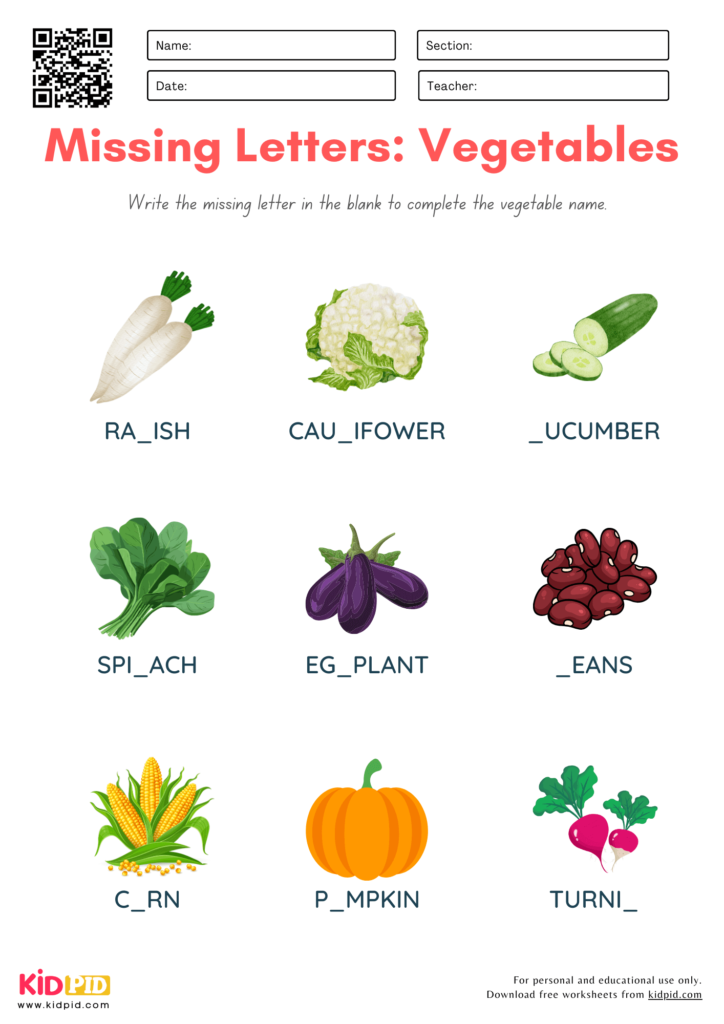
- RADISH
- CAULIFLOWER
- CUCUMBER
- SPINACH
- EGGPLANT
- BEANS
- CORN
- PUMPKIN
- TURNIP
If the students want to learn about the names of various vegetables and practice the spelling of the names, then here is the worksheet to help them. They have to write the missing letter to spell the whole name of the vegetables. There is also an answer key below the worksheet to help students complete the worksheet effectively.
Key Facts About This Worksheet
- Target Audience: Designed specifically for Grade 1 students to align with early primary literacy standards.
- Educational Focus: Combines vocabulary building (vegetable names) with spelling reinforcement and letter recognition.
- Curriculum Alignment: Developed by the Kidpid Content Team, consisting of experienced educators and curriculum researchers.
- Dual Benefit: Beyond linguistic skills, the worksheet serves as a tool to promote healthy eating habits by familiarizing children with various nutritious vegetables.
- Format: Printable, user-friendly activity sheets that include an answer key for independent learning or guided support.
Parts, Types, and Examples
The worksheet is structured to move from simple recognition to mastery:
- Examples of Vegetables Included:
- Root/Tuber Vegetables: Onion, Potato, Radish, Turnip.
- Leafy Greens: Spinach.
- Cruciferous/Other: Broccoli, Cauliflower, Cucumber, Bell Peppers, Eggplant, Beans, Corn, Pumpkin, Garlic, Chillies, Peas.
- Activity Type: Fill-in-the-blank spelling exercise. Students are provided with the full word but with specific letters missing, requiring them to use cognitive recall to complete the spelling correctly.
How Does This Worksheet Work?
This worksheet utilizes the “Cloze” procedure—a proven educational technique where a portion of language is omitted, and the student must replace it.
- Visual Recognition: Students look at the vegetable name and identify the missing grapheme (letter).
- Cognitive Recall: The student must associate the image (or the partial word) with the correct spelling they have learned in class or at home.
- Verification: The included answer key allows students to check their work immediately, promoting self-assessment and reducing frustration.
Benefits of Learning About This Worksheet
- Spelling Fluency: Regular practice helps transition common vegetable names from short-term memory to long-term vocabulary.
- Healthy Lifestyle Advocacy: It bridges the gap between academics and health, encouraging children to think about nutrition.
- Cognitive Development: Exercises like these enhance attention to detail and improve visual-orthographic memory.
- Confidence Building: The availability of an answer key empowers children to learn independently, fostering a sense of accomplishment.
Learning Objectives
By completing this worksheet, students will:
- Correctly identify and spell a list of at least 15 common vegetables.
- Demonstrate improved letter recognition and handwriting coordination.
- Expand their category-specific vocabulary related to food and nature.
Worksheet Instructions
- Preparation: Download and print the worksheet from the link provided on the page.
- Observation: Look at the word list provided in the activity.
- Execution: Identify the missing letters in the provided blanks and fill them in using a pencil.
- Review: Once finished, use the provided answer key to check your spelling. If any are incorrect, write the correct spelling three times to reinforce learning.
Interesting Facts About These Vocabulary Words
- Botanical vs. Culinary: Many items we call “vegetables” (like tomatoes, cucumbers, and pumpkins) are botanically classified as fruits because they contain seeds.
- Diversity in Nutrition: Each vegetable on the list—from the sulfur-rich garlic to the iron-packed spinach—provides unique vitamins essential for a growing child’s development.
- Global Staples: Vegetables like potatoes and onions are staple ingredients used in cuisines across almost every culture on earth.
Real-Life Applications
- Grocery Shopping: Children can use their newly learned vocabulary to help parents identify vegetables at the supermarket.
- Meal Preparation: Recognizing these words helps children follow simple recipes, encouraging their involvement in cooking healthy meals.
- Garden Literacy: This vocabulary is a foundational step for children interested in school gardens or learning about where their food comes from.
FAQs
Q1. Is this worksheet appropriate for students younger than Grade 1?
Answer: Yes, advanced Kindergarteners or early readers who are working on spelling foundational words can also benefit from these activities.
Q2. Can these worksheets be used for remote learning?
Answer: Absolutely. They are printable and designed for ease of use in home-schooling environments or as supplemental homework.
Q3. Does the worksheet cover nutritional information?
Answer: While the primary focus is literacy and spelling, the activity is designed to spark interest in healthy eating, which can be expanded upon by parents or teachers using the suggested “Vitamins in Fruits & Vegetables” book resource.

This Grade 1 worksheet helps children complete missing letters in vegetable names while improving spelling, vocabulary, and letter recognition. It builds confidence, observation skills, and supports enjoyable everyday learning through practice. Discover quizzes, worksheets, essays, flashcards, paragraphs, and interactive resources and fun interactive learning resources for kids on our website. Connect with us on YouTube & Facebook.
The Content Team crafts the worksheet to encourage effective practice.
Reviewed By Ishika
Read More: