A pictograph is a representation of data with the help of images. Second-graders have to analyze the pictograph about how many people have voted. Based on the pictograph data, they will answer the given questions correctly in the blanks. So check out these worksheets and practice the questions to learn to analyze data. The pictograph worksheet will generate interest among kids.

[Scroll Down for Download Link]

Analyze The Pictograph Worksheets For Grade 2

Read More: Rounding 3 Digit Numbers to Nearest 100 Worksheet For Grade 3

Pictograph Worksheet For Grade 2

Q. How many people like pizza?
Ans. 6

Q. Which two foods have the same number of votes?
Ans. Noodles and Burger

Q. Which has the fewest votes?
Ans. Pasta

Q. Which is most loved by people?
Ans. French fries

Q. Write the number of votes French fries have.
Ans. 7

This is a pictograph worksheet for second-grade students. A group of people voted for their favorite junk food and drew a pictograph, so answer the questions correctly based on the given pictograph. It includes an answer key for the students to correct their mistakes.
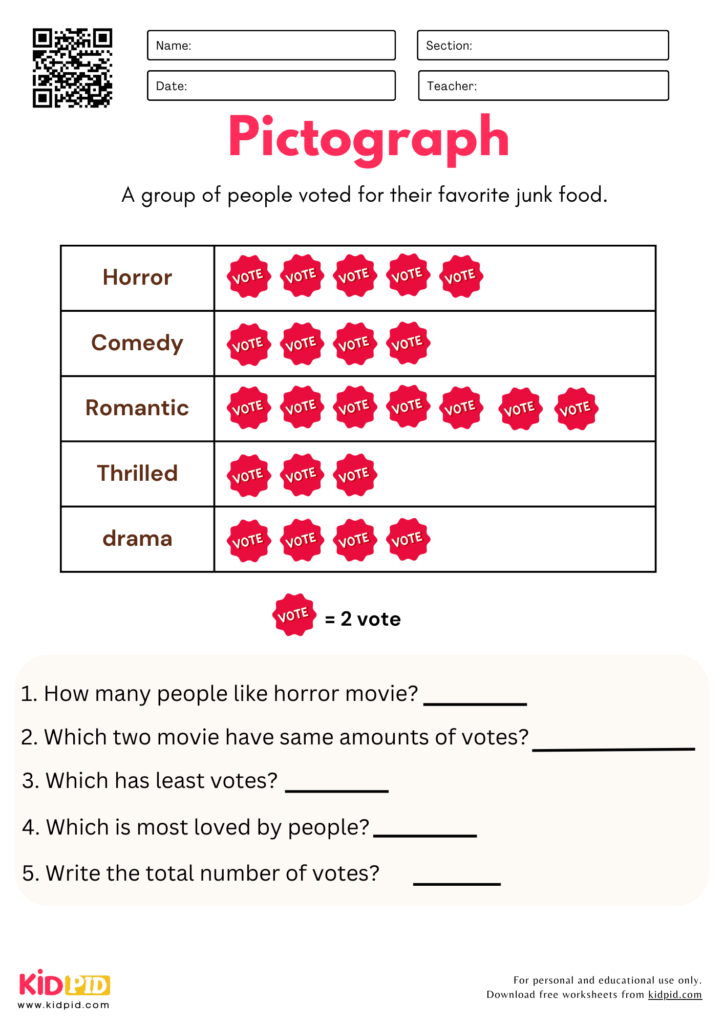
Pictograph Worksheet For Grade 2

Q. How many people like horror movies?
Ans. 10

Q. Which two movies have the same number of votes?
Ans. Comedy and Drama

Q. Which has the fewest votes?
Ans. Thrilled

Q. Which is most loved by people?
Ans. Romantic

Q. Write the total number of votes?
Ans. 46

Students will practice the pictograph data in this worksheet. They will answer the given questions based on the group of people who voted for their favorite type of movie and create a pictograph. It consists of an answer key for the correction and completion of the worksheet.

Key Facts About Pictograph Worksheets for Grade 2

  • Visual Learning: Pictographs use simple images or icons to represent data, making abstract mathematical concepts tangible and easy to visualize for 7- and 8-year-olds.
  • Skill Building: These worksheets are designed to help students transition from basic counting to data interpretation, a foundational skill in statistics.
  • Grade-Level Alignment: Tailored specifically for Grade 2, these exercises focus on identifying trends, comparing quantities, and performing simple calculations based on visual data.
  • Self-Correction: High-quality pictograph worksheets include an answer key, encouraging independent learning and allowing students to verify their own progress.

Parts, Types, and Examples of Pictographs

Understanding the structure of a pictograph is the first step toward mastery.

  • Title: Describes what the data represents (e.g., “Favorite Junk Foods”).
  • Categories/Labels: The items being compared (e.g., Pizza, Burger, Noodles).
  • Symbols/Icons: The images used to represent the quantity of each category.
  • Key/Legend: A crucial element that explains what each symbol represents (e.g., one star = 2 votes).
  • Examples:
    • Simple Pictograph: Each symbol represents a value of 1.
    • Scaled Pictograph: Each symbol represents a value of 2, 5, or 10 (common in more advanced Grade 2 challenges).

How Does a Pictograph Worksheet Work?

A pictograph worksheet acts as a bridge between looking at a picture and understanding numerical data.

  1. Observe: The student looks at the title and labels to understand the context.
  2. Consult the Key: The student checks the legend to understand the “value” of each picture.
  3. Count: The student counts the symbols for a specific category.
  4. Calculate: The student multiplies the count by the value defined in the key.
  5. Analyze: The student answers questions requiring comparison (e.g., “Which has more?”) or totaling (e.g., “What is the total number of votes?”).

Benefits of Learning About Pictographs

  • Improves Analytical Thinking: Teaches students how to derive information from organized data rather than just random numbers.
  • Enhances Visual Literacy: Helps children interpret graphical representations found in textbooks, news, and digital media.
  • Real-World Context: Connects classroom math to real-world scenarios, such as tracking inventory, voting results, or hobby preferences.
  • Foundational Math Confidence: Mastering basic graphing builds confidence for tackling more complex data structures like bar charts and line graphs in later grades.

Learning Objectives

By completing these worksheets, students will be able to:

  • Read and interpret information presented in a pictograph.
  • Compare quantities using visual data.
  • Accurately answer analytical questions derived from a graph.
  • Understand the importance of a “Key” or “Legend” in data representation.

Worksheet Instructions

  1. Read the Title: Understand the “why” behind the data collection.
  2. Examine the Key: Always look at the key first to determine the value of each symbol.
  3. Analyze Categories: Scan through the rows or columns to identify the different items being measured.
  4. Count Carefully: Use a pencil to mark symbols as you count to avoid skipping or double-counting.
  5. Answer Questions: Read each question carefully and cross-reference your findings with the graph.
  6. Verify: Check your answers against the provided answer key once you have finished the activity.

Interesting Facts About Pictographs

  • Universal Language: Pictographs can be understood across language barriers because they use universal symbols rather than words.
  • Ancient Roots: Humans have used visual representations for data since ancient civilizations, long before standard bar graphs were invented.
  • Data Simplified: They are the most user-friendly way to display data, which is why they are often used in elementary education and introductory business presentations.

Vocabulary Words

  • Pictograph: A graph that uses pictures to show information.
  • Data: Information or facts collected for analysis.
  • Key (Legend): A guide that explains what each symbol in the graph represents.
  • Category: A specific group or item being compared in the graph.
  • Analyze: To study something carefully to understand its meaning.

Real-Life Applications

  • Classroom Management: Teachers often use pictographs to track book-reading goals or attendance.
  • Consumer Choices: Companies use pictographs to show which products are the most popular among shoppers.
  • Weather Tracking: Simple icons can represent sunny, rainy, or cloudy days to create a monthly weather log.
  • Healthy Eating: Tracking daily fruit or vegetable servings using a pictograph.

FAQs

Q1. Why is the “Key” so important?

Answer: Without the key, you wouldn’t know if one symbol equals 1, 5, or 100 items. It is the rulebook for the graph.

Q2. Are these worksheets suitable for all Grade 2 students?

Answer: Yes, these worksheets are designed to be accessible, but they can be scaled in difficulty by changing the value represented by each symbol (e.g., from 1 to 5).

Q3. What should I do if my child struggles with math?
Answer: Encourage them to count the symbols one by one and write the numerical value next to each category before attempting to answer the questions.

These Pictograph Worksheets for Grade 2 help students read, create, and interpret pictographs with confidence. Engaging activities strengthen counting, data analysis, comparison, and graph-reading skills while making math enjoyable through colorful visual learning. Keep learning exciting with printable worksheets, essays, quizzes, paragraphsflashcards, and interactive resource materials. Join us on Telegram, YouTube, and Facebook.

Our Content Team created this worksheet to elevate student learning.

Reviewed By Minakshi

Read More:

About the Author

Content Team

Kidpid Content Team is a team of experienced educators, curriculum researchers, and child-focused content creators specializing in early childhood and primary education. The team develops high-quality, research-based worksheets, learning activities, and educational articles aligned with age-appropriate learning standards. Every resource is carefully reviewed to ensure accuracy, clarity, and educational value, making Kidpid a trusted platform for parents, teachers, and schools worldwide.

View All Articles