


Engaging kindergarten students with a play vocabulary worksheet offers a dynamic and enjoyable way to enhance their language skills. It fosters a love for learning while building a strong foundation in vocabulary. This interactive approach ensures children develop essential communication abilities in a fun and memorable manner.
[Scroll Down for Download Link]
Contents
- Play Words Missing Letter
- Key Facts About Play Vocabulary Worksheets for Kindergarten
- Parts, Types, and Examples of Play Vocabulary
- How Does a Play Vocabulary Worksheet Work?
- Benefits of Learning Play Vocabulary
- Learning Objectives & Worksheet Instructions
- Interesting Facts About Play Vocabulary Words
- Real-Life Applications
- FAQs
Play Words Missing Letter
Read More: Festival Vocabulary Printable Worksheets for Kids

- Walk
- Swim
- Slide
- Run
- Crawl
- Stroll

- Skate
- Kick
- Skip
- Build
- Hop
- Jump
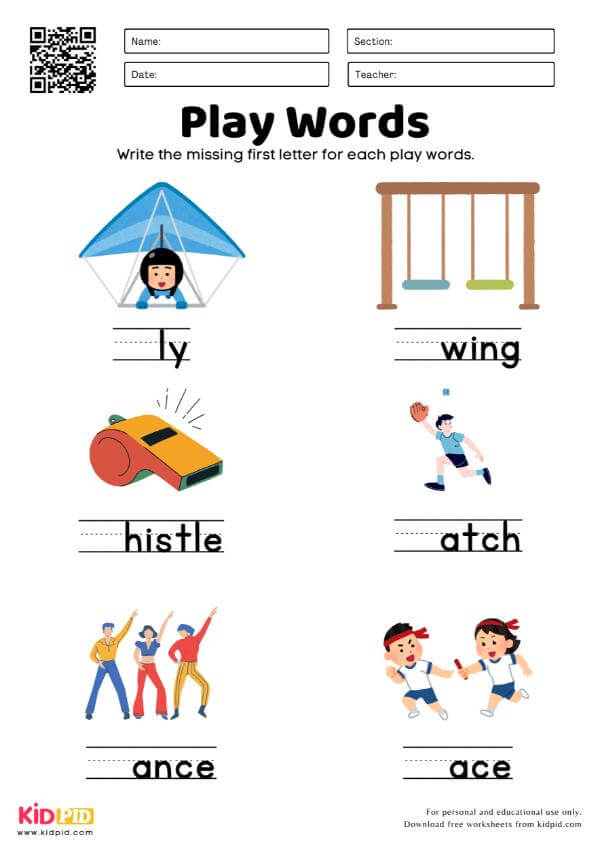
- Fly
- Swing
- Whistle
- Catch
- Dance
- Race
Key Facts About Play Vocabulary Worksheets for Kindergarten
Introducing language lessons through topics children already love – like playing – is one of the most effective strategies in early childhood education. This approach roots abstract linguistic concepts in tangible, everyday experiences.
- Target Age Group: Kindergartners and preschoolers (Ages 4–6).
- Core Focus Areas: Action verbs (motion words), reading readiness, phonics, and spelling patterns.
- Activity Mechanics: Identification games, spelling via missing letters, and fine motor skills reinforcement (tracing or writing).
- Alignment: Complies with early foundational reading benchmarks (like CCSS.ELA-LITERACY.RF.K.1) focused on understanding printed words and their meanings.
Parts, Types, and Examples of Play Vocabulary
A well-rounded vocabulary resource targets different facets of play. The Kidpid worksheet splits these into action-based categories that help children connect physical actions to written symbols:
1. Active & Outdoor Play Words
These action verbs (words describing a physical action) describe full-body movements typically seen on the playground or during sports.
- Examples: Run, Jump, Hop, Skip, Skate, Kick, Slide, Swim, Race
2. Creative & Social Play Words
Words that highlight imaginative play, building things, or interactive group communication.
- Examples: Build, Dance, Swing, Catch, Fly, Whistle, Stroll, Crawl
3. Structural Components of the Worksheet
To keep young minds engaged, a premium printable includes a mix of:
- Visual Tracing Aids: Dotted guidelines help students form letters correctly.
- Missing Letter Tasks: Phonics puzzles (e.g., S _ i d e or R u _) to encourage phonemic awareness—the ability to identify individual sounds in spoken words.
How Does a Play Vocabulary Worksheet Work?
Young children learn best through scaffolded instruction—a teaching method that moves students progressively toward stronger independence in the learning process. These sheets are systematically engineered to guide a child through three stages of literacy:
- Visual Recognition: The child identifies a picture or associates a spoken word (like “Slide”) with an action they perform in real life.
- Phonics Decoding: By interacting with missing letter puzzles, the child sounds out the letters they see and uses phonetic logic to figure out the letter that completes the word.
- Graphomotor Practice: Writing the missing letters strengthens muscle memory and fine motor skills, locking the spelling structure into long-term retention.
Benefits of Learning Play Vocabulary
Learning action and play-themed words early gives young learners a distinct advantage in their developmental milestones:
- Enhanced Expressive Language: Children shift from vague gesturing (“I want to go over there”) to precise communication (“I want to slide!”).
- Boosted Reading Comprehension: Recognizing these common action verbs by sight makes it significantly easier to read early-stage storybooks smoothly.
- Accelerated Social-Emotional Skills: When kids can clearly articulate play styles, they resolve playground conflicts faster and cooperate more effectively during group activities.
- Cognitive Mapping: Connecting words to physical play movements builds neural pathways linking language to sensory experiences.
Learning Objectives & Worksheet Instructions
Learning Objectives
By the end of this printable activity, the student will be able to:
- Identify and read basic five- and six-letter play verbs.
- Supply missing vowels or consonants to complete target vocabulary words.
- Demonstrate improved pencil control and letter configuration layout.
Step-by-Step Worksheet Instructions
Parents and teachers can guide children through the printable with these simple cues:
- Look and Say: Have the child look at the word (or accompanying action) and say the word aloud clearly.
- Sound Out: Ask the child to slowly segment the sounds in the word to identify the missing letter (e.g., “Listen to sk-i-p, what sound is missing in the middle?”).
- Fill in the Blank: Guide the child to write the missing letter carefully inside the blank space using a pencil.
- Read & Celebrate: Have the child point to the complete word and read it back from left to right.
Interesting Facts About Play Vocabulary Words
- Verbs Fuel Early Brain Power: Linguists note that toddlers who learn and use a wide range of action verbs early on tend to develop advanced grammar skills much faster down the road than children who stick mostly to nouns.
- Play is Contextual Learning: Famed psychologist Jean Piaget noted that “play is the work of childhood.” Learning words associated with play ensures high engagement because the child is learning the language of their own primary occupation.
- The “Missing Letter” Effect: Omitting pieces of a word triggers a psychological drive to solve a puzzle. This active problem-solving technique locks the spelling into memory far better than passive, repetitive copying ever could.
Real-Life Applications
How do you bridge the gap between a paper worksheet and the real world? Use these vocabulary words dynamically outside the classroom:
- The Simon Says Variation: Play a quick round of “Simon Says” using only the words from the worksheet (e.g., “Simon says: Stroll! Simon says: Skip!”).
- Storytime Focus: While reading bedtime or classroom stories, challenge your child to clap or raise their hand whenever they spot or hear one of their play words.
- Playground Commentary: Turn a trip to the local park into a live language lesson. Narrate actions in real-time: “Look, that boy is sprinting to the swing! Can you hop over to the sandbox?”
FAQs
Q1. At what age is this play vocabulary sheet best suited?
Answer: This worksheet is ideally designed for kindergartners (ages 5–6), but it serves as an excellent challenge for advanced preschoolers (age 4) or a wonderful remedial review for first-grade students who need extra reading practice.
Q2. How does solving missing letters help with phonics?
Answer: It forces children to map sounds to letters (a process called orthographic mapping). Instead of just memorizing what a word looks like, the child has to analyze the internal sound patterns to figure out exactly which letter is missing.
Q3. How many new vocabulary words should a kindergartner learn a week?
Answer: On average, introducing 2 to 5 high-frequency or thematic words per week is perfect for this developmental stage. The focus should always be on deep comprehension and usage rather than overwhelming them with a massive list.
Q4. Can this worksheet be used for English as a Second Language (ESL) students?
Answer: Yes! Because the vocabulary is entirely rooted in universal, high-context physical actions, this is an excellent tool for ESL/ELL young learners to quickly pick up essential English verbs.
You’ve done a fantastic job with the Play Vocabulary Worksheet! By learning and writing new play-related words, you’ve practiced both your reading and writing skills. Keep exploring and having fun with different types of play, and continue to learn new words. Remember, learning can be an exciting adventure, and you’re doing great! Make learning enjoyable with flashcards, quizzes, worksheets, essays, paragraphs, and interactive resources available on our website. Connect with us on YouTube & Facebook.
The Content Team created this worksheet to enhance learning in academics.
Reviewed By Kartik
Read More:



