In geometry, reflection refers to reproducing the given object by imagining the image that would be produced if there were a mirror in front of the object. When reflecting a figure in a line or in a point, the end image is identical to the preimage, as it maps every point of a figure to the image across a fixed line. The fixed line is called the line of reflection. In simpler terms, reflecting a shape in geometry means to flip the given shape over a mirror line. It is mirroring the shape on the other side. Since the shape is mirrored, it faces the opposite direction.
Contents
- Reflections Over a Line Math Worksheets
- Key Facts About Reflections Over a Line Math Worksheets
- Parts/Types/Examples of Reflections Over a Line Math Worksheets
- How do Reflections Over a Line Math Worksheets Work?
- Benefits of Learning About Reflections Over a Line Math Worksheets
- Learning Objectives
- Worksheet Instructions
- Interesting Facts About Reflections Over a Line
- Vocabulary Words
- Real-Life Applications
- FAQs
- Q1. What is a reflection in geometry?
- Q2. Does a reflected shape change size?
- Q3. What is a line of reflection?
- Q4. Why are reflection worksheets important?
- Q5. Can reflections be performed on a coordinate plane?
- Q6. What skills do these worksheets develop?
- Q7. At what grade level are reflection worksheets useful?
- Q8. How do reflections relate to real life?
- Q9. What is the difference between reflection and rotation?
- Q10. How can students improve their reflection skills?
- Read More:
Reflections Over a Line Math Worksheets

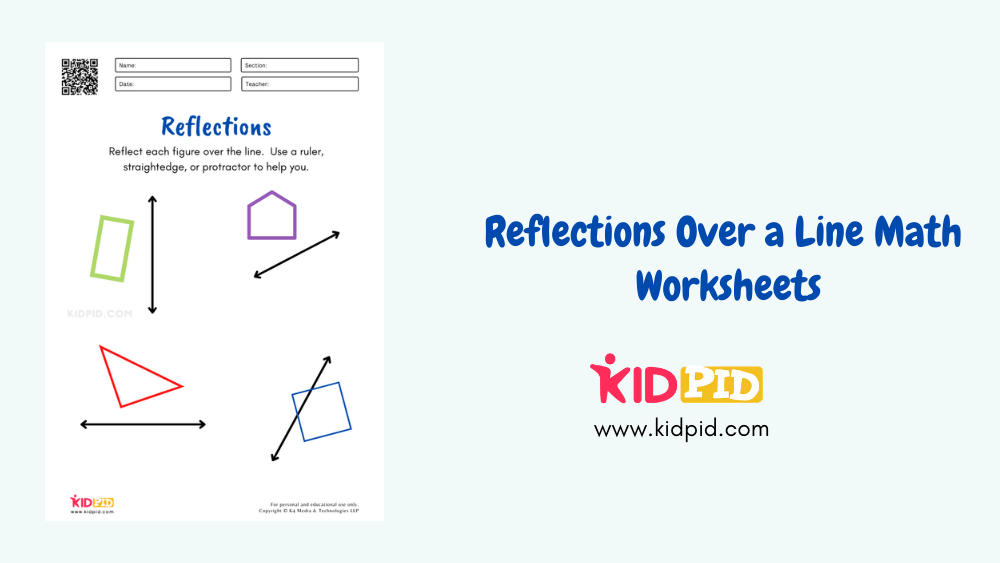
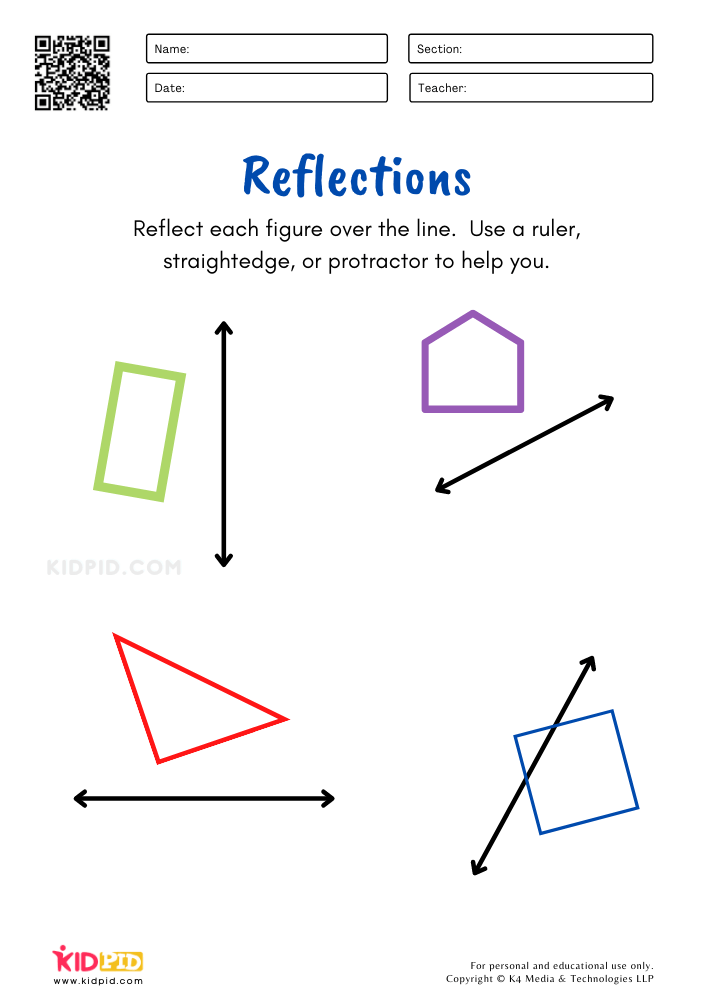
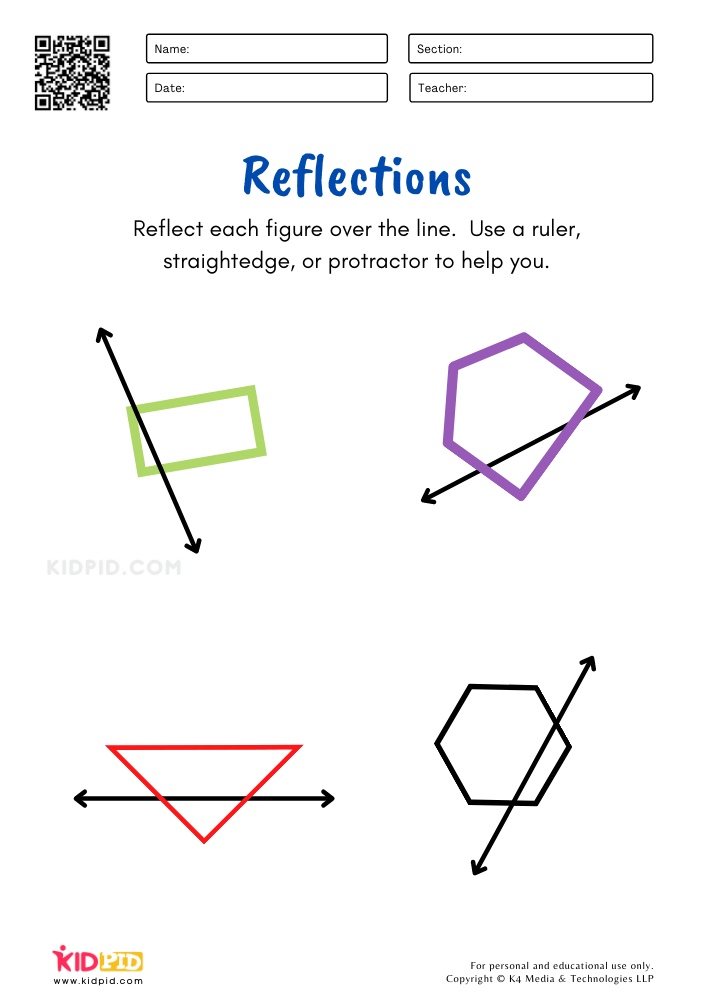
Our printable reflection worksheets provide exercises to understand the concepts of reflection. In the first worksheet, there are four shapes to reflect over the line. The first one is a rectangle, the second is a pentagon. Then we have a triangle and a square. This gives you enough practise to master the basics of reflecting shapes over a line.
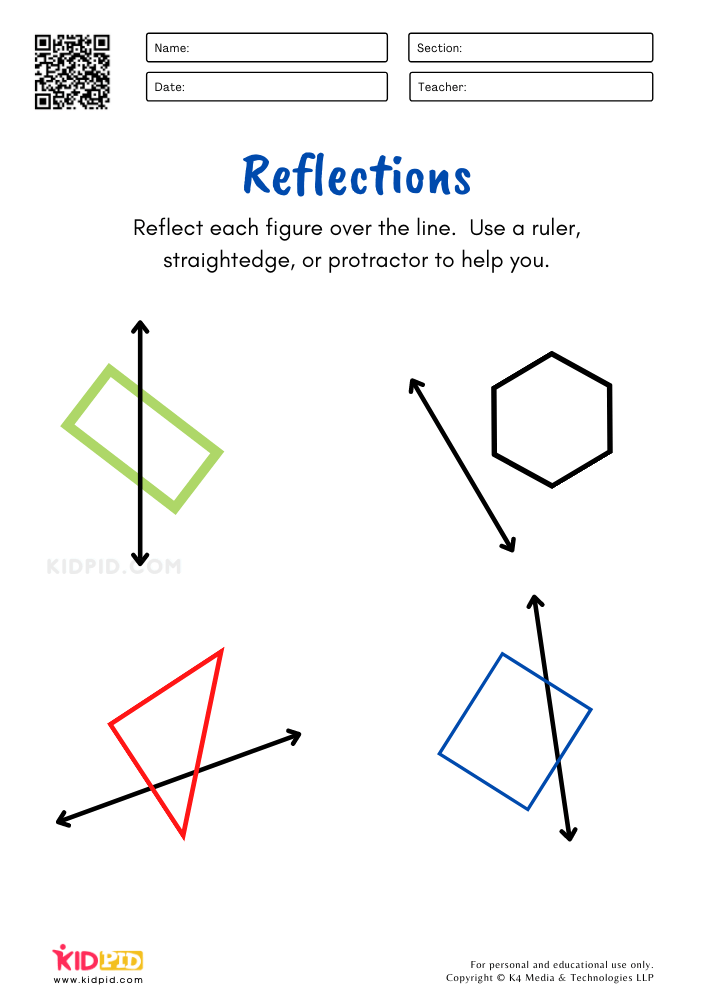
Reflecting a shape is easy. To reflect a shape, we move the corners and then join them together. Hence, the reflected shape is the same size and shape as the original object, but mirrored, i.e., the corners of the reflected shape are the same distance from the mirror line but are now facing the opposite direction to the original shape. This is the second worksheet where you can apply your knowledge.
The third worksheet gives you more exercises to work with. This one includes a hexagon to test your understanding. You need to reflect each of the given figures over the line. You can use a ruler, straightedge, or protractor for your help.
Key Facts About Reflections Over a Line Math Worksheets
Reflections Over a Line Math Worksheets help students understand the geometric transformation known as reflection, where a shape is flipped across a line to create a mirror image. These worksheets introduce concepts of symmetry, coordinate geometry, and spatial reasoning through engaging activities. Students learn to identify lines of reflection, plot reflected points, and analyze how shapes change position while maintaining size and shape. Suitable for elementary and middle school learners, these worksheets build a strong foundation in geometry and critical thinking.
Parts/Types/Examples of Reflections Over a Line Math Worksheets
Parts of the Worksheets:
- Original shape or figure
- Line of reflection
- Coordinate grid (if applicable)
- Reflection drawing area
- Practice questions and answer spaces
Types of Reflection Worksheets:
- Reflection across a vertical line
- Reflection across a horizontal line
- Reflection across diagonal lines
- Coordinate plane reflections
- Symmetry and mirror image exercises
Examples:
- Reflecting a triangle across the y-axis
- Flipping a square over a horizontal line
- Drawing the reflected image of a polygon on a grid
- Identifying lines of symmetry in shapes
How do Reflections Over a Line Math Worksheets Work?
These worksheets provide students with shapes, points, or figures and a designated line of reflection. Learners must determine the mirror image of the given figure by measuring equal distances from the reflection line. Activities may involve drawing reflected shapes, plotting coordinates, identifying symmetry, or solving reflection-based geometry problems. Through repeated practice, students develop a deeper understanding of transformations and geometric relationships.
Benefits of Learning About Reflections Over a Line Math Worksheets
- Strengthens geometry and transformation skills
- Develops spatial awareness and visualization abilities
- Improves problem-solving and logical reasoning
- Enhances understanding of symmetry and patterns
- Builds confidence in coordinate graphing
- Supports preparation for advanced math concepts
- Encourages attention to detail and accuracy
Learning Objectives
By completing these worksheets, students will:
- Understand the concept of reflection in geometry
- Identify lines of reflection and symmetry
- Reflect shapes accurately across different lines
- Use coordinate grids to perform reflections
- Recognize mirror images and geometric transformations
- Apply reflection skills to real-world situations
- Improve mathematical reasoning and visualization
Worksheet Instructions
- Carefully observe the shape and the line of reflection.
- Count the distance between each point and the reflection line.
- Plot corresponding reflected points on the opposite side.
- Connect the reflected points to form the new shape.
- Check that both figures are equal distances from the reflection line.
- Complete all practice problems neatly and accurately.
- Review your answers for correctness before moving on.
Interesting Facts About Reflections Over a Line
- Reflections create mirror images of shapes.
- Reflected figures remain the same size and shape.
- Reflection is one of the four basic geometric transformations.
- Many natural objects display reflection symmetry.
- Mirrors work using the principle of reflection.
- Reflection helps architects and artists create balanced designs.
- Symmetry and reflection are widely used in engineering and technology.
Vocabulary Words
- Reflection – A flip of a figure across a line.
- Line of Reflection – The line over which a figure is reflected.
- Symmetry – Balanced proportions on opposite sides of a line.
- Mirror Image – The reflected version of a figure.
- Transformation – A change in a figure’s position or orientation.
- Coordinate Plane – A grid used to plot points and shapes.
- Vertex – A corner point of a shape.
- Congruent – Having the same size and shape.
- Axis – A reference line on a coordinate plane.
- Geometric Figure – A shape formed by points and lines.
Real-Life Applications
Reflection concepts are used in many everyday situations, including:
- Mirror design and placement
- Architecture and building layouts
- Logo and graphic design
- Art and pattern creation
- Engineering blueprints
- Computer graphics and animation
- Photography and image editing
- Road signs and safety markings
- Fashion and textile design
- Robotics and computer vision systems
FAQs
Q1. What is a reflection in geometry?
Answer: A reflection is a transformation that flips a figure across a line to create a mirror image.
Q2. Does a reflected shape change size?
Answer: No. The reflected figure remains congruent to the original shape.
Q3. What is a line of reflection?
Answer: It is the line across which a figure is flipped or reflected.
Q4. Why are reflection worksheets important?
Answer: They help students understand geometry, symmetry, and spatial relationships.
Q5. Can reflections be performed on a coordinate plane?
Answer: Yes. Students can reflect points and shapes across the x-axis, y-axis, or other lines.
Q6. What skills do these worksheets develop?
Answer: They improve geometry knowledge, visualization, logical thinking, and problem-solving abilities.
Q7. At what grade level are reflection worksheets useful?
Answer: They are commonly used from elementary through middle school, depending on complexity.
Q8. How do reflections relate to real life?
Answer: Reflections are used in mirrors, architecture, design, technology, art, and engineering.
Q9. What is the difference between reflection and rotation?
Answer: Reflection flips a figure, while rotation turns it around a fixed point.
Q10. How can students improve their reflection skills?
Answer: Regular practice with grids, symmetry exercises, and transformation worksheets helps strengthen understanding and accuracy.
Understanding reflections helps students visualize symmetry and geometric transformations with confidence. These worksheets sharpen spatial awareness, strengthen geometry concepts, and encourage logical thinking through hands-on mathematical exploration. Browse our educational library packed with essays, flashcards, worksheets, quizzes, paragraphs, and enjoyable learning activities. Stay connected on YouTube & Facebook.
The Content Team created this worksheet to foster learning excellence.
Reviewed By Sanjana
Read More: