

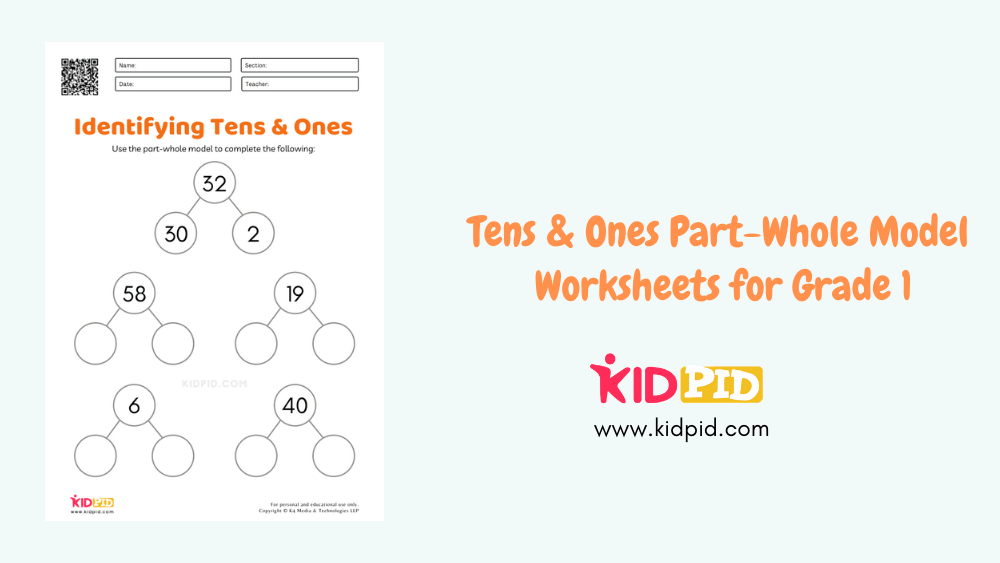
This worksheet consists of a total of ten sheets with exercises based on the part-whole model for identifying tens and ones. It is an introduction to place value systems in mathematics. With the help of these worksheets, children would learn to identify digits in place values of ones and tens. The first one is solved to give you an idea of what needs to be done.
Contents
- One Part-Whole Model Practice Worksheets
- Key Facts About Tens & Ones Part-Whole Model Worksheets
- Parts, Types, and Examples of the Part-Whole Model
- How Does the Tens & Ones Part-Whole Model Work?
- Benefits of Learning About Tens & Ones via the Part-Whole Model
- Learning Objectives
- Worksheet Instructions
- Interesting Facts About Place Value and Part-Whole Systems
- Vocabulary Words
- Real-Life Applications
- FAQs
- Q1: Why use the part-whole model instead of just teaching standard column addition?
- Q2: My child is struggling to write the correct numbers in the parts. What should I do?
- Q3: At what age should children start learning the part-whole model?
- Q4: Are these worksheets aligned with standard elementary school curricula?
- You may like this:
One Part-Whole Model Practice Worksheets

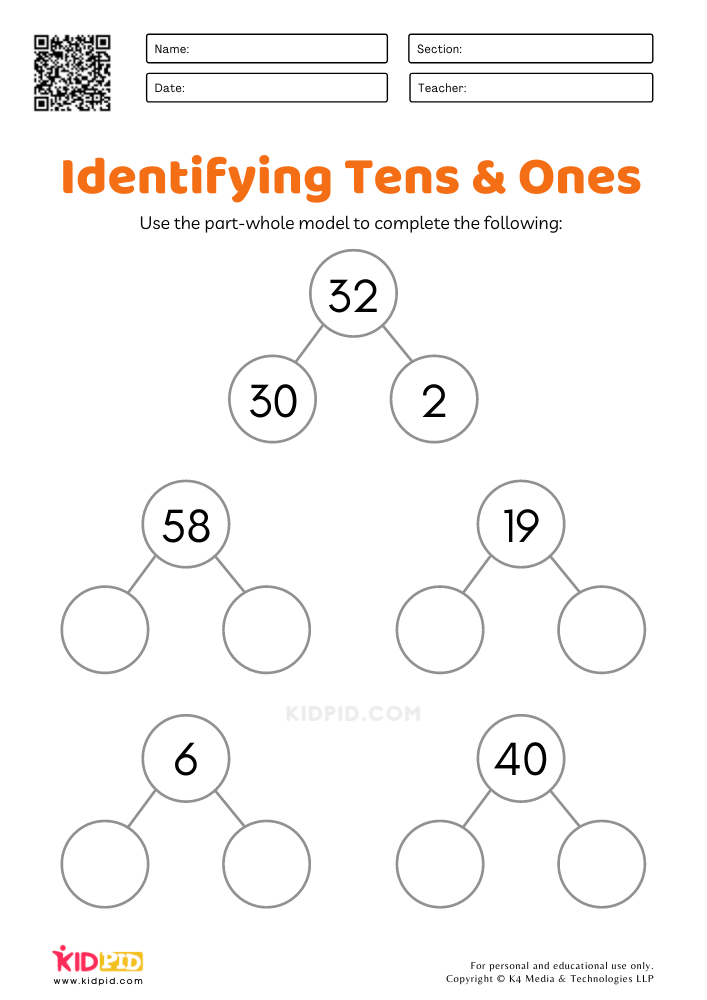
The worksheets are based on the part-whole model. It is the concept of how numbers can be split into different parts based on the number of digits.
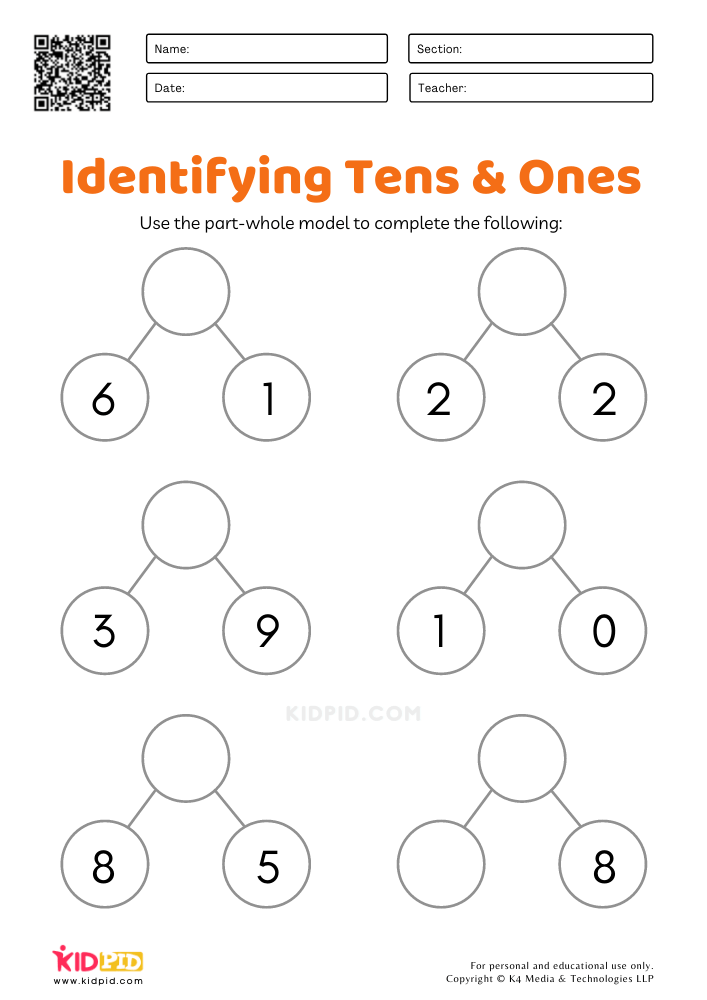
The part-whole model is used to understand the relationship between whole numbers and parts. Identifying tens and ones through the use of the part-whole system would allow learners to understand the fundamentals of addition and subtraction, too.
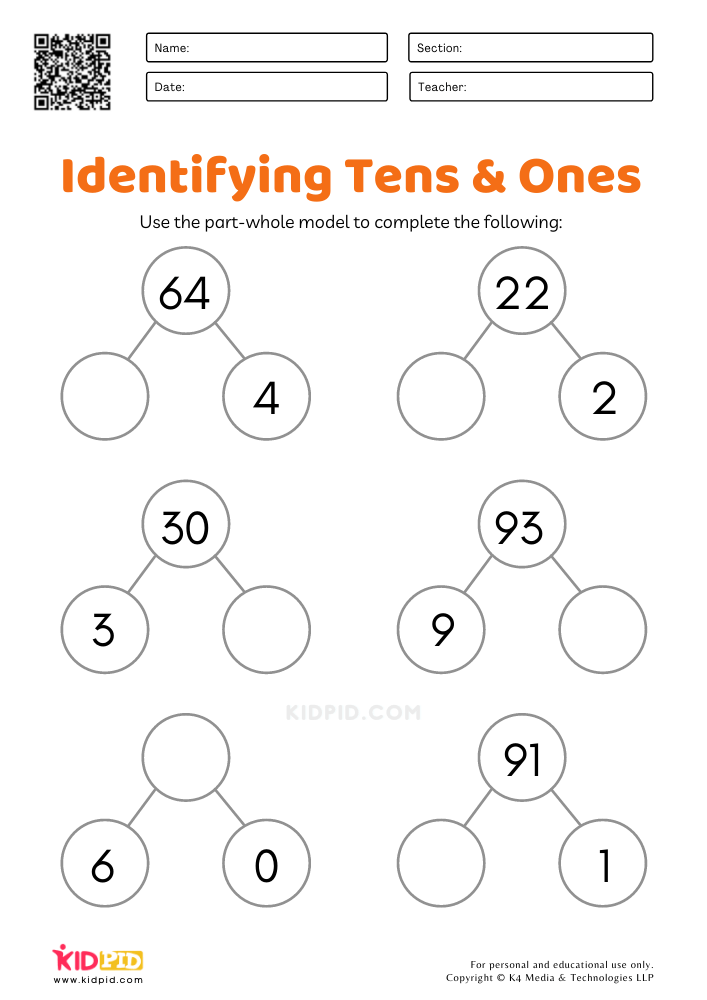
In the base ten number system, each place has ten times the value of the place to its right. Similarly, a number in the units place has a value that is ten times less than the value of the number in the place value of ten.
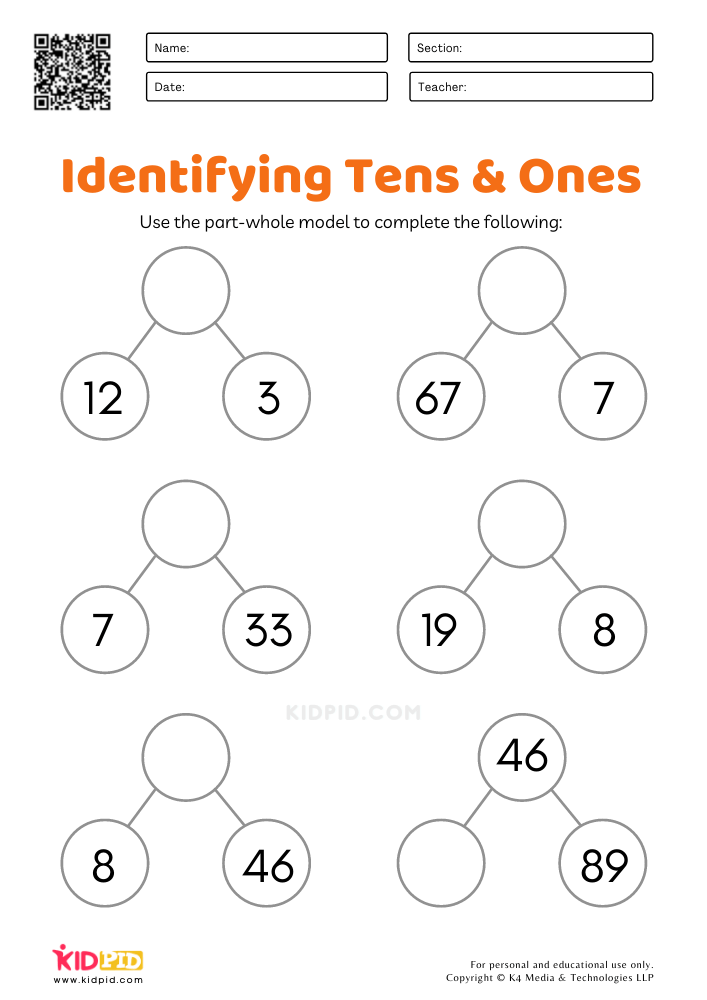
These exercises would help students understand the base 10 number system. These worksheets focus on numbers less than 100 as we are only using two-digit numbers.
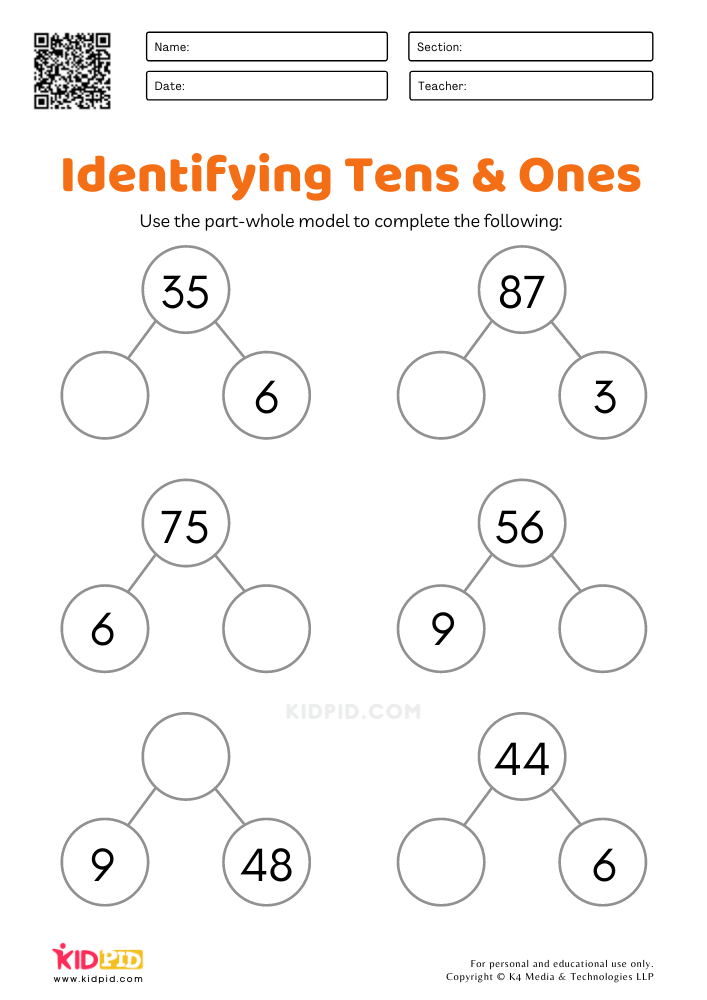
This is the sixth worksheet. All of our worksheets consist of six questions. It allows kids to practice until they grasp the concept. If he is having trouble understanding it, offer him proper guidance.
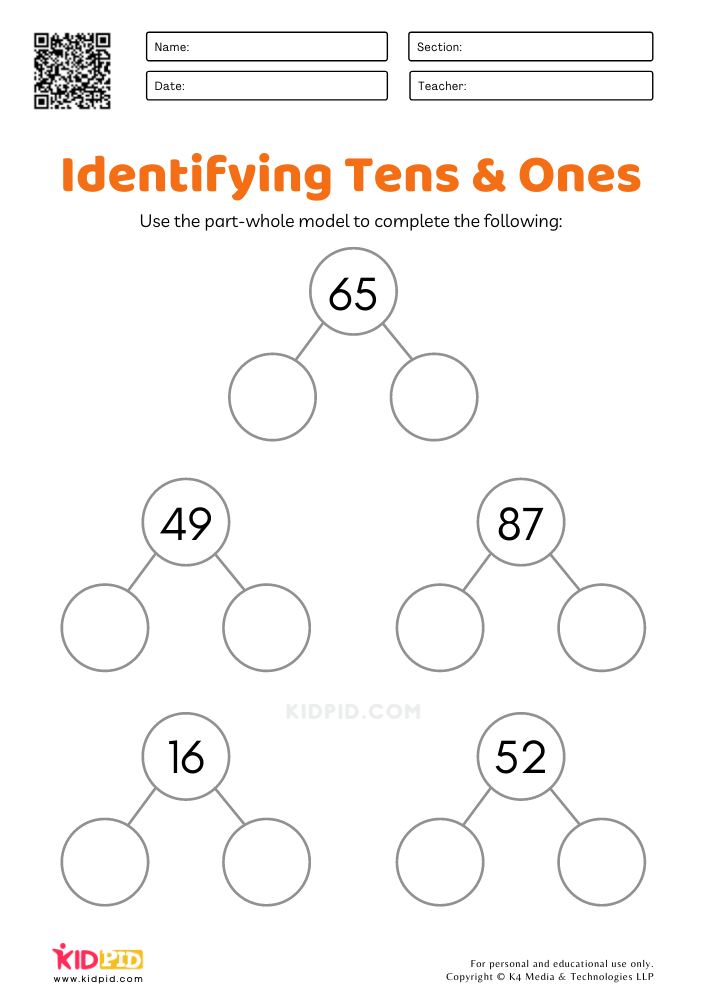
It is better to ask kids to practice some of these worksheets at first. Asking them to do all of these in one go would hinder their progress if they haven’t understood the concept yet.
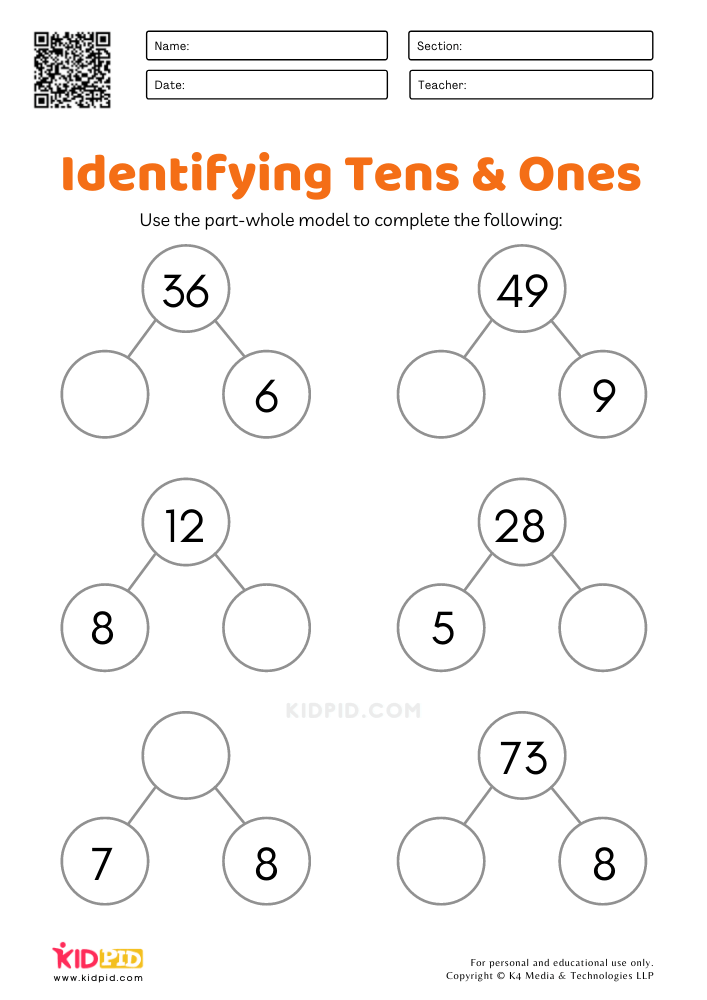
All of our worksheets are downloadable. Download and print these to teach the first-graders the use of the part-whole model for identifying place values.
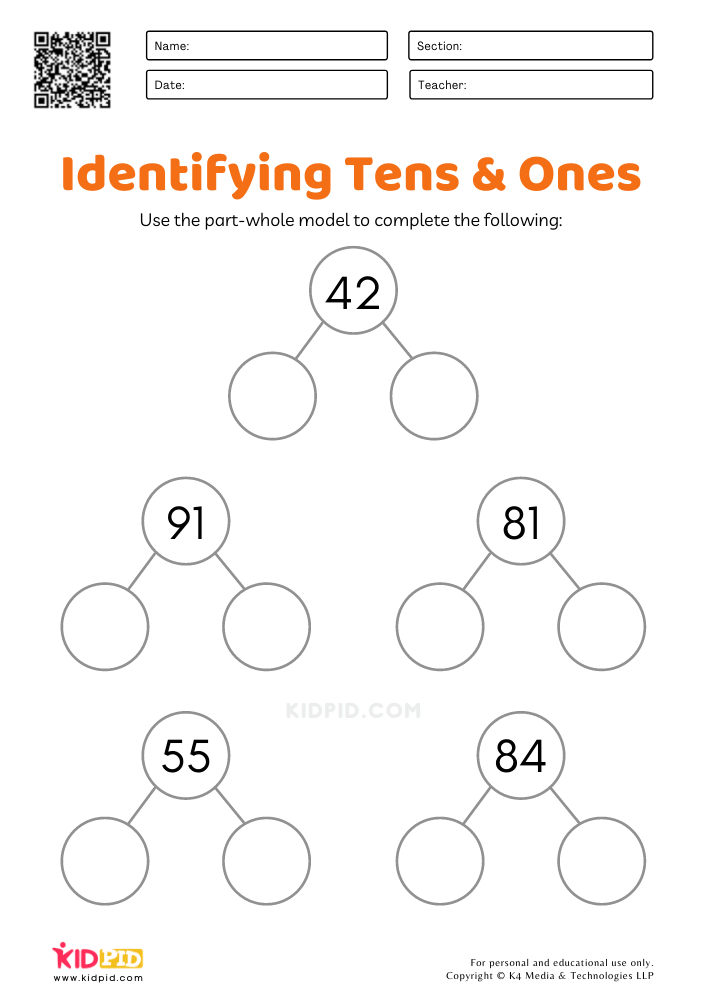
These worksheets would help kids practice identifying the place values of tens and ones in numbers ranging from 01 -99.
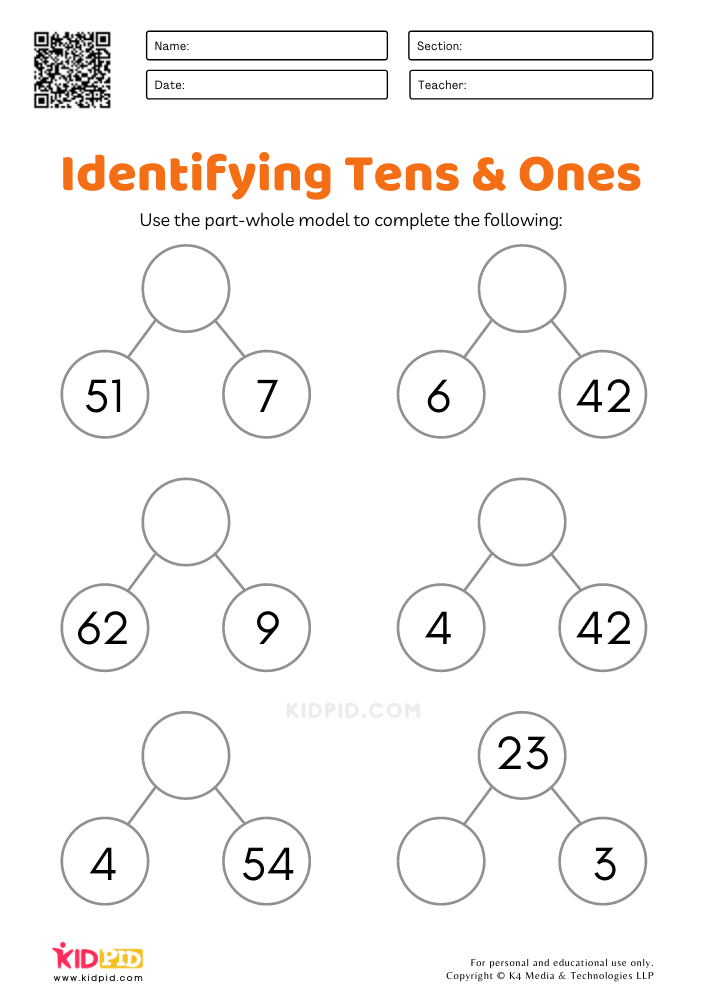
This is the last worksheet. By now, the kid must have developed an understanding of the concept. Test it by using this sheet.
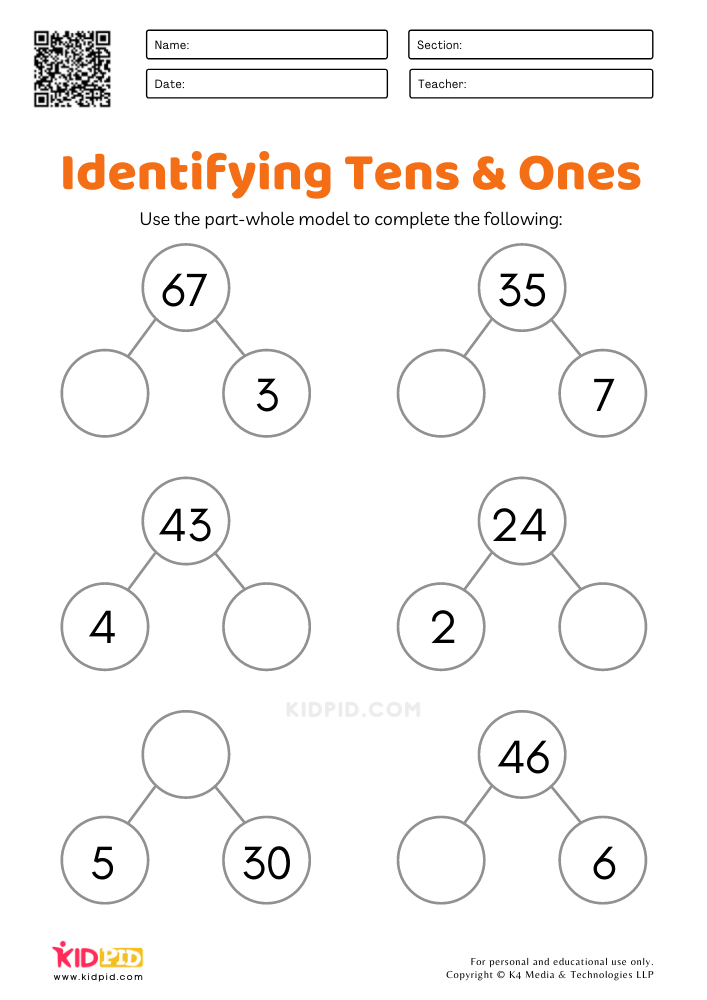
Help your kid learn the place values of tens and ones by using the concept of the part-whole system. It is one of the building blocks of mathematics, without which it is impossible to excel in the subject. Download these worksheets and get started now!
Key Facts About Tens & Ones Part-Whole Model Worksheets
- Target Audience: Specifically designed for Grade 1 students (typically ages 6–7), aligned with early foundational math curricula (such as Common Core Standards for Numbers and Operations in Base Ten).
- Core Mathematical Focus: Combines place value understanding with the visual schema of the part-whole model for two-digit numbers up to 99.
- Format: A comprehensive, downloadable 10-sheet printable bundle containing 6 targeted practice problems per page to avoid cognitive overload.
- Scaffolded Learning: Features a fully completed example on the first page to guide independent or parent-led study.
- No-Prep Tool: Free, print-ready resource ideal for classroom warm-ups, homework, math centers, or homeschooling interventions.
Parts, Types, and Examples of the Part-Whole Model
The part-whole model is a visual mathematical framework consisting of three interconnected circles or boxes: one large “whole” connected to two or more smaller “parts.”
- The Whole: The complete two-digit number representing the total quantity (e.g.,
45). - The Tens Part: The portion of the number representing the value of the tens digit (e.g.,
40or “4 Tens”). - The Ones Part: The portion of the number representing the remaining individual units (e.g.,
5or “5 Ones”).
Examples Found in the Worksheets:
- Standard Breakdown: Whole: 27 | Part 1 (Tens): 20 | Part 2 (Ones): 7
- Worded Representation: Whole: 63 | Part 1: 6 Tens | Part 2: 3 Ones
- Missing Part Application: Whole: 84 | Part 1: 80 | Part 2:? (Student fills in 4)
How Does the Tens & Ones Part-Whole Model Work?
The part-whole model works by providing a concrete visual graphic organizer that maps abstract numerals to physical, conceptual values.
When a 1st grader encounters a number, their brain might initially see it as two isolated digits next to each other (“3” and “8”). The model forces a structural breakdown:
- The student visualizes the number 38 sitting at the top of the hierarchy (the Whole).
- The model branches down into two separate paths (Parts).
- The student deconstructs the number based on its position in the base-10 system. They recognize that the “3” actually represents 30 (three blocks of ten) and the “8” represents 8 (eight single units).
- By writing
30and8into the respective part bubbles, the child physically and mentally proves that 30 + 8 = 38.
Benefits of Learning About Tens & Ones via the Part-Whole Model
- Prevents Rote Memorization: Instead of just memorizing digit positions, children understand the actual quantity and value a number holds.
- Smooth Transition to Abstract Math: It acts as a bridge between concrete math manipulatives (like base-ten blocks) and abstract mathematical writing (equations).
- Boosts Mental Math Skills: Breaking numbers into friendly intervals of 10 allows children to perform mental additions and subtractions much faster later on.
- Builds Algebraic Thinking: Seeing how a total is composed of multiple missing pieces lays early foundations for algebraic logic (e.g., solving for x in 40 + x = 45).
Learning Objectives
By working through these math worksheets, Grade 1 students will achieve the following learning benchmarks:
- Identify and isolate the digits in the tens and ones places for any number between 01 and 99.
- Decompose two-digit numbers into their expanded component values (e.g., understanding that 52 is 50 + 2).
- Demonstrate an understanding of the base-10 number system, recognizing that each step to the left represents a value ten times greater.
- Apply part-whole visual relationships to basic addition and subtraction concepts.
Worksheet Instructions
To maximize your child’s success, follow these instructional steps when using the printables:
- Review the Example: Look at the very first problem on Sheet 1 together. Point out how the “Whole” number at the top is split into the two lower “Part” circles.
- Identify the Whole: Have the student read the number inside the primary circle aloud.
- Isolate the Tens: Ask, “How many tens are hiding in this number?” Have them write that value (e.g., 40 for 42) into the first part of the circle.
- Isolate the Ones: Ask, “How many individual ones are left over?” Have them write that single digit into the remaining part of the circle.
- Pace the Practice: Do not try to complete all 10 worksheets in one day. Focus on 1 or 2 sheets per session to avoid frustration and build sustainable cognitive retention.
Interesting Facts About Place Value and Part-Whole Systems
- The Power of Zero: The concept of place value is what makes the number
0so magical! Without place value columns, we couldn’t distinguish between 4, 40, or 400. Zero acts as the ultimate placeholder. - Singapore Math Standard: The part-whole model is heavily inspired by Singapore Math pedagogical techniques, which are globally recognized for producing top-tier mathematical proficiency in young learners.
- Ancient Roots: Our base-10 system exists primarily because humans have ten fingers! Early ancestors used their hands to count in parts and wholes, which naturally evolved into our modern number system.
Vocabulary Words
- Base-10 System: The standard number system we use, where each digit position has ten times the value of the place to its right.
- Place Value: The value of a digit based on its position within a number (such as units, tens, or hundreds).
- Decompose: To break a whole number down into smaller, manageable numeric parts.
- Whole: The complete, total number or amount before it is divided.
- Part: A smaller fraction or component of a total number.
- Digits: The individual symbols from 0 to 9 used to write numbers.
Real-Life Applications
Understanding tens and ones using a part-whole perspective isn’t just for tests—it’s used daily in the real world:
- Handling Money: Counting a handful of ten-dollar bills and one-dollar bills requires identical place value deconstruction (3 ten-dollar bills and 4 one-dollar bills make $34).
- Time Management: Calculating minutes on a clock or tracking days on a calendar often relies on grouping things into sets of tens.
- Organizing and Packaging: From a box of 10 donuts to a pack of 10 crayons, items in grocery and toy stores are frequently bundled in groups of tens and individually for easy inventory tracking.
FAQs
Q1: Why use the part-whole model instead of just teaching standard column addition?
Answer: Standard columns focus heavily on procedural memorization (“carry the one”). The part-whole model focuses on conceptualization. It ensures that when a child carries a digit, they know they are moving an entire chunk of “10,” not just a random “1.”
Q2: My child is struggling to write the correct numbers in the parts. What should I do?
Answer: Pair the worksheets with physical manipulatives. Use physical objects like Legos, pretzels, or straws grouped into bundles of 10. Let them physically split the bundles from the single pieces so they can literally see what goes into the “tens part” and “ones part.”
Q3: At what age should children start learning the part-whole model?
Answer: Early exposure begins in Kindergarten with numbers 1 to 10. However, Grade 1 (ages 6-7) is the optimal window to introduce the model to two-digit place values up to 99, as highlighted in these worksheets.
Q4: Are these worksheets aligned with standard elementary school curricula?
Answer: Yes, these worksheets perfectly support primary mathematics curricula worldwide, explicitly targeting foundational place value and number fluency competencies.
Understanding place value becomes more meaningful through part-whole models. These Grade 1 worksheets simplify tens and ones concepts, strengthen number relationships, and prepare children for more advanced mathematical thinking. Explore our collection of educational content featuring worksheets, essays, paragraphs, flashcards, Quizzes, and enjoyable interactive resources. Stay updated by following us on YouTube & Facebook.
The Content Team prepared this worksheet to improve learning achievement.
Reviewed By Komal Singh
You may like this:



