
If you want to strengthen your mental ability and critical thinking, then this is the right place for you. These worksheets are designed for kindergarten kids to practice identifying things that do not belong, which is the odd one out. So check out these worksheets and build your knowledge by practicing them.
Contents
- Cross Out The Picture That Does Not Belong With The Rest Worksheets For Kindergarten
- Key Facts About “Things That Do Not Belong” Worksheets
- Parts/Types/Examples of “Things That Do Not Belong” Worksheets
- How Does This Worksheet Work?
- Benefits of Learning About “Things That Do Not Belong”
- Learning Objectives
- Worksheet Instructions
- Interesting Facts About Vocabulary Words
- Real-Life Applications
- FAQs
Cross Out The Picture That Does Not Belong With The Rest Worksheets For Kindergarten
[Scroll Down for Download Link]
Read More: Alphabet Tracing Worksheet for Kindergarten




Key Facts About “Things That Do Not Belong” Worksheets
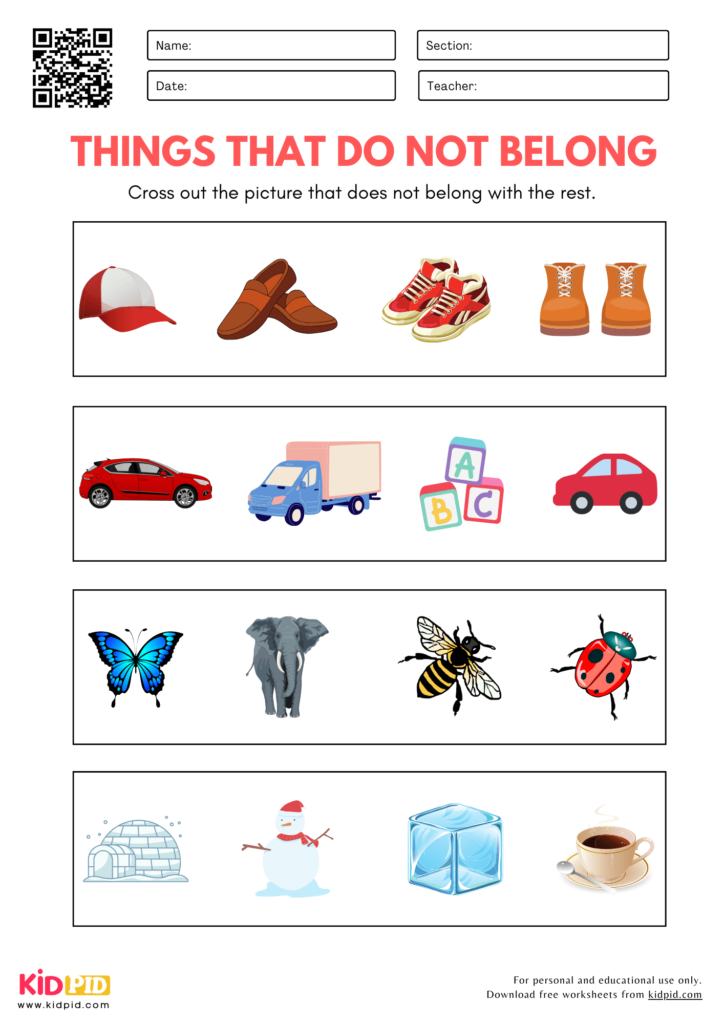
These worksheets, commonly known as “Odd One Out” exercises, are fundamental tools for early childhood development. Designed specifically for kindergarteners, they focus on:
- Cognitive Foundation: They serve as an entry point into deductive reasoning.
- Visual Literacy: Children must observe, analyze, and compare images to identify discrepancies.
- Educational Purpose: They are not just games; they are structured exercises designed to enhance categorization skills, which are essential for future scientific and mathematical thinking.
Parts/Types/Examples of “Things That Do Not Belong” Worksheets
These activities vary in complexity to grow with the child:
- Categorical Odd One Out: A group of three fruits and one vehicle (e.g., Apple, Banana, Pear, Car).
- Attribute-Based Exercises: A group of four objects where three share a color or shape, and one does not.
- Functional Odd One Out: Identifying items that do not belong in a specific setting (e.g., a toaster found in a bathroom scene).
- Progressive Difficulty: Moving from simple, high-contrast images to more complex scenes requiring deeper contextual understanding.
How Does This Worksheet Work?
The mechanism is simple yet effective:
- Observation: The child examines a set of four or more images.
- Comparison: The child mentally groups the items that share a common trait (e.g., “These are all animals”).
- Identification: The child spots the item that lacks this shared trait (the “intruder”).
- Action: The child physically crosses out the item, reinforcing the cognitive decision with a motor skill action. This process encourages repetition, which is vital for cementing new neural pathways.
Benefits of Learning About “Things That Do Not Belong”
- Enhanced Critical Thinking: Promotes the ability to analyze and categorize information.
- Language Development: Encourages children to articulate why an item does not belong, building vocabulary related to categories.
- Improved Concentration: Requires focused attention on visual details.
- Problem Solving: Builds the confidence to approach a problem, evaluate the evidence, and come to a logical conclusion.
Learning Objectives
By completing these worksheets, students will:
- Identify relationships between common objects.
- Develop the ability to classify objects based on specific attributes (size, shape, color, function).
- Demonstrate increased visual discrimination skills.
- Practice independent decision-making and logical justification.
Worksheet Instructions
- Review the Group: Ask the child to name each picture to ensure they recognize the objects.
- Identify the Category: Ask, “What do these pictures have in common?”
- Spot the Odd One: Ask, “Which one doesn’t fit with the others?”
- Cross It Out: Have the child use a pencil or crayon to clearly cross out the item that does not belong.
- Explain: Ask the child to explain their reasoning (e.g., “The cat doesn’t belong because it’s an animal, but the others are all food.”).
Interesting Facts About Vocabulary Words
- Categorization: The process of putting things into groups.
- Attribute: A quality or feature regarded as a characteristic or inherent part of someone or something.
- Odd One Out: A popular logic puzzle where one member of a set is different from the others.
- Visual Discrimination: The ability to see differences and similarities between objects or pictures.
Real-Life Applications
The skills learned here extend far beyond the classroom:
- Sorting Tasks: Organizing toys, cleaning up, or helping with laundry.
- Daily Safety: Recognizing that certain items (like cleaning supplies or tools) do not belong in a “play” area.
- Scientific Thinking: Helping children understand how scientists group animals, plants, and materials.
FAQs
Q1. At what age should a child start these worksheets?
Answer: Typically, these are perfect for kindergarteners (ages 4-6), but they can be introduced earlier if a child shows readiness for classification tasks.
Q2. Why is crossing out the picture important?
Answer: It provides a tactile connection to the cognitive process. It is a physical “finalization” of their logical decision.
Q3. Can these worksheets help with reading?
Answer: Yes. Visual discrimination is a precursor to reading; just as children must distinguish between subtle differences in shapes to categorize items, they must distinguish between subtle differences in letter forms (e.g., ‘b’ vs ‘d’) to read effectively.
Finding the item that does not belong encourages kindergarten children to think critically, recognize patterns, improve classification skills, and strengthen logical reasoning through enjoyable activities that make learning both fun and meaningful. Visit our website to enjoy printable quizzes, worksheets, essays, flashcards, paragraphs, and interactive resources for children. Follow us on YouTube & Facebook.
The Content Team thoughtfully designs the worksheet to enhance learning through repetition.
Reviewed By Sanjana
Read More: