
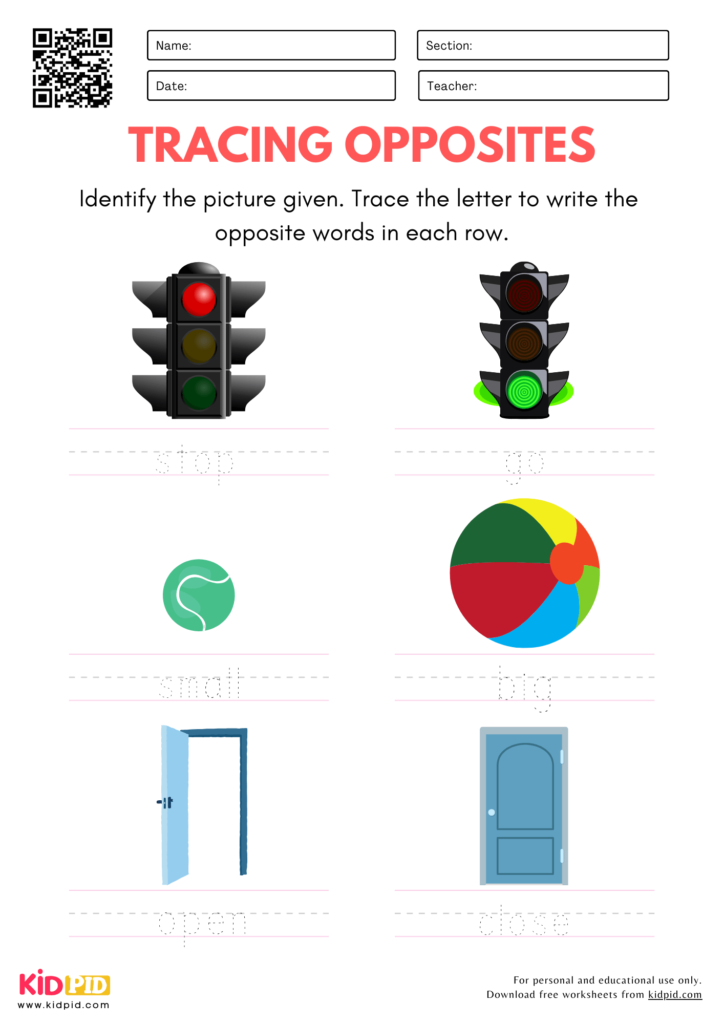
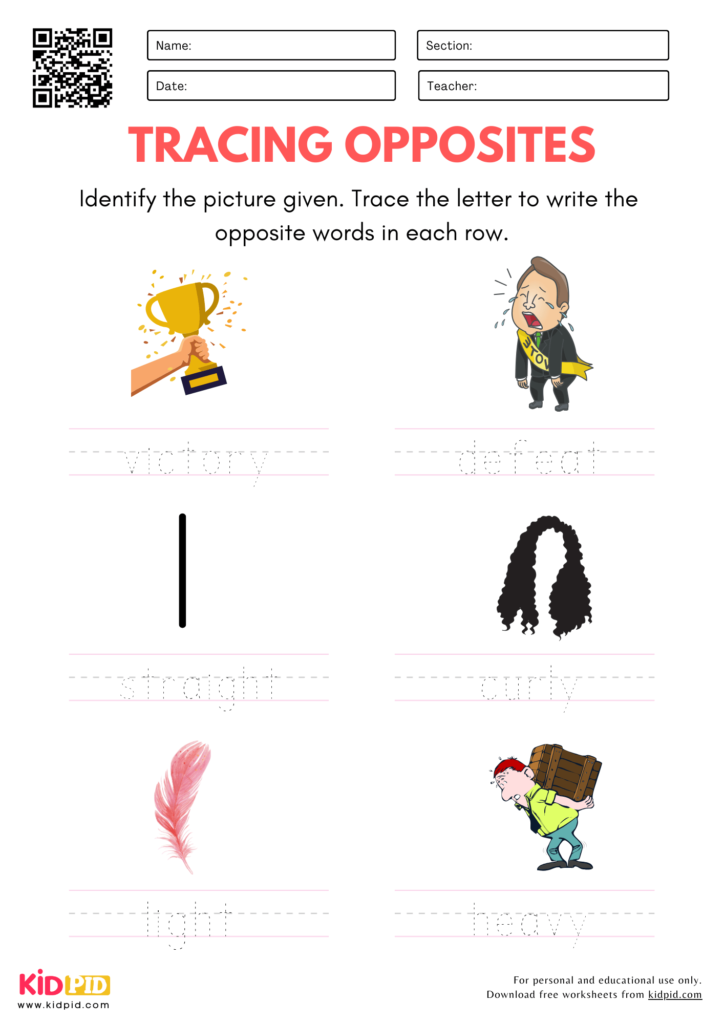
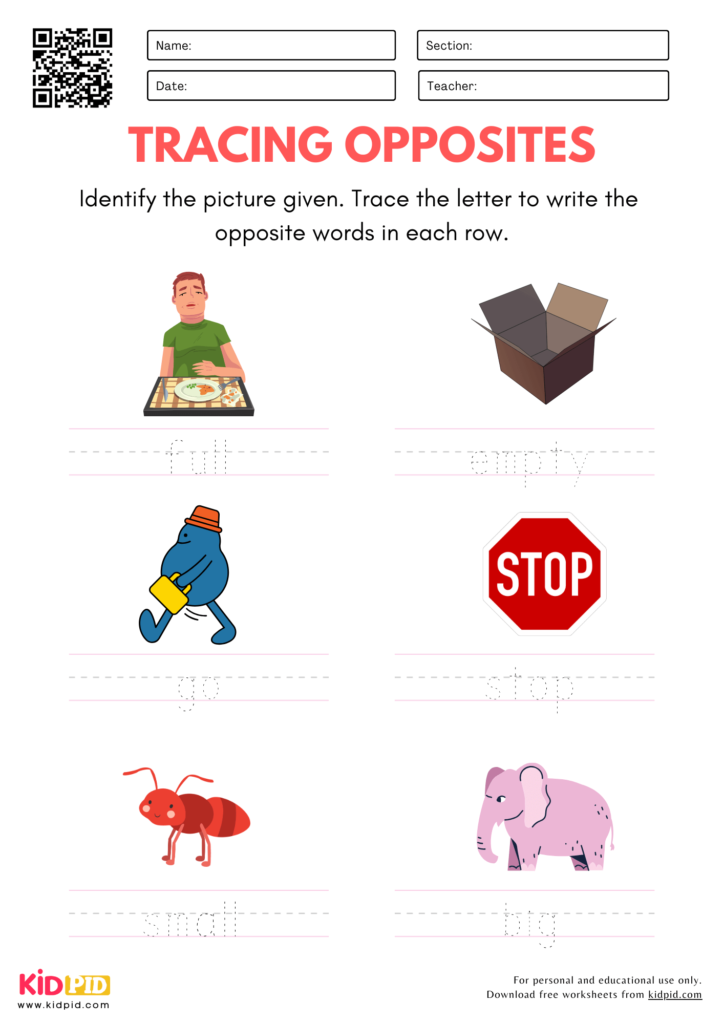
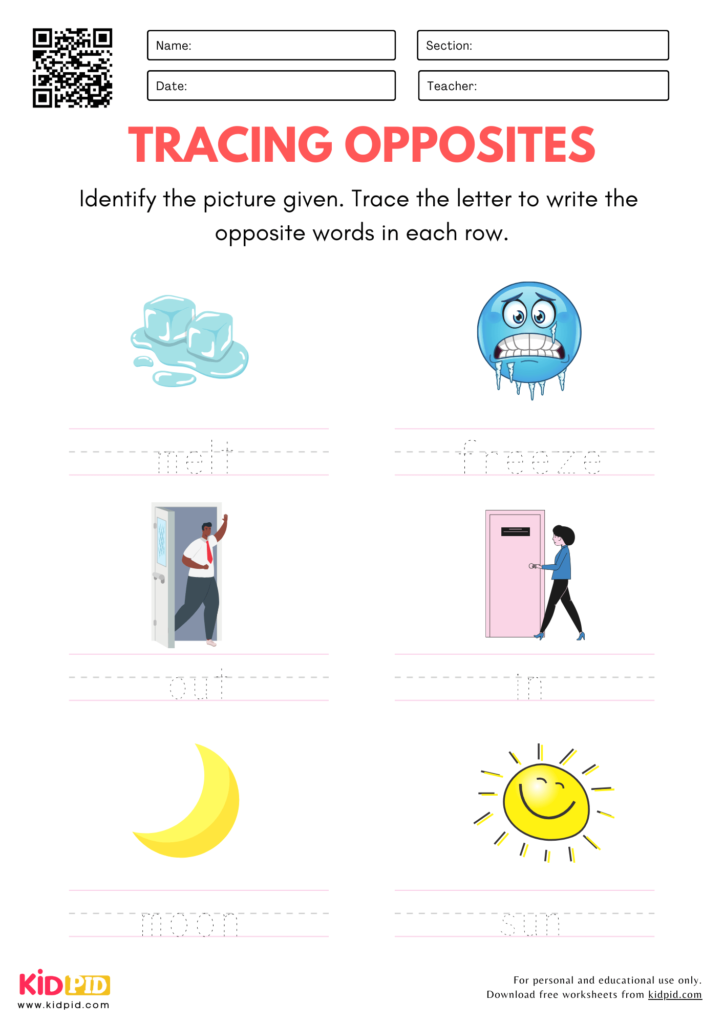
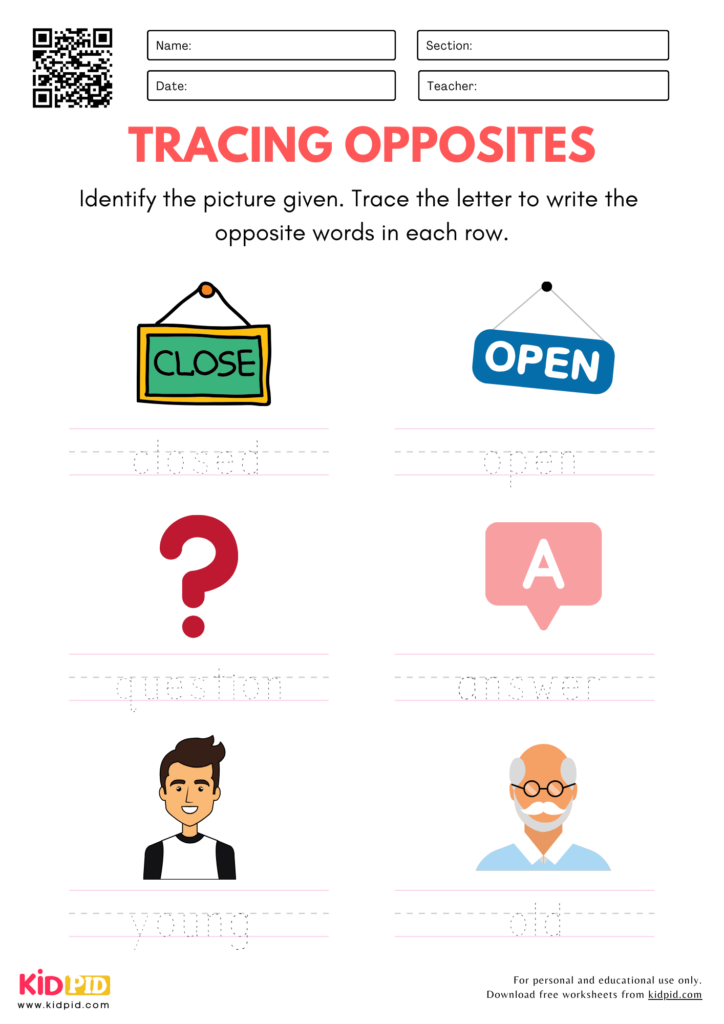
Here are some amazing worksheets that will enhance your vocabulary. They are designed for kindergarten kids to improve their knowledge of new words and their opposites, as it will be helpful for them in the future. So kids have to identify the picture given in the worksheet and trace the letter to write the opposite words in each row.
Contents
- Identify, Trace & Write The Opposite Word Worksheets For Kindergarten
- Key Facts About Tracing Opposite Words Worksheets
- Parts/Types/Examples of Tracing Opposite Words Worksheets
- How Does Tracing Opposite Words Work?
- Benefits of Learning About Opposite Words Worksheets
- Learning Objectives
- Worksheet Instructions
- Interesting Facts About Opposite Word Vocabulary
- Real-Life Applications
- FAQs
Identify, Trace & Write The Opposite Word Worksheets For Kindergarten
[Scroll Down for Download Link]
Read More: Opposite Words Book For Kids





Key Facts About Tracing Opposite Words Worksheets
- Target Audience: Specifically tailored for kindergarteners (ages 4–6) developing early literacy skills.
- Educational Purpose: Combines fine motor skill development (tracing) with cognitive linguistic growth (understanding antonyms).
- Skill Integration: These worksheets bridge the gap between visual recognition (identifying pictures) and written expression (tracing words).
- Expert Design: Developed by the Kidpid Content Team, ensuring the curriculum is age-appropriate and research-backed.
- Accessibility: Designed as free, printable resources for teachers and parents to use in classroom settings or at home.
Parts/Types/Examples of Tracing Opposite Words Worksheets
These worksheets generally feature a three-step design approach:
- Visual Prompts: Illustrations representing a concept (e.g., a “Big” elephant vs. a “Small” mouse).
- Tracing Guides: Dotted-line text that allows children to practice letter formation while learning the vocabulary.
- Common Antonym Pairs Included:
- Size: Big/Small, Tall/Short
- Temperature: Hot/Cold
- State: Happy/Sad, Open/Closed
- Direction: Up/Down, In/Out
How Does Tracing Opposite Words Work?
These worksheets operate on a multi-sensory learning model:
- Identification: The child identifies the illustration, which activates prior knowledge about the object.
- Cognitive Association: The child learns the relationship between two contrasting concepts (e.g., that “up” is the opposite of “down”).
- Kinesthetic Reinforcement: By tracing the letters, the child reinforces orthographic patterns (spelling) and improves pencil control, which is crucial for early writing development.
Benefits of Learning About Opposite Words Worksheets
- Enhanced Vocabulary: Teaches children how to describe their world more precisely.
- Improved Writing Readiness: Regular tracing strengthens hand muscles and enhances spatial awareness on the page.
- Logical Reasoning: Understanding opposites is a foundational skill for early logic, classification, and critical thinking.
- Fluency: Using antonyms prepares children for more complex sentence structures as they progress into Grade 1 and beyond.
Learning Objectives
By completing these worksheets, students will be able to:
- Recognize and name common antonym pairs.
- Demonstrate proper pencil grip and control through tracing.
- Associate words with their corresponding visual representations.
- Increase confidence in early reading and writing tasks.
Worksheet Instructions
- Print: Download the high-quality PDF provided on the Kidpid page.
- Observe: Ask the child to describe the pictures on the left and the right.
- Trace: Guide the child to trace the letters carefully, following the dotted lines from left to right.
- Practice: Encourage the child to say the words aloud as they finish tracing to link visual, auditory, and kinesthetic pathways.
Interesting Facts About Opposite Word Vocabulary
- Linguistic Foundation: Opposite words (antonyms) are among the first complex linguistic concepts children master after learning nouns.
- Contextual Learning: Children learn antonyms fastest when they are paired with familiar objects rather than abstract lists.
- Brain Development: Teaching opposites helps the brain categorize information, which is a precursor to later mathematical and scientific classification skills.
Real-Life Applications
- Descriptive Speech: Helps children explain their feelings (e.g., “I am not sad, I am happy”).
- Following Directions: Understanding commands like “Open the box” vs. “Close the box” or “Put it in” vs. “Take it out.”
- Early Reading: Familiarity with these basic words increases reading speed and comprehension in early reader books.
FAQs
Q1. At what age should a child start using these worksheets?
Answer: These are ideal for children aged 4–6, typically in Pre-K or Kindergarten, who are beginning to show an interest in writing.
Q2. Are these worksheets suitable for non-native English speakers?
Answer: Yes. Because they use visual aids (pictures), they are an excellent tool for ESL/ELL students to build basic English vocabulary.
Q3. Can these be used for homeschooling?
Answer: Absolutely. They are designed to be intuitive, allowing parents to guide their children through the activities without needing professional teaching experience.
Introduce opposite words through fun tracing activities in this Kindergarten worksheet. Children improve handwriting, vocabulary, letter formation, and word recognition while building early language skills with engaging and enjoyable practice. Build knowledge through quizzes, worksheets, essays, flashcards, paragraphs, and interactive resources Available on our website. Follow us on YouTube & Facebook.
This educational worksheet is prepared by our Content Team to support student growth.
Reviewed By Komal Singh
Read More: