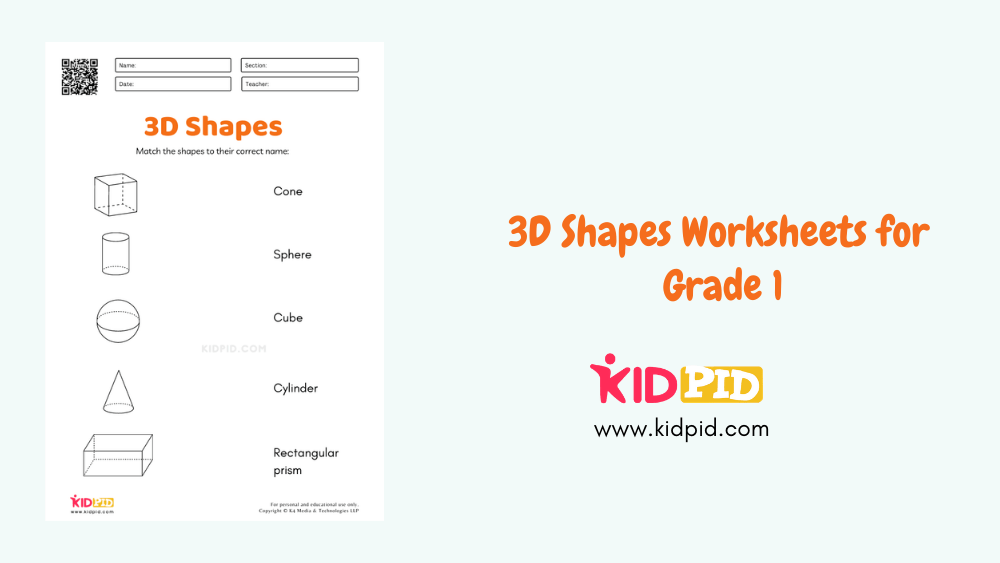
Here’s an edition where we are providing various kinds of worksheets to enrich your kids’ brains by boosting their learning and understanding skills. Nowadays, in the modern world, it is very important to help children while introducing the basic concepts of different shapes and sizes so that they can develop their intellectual abilities.
Contents
- 3D Shapes Worksheets for Grade 1
- Key Facts About 3D Shapes Worksheets for Grade 1
- Parts, Types, and Examples of 3D Shapes Worksheets for Grade 1
- How Does the 3D Shapes Worksheets for Grade 1 Work?
- Benefits of Learning About 3D Shapes Worksheets for Grade 1
- Learning Objectives
- Worksheet Instructions
- Interesting Facts About 3D Shapes
- Vocabulary Words
- Real-Life Applications
- FAQs
- Q1. What are 3D shapes?
- Q2. Which 3D shapes are taught in Grade 1?
- Q3. Why are 3D shape worksheets important?
- Q4. How can parents help children learn 3D shapes?
- Q5. What is the difference between 2D and 3D shapes?
- Q6. Are 3D shape worksheets suitable for beginners?
- Q7. What skills do children develop through 3D shape activities?
- Read More:
What are 3D Shapes?
3D shapes are nothing but solids that consist of 3 dimensions, namely, length, breadth, and height. The “D” in “3D shapes” stands for “Dimensional.”
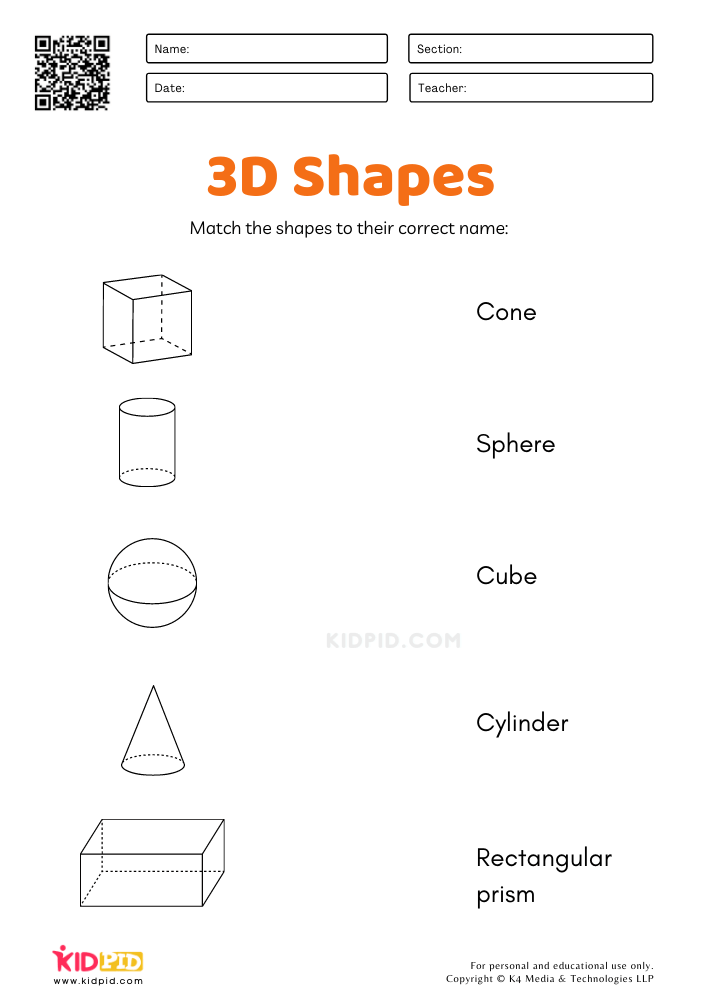
A kid needs to learn some more stuff, which is important as well. In this worksheet, we have brought some 3D shapes which have to be matched with their respective correct names.
3D Shapes Worksheets for Grade 1

WORKSHEET 1
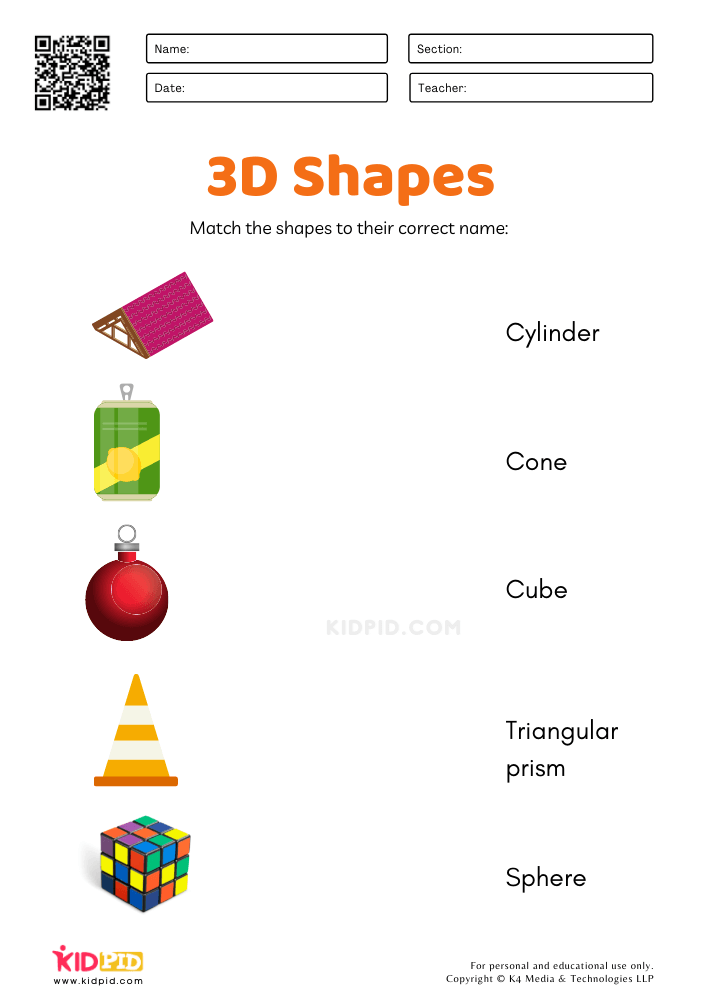
In this first worksheet, the kid has to match the 3D figure with its respective correct name. This worksheet can help children learn about different shapes, sizes, and the names of various geometrical shapes.
WORKSHEET 2
Just like the first worksheet, the kid will now have to match some more shapes with their names. Here, some new shapes are introduced, like Cone, Cube, Sphere, etc. These types of worksheets help kids identify and remember the names of different shapes. It is perfect for kids of such an age.
WORKSHEET 3
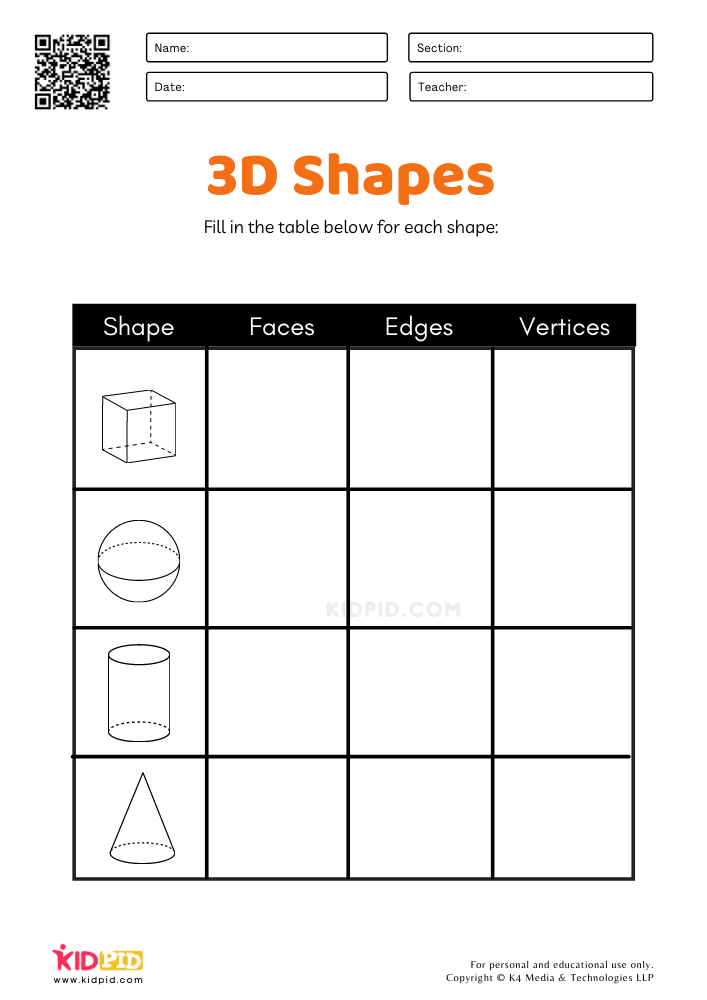
The third worksheet leads us to a new level and a series of questions. This certainly becomes interesting for the kid as they will learn new patterns and learn the ‘Edges’, ‘Vertices’ of the shape. This is where the kid might face some difficulties while solving, and the child’s queries need to be answered.
WORKSHEET 4
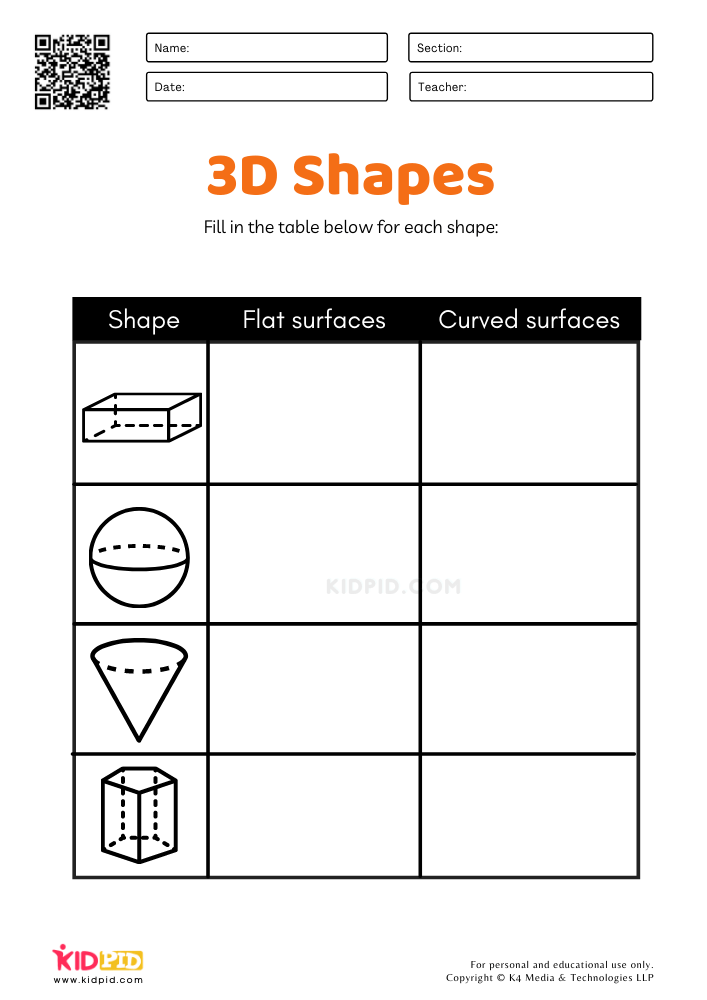
The level of the shapes just keeps getting bigger and more interesting. Once the child has understood the concept of 3D shapes and how they are made, they need to figure out what the shapes are made of. Are they made up of a Flat surface or do they have a Curved surface? To make things interesting, the 3D shapes have been traced in such a manner that the child will be able to understand the theory or the concept quickly without any additional trouble.
WORKSHEET 6
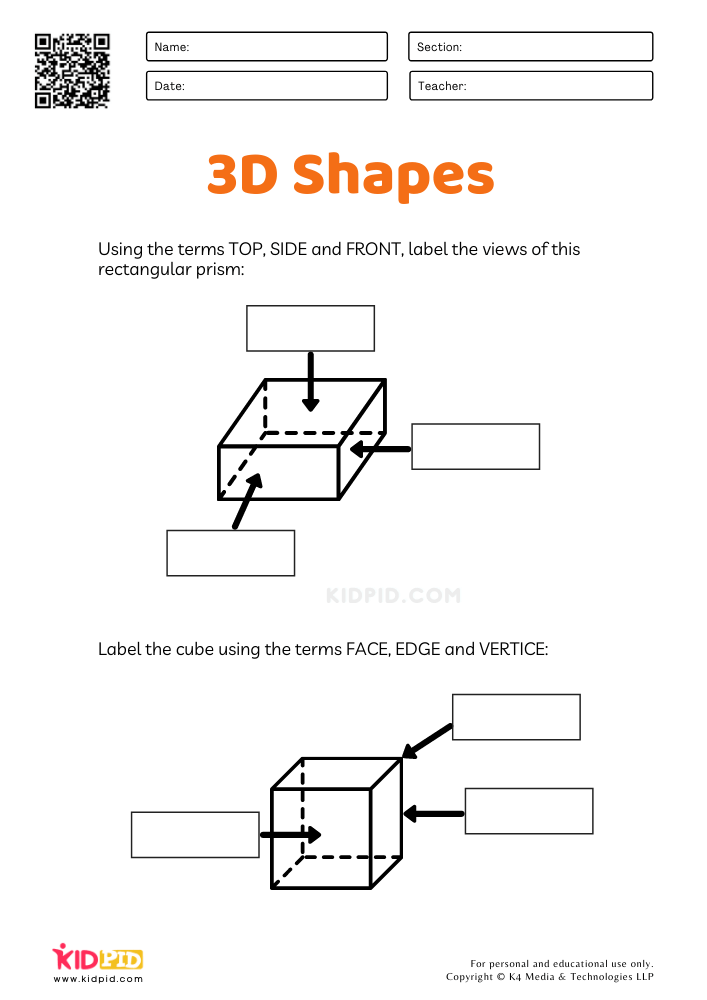
Worksheet 6 introduces children to new shapes like ‘Rectangular Prism’ and ‘Cube,’ where they need to label the sides of the given shape. In this worksheet, the child will learn new names, which is very beneficial to them. Along with understanding the names of shapes, the attention of the child is very important.
WORKSHEET 7
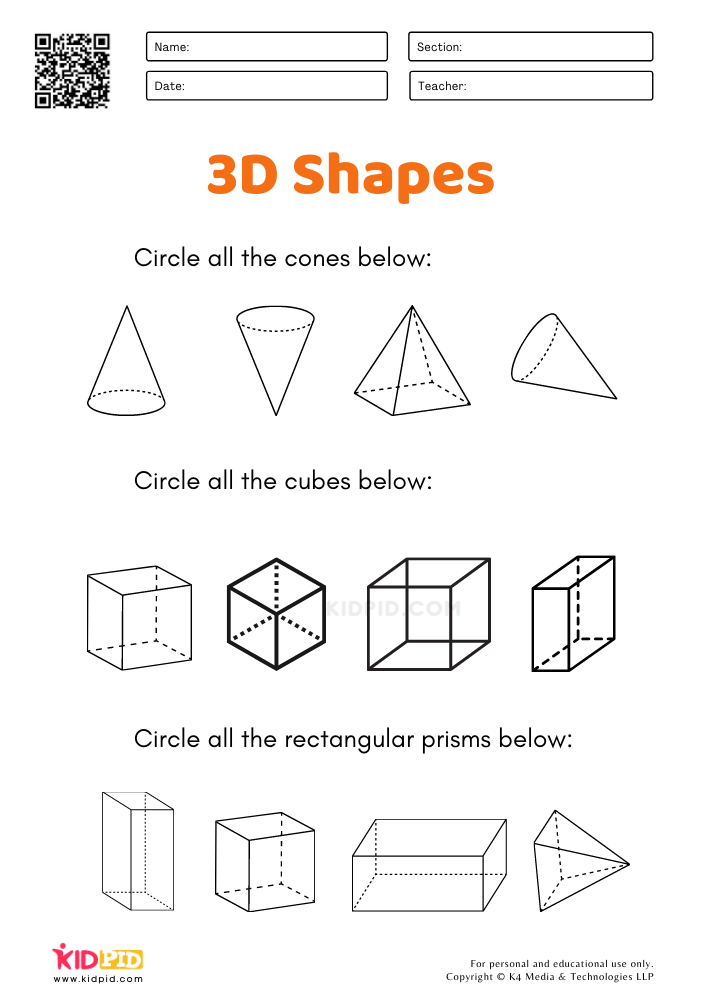
The seventh worksheet tests how much children have learned so far. The previous worksheets have helped the kid to understand the different types of shapes and their various aspects. Here, the kid will have to circle all the Cones and Cubes given in the worksheet.
WORKSHEET 8
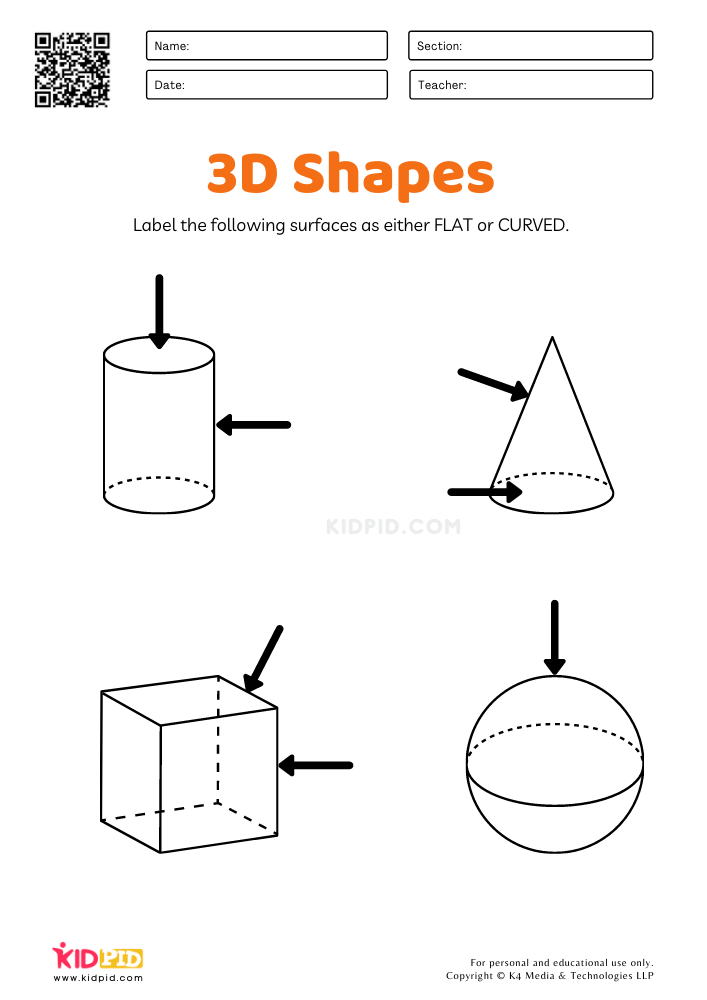
This worksheet will ask children to identify whether the given shape has a flat or a curved surface. The good thing about these worksheets is that the kids will not get bored at any stage. The child must know the importance of these worksheets and how this is going to help them develop their mental abilities. That is very essential.
WORKSHEET 9
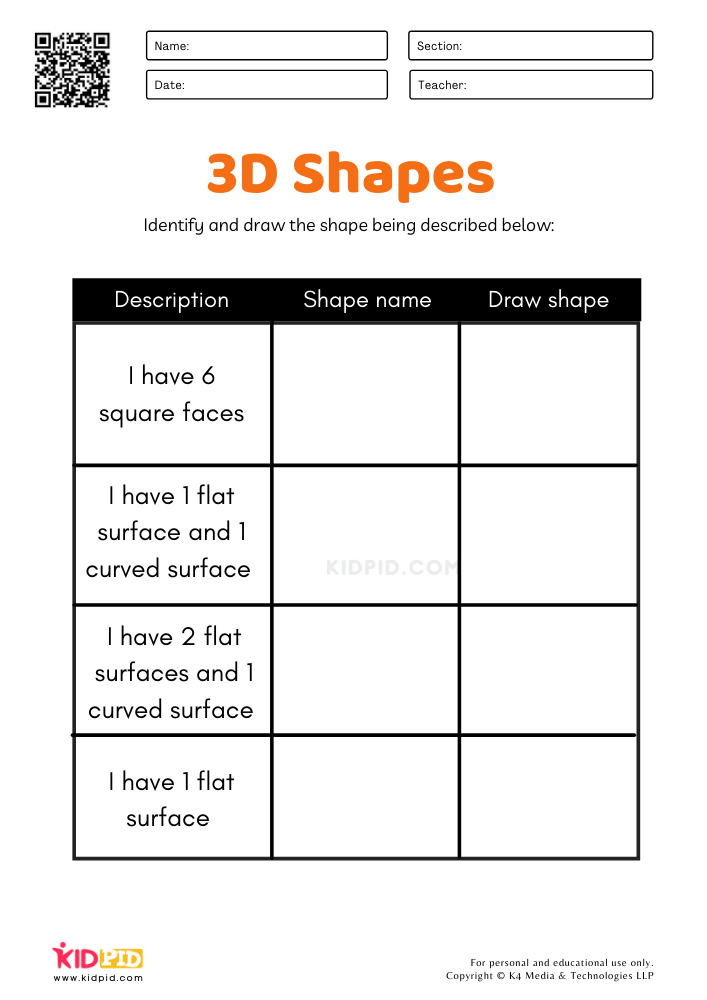
The final worksheet is the most important one because it’ll test the child’s learning and understanding skills. Here, the kid needs to tell the name of the shape and then draw it by reading the description. It has the same concept, but like every worksheet, the shapes are not presented here, which introduces another level of difficulty in the exercise.
After handing in the worksheet, the parents have to be responsible as well for being competent and supervising them if they make errors. This is all children need in their early days before going to school – regular practice. Worksheets are a fun and interesting way to approach topics that are not always fun.
Key Facts About 3D Shapes Worksheets for Grade 1
3D Shapes Worksheets for Grade 1 help young learners recognize, identify, and understand solid shapes found in everyday life. These worksheets introduce basic geometry concepts through engaging activities, visual exercises, matching tasks, and shape recognition challenges.
Key facts include:
- Designed specifically for first-grade students.
- Introduces common 3D shapes such as cubes, spheres, cones, cylinders, and rectangular prisms.
- Encourages hands-on and visual learning.
- Develops spatial awareness and observation skills.
- Helps students connect geometric concepts to real-world objects.
- Supports early math curriculum standards.
- Improves problem-solving and critical-thinking abilities.
Parts, Types, and Examples of 3D Shapes Worksheets for Grade 1
3D shape worksheets come in various formats to keep learning interactive and enjoyable.
Parts of a 3D Shape Worksheet
- Shape identification section
- Shape tracing activities
- Labeling exercises
- Matching shapes to objects
- Counting faces, edges, and vertices
- Coloring and sorting tasks
Types of Worksheets
- Shape recognition worksheets
- Match-the-shape activities
- Shape sorting worksheets
- Trace and draw 3D shapes
- Real-life object identification worksheets
- Cut-and-paste shape activities
Examples
- Match a cube with a dice.
- Identify a sphere from a basketball image.
- Color all cylinders in a worksheet.
- Count the faces of a cube.
- Sort objects into cone, cylinder, and sphere categories.
How Does the 3D Shapes Worksheets for Grade 1 Work?
These worksheets guide students through structured activities that gradually build understanding of three-dimensional figures.
The learning process typically includes:
- Recognizing different 3D shapes.
- Learning shape names and characteristics.
- Comparing shapes based on faces, edges, and vertices.
- Connecting shapes to real-world objects.
- Practicing through drawing, matching, and sorting activities.
- Reinforcing concepts through repeated exposure and review exercises.
Visual illustrations make it easier for children to understand the difference between flat (2D) and solid (3D) shapes.
Benefits of Learning About 3D Shapes Worksheets for Grade 1
Learning about 3D shapes provides a strong foundation for future geometry lessons.
Benefits include:
- Improves geometric understanding.
- Enhances visual-spatial reasoning.
- Strengthens observation and classification skills.
- Encourages logical thinking.
- Builds confidence in mathematics.
- Supports STEM learning readiness.
- Helps children identify shapes in everyday environments.
- Promotes hands-on and interactive learning experiences.
Learning Objectives
After completing these worksheets, students should be able to:
- Identify common 3D shapes.
- Name cubes, cones, cylinders, spheres, and rectangular prisms.
- Describe basic shape attributes.
- Differentiate between various solid figures.
- Match shapes with real-life objects.
- Count simple faces, edges, and vertices where appropriate.
- Develop spatial awareness and geometry vocabulary.
- Apply shape knowledge in everyday situations.
Worksheet Instructions
To get the most from these worksheets, students should:
- Read the directions carefully.
- Observe each shape closely.
- Match shapes with the correct names or objects.
- Color or trace shapes neatly when instructed.
- Count faces, edges, or corners if required.
- Complete all sorting and labeling activities.
- Review answers after finishing.
- Ask for help when encountering unfamiliar shapes.
Parents and teachers can encourage discussions about shapes seen at home, school, or outdoors.
Interesting Facts About 3D Shapes
- A sphere has no edges and no vertices.
- A cube has 6 equal square faces.
- Cones have one circular base and one vertex.
- Cylinders have two circular faces connected by a curved surface.
- Many everyday objects are examples of 3D shapes.
- Buildings, toys, and containers are often designed using geometric solids.
- Understanding 3D shapes helps children visualize objects from different angles.
- Engineers, architects, and designers use 3D geometry every day.
Vocabulary Words
Understanding these important terms helps children master geometry concepts.
| Word | Meaning |
|---|---|
| 3D Shape | A shape with length, width, and height |
| Cube | A solid shape with six equal square faces |
| Sphere | A perfectly round solid shape |
| Cone | A shape with a circular base and one pointed vertex |
| Cylinder | A solid with two circular faces and a curved surface |
| Rectangular Prism | A box-shaped solid with rectangular faces |
| Face | A flat surface on a solid shape |
| Edge | The line where two faces meet |
| Vertex | A corner where edges meet |
| Solid Figure | Another name for a 3D shape |
Real-Life Applications
3D shapes are everywhere in daily life and help children understand the world around them.
Examples include:
- Dice resemble cubes.
- Soccer balls resemble spheres.
- Ice cream cones resemble cones.
- Soda cans resemble cylinders.
- Shipping boxes resemble rectangular prisms.
- Buildings and furniture use combinations of 3D shapes.
- Packaging designers use solid shapes to create containers.
- Architects use geometric solids when designing structures.
Recognizing these shapes helps children connect classroom learning with real-world experiences.
FAQs
Q1. What are 3D shapes?
Answer: 3D shapes are solid figures that have length, width, and height. They occupy space and can be held or touched.
Q2. Which 3D shapes are taught in Grade 1?
Answer: Grade 1 students commonly learn about cubes, spheres, cones, cylinders, and rectangular prisms.
Q3. Why are 3D shape worksheets important?
Answer: They help children develop geometry skills, spatial awareness, and the ability to recognize shapes in everyday life.
Q4. How can parents help children learn 3D shapes?
Answer: Parents can point out shapes at home, use building blocks, and encourage children to identify objects based on their shapes.
Q5. What is the difference between 2D and 3D shapes?
Answer: 2D shapes are flat and have only length and width, while 3D shapes have length, width, and height.
Q6. Are 3D shape worksheets suitable for beginners?
Answer: Yes. Grade 1 worksheets are designed with simple activities, colorful illustrations, and age-appropriate exercises that make learning easy and engaging.
Q7. What skills do children develop through 3D shape activities?
Answer: Children improve geometry knowledge, observation skills, spatial reasoning, classification abilities, and mathematical confidence.
Exploring three-dimensional shapes helps children connect geometry with the world around them. These Grade 1 worksheets strengthen shape recognition, spatial awareness, and everyday mathematical observation through engaging activities. Unlock more learning opportunities with our collection of worksheets, essays, flashcards, paragraphs, quizzes, and interactive resources. Follow us on YouTube & Facebook for fresh content daily.
The Content Team crafted this worksheet to enhance learning progress.
Reviewed By Srijony Das
Read More: