
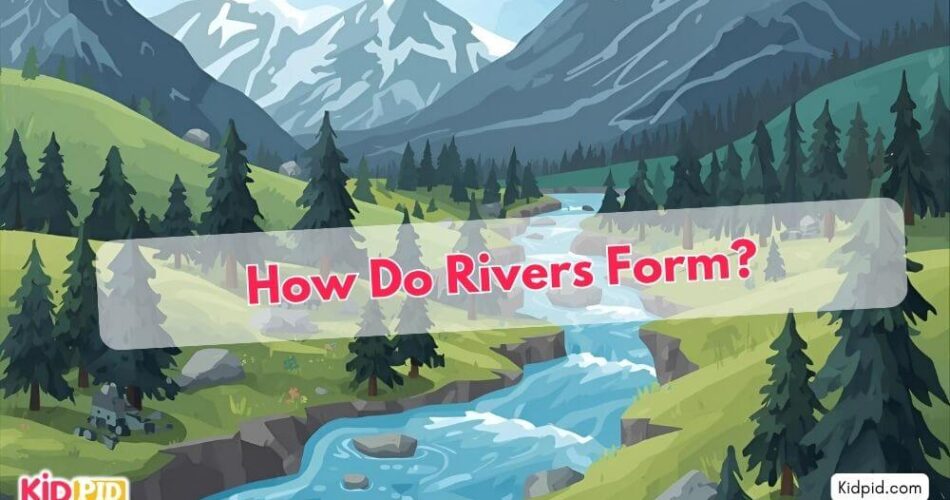
Rivers form from precipitation such as rain or snow that collects and flows downhill due to gravity, initially forming small streams. These streams merge with other streams, increasing in size, and eventually form a river as they continue to flow towards lower elevations, often emptying into a larger body of water like an ocean, sea, or lake.
MCQs
1. Which of the following is not a way rivers can form?
A) Melting snow from mountains
B) Rainfall collecting in streams
C) Lava flows creating channels
D) Trees gathering water in their roots
2. What process primarily contributes to the formation and shaping of river valleys?
A) Erosion
B) Photosynthesis
C) Condensation
D) Transpiration
3. What is a river’s mouth?
A) The deepest part of the river
B) The source of the river
C) Where the river flows into another body of water
D) A type of fish found in rivers
4. What feature is formed when a river deposits sediment at its mouth?
A) Canyon
B) Waterfall
C) Delta
D) Geyser
Fill in The Blanks
Choose from These Words: precipitation, watercourse, glaciers, water.
1. Rivers formed when water from _________ flows downhill due to gravity.
2. The path that water follows to form a river is called a __________.
3. Rivers can also be formed by melting ice from __________ or ice caps.
4. Rivers play an important role in the _________ cycle.
True / False
1. Rivers form through a process called erosion (True / False)
2. Rainfall plays a role in the formation of rivers (True / False)
3. Rivers are stationary bodies of water that never move (True / False)
4. Rivers are created instantly and do not take time to form (True / False)
Read More: