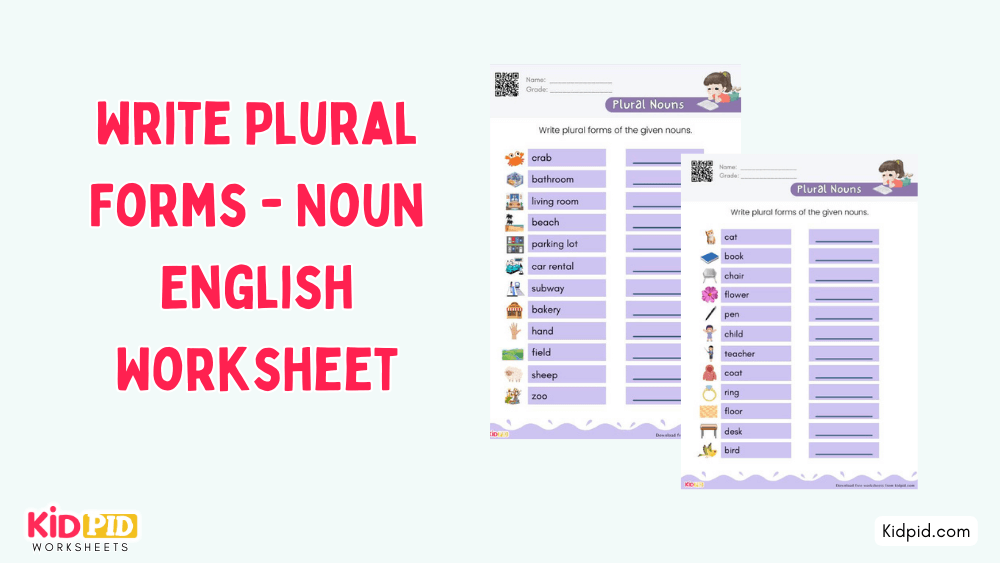
Strengthening your ability to form plural nouns is crucial for effective written and verbal communication. This worksheet challenges you to take singular noun forms and correctly transform them into their plural counterparts, reinforcing your understanding of this essential grammatical skill.
[Scroll Down for Download Link]
Contents
- Write Plural Forms Worksheets For Kids
- Key Facts About the Write Plural Forms Noun Worksheet
- Parts, Types, and Examples Found in the Worksheet
- How Does the Write Plural Forms Noun Worksheet Work?
- Benefits of Learning About Plural Nouns
- Learning Objectives
- Worksheet Instructions
- Interesting Facts About Plural Nouns
- Worksheet Vocabulary Words
- Real-Life Applications
- FAQs
- You may like these:
- Printable Worksheets on the Application of Collective Nouns for Grade 2
- Printable Worksheets for Matching Collective Nouns for Grade 2
- Printable Worksheets on Proper and Common Nouns for Grade 1
- Printable Worksheets on Possessive Nouns for Grade 1
- Printable Worksheets on Common and Proper Nouns for Grade 2
Write Plural Forms Worksheets For Kids
Read More: Nouns Matching Flashcards

- Car -> Cars
- Sun -> Suns
- Table -> Tables
- Tree -> Trees
- Shoe -> Shoes
- Elephant -> Elephants
- Tooth -> Teeth
- Computer -> Computers
- Baby -> Babies
- Knife -> Knives
- Actor -> Actors
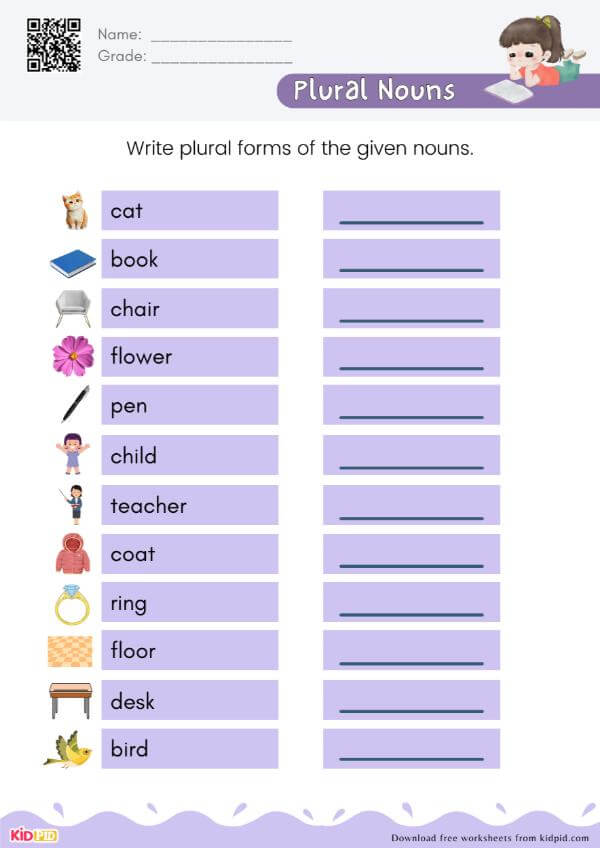
- Cat -> Cats
- Book -> Books
- Chair -> Chairs
- Flower -> Flowers
- Pen -> Pens
- Children -> Children
- Teacher -> Teachers
- Coat -> Coats
- Rings -> Rings
- Floor -> Floors
- Desk -> Desks
- Bird -> Birds
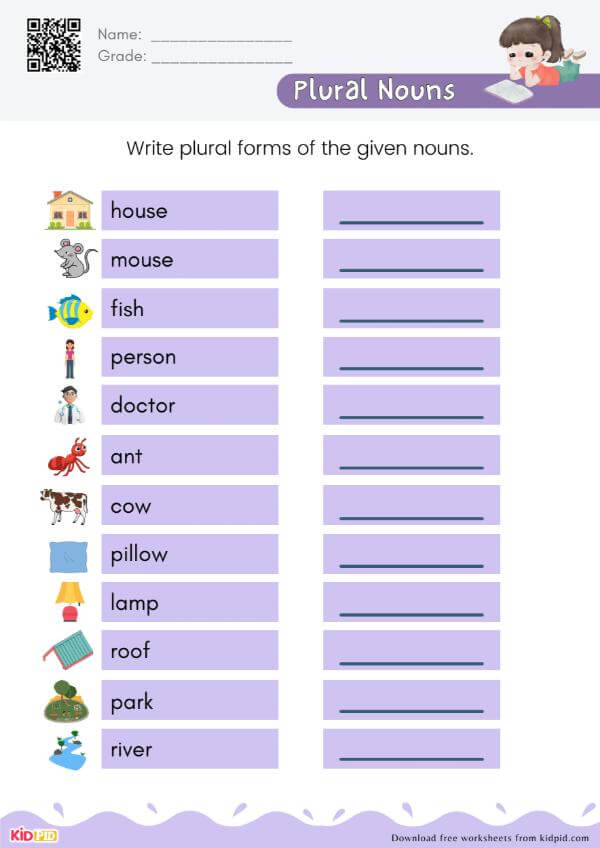
- House -> Houses
- Mouse -> Mice
- Fish -> Fishes
- Person -> Persons
- Doctor -> Doctors
- Ant -> Ants
- Cow -> Cows
- Pillow -> Pillows
- Lamp -> Lamps
- Roof -> Roofs
- Park -> Parks
- River -> Rivers
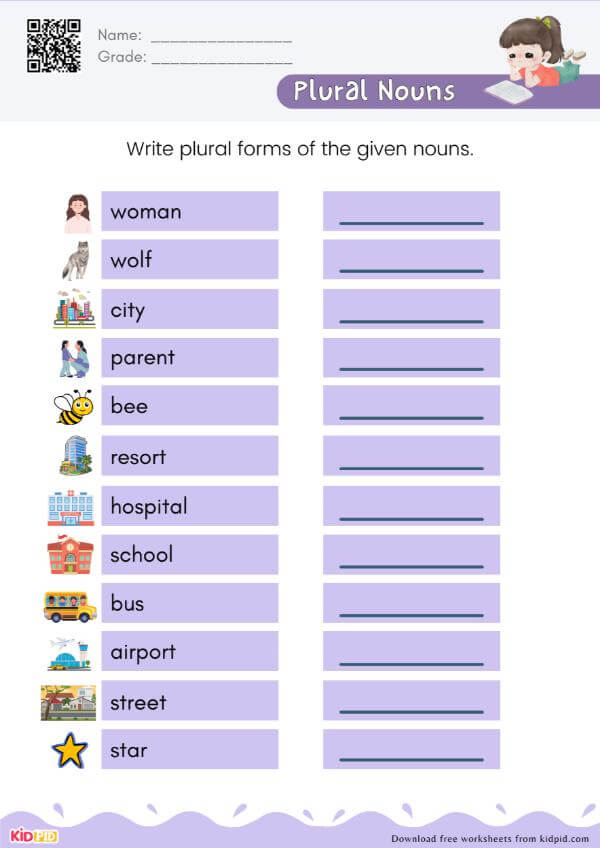
- Woman ->Women
- Wolf -> Wolves
- City -> Cities
- Parent -> Parents
- Bees -> Bees
- Resort -> Resorts
- Hospital -> Hospitals
- School -> Schools
- Bus -> Buses
- Airport -> Airports
- Street -> Streets
- Star -> Stars
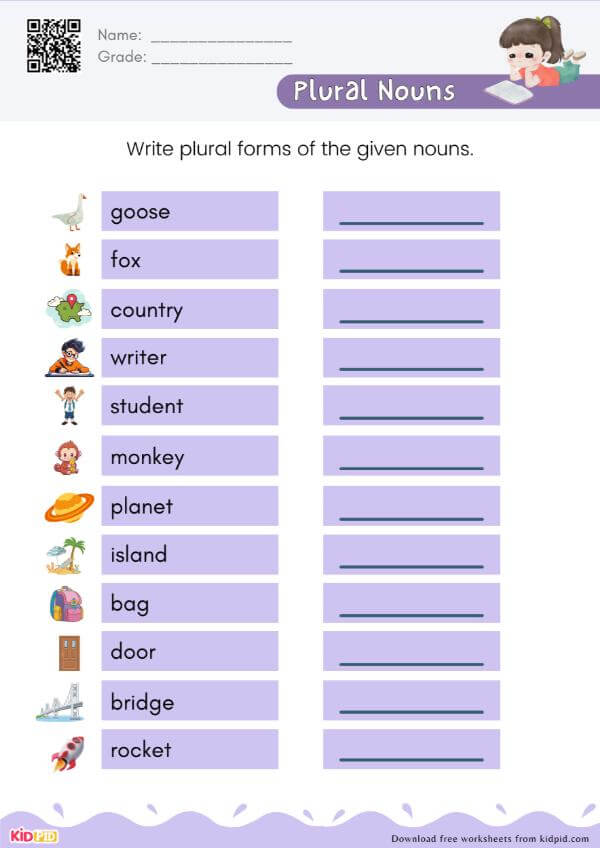
- Goose -> Geese
- Fox -> Foxes
- Country -> Countries
- Writer -> Writers
- Student -> Students
- Monkey -> Monkeys
- Planet -> Planets
- Island -> Islands
- Bag -> Bags
- Door -> Doors
- Bridge -> Bridges
- Rocket -> Rockets
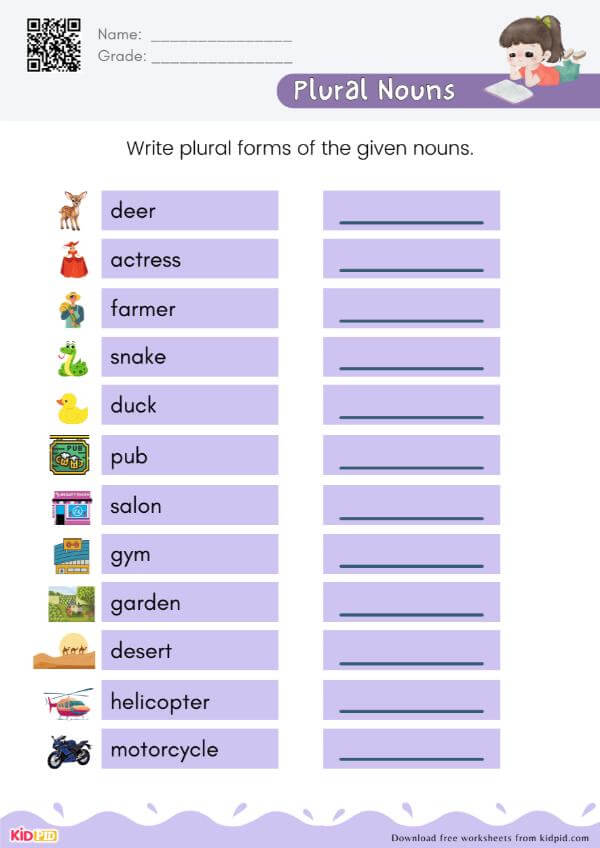
- Deer -> Deer
- Actress -> Actresses
- Farmer -> Farmers
- Snake -> Snakes
- Duck -> Ducks
- Pub -> Pubs
- Saloon -> Saloons
- Gym -> Gyms
- Garden -> Gardens
- Desert -> Deserts
- Helicopter -> Helicopters
- Motorcycle -> Motorcycles
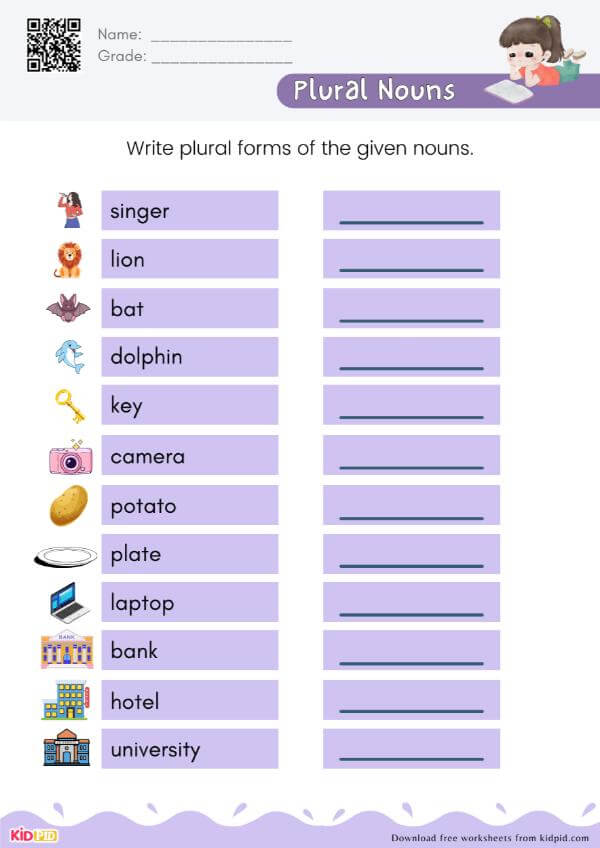
 Singer -> Singers
- Lion -> Lions
- Bat -> Bats
- Dolphin -> Dolphins
- Key -> Keys
- Camera -> Cameras
- Potato -> Potatoes
- Plate -> Plates
- Laptop -> Laptops
- Bank -> Banks
- Hotel -> Hotels
- University -> Universities
 Singer -> Singers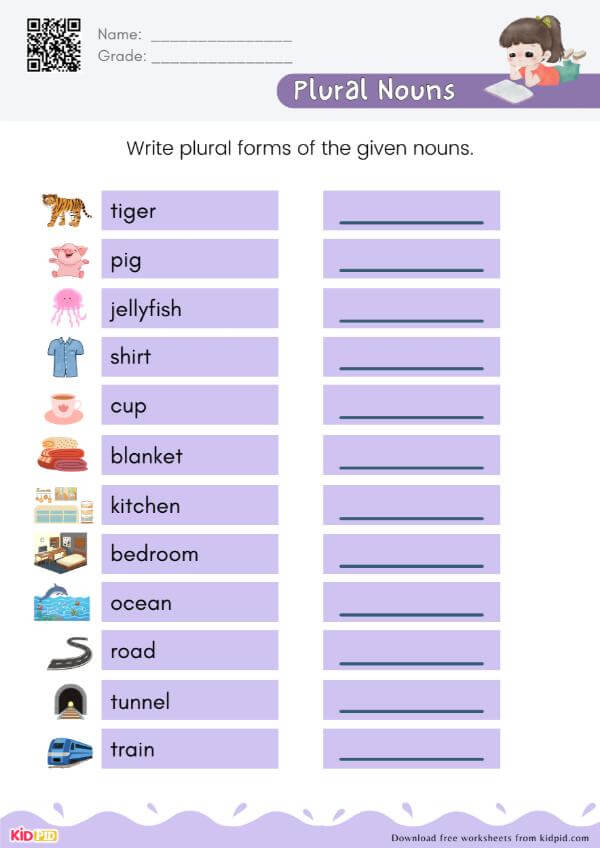
- Tiger -> Tigers
- Pig -> Pigs
- Jellyfish -> Jellyfishes
- Shirt -> Shirts
- Cup -> Cups
- Blanket -> Blankets
- Kitchen -> Kitchens
- Bedroom -> Bedrooms
- Ocean -> Oceans
- Road -> Roads
- Tunnel -> Tunnels
- Train -> Trains
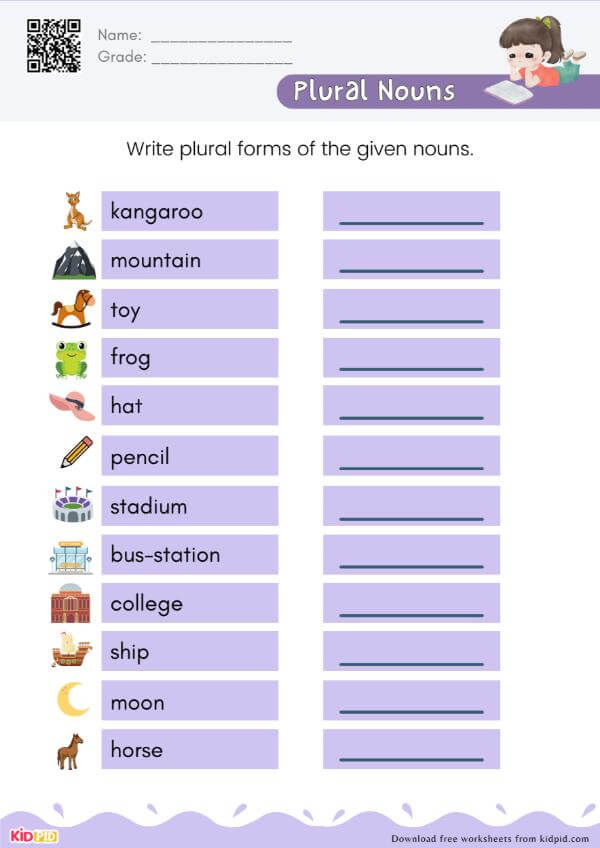
- Kangaroo -> Kangaroos
- Mountain -> Mountains
- Toy -> Toys
- Frog -> Frogs
- Hat -> Hats
- Pencil -> Pencils
- Stadium -> Stadiums
- Bus Station -> Bus Stations
- College -> Colleges
- Ship -> Ships
- Moon -> Moons
- Horse -> Horses
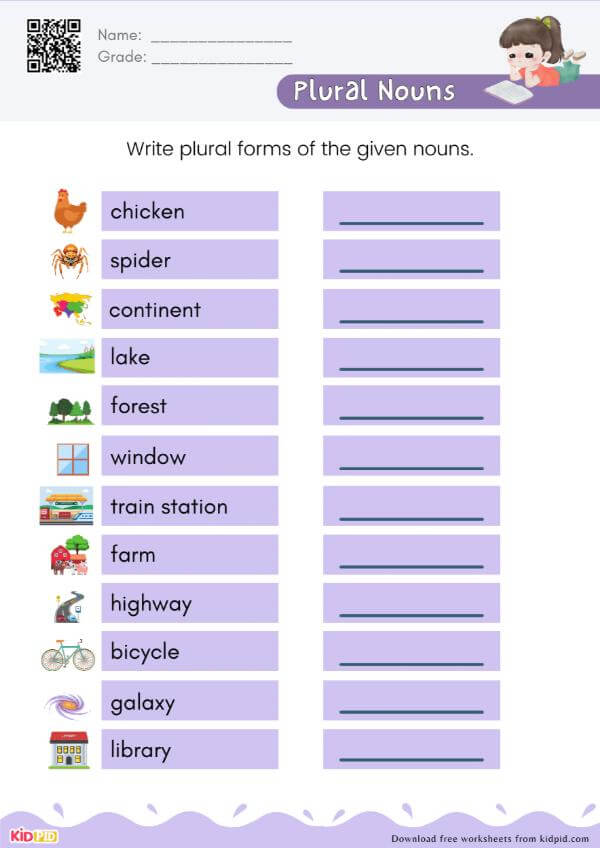
- Chicken -> Chickens
- Spider -> Spiders
- Lake -> Lakes
- Forest -> Forests
- Window ->Windows
- Train Station ->Train Stations
- Farm -> Farms
- Highway -> Highways
- Bicycle -> Bicycles
- Galaxy -> Galaxies
- Library -> Libraries
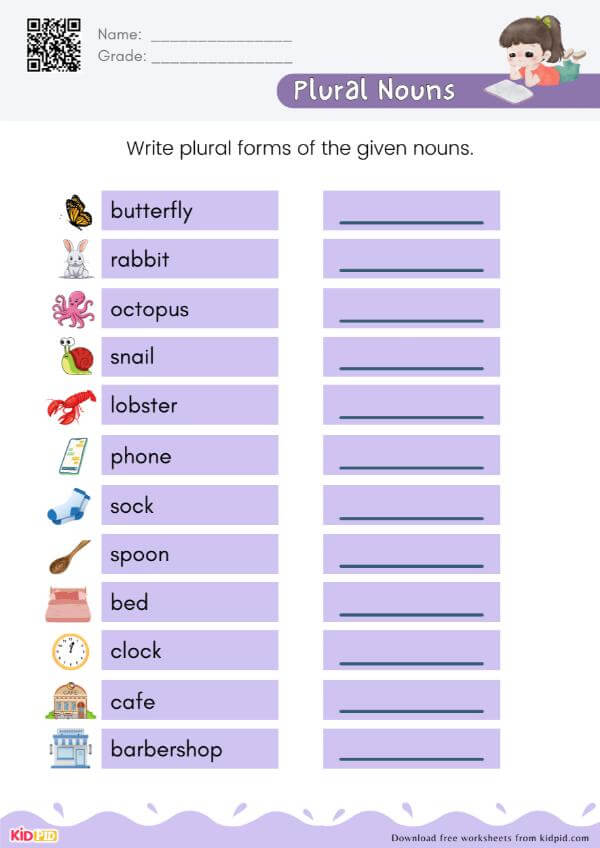
- Butterfly -> Butterflies
- Rabbit -> Rabbits
- Octopus -> Octopuses
- Lobster -> Lobsters
- Phone -> Phones
- Sock -> Socks
- Spoon -> Spoons
- Bed -> Beds
- Clock -> Clocks
- Cafe -> Cafes
- Barbershop -> Barbershops
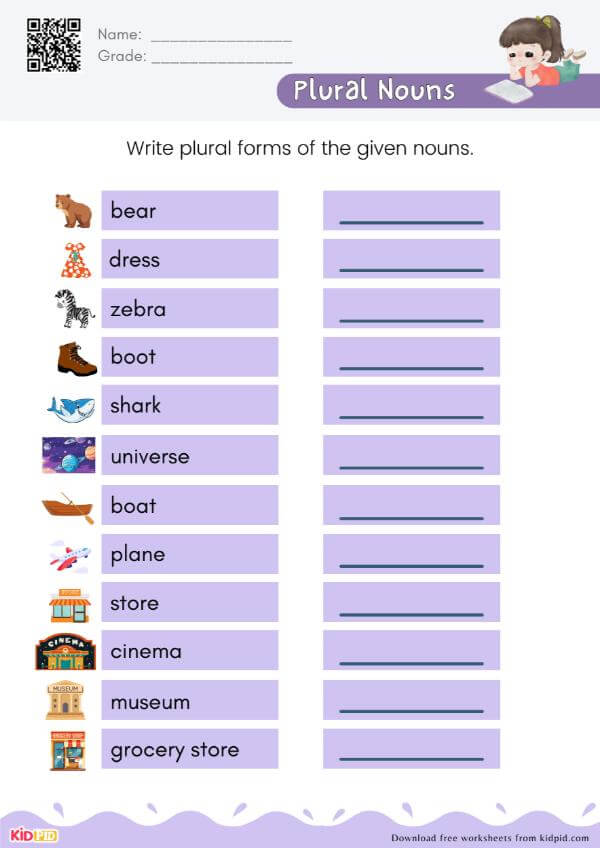
- Bear -> Bears
- Dress -> Dresses
- Zebra -> Zebras
- Boot -> Boots
- Shark -> Sharks
- Universe -> Universes
- Boat -> Boats
- Plane -> Planes
- Store -> Stores
- Cinema -> Cinemas
- Museum -> Museums
- Grocery Store -> Grocery Stores
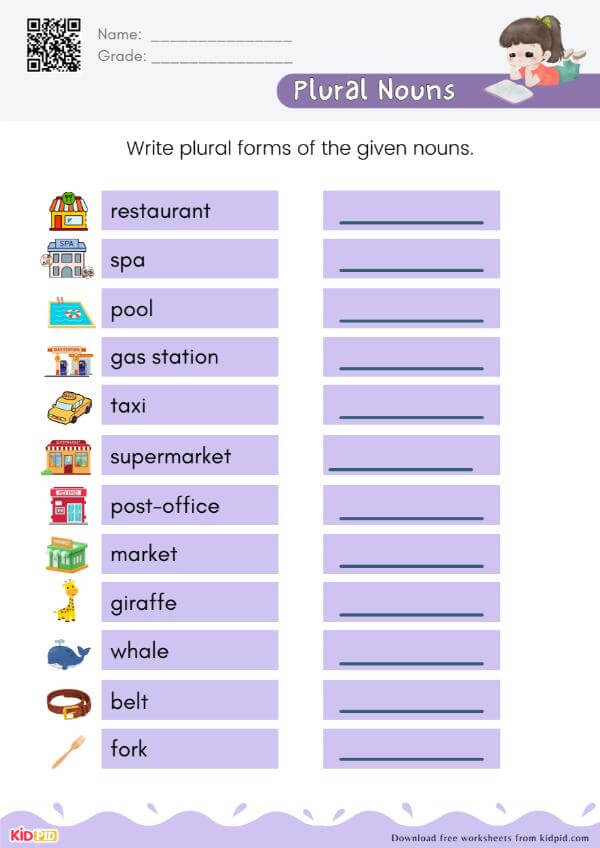
- Restaurant -> Restaurants
- Spa -> Spas
- Pool -> Pools
- Gas Station -> Gas Stations
- Taxi -> Taxies
- Supermarket -> Supermarkets
- Post Office -> Post Offices
- Market -> Markets
- Giraffe -> Giraffes
- Whale -> Whales
- Belt -> Belts
- Fork -> Forks
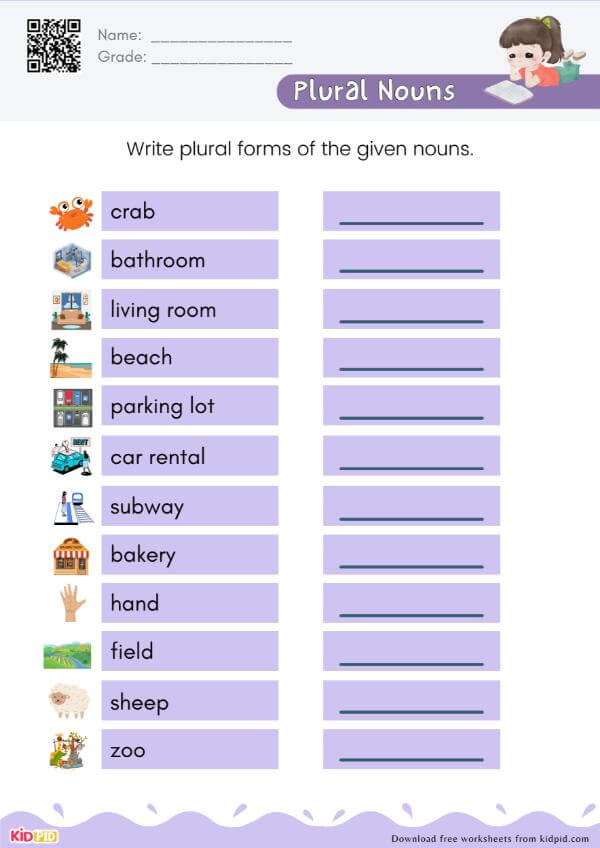
- Crab -> Crabs
- Bathroom -> Bathrooms
- Living Room -> Living Rooms
- Beach -> Beaches
- Parking Lot -> Parking Lots
- Car Rental -> Car Rentals
- Subway -> Subways
- Bakery -> Bakeries
- Hand -> Hands
- Field -> Fields
- Sheep -> Sheep
- Zoo -> Zoos
Key Facts About the Write Plural Forms Noun Worksheet
- Target Audience: Primarily designed for early elementary students (Grade 1 and Grade 2), English Language Learners (ELL), and young children building foundational literacy skills.
- Focus Area: Morphological awareness—the cognitive ability to recognize and manipulate the building blocks of words (like adding -s, -es, or changing internal vowels).
- Format: A highly structured, printable drill-and-practice layout that pairs common singular nouns alongside empty fields to encourage written retrieval.
- Skill Level: Accommodates a scaffolded learning curve, transitioning from simple regular plurals to challenging irregular nouns.
Parts, Types, and Examples Found in the Worksheet
The Kidpid “Write Plural Forms” worksheet systematically introduces children to different linguistic rules of the English language. Rather than presenting nouns randomly, the material covers distinct categories:
1. Regular Plurals (The “Add -s” Rule)
The vast majority of English nouns simply require an s at the end. This worksheet provides heavy reinforcement for this foundational rule using highly familiar everyday objects.
- Examples: Car → Cars, Table → Tables, Tree → Trees, Computer → Computers, Pen → Pens, Desk → Desks.
2. Sibilant Endings (The “Add -es” Rule)
When a singular noun ends in a sibilant sound—such as -sh, -ch, -x, or -ss—adding just an s would make it impossible to pronounce. Children learn to add -es to create an extra syllable.
- Examples: Fox → Foxes, Actress → Actresses, Dress → Dresses, Bus → Buses.
3. Mutating Vowels (Irregular Plurals)
Some of the oldest words in the English language do not follow modern spelling rules. Instead of adding a suffix, they undergo an internal vowel shift (known historically as an umlaut plural).
- Examples: Tooth → Teeth, Mouse → Mice, Woman → Women, Goose → Geese.
4. The “Y” to “Ies” Shift
When a noun ends in a consonant followed by a y, the y must transform into an i before adding– es.
- Examples: Baby → Babies, City → Cities, Country → Countries, University → Universities, Galaxy → Galaxies.
5. Base Plurals (Zero-Change Nouns)
Certain animal names remain completely identical whether you are talking about one or an entire herd. This teaches children that context clues in a sentence are sometimes the only way to identify pluralization.
- Examples: Deer → Deer, Sheep → Sheep.
How Does the Write Plural Forms Noun Worksheet Work?
This educational resource leverages a clear three-step cognitive cycle to help children internalize spelling mechanics:
1. Visual and Phonological Recognition (Step 1)
The student reads the singular noun aloud or silently (e.g., Baby). This activates their prior knowledge of the object and its spoken sound.
2. Rule Retrieval and Mapping (Step 2)
The brain identifies the word’s structural ending. The student recalls the corresponding grammatical rule (e.g., “Ends in a consonant plus Y, so drop the Y and add- ies”).
3. Graphomotor Execution (Step 3)
The child physically writes out the plural form (Babies) in the blank space. This tactile action builds muscle memory and locks in correct spelling patterns.
Benefits of Learning About Plural Nouns
Mastering the pluralization of nouns yields massive returns across a child’s entire academic journey.
- Prevents Subject-Verb Disagreement: A child cannot write a grammatically correct sentence if they do not know whether their subject is singular or plural. Knowing the difference ensures they use the correct verbs (e.g., “The baby sleeps” vs. “The babies sleep”).
- Accelerates Reading Fluency: When a child recognizes plural suffixes instantaneously, they stop stuttering over word endings and can focus on decoding the actual meaning of the text.
- Boosts Written Confidence: Eliminating spelling anxiety around common words frees up cognitive space, allowing young writers to focus on creativity, narrative flow, and complex ideas.
Learning Objectives
By completing these comprehensive grammar sheets, young learners will achieve the following standardized academic milestones:
- Identify the difference between a singular entity (one) and a plural entity (more than one).
- Apply standard spelling suffixes (-s, -es, -ies) accurately to a diverse list of common nouns.
- Memorize crucial irregular plural exceptions that do not follow traditional phonetic patterns.
- Demonstrate improved spelling precision and vocabulary breadth across academic and everyday terms.
Worksheet Instructions
To maximize the educational impact of this practice sheet, guide your students or children using these explicit directions:
Student Instructions:
- Carefully read the singular noun printed on the left side of the row.
- Think about how many there are if you have more than one. Say the plural word out loud.
- Write the correct spelling of the plural form in the empty blank provided on the right.
- Double-check your work! Look closely at tricky words that end in y, x, or have completely irregular changes.
Interesting Facts About Plural Nouns
Grammar is far from boring when you look at its historical roots. Share these fun facts with kids to spark curiosity:
- The “Zero Change” Mystery: Words like sheep and deer don’t change in the plural form because they come from Old English hunting traditions, where animals tracked in groups were often referred to collectively as a single mass noun.
- The Changing Octopus: While this worksheet highlights Octopuses as the correct standard plural, you will occasionally hear people say Octopi. However, because “octopus” is Greek (not Latin), octopuses is actually the most accurate linguistic form!
- The “V” Transformation: Words like ” knife” change to “knives” and “wolf” changes to “wolves” because centuries ago, it was physically easier for speakers to transition from a soft “f” sound to a hard “s” sound by vocalizing it into a “v”.
Worksheet Vocabulary Words
This worksheet is an excellent tool for expanding a child’s thematic vocabulary. The words included span multiple categories, allowing teachers to integrate them into wider spelling and science lessons:
- Animals & Nature: Elephant, Cat, Bird, Ant, Cow, Bee, Wolf, Goose, Fox, Star, Planet, Island, Rocket, Deer, Snake, Duck, Lion, Bat, Dolphin, Tiger, Pig, Jellyfish, Kangaroo, Mountain, Frog, Moon, Horse, Chicken, Spider, Lake, Forest, Butterfly, Rabbit, Octopus, Lobster, Bear, Zebra, Shark, Giraffe, Whale, Crab, Sheep, Zoo.
- Household Objects & Tech: Table, Tree, Shoe, Computer, Chair, Flower, Pen, Coat, Ring, Floor, Desk, House, Pillow, Lamp, Roof, Bag, Door, Key, Camera, Plate, Laptop, Shirt, Cup, Blanket, Pencil, Phone, Sock, Spoon, Bed, Clock, Boot, Boat, Plane, Belt, Fork.
- Community & Places: Park, River, Resort, Hospital, School, Airport, Street, Bridge, Pub, Saloon, Gym, Garden, Desert, Bank, Hotel, University, Kitchen, Bedroom, Ocean, Road, Tunnel, Train, Stadium, College, Library, Window, Farm, Highway, Bicycle, Galaxy, Cafe, Barbershop, Store, Cinema, Museum, Restaurant, Spa, Pool, Supermarket, Market, Bathroom, Living Room, Beach.
- People & Roles: Actor, Teacher, Children, Person, Doctor, Woman, Parent, Writer, Student, Actress, Farmer, Singer.
Real-Life Applications
Grammar sheets aren’t just for passing tests; they have direct, everyday utility in a child’s life:
- Following Instructions: Whether reading a recipe (“add 3 potatoes”) or assembly steps (“connect two wheels”), understanding plurals ensures children execute tasks accurately.
- Texting and Digital Communication: As children begin interacting with educational software, search engines, and messaging tools, typing correct plurals ensures they retrieve accurate information and are understood by others.
- Descriptive Speech: Telling a parent about a trip to the zoo requires plurals. There is a massive operational difference between saying, “I saw a monkey!” and “I saw monkeys!”
FAQs
Q1. What grade level is this worksheet best suited for?
Answer: This worksheet is highly optimized for students in 1st Grade and 2nd Grade. It can also be utilized as a remedial review tool for 3rd graders or as an introductory resource for English as a Second Language (ESL) students of various ages.
Q2. Why does my child keep writing “babys” instead of “babies”?
Answer: This is a completely normal developmental error called overgeneralization. Your child understands the primary rule (add -s to make things plural), but they haven’t fully memorized the spelling exception for words ending in a consonant plus y. Targeted practice with this specific worksheet category will fix this habit.
Q3. What is the best way to practice irregular plurals?
Answer: Because irregular plurals (like mice, teeth, and geese) do not follow predictable phonetic patterns, they are best mastered through visual exposure, flashcards, and repetitive written drills like those offered in our printable packages.
Q4. Can I download and print these sheets for classroom use?
Answer: Yes! The Kidpid Content Team designs these resources specifically for educators, homeschooling parents, and tutors to download and print freely for educational, non-commercial purposes.

The Write Plural Forms – Noun English Worksheet helps children practice forming plural nouns with confidence. Engaging activities strengthen grammar, spelling, vocabulary, and writing skills while supporting early language development through enjoyable practice. Encourage learning every day with free worksheets, essays, paragraphs, flashcards, quizzes, and interactive resources from our website. Stay connected on YouTube & Facebook for fresh content.
The Content Team developed this worksheet to advance learning success.
Reviewed By Poornima Ravi
You may like these:
Printable Worksheets on the Application of Collective Nouns for Grade 2
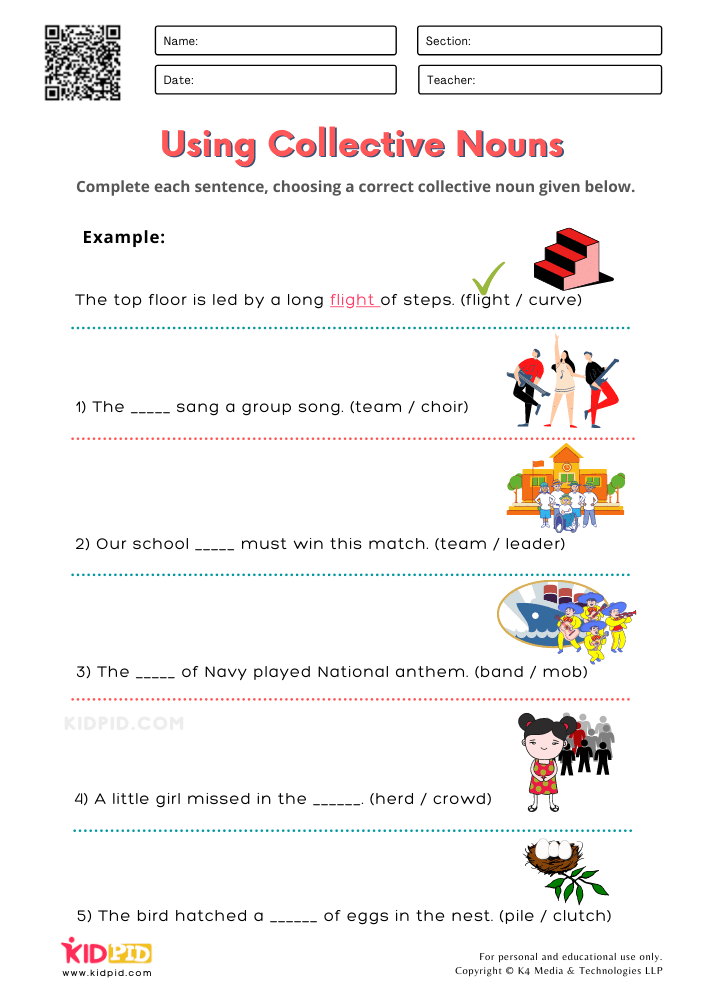
These worksheets help Grade 2 students practice using collective nouns in context, enhancing vocabulary and understanding of group terminology through engaging and educational exercises tailored for young learners.
Printable Worksheets for Matching Collective Nouns for Grade 2
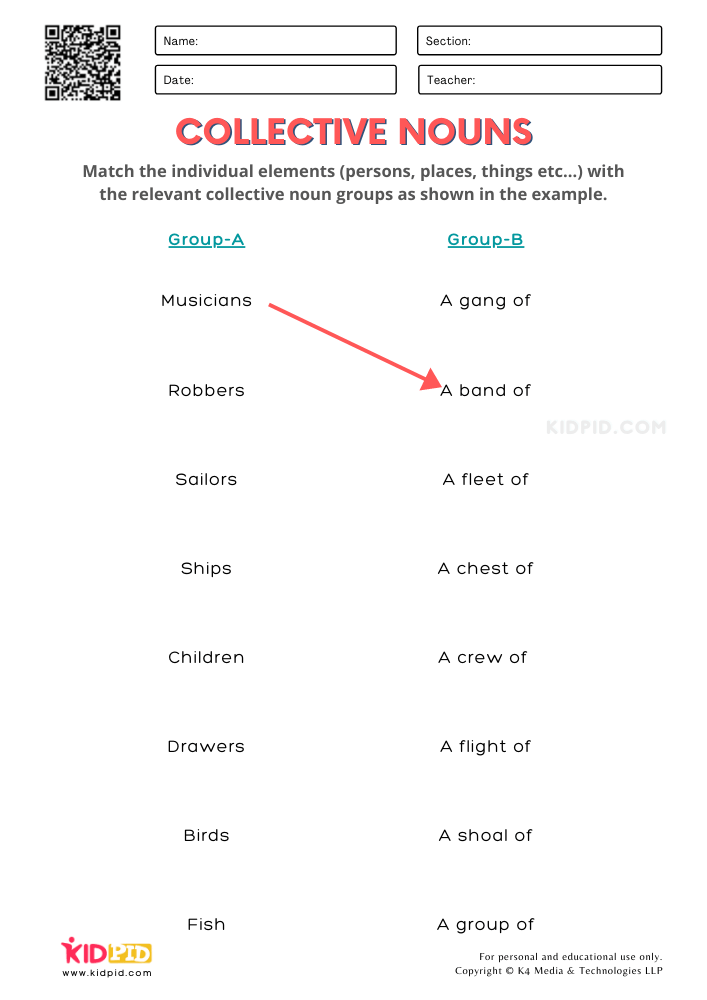
Designed for second graders, these worksheets involve matching collective nouns with corresponding groups, fostering critical thinking and reinforcing comprehension of collective noun usage effectively.
Printable Worksheets on Proper and Common Nouns for Grade 1
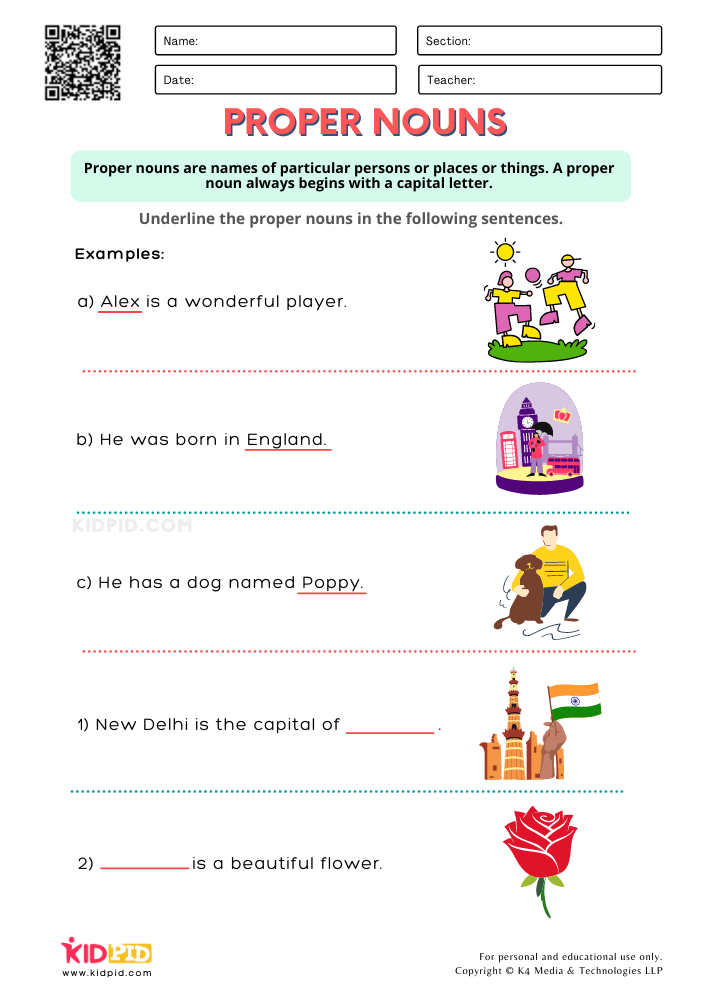
These worksheets introduce Grade 1 students to proper and common nouns, helping them distinguish between the two forms while building foundational grammar and vocabulary skills systematically.
Printable Worksheets on Possessive Nouns for Grade 1
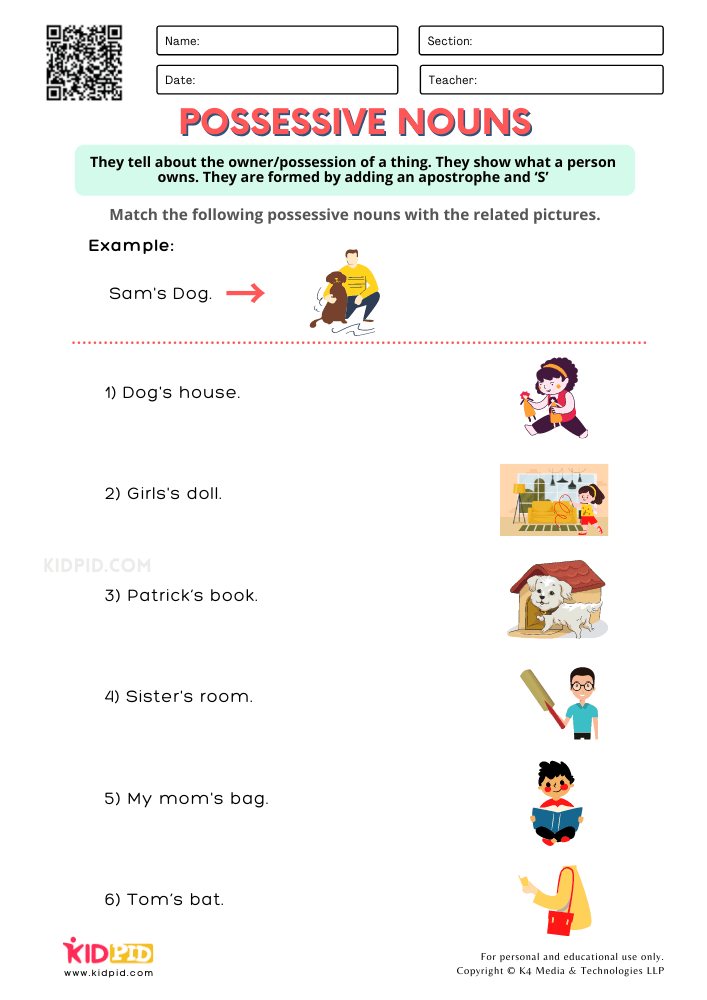
Tailored for first graders, these worksheets focus on recognizing and forming possessive nouns, strengthening understanding of ownership concepts, and improving grammatical accuracy through structured practice.
Printable Worksheets on Common and Proper Nouns for Grade 2
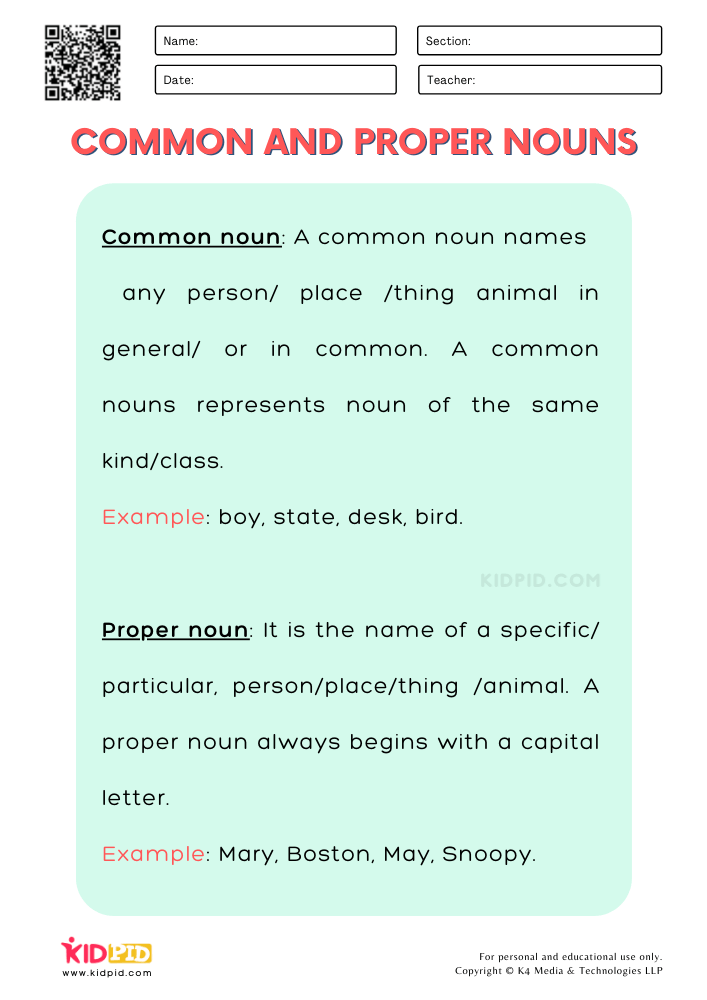
These worksheets assist Grade 2 learners in differentiating between common and proper nouns, enhancing their language proficiency, and expanding vocabulary through targeted and engaging exercises.