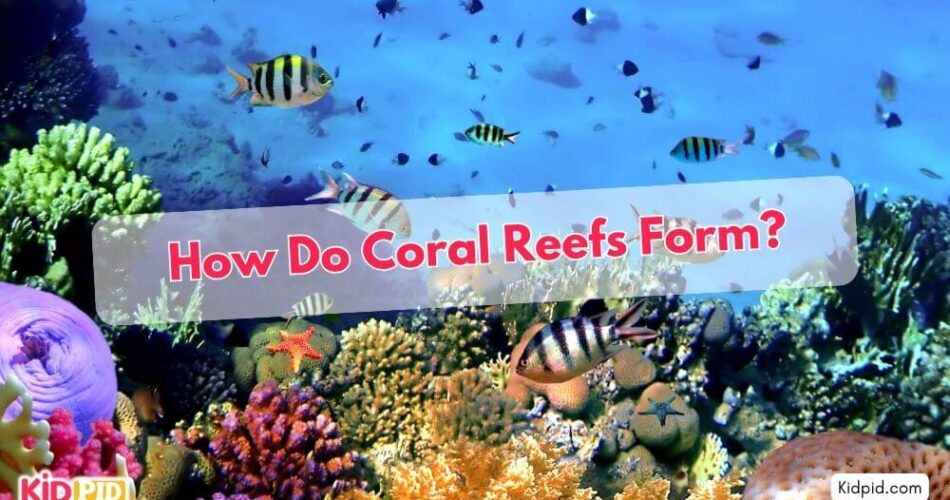
Coral reefs form when coral polyps, small marine animals, attach themselves to rocks or other hard surfaces on the ocean floor. Over time, these polyps multiply and create colonies. They secrete calcium carbonate, which builds up and forms the reef structure. As the coral grows, it provides a habitat for a diverse array of marine life.

Contents
- MCQs
- Fill in The Blanks
- 1. Some animals migrate to find better _______ sources.
- 2. Migration helps animals survive and thrive in their ________ habitats.
- 3. Animals migrate to find suitable _______ grounds.
- 4. Why do some animals migrate? To escape harsh ________ conditions.
- 5. Migration is the regular seasonal movement of ________ from one place to another.
- True / False
- 1. Coral reefs are made up of living organisms called coral polyps (True/False)
- 2. Coral reefs are formed by volcanic eruptions (True/False)
- 3. Coral reefs can only form in cold water (True/False)
- 4. Coral reefs provide a habitat for a diverse range of marine life (True/False)
- 5. Coral reefs are not affected by human activities (True/False)
MCQs
1. How do coral polyps get their food?
A. By hunting small fish
B. Through photosynthesis performed by algae living in their tissues
C. By filtering nutrients from the water
D. Eating plants on the ocean floor
Answer: B. Through photosynthesis performed by algae living in their tissues
Explanation: Coral polyps have a symbiotic relationship with tiny algae called zooxanthellae that live in their tissues. The algae perform photosynthesis, producing oxygen and food, which the coral uses, and in return, the coral provides the algae with a protected environment and the compounds they need for photosynthesis.
2. What is the importance of coral reefs to marine life?
A. They provide a hiding place from predators
B. They offer a rich source of nutrients
C. They serve as breeding and nursery grounds for many marine species
D. All of the above
Answer: D. All of the above
Explanation: Coral reefs are vital to marine life as they provide habitat, food, and breeding grounds for a vast number of marine species. They act as a shelter from predators, offer a rich source of nutrients, and serve as crucial breeding and nursery areas.
3. Which of the following factors contribute to the growth of coral reefs?
A. Warm water temperatures
B. High salinity levels
C. Clearwater
D. All of the above
Answer: D. All of the above
Explanation: Coral reefs thrive in conditions where there is warm water, high salinity, and clear water. These conditions allow sunlight to penetrate, which is essential for the photosynthesis performed by the algae living in the coral polyps.
Fill in The Blanks
Choose from These Words: food, natural, breeding, weather, and animals.
1. Some animals migrate to find better _______ sources.
Answer: food
2. Migration helps animals survive and thrive in their ________ habitats.
Answer: natural
3. Animals migrate to find suitable _______ grounds.
Answer: breeding
4. Why do some animals migrate? To escape harsh ________ conditions.
Answer: weather
5. Migration is the regular seasonal movement of ________ from one place to another.
Answer: animals
True / False
1. Coral reefs are made up of living organisms called coral polyps (True/False)
True: Coral reefs are formed by coral polyps secreting a hard outer skeleton.
2. Coral reefs are formed by volcanic eruptions (True/False)
False: Coral reefs are formed by the accumulation of coral polyp skeletons over time.
3. Coral reefs can only form in cold water (True/False)
False: Coral reefs can form in warm, tropical waters where coral polyps thrive.
4. Coral reefs provide a habitat for a diverse range of marine life (True/False)
True: Coral reefs are known for their biodiversity and provide a home for many species of fish, plants, and other organisms.
5. Coral reefs are not affected by human activities (True/False)
False: Human activities such as pollution, overfishing, and climate change can hurt coral reefs and threaten their survival.
Read More: