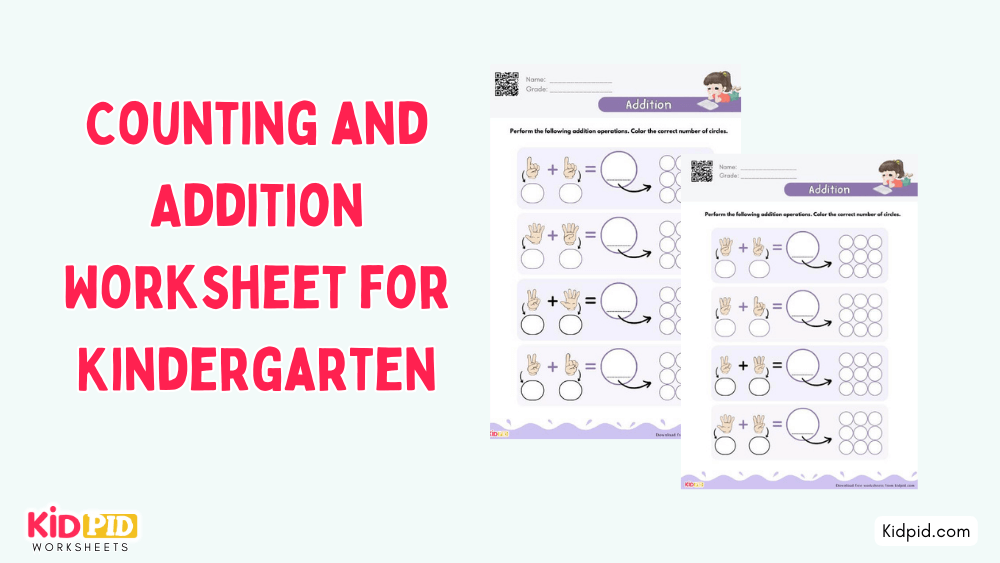
This counting and addition worksheet is designed for kindergarten students to practice basic numerical skills. It covers simple counting, number recognition, and single-digit addition, helping children build a strong foundation in early math concepts.
[Scroll Down for Download Link]
Contents
- Counting And Addition Worksheet
- Key Facts About Counting and Addition Worksheet for Kindergarten
- Parts/Types/Examples of Counting and Addition Worksheets
- How Does a Counting and Addition Worksheet Work?
- Benefits of Learning About Counting and Addition Worksheets
- Learning Objectives
- Worksheet Instructions
- Interesting Facts About Counting and Addition
- Vocabulary Words
- Real-Life Applications
- FAQs
- Q1. What is a Counting and Addition Worksheet?
- Q2. Who can use this worksheet?
- Q3. Why are pictures used in addition to worksheets?
- Q4. What skills do children develop from these worksheets?
- Q5. How often should children practice counting and addition?
- Q6. Are counting and addition worksheets suitable for home learning?
- Q7. How do these worksheets support kindergarten learning standards?
Counting And Addition Worksheet
Read More: Two-digit Addition Math Worksheets for Kids


Key Facts About Counting and Addition Worksheet for Kindergarten
The Counting and Addition Worksheet for Kindergarten is a foundational math activity designed to help young learners develop number recognition, counting accuracy, and basic addition skills. These worksheets use engaging pictures, objects, and numbers to make learning fun and interactive. Kindergarten students practice counting groups of items and combining them to find totals, which builds a strong understanding of early arithmetic concepts. The activities are typically aligned with early childhood education standards and support the development of logical thinking, problem-solving, and mathematical confidence.
Parts/Types/Examples of Counting and Addition Worksheets
Parts of a Counting and Addition Worksheet
- Number counting exercises
- Picture-based addition problems
- Object grouping activities
- Number-matching sections
- Fill-in-the-blank addition equations
- Visual counting illustrations
Types of Counting and Addition Worksheets
- Picture counting worksheets
- Count and write worksheets
- Simple addition worksheets
- Count and add activities
- Number bond worksheets
- Missing number addition worksheets
Examples
- Count 3 apples and 2 apples, then write the answer (5).
- Count the animals in two groups and find the total.
- Add the objects shown in the pictures and write the sum.
- Match the addition equations with the correct answers.
How Does a Counting and Addition Worksheet Work?
These worksheets guide children through visual and hands-on math practice. Students first count the objects shown in pictures and then combine groups to perform addition. By seeing quantities represented visually, children understand that addition means putting groups together to make a larger number. Repeated practice strengthens counting skills, number sense, and early calculation abilities. The worksheet gradually introduces simple equations to connect visual learning with mathematical symbols.
Benefits of Learning About Counting and Addition Worksheets
- Develops strong number recognition skills.
- Improves counting accuracy and fluency.
- Introduces the concept of addition simply.
- Strengthens problem-solving and logical thinking.
- Builds confidence in early mathematics.
- Enhances concentration and attention to detail.
- Prepares children for more advanced math concepts.
- Encourages independent learning and practice.
Learning Objectives
By completing this worksheet, children will:
- Recognize and identify numbers correctly.
- Count objects accurately.
- Understand the meaning of addition.
- Combine groups to find totals.
- Improve basic math problem-solving skills.
- Strengthen visual learning abilities.
- Build confidence in using numbers.
- Develop foundational arithmetic knowledge.
Worksheet Instructions
- Look carefully at each group of objects.
- Count the items in the first group.
- Count the items in the second group.
- Add the two groups together.
- Write the correct total in the answer box.
- Double-check your counting before moving on.
- Complete all questions neatly and carefully.
Interesting Facts About Counting and Addition
- Counting is one of the earliest math skills children learn.
- Addition is often called the process of “putting together.”
- Ancient civilizations used counting systems thousands of years ago.
- Visual objects help young learners understand numbers more easily.
- Strong counting skills contribute to future success in mathematics.
- Addition is used every day when shopping, cooking, and playing games.
- Kindergarten math activities help build lifelong numeracy skills.
Vocabulary Words
| Word | Meaning |
|---|---|
| Count | To determine how many items there are |
| Number | A symbol used to represent quantity |
| Addition | Combining two or more groups |
| Sum | The answer to an addition problem |
| Object | A thing that can be counted |
| Group | A collection of items |
| Total | The complete amount after adding |
| Equation | A math sentence showing numbers and operations |
| Quantity | The amount of something |
| Numeral | A written symbol representing a number |
Real-Life Applications
Counting and addition are important everyday skills that children use regularly:
- Counting toys during playtime.
- Adding pieces while building with blocks.
- Counting fruits in a lunchbox.
- Determining the total number of classmates present.
- Adding points in simple games.
- Counting money and understanding purchases.
- Measuring ingredients while helping in the kitchen.
- Organizing and sorting household items.
These practical applications help children understand why math is useful in daily life.
FAQs
Q1. What is a Counting and Addition Worksheet?
Answer: A Counting and Addition Worksheet is an educational activity that helps children practice counting objects and solving simple addition problems.
Q2. Who can use this worksheet?
Answer: It is ideal for kindergarten students, preschool learners, parents, and teachers introducing basic math concepts.
Q3. Why are pictures used in addition to worksheets?
Answer: Pictures provide visual support that helps children understand quantities and the concept of combining groups.
Q4. What skills do children develop from these worksheets?
Answer: Children improve counting, number recognition, addition, problem-solving, concentration, and critical thinking skills.
Q5. How often should children practice counting and addition?
Answer: Regular practice, even for 10–15 minutes a day, can significantly improve early math skills.
Q6. Are counting and addition worksheets suitable for home learning?
Answer: Yes. They are excellent resources for homeschooling, homework, classroom centers, and independent practice.
Q7. How do these worksheets support kindergarten learning standards?
Answer: They help children meet foundational math objectives related to counting, cardinality, number operations, and early addition concepts.
The addition worksheet provides an engaging and age-appropriate way for kindergarten students to develop their counting and addition abilities. Regular practice with these fundamental math skills will set them up for success in their continued academic journey. Discover engaging worksheets, essays, paragraphs, flashcards, quizzes, and interactive resources that help children learn while having fun. Follow us on YouTube & Facebook for updates.
The Content Team prepared this worksheet to support overall learning progress.
Reviewed By Sandra K Udayan
Read More: