

Today, we are here with rainbow single-digit addition worksheets for kindergarten kids. Let’s enjoy learning with these free printables.
Contents
- Learning the basic Maths – ADDITION
- How to master the Addition skills:
- How to make the exercises interesting
- Rainbow Single-Digit Addition Worksheets
- Key Facts About Rainbow Single-Digit Addition Worksheets
- Parts/Types/Examples of Rainbow Single-Digit Addition Worksheets
- How do Rainbow Single-Digit Addition Worksheets Work?
- Benefits of Learning About Rainbow Single-Digit Addition Worksheets
- Learning Objectives
- Worksheet Instructions
- Interesting Facts About Rainbow Single-Digit Addition Worksheets
- Real-Life Applications
- FAQs
- Q1. What age group are Rainbow Single-Digit Addition Worksheets suitable for?
- Q2. What skills do these worksheets develop?
- Q3. Are these worksheets useful for homeschooling?
- Q4. Why are rainbow themes used in math worksheets?
- Q5. Can beginners use these worksheets?
- Q6. How often should children practice addition worksheets?
- Q7. Do these worksheets support independent learning?
- Read More:
Learning the basic Maths – ADDITION
- Addition is the process of calculating the total of two or more numbers or amounts.
- It is the basis of all mathematics.
- Brahmagupta discovered addition along with subtraction, multiplication, and division.
- The plus sign ‘ + ‘ is used to denote addition. Example: 2+2
- The answer to addition is called the Sum. Example: 2+2= 4
- The addition of small numbers can be done with the help of our fingers, too.
- Adding zero ‘0’ to any number gives the sum as the number itself.
- It doesn’t matter in which order we add a group of numbers together, as the answer will always be the same. Example: 1+2+3+4 gives the same answer (10) as 4+3+1+2.
How to master the Addition skills:
- We can use addition in our everyday situations.
- When travelling, we can add up the distance. Example: 5 (km)+ 6(km)= 11 (km)
- We can use addition in counting money.
- We should avoid using tricks, as more tricks will lead to more confusion.
- We should also avoid doing the addition in our heads as kids because, as kids, we should learn and practice the exact method.
- We can randomly pick up any number and can ask the kid to answer it. It will help the parents and the teachers to know that the kid is not mugging up the homework and instead is trying their best to learn the Addition problems method.
- If a kid takes less than five seconds, he/she has mastered the Addition method.
How to make the exercises interesting
- By using a color scheme. Human brains are attracted to colors. Using different colors will make the task more interesting, and the child will also pay attention.
- Parents can make it interesting at home by giving their kids various tasks and telling them that if they finish them within a given time, they will win various prizes. This method will help a child develop their speed and accuracy.
- Games make the learning process more fun. Worksheets are great for games, as they will also give your kid written practice and hence will also improve their handwriting.
- Keep revising. If a kid has mastered an easy addition, don’t just jump to a difficult one. Keep mixing and matching. It will help make their memory stronger. Example: your kid has learnt how to do smaller additions like 3+3, 4+5, etc., then start giving them three numbers to add, but for a start, pick a number less than 10. Example: 2+3+6.
Rainbow Single-Digit Addition Worksheets

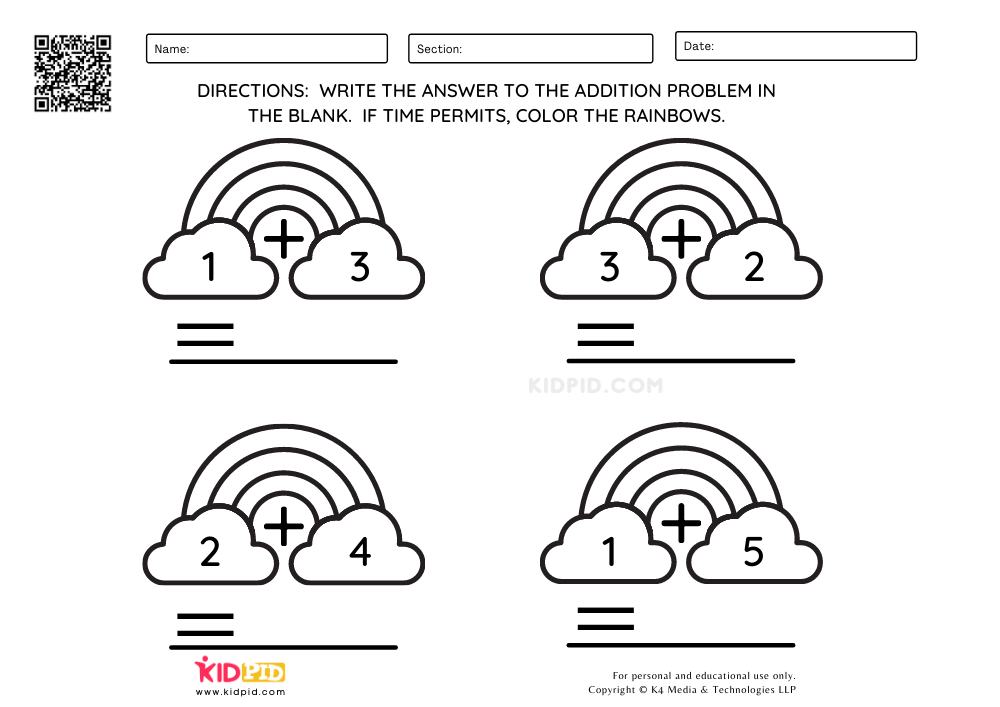
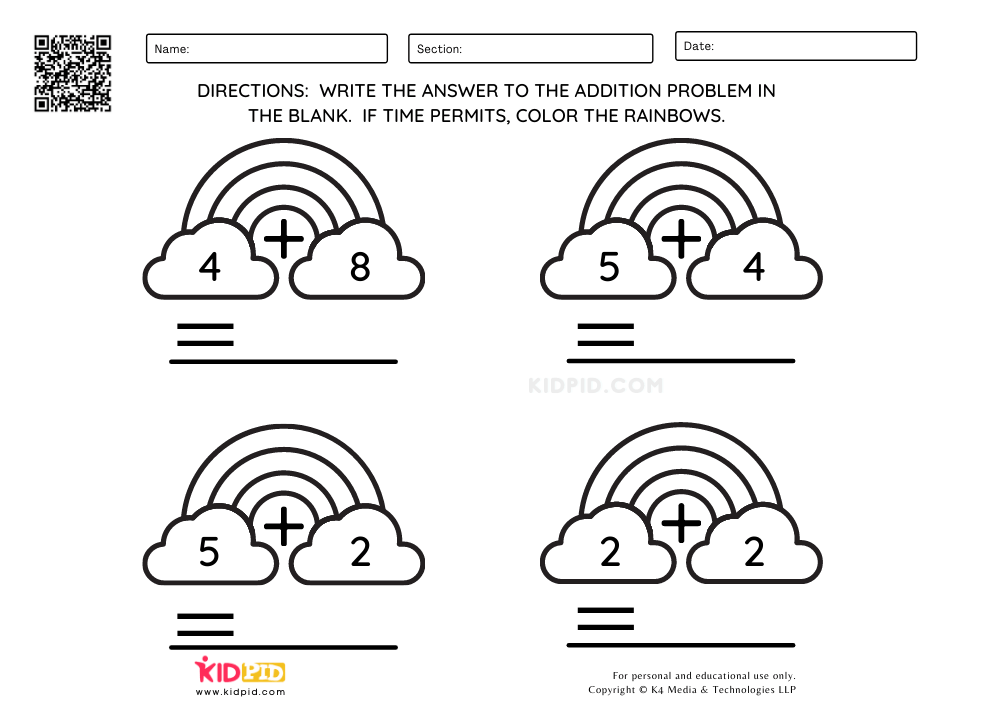
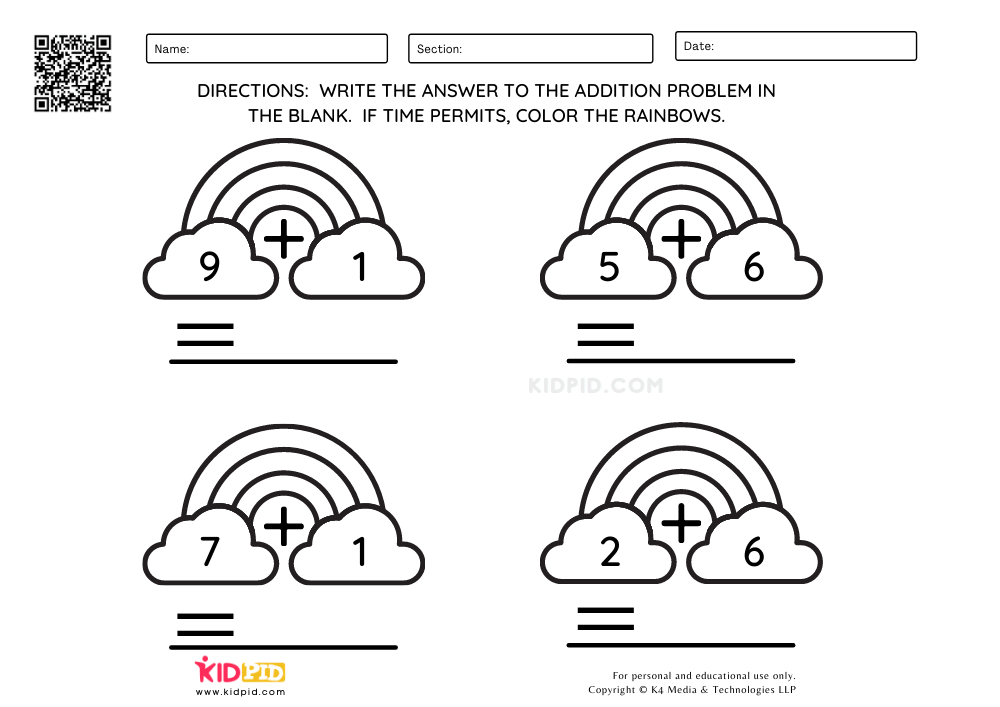
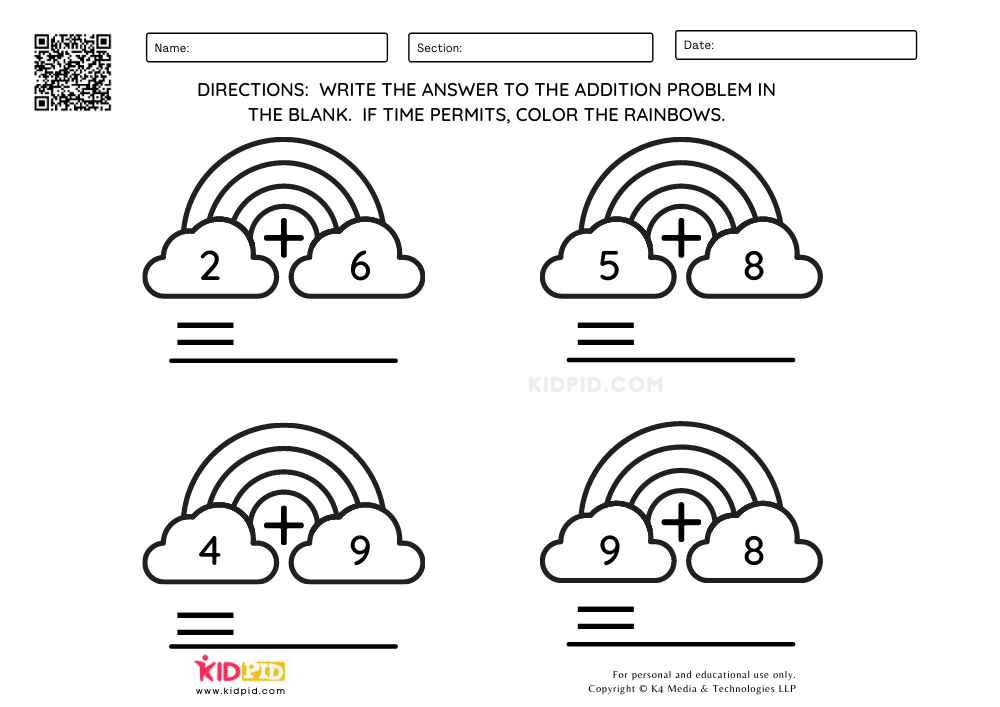
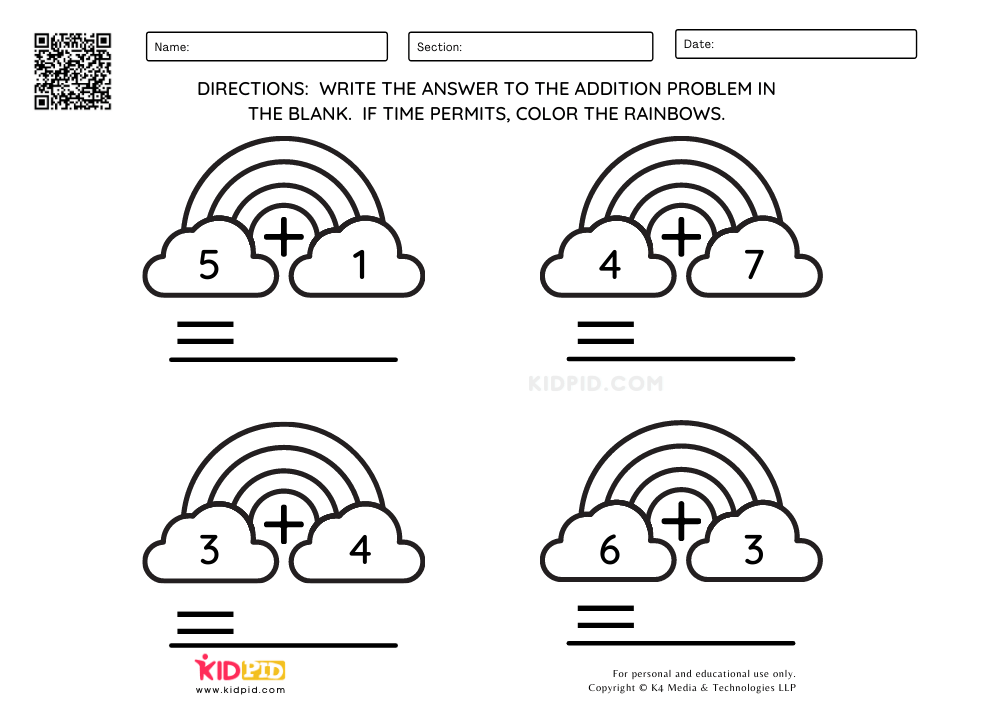
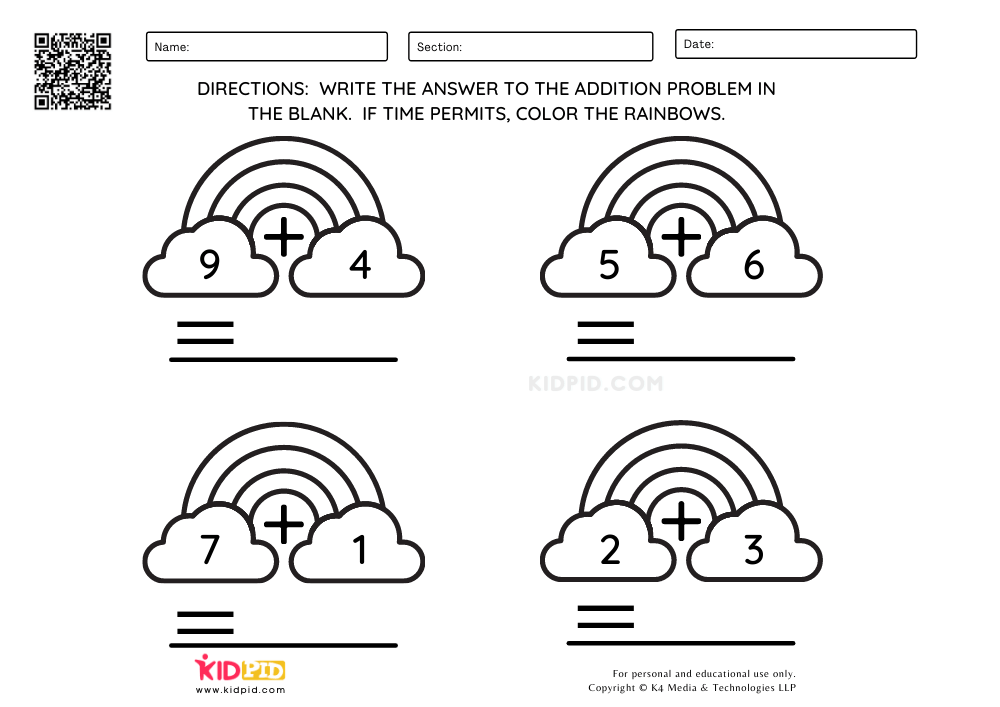
Write the answer to the addition problem in the blank provided in the worksheets. You can also color the rainbow in your free time.
Printable 1
Printable 2
Printable 3
Printable 4
Printable 5
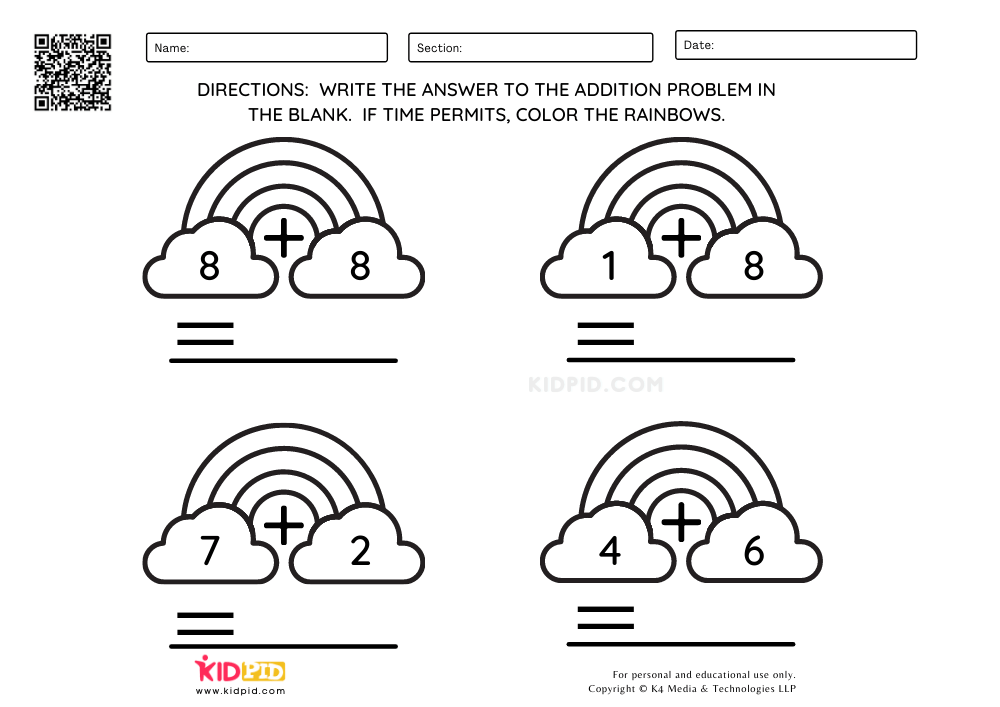
Printable 6
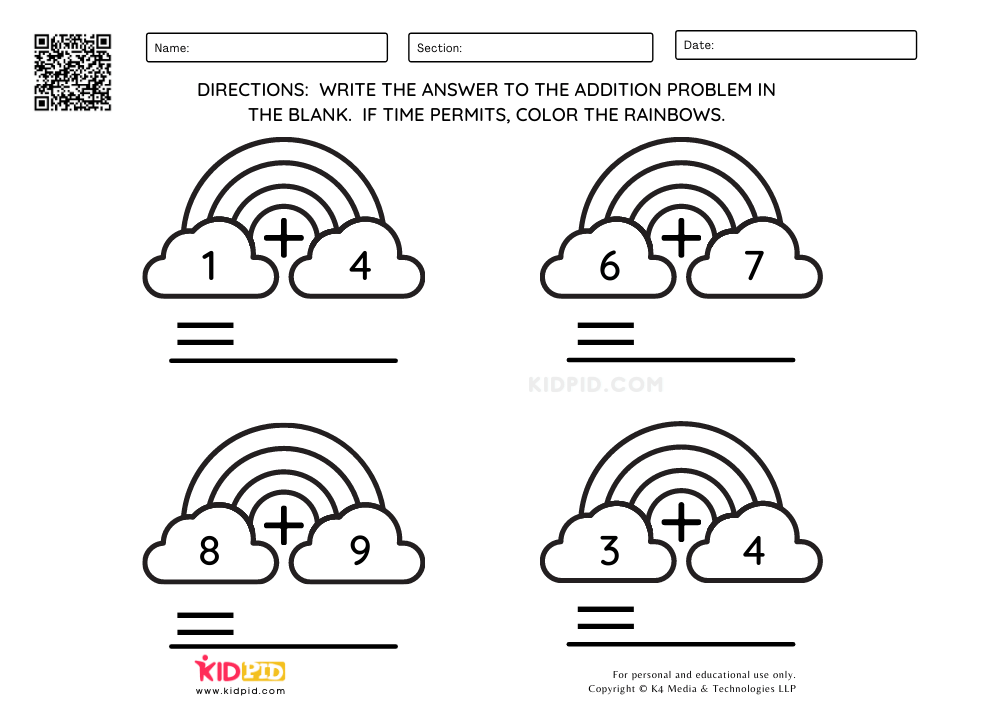
Printable 7
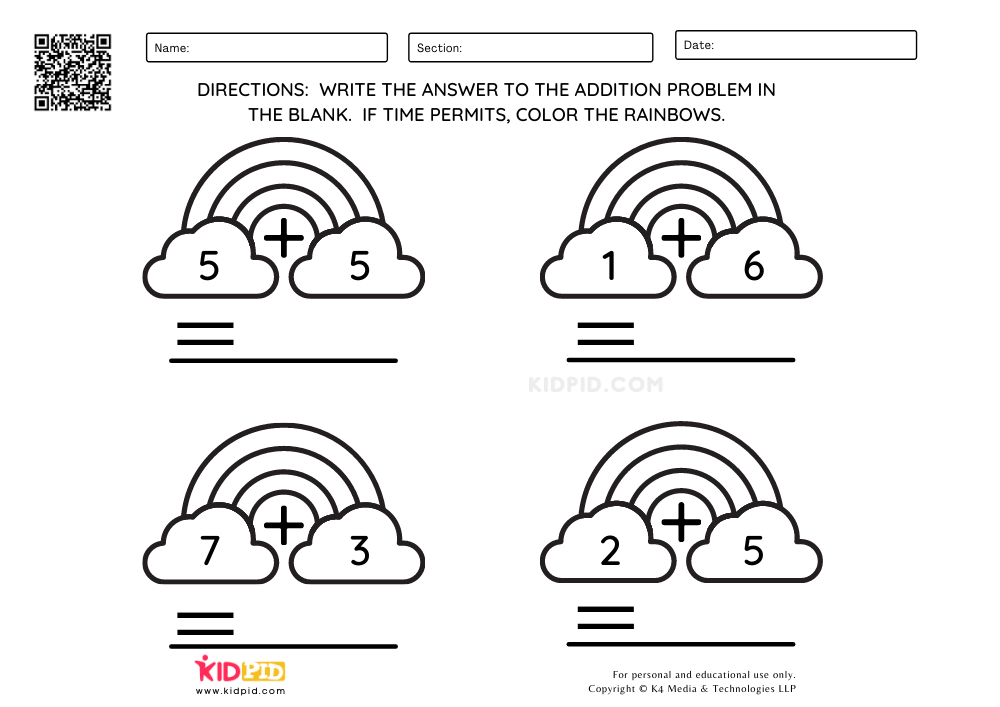
Printable 8
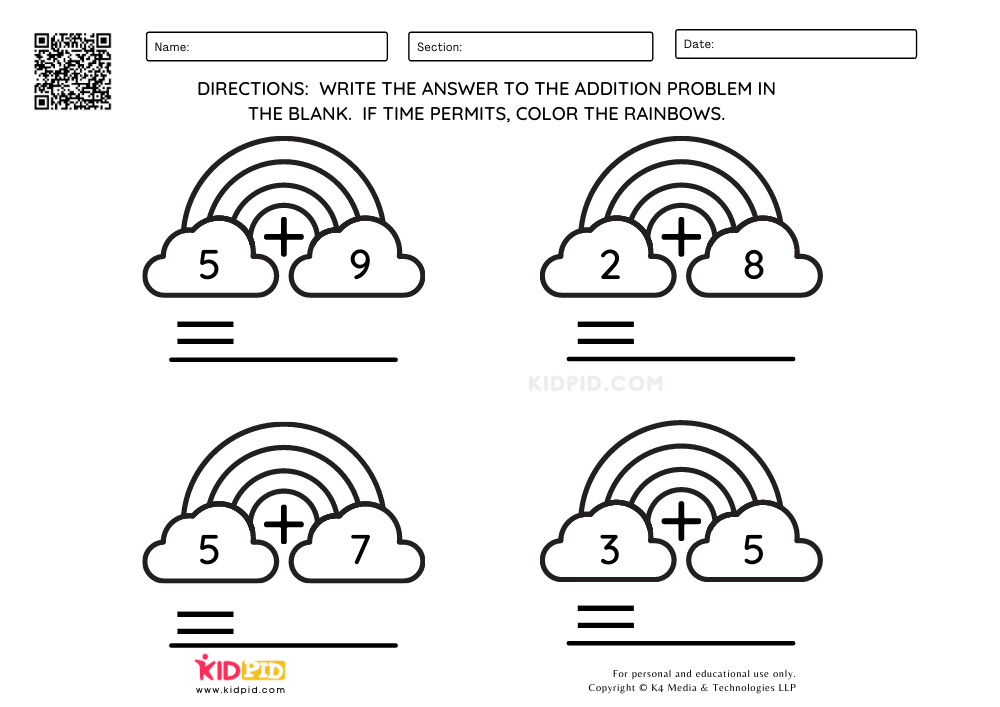
Printable 9
Printable 10
Key Facts About Rainbow Single-Digit Addition Worksheets
Rainbow Single-Digit Addition Worksheets are engaging educational resources designed to help young learners practice basic addition facts using colorful rainbow-themed activities. These worksheets combine visual learning with mathematical exercises, making addition more enjoyable and easier to understand for preschoolers, kindergarteners, and first-grade students.
Key facts include:
- Focuses on adding single-digit numbers from 0 to 9.
- Uses rainbow visuals to increase student engagement.
- Supports early numeracy and mental math development.
- Encourages number recognition and counting skills.
- Suitable for classroom learning, homeschooling, and extra practice.
- Helps children build confidence in solving simple addition problems.
These worksheets are created by educational experts to align with early childhood math learning objectives and provide age-appropriate practice opportunities.
Parts/Types/Examples of Rainbow Single-Digit Addition Worksheets
Rainbow Single-Digit Addition Worksheets come in various formats to suit different learning styles.
Parts of the Worksheets:
- Addition equations
- Rainbow coloring sections
- Number matching activities
- Answer spaces
- Visual counting aids
- Practice exercises
Types of Worksheets:
- Rainbow color-by-sum worksheets
- Missing number addition worksheets
- Count-and-add rainbow activities
- Number bond rainbow worksheets
- Trace and solve addition worksheets
- Picture-based addition worksheets
Examples:
- 4 + 3 = __
- 6 + 2 = __
- Fill the missing number: __ + 5 = 8
- Color the rainbow section that equals 7
How do Rainbow Single-Digit Addition Worksheets Work?
Rainbow Single-Digit Addition Worksheets use colorful visual elements to make learning addition interactive and enjoyable. Children solve addition problems and then complete associated rainbow-themed activities such as coloring, matching, or tracing.
The process typically includes:
- Read the addition equation.
- Count objects or use visual clues if provided.
- Calculate the total sum.
- Write the answer in the designated space.
- Complete the rainbow coloring or matching activity.
This combination of visual learning and mathematical practice helps reinforce addition concepts while keeping children motivated.
Benefits of Learning About Rainbow Single-Digit Addition Worksheets
These worksheets provide numerous educational benefits for young learners.
- Strengthens basic addition skills.
- Improves number sense and numerical fluency.
- Enhances concentration and problem-solving abilities.
- Develops hand-eye coordination through coloring activities.
- Promotes independent learning.
- Builds confidence in mathematics.
- Makes learning fun through colorful rainbow themes.
- Supports classroom and home learning environments.
Regular practice can help children develop a strong mathematical foundation that supports future learning.
Learning Objectives
By completing Rainbow Single-Digit Addition Worksheets, children will be able to:
- Recognize and identify numbers from 0 to 9.
- Solve single-digit addition problems accurately.
- Improve counting and number recognition skills.
- Develop mental math strategies.
- Strengthen logical thinking and reasoning.
- Enhance fine motor skills through writing and coloring activities.
- Gain confidence when working with basic arithmetic concepts.
Worksheet Instructions
Follow these simple steps to complete the worksheet:
- Look carefully at each addition problem.
- Count the objects or numbers if visual aids are provided.
- Add the numbers together.
- Write the correct answer in the blank space.
- Color, trace, or match the rainbow sections according to the worksheet directions.
- Review your answers when finished.
Parents and teachers should encourage children to solve problems independently before offering assistance.
Interesting Facts About Rainbow Single-Digit Addition Worksheets
- Rainbows are often used in educational materials because bright colors help capture children’s attention.
- Visual learning activities can improve information retention in young learners.
- Addition is one of the first arithmetic operations children learn.
- Color-based activities can increase student motivation and participation.
- Combining art and math helps create a more engaging learning experience.
- Repetitive addition practice strengthens long-term math fluency.
Real-Life Applications
Single-digit addition is used in everyday situations, including:
- Counting toys and games.
- Adding pieces of fruit during snack time.
- Calculating the total number of crayons or pencils.
- Counting students in a classroom.
- Tracking points during games and activities.
- Shopping and counting small quantities of items.
Learning addition helps children understand practical math skills they will use throughout life.
FAQs
Q1. What age group are Rainbow Single-Digit Addition Worksheets suitable for?
Answer: These worksheets are generally designed for children aged 4 to 7 years, including preschool, kindergarten, and first-grade students.
Q2. What skills do these worksheets develop?
Answer: They improve addition skills, number recognition, counting abilities, problem-solving, concentration, and fine motor skills.
Q3. Are these worksheets useful for homeschooling?
Answer: Yes. They are excellent resources for homeschooling, classroom practice, tutoring sessions, and extra math reinforcement at home.
Q4. Why are rainbow themes used in math worksheets?
Answer: Rainbow themes make learning visually appealing and engaging, helping children stay motivated while practicing important math concepts.
Q5. Can beginners use these worksheets?
Answer: Absolutely. The worksheets focus on basic single-digit addition, making them ideal for children who are just beginning to learn arithmetic.
Q6. How often should children practice addition worksheets?
Answer: Short practice sessions of 10–15 minutes several times per week can help reinforce addition skills effectively without overwhelming young learners.
Q7. Do these worksheets support independent learning?
Answer: Yes. Most activities are designed with simple instructions that allow children to complete them independently while building confidence in their math abilities.
As a parent, one should always have faith in their children. Education and knowledge are not related to age. So, if your child is taking time to learn things, let them take their time. Instead of shouting at them, support them in building their confidence. If he/she faces a problem in solving any question, make them understand with patience; also, try to tell them the solution in pieces. Practice will make them faster. Remember the fact that ‘Slow and steady always wins the race’. Browse our website to access engaging worksheets, essays, paragraphs, flashcards, quizzes, and interactive educational content. Follow us on YouTube & Facebook.
This worksheet was created by the Content Team to encourage academic growth.
Reviewed By Minakshi
Read More:



