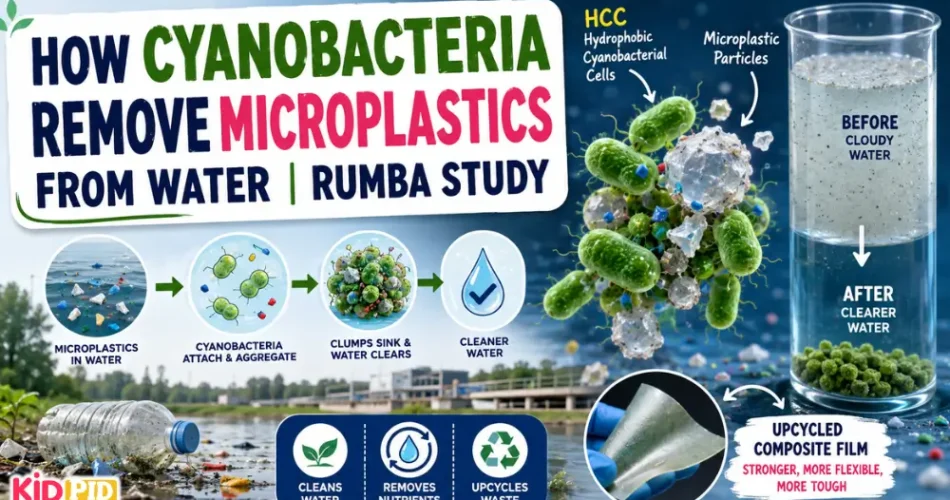
Scientists have discovered a surprising new way to help remove microplastics from water. By engineering tiny organisms called cyanobacteria, researchers were able to catch more than 91% of certain microplastic particles in just one hour.
Contents
- Introduction: What Are Microplastics and Why Are They a Problem?
- Meet the Tiny Plastic-Catching Cyanobacteria
- The Big Question
- Experiment 1: Can Cyanobacteria Catch Microplastics?
- What Happened?
- How Much Plastic Was Removed?
- Looking at the Cells Under Powerful Microscopes
- Why Did the Plastic Stick?
- A Clever Test to Check the Idea
- Did It Work With Other Plastics?
- Testing Real Water
- Could the Cyanobacteria Clean Wastewater at the Same Time?
- Two Jobs at the Same Time
- What Happened to the Collected Plastic?
- The Stretch Test
- Summary: What Did the Scientists Discover?
- Is RUMBA Ready to Clean Our Rivers?
- Why Is This Study Important?
- Key Words to Know
- Check Your Understanding
- References
Introduction: What Are Microplastics and Why Are They a Problem?
Have you ever seen an old plastic bottle crack and break into smaller pieces?
Plastic does not simply disappear when it breaks. Instead, it can split into tinier and tinier pieces.
Very small pieces of plastic are called microplastics. Some are so tiny that they are much smaller than a grain of sand!
👉Useful Read: Life Cycle of a Plastic Bottle
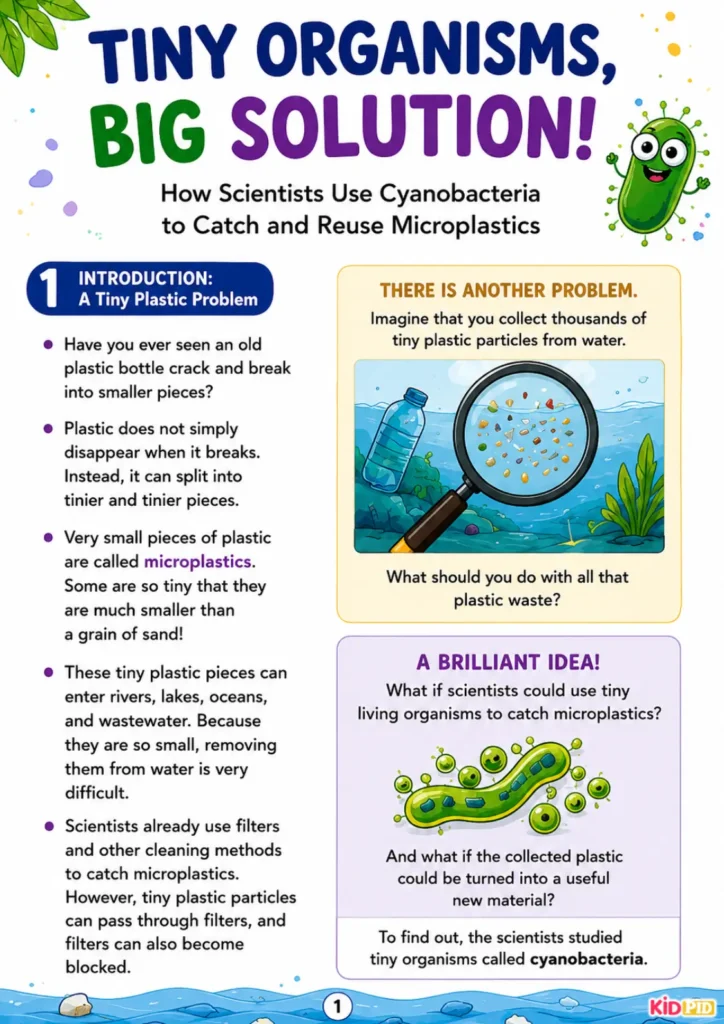
These tiny plastic pieces can enter rivers, lakes, oceans, and wastewater. Because they are so small, removing them from water is very difficult.
Scientists already use filters and other cleaning methods to catch microplastics. However, tiny plastic particles can pass through filters, and filters can also become blocked.
There is another problem.
Imagine that you collect thousands of tiny plastic particles from water.
What should you do with all that plastic waste?
A team of scientists had an interesting idea.
What if they could use tiny living organisms to catch microplastics?
And what if the collected plastic could be turned into a useful new material?
To find out, the scientists studied tiny organisms called cyanobacteria.
Meet the Tiny Plastic-Catching Cyanobacteria
Cyanobacteria are microscopic living organisms.
Like plants, they use sunlight to grow.
The scientists studied a fast-growing cyanobacterium called Synechococcus elongatus UTEX 2973.
They used two types of cyanobacteria.
Normal Cyanobacteria
The first group was made of normal cyanobacteria.
Scientists called them WT, which means wild type.
These cells were used for comparison.
Special Engineered Cyanobacteria
The second group was changed by scientists.
These cells produced a large amount of a chemical called limonene.
Limonene is also found in citrus fruits such as lemons and oranges.
The limonene made the outside of the cyanobacteria more hydrophobic.
Hydrophobic means water-repelling.
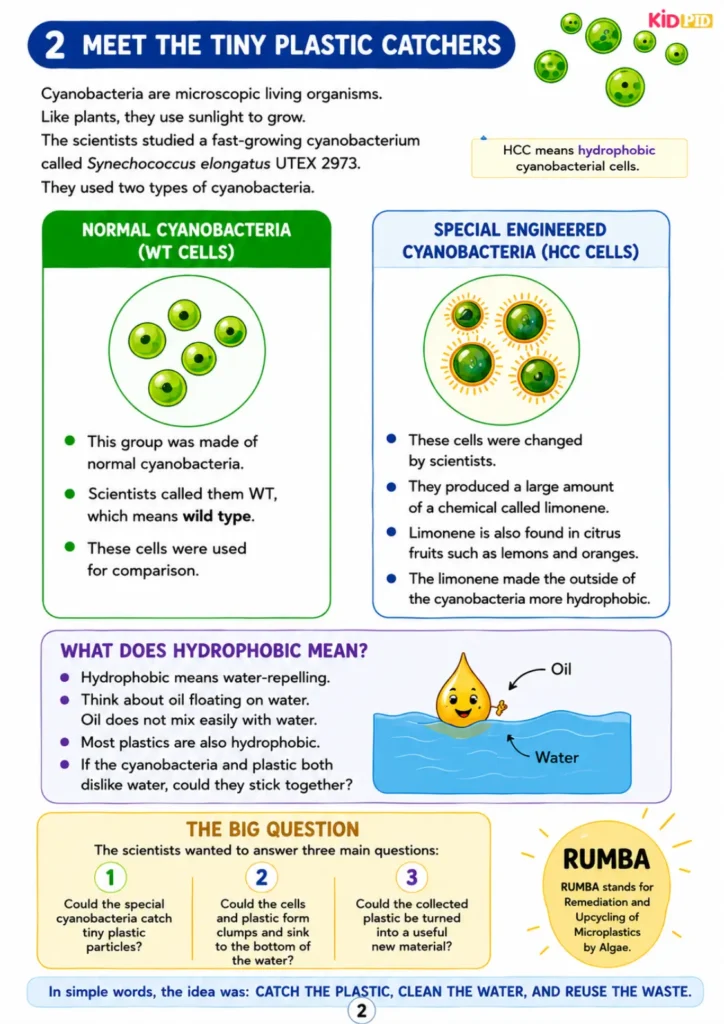
Think about oil floating on water. Oil does not mix easily with water.
Most plastics are also hydrophobic.
This gave the scientists an idea.
If the cyanobacteria and plastic both dislike water, could they stick together?
The scientists called the special cells HCC, or hydrophobic cyanobacterial cells.
The Big Question
The scientists wanted to answer three main questions:
- Could the special cyanobacteria catch tiny plastic particles?
- Could the cells and plastic form clumps and sink to the bottom of the water?
- Could the collected plastic be turned into a useful new material?
The scientists called their idea RUMBA.
RUMBA stands for Remediation and Upcycling of Microplastics by Algae.
In simple words, the idea was:
Catch the plastic, clean the water, and reuse the waste.
Experiment 1: Can Cyanobacteria Catch Microplastics?
The scientists first tested a plastic called polystyrene, or PS.
Polystyrene is used in many plastic products and packaging materials.
The plastic particles used in the experiment were extremely small.
Some were only 200 nanometres wide.
A nanometre is one billionth of a metre! (Imagine a single strand of human hair; if you sliced it into 100,000 super-thin strips, each strip would be about one nanometre wide!)
The scientists mixed the tiny plastic particles with the cyanobacteria.
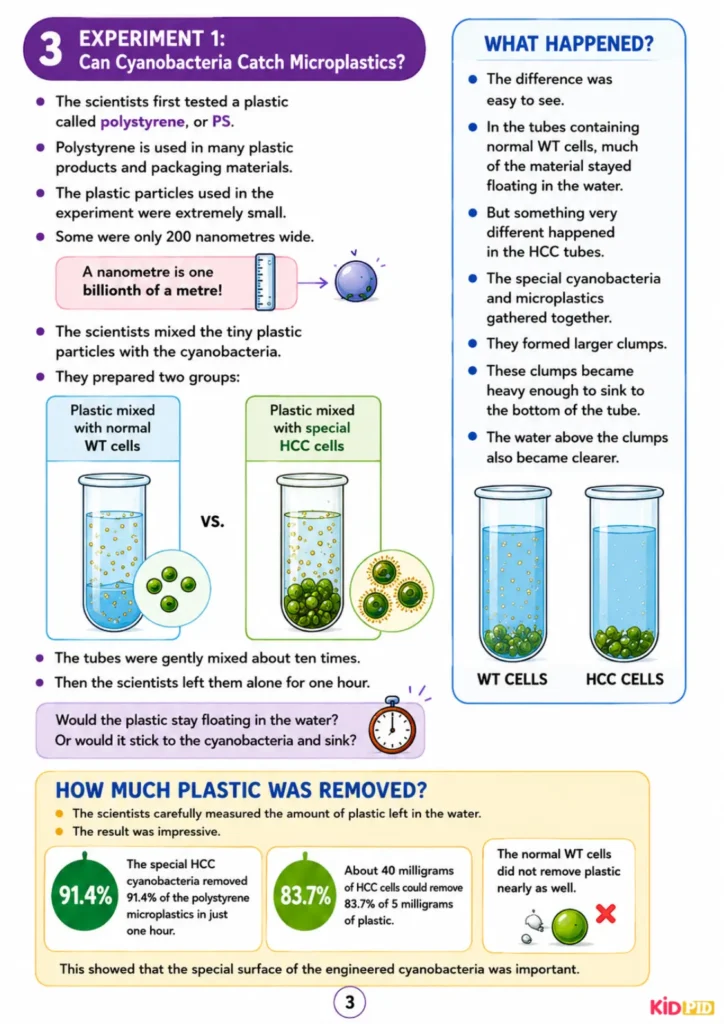
They prepared two groups:
- Plastic mixed with normal WT cells
- Plastic mixed with special HCC cells
The tubes were gently mixed about ten times.
Then the scientists left them alone for one hour.
They watched carefully.
Would the plastic stay floating in the water?
Or would it stick to the cyanobacteria and sink?
What Happened?
The difference was easy to see.
In the tubes containing normal WT cells, much of the material stayed floating in the water.
But something very different happened in the HCC tubes.
The special cyanobacteria and microplastics gathered together.
They formed larger clumps.
These clumps became heavy enough to sink to the bottom of the tube.
The water above the clumps also became clearer.
This was an important clue.
It suggested that many of the tiny plastic particles were no longer floating in the water.
How Much Plastic Was Removed?
The scientists carefully measured the amount of plastic left in the water.
The result was impressive.
The special HCC cyanobacteria removed 91.4% of the polystyrene microplastics in just one hour.
The researchers also found that about 40 milligrams of HCC cells could remove 83.7% of 5 milligrams of plastic.
The normal WT cells did not remove plastic nearly as well.
This showed that the special surface of the engineered cyanobacteria was important.
But the scientists still wanted to know:
Why were the HCC cells so good at catching plastic?
Looking at the Cells Under Powerful Microscopes
The scientists used special microscopes to look closely at the cells and plastic.
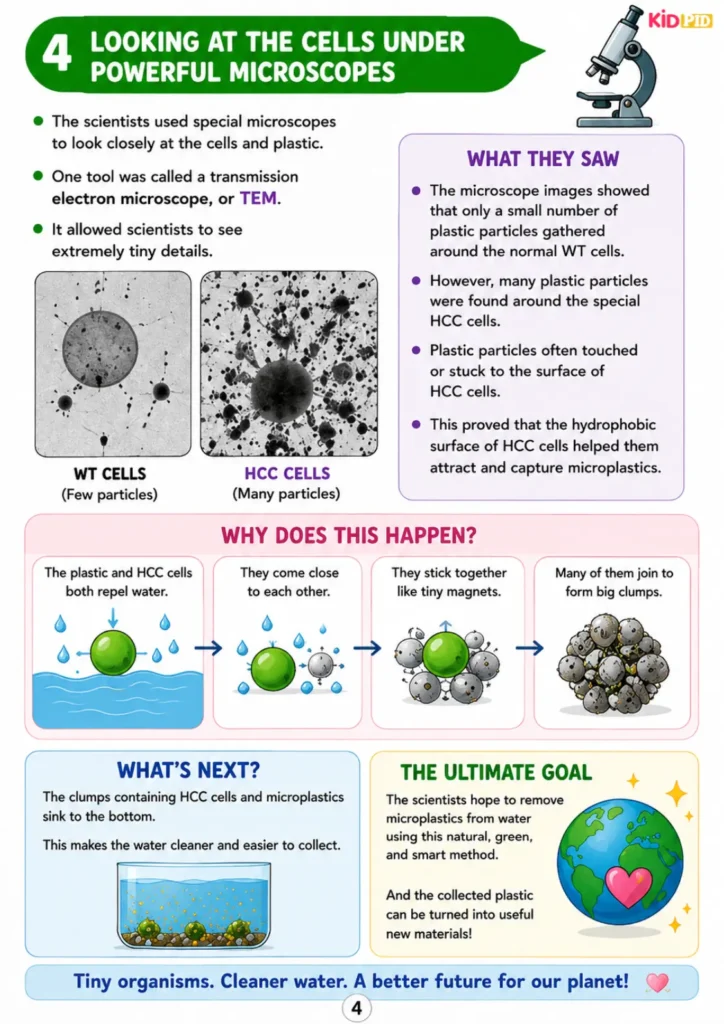
One tool was called a transmission electron microscope, or TEM.
It allowed scientists to see extremely tiny details.
The microscope images showed that only a small number of plastic particles gathered around the normal WT cells.
However, many plastic particles were found around the special HCC cells.
Plastic particles often collected where several HCC cells touched one another.
The scientists also used another imaging method called SRS microscopy.
This special microscope can detect chemicals in a sample.
The researchers looked for two things:
- Limonene around the cyanobacteria
- Polystyrene plastic
They found the signals for limonene and plastic in the same areas.
This gave the scientists an important clue.
The limonene was probably helping the cyanobacteria attract the plastic.
Why Did the Plastic Stick?
Imagine putting a drop of oil into water.
The oil tries to stay away from the water.
If other oily drops are nearby, they often join together.
Something similar may have happened in this experiment.
The HCC cells had a water-repelling surface because of limonene.
The plastic particles were also water-repelling.
Instead of staying surrounded by water, the cells and plastic moved closer together.
The cyanobacteria stuck to the plastic.
More cells joined.
More plastic joined.
Slowly, larger clumps formed.
The clumps became heavier and sank.
The normal WT cells did not have the same strongly water-repelling surface.
That is why they caught much less plastic.
A Clever Test to Check the Idea
Scientists do not want to simply guess why something happens.
They try to test their explanations.
The researchers added a substance called Tween 20.
Tween 20 can disturb water-repelling interactions.
The scientists thought:
If hydrophobic attraction is helping the cells catch plastic, disturbing this attraction should stop the clumps from forming.
That is exactly what happened.
After Tween 20 was added, the HCC cells and plastic formed far fewer clumps.
Much more plastic remained floating in the water.
This gave the researchers stronger evidence that water-repelling attraction was helping the HCC cells catch microplastics.
Did It Work With Other Plastics?
Polystyrene is only one type of plastic.
Real water can contain many different kinds of plastic waste.
So the scientists tested two more plastics.
They tested:
PET, a plastic commonly used in drink bottles.
PE, or polyethylene, a plastic used in bags, containers, and many other products.
The special HCC cyanobacteria attached to both PET and PE particles.
The normal WT cells showed very little interaction with these plastics.
This suggested that the idea might work with more than one type of microplastic.
Testing Real Water
Laboratory water is carefully controlled.
But rivers and wastewater are much more complicated.
They may contain dirt, nutrients, chemicals, and many other tiny particles.
The scientists wanted to know if their special cyanobacteria could still catch plastic in more realistic water.
They collected surface water and wastewater.
Then they added tiny polystyrene particles.
Once again, they compared normal WT cells with special HCC cells.
The HCC cells performed much better.
For larger tested polystyrene particles, the amount of plastic remaining suspended in the water fell by about 90% compared with the WT samples.
For the smallest tested particles, the decrease was about 80%.
The scientists also collected real environmental particles from about 200 litres of water.
They used special sieves and filters to separate tiny particles.
A dye called Nile Red helped them identify plastic under a microscope.
The HCC cells were able to interact with real environmental microplastic particles too.
Could the Cyanobacteria Clean Wastewater at the Same Time?
The scientists then asked another exciting question.
Could the cyanobacteria catch plastic and help clean wastewater at the same time?
Wastewater can contain nutrients such as:
- Nitrate
- Ammonia
- Phosphate
Too many of these nutrients in water can cause environmental problems.
However, cyanobacteria can use some of these nutrients to grow.
The researchers built a special container called a photobioreactor.
A photobioreactor is a container designed to grow tiny photosynthetic organisms using light.
The scientists added wastewater, cyanobacteria, and microplastics.
Then they watched the system for several days.
Two Jobs at the Same Time
The cyanobacteria did more than catch plastic.
They also used nutrients from the wastewater.
By day 8, the system removed:
- 78.5% of microplastics from incoming wastewater
- 88.6% of microplastics from treated wastewater
The system also removed more than 97% of nitrate.
This meant the cyanobacteria were doing two useful jobs.
They were helping collect microplastics.
At the same time, they were using nutrients from wastewater to grow.
However, the scientists noticed an interesting problem.
By day 9, the cyanobacteria were still removing nutrients very well, but their ability to remove microplastics had decreased.
Why?
The scientists think the cells may have started running out of important nutrients.
This could have caused them to produce less limonene.
Less limonene may have made the cells less water-repelling.
If the cells became less hydrophobic, they may not have attracted plastic as strongly.
Scientists will need more experiments to find out if this explanation is correct.
What Happened to the Collected Plastic?
Catching microplastics is only part of the problem.
The plastic still exists after it is removed from water.
The researchers did not want to simply throw the plastic-rich clumps away.
Instead, they tried to upcycle them.
Upcycling means turning waste into a useful new material.
The scientists collected the clumps of cyanobacteria and polystyrene from the bottom of the containers.
They dried and processed the material.
Then they turned it into thin plastic-like films.
The researchers also made a film using pure polystyrene.
Now they could compare the two materials.
The Stretch Test
A machine pulled strips of the films until they broke.
The scientists measured three important properties.
Strength: How much pulling force could the material handle?
Stretchiness: How far could it stretch?
Toughness: How much energy could it absorb before breaking?
The upcycled cyanobacteria-plastic film was not as strong as pure polystyrene.
Its pulling strength was about 66.5% of the strength of pure polystyrene film.
But the new material had two interesting advantages.
It could stretch 2.3 times more.
It was also 2.2 times tougher.
This means the upcycled material could bend and absorb more energy before breaking.
The experiment showed that captured plastic might not always have to become useless waste.
It could possibly become part of a new material.
Summary: What Did the Scientists Discover?
The experiments showed that specially engineered cyanobacteria could rapidly gather tiny plastic particles.
The limonene produced by the cells made their surfaces more water-repelling.
Because plastic is also water-repelling, the cells and plastic gathered together.
They formed larger clumps.
The clumps became heavy and sank.
In laboratory experiments, the HCC cells removed 91.4% of polystyrene microplastics in one hour.
The cells also interacted with PET and PE plastics.
They worked in surface water and wastewater.
At the same time, the cyanobacteria could use nutrients from wastewater to grow.
Finally, the collected plastic and cyanobacteria were turned into a new composite film.
Is RUMBA Ready to Clean Our Rivers?
Not yet.
This research is an early but exciting step.
Real rivers and wastewater can contain many different substances.
They may contain:
- Different types of plastics
- Metals
- Chemicals
- Dirt
- Organic waste
- Other microorganisms
Scientists need to find out how these substances affect the special cyanobacteria.
There is also another important question.
The HCC cells were changed using genetic engineering.
- Scientists must carefully study how to safely use engineered organisms outside a laboratory.
- They need to make sure the cells remain controlled and do not cause unexpected environmental problems.
- Researchers must also find ways to keep the cells producing enough limonene for long periods.
- More experiments are needed before this technology can be used on a large scale.
Why Is This Study Important?
Microplastics are extremely difficult to remove because they are so tiny.
This study shows a creative new way of thinking about the problem.
Instead of building only another filter, the scientists asked:
Can living cells help gather tiny plastic particles?
Then they asked another question:
Can we turn the collected plastic into something useful?
The RUMBA idea tries to connect three jobs:
Catch microplastics.
Help clean wastewater.
Turn collected waste into a new material.
The biggest lesson from this research is that solving pollution is not always just about collecting waste.
Scientists can also think about what happens to the waste after it is collected.
Key Words to Know
- Microplastic: A very tiny piece of plastic.
- Cyanobacteria: Tiny organisms that use sunlight to grow.
- Hydrophobic: Water-repelling.
- Limonene: A chemical found in citrus plants. The engineered cyanobacteria in this study produced large amounts of it.
- Wild Type (WT): The normal form of an organism used for comparison.
- HCC: Special cyanobacteria engineered to have a more water-repelling surface.
- Aggregation: When tiny particles gather together to form larger clumps.
- Sedimentation: When particles sink to the bottom of a liquid.
- Turbidity: A measurement of how cloudy water is.
- Biomass: Material made from living or recently living organisms.
- Upcycling: Turning waste into a new and useful material.
- Photobioreactor: A special container used to grow organisms that need light.
Check Your Understanding
- Why are microplastics difficult to remove from water?
- What special chemical made the HCC cells more water-repelling?
- Why did the scientists compare HCC cells with normal WT cells?
- What happened when HCC cells were mixed with microplastics?
- How much polystyrene microplastic did the HCC cells remove in one hour?
- Why did the scientists add Tween 20 to the experiment?
- How did the cyanobacteria help clean wastewater?
- What did the scientists make from the collected plastic and cyanobacteria?
- Why is RUMBA not ready to clean rivers on a large scale yet?
- What do you think scientists should test next?
References
- Long, B., Li, Q., Hu, C., et al. (2025). Remediation and upcycling of microplastics by algae with wastewater nutrient removal and bioproduction potential. Nature Communications, 16, 11570. The paper reports the RUMBA concept, 91.4% PS removal within one hour, wastewater integration and composite-film experiments.
Original research paper and supplementary information - National Oceanic and Atmospheric Administration (NOAA): Marine Microplastics — background information about microplastics and their presence in aquatic environments.
NOAA Marine Microplastics Program - United States Environmental Protection Agency (EPA): Microplastics Research — information about scientific research into microplastics in the environment.
EPA Microplastics Research - World Health Organization (WHO): Microplastics in drinking-water — a scientific background resource about microplastics and drinking water.
WHO Microplastics in Drinking-water